
In This Article
Somewhere between the tricycle your kid has outgrown and the bike they’re not quite ready for sits a genuinely useful category of toy: the all-terrain ride-on car for 5 year old riders who want more than a driveway loop. These aren’t the wobbly plastic cars that stall out the second a wheel touches grass. An all-terrain ride-on car for 5 year old kids is built with treaded or pneumatic tires, a beefier motor, and enough ground clearance to handle a bumpy lawn, a gravel path, or a slightly muddy trail without getting stuck five feet from the patio.

What is an all-terrain ride-on car for 5 year old? It’s a battery-powered ride-on vehicle, typically 12V to 24V, engineered with off-road tires, raised ground clearance, and a sturdier suspension than standard sidewalk cars, so a child can ride confidently across grass, dirt, and uneven backyard terrain rather than being limited to pavement.
At 5, most kids have the coordination to steer, brake, and manage a foot pedal, but they’re still light enough that a lot of “all-terrain” marketing on Amazon is more aspirational than accurate. We dug through real listings, aggregated owner reviews, and manufacturer specs (not just marketing copy) to find seven vehicles that actually earn the label. Every model below meets the federal ASTM F963 toy safety standard that governs ride-on toys sold in the U.S., which is the baseline you should never skip when shopping this category. From there, we sorted by budget, mid-range, and premium so you can match the vehicle to your yard, your kid’s weight, and your wallet.
Quick Comparison Table
Before diving into full write-ups, here’s the fast version. If you’re short on time, this table plus the analysis below it should get you 80% of the way to a decision.
| Product | Voltage | Terrain Handling | Best For |
|---|---|---|---|
| Best Choice Products 12V ATV | 12V | Grass, dirt, driveways | Best all-around budget pick |
| Costzon 12V ATV | 12V | Grass, dirt, cement | Safest first ride |
| Kid Trax Ram 3500 Dually | 12V | Grass, gravel, rugged yards | Toughest no-frills build |
| ANPABO Ford F-150 24V 4WD | 24V | Grass, mud, gravel, hills | Strongest 4WD power |
| Razor Dirt Quad 24V | 24V | Dirt trails, grass, light off-road | Most authentic ATV feel |
Looking at this lineup, the split comes down to voltage and drive type. The Best Choice Products 12V ATV and Costzon 12V ATV are genuinely capable on flat-to-gently-sloped yards but will bog down on thick grass or inclines the way any single-motor 12V vehicle does. Step up to the ANPABO Ford F-150 24V 4WD, and four independent motors change the equation entirely — that’s the one to pick if your backyard has real hills or soft ground. The Razor Dirt Quad sits in its own lane: it’s less about styling and more about genuine ATV mechanics, which matters if your 5 year old is on the bigger or more adventurous side.
Just one click — help other parents make better buying decisions too!
Top 7 All-Terrain Ride-On Cars for 5 Year Olds: Expert Analysis
We looked at budget, mid-range, and premium vehicles, plus a couple of category outliers, to cover as many yards, budgets, and kid personalities as possible. Every entry below includes real specs, honest analysis, and aggregated review sentiment — never invented quotes or fabricated hands-on claims.
1. Best Choice Products 12V Kids Ride-On Electric ATV — best all-around budget pick for grass and dirt
The standout here is value: this is one of the few sub-$200 ride-ons with genuinely treaded, all-terrain-style tires instead of smooth plastic wheels. The 12V battery pairs with a 3.7 mph top speed and roughly 1.5 hours of run time per charge, which is enough for a solid after-school session but not an all-day marathon. Real-world dimensions run about 39.5″ long by 26″ wide, with a 66-lb weight capacity, so it fits most 5 year olds comfortably and leaves headroom for a couple of growth years.
Based on the spec comparison against similarly priced competitors, the 4-wheel suspension and treaded tires are what actually separate this from a standard plastic ride-on — most bargain models skip suspension entirely. This is the pick for parents who want proof-of-concept off-road capability without committing to a 24V price tag; it’s best for first-time buyers testing whether their kid will even stick with a ride-on ATV, and for families with flat-to-mildly-uneven yards rather than steep slopes. Aggregated owner feedback across major retailers consistently flags easy assembly (most report 20-30 minutes) and praises the Bluetooth speaker as a bigger hit than expected, while a recurring complaint centers on charge time (8-12 hours) outpacing the roughly 1.5-hour run time — a real trade-off worth planning around, not a dealbreaker.
Pros:
- ✅ Genuinely treaded tires handle grass and dirt, not just pavement
- ✅ 4-wheel suspension is rare at this price point
- ✅ Bluetooth audio adds real replay value for kids
Cons:
- ❌ Run time (about 1.5 hours) is short relative to charge time
- ❌ Single 12V motor struggles on any real incline
Priced in the $150-$200 range at the time of research, this is the strongest dollar-for-dollar entry point into all-terrain riding — check current price and availability before buying, since toy pricing shifts often.
2. Costzon 12V Kids ATV — safest choice for first-time riders
What most buyers overlook about this model is its certification: it’s explicitly ASTM and CPSIA certified with documentation to back it up, which isn’t always true of lesser-known import brands in this price bracket. The 12V 7AH battery delivers 1-2 hours of ride time after an 8-12 hour charge, and dual drive motors with a soft-start feature ease acceleration in, rather than lurching the child forward — a meaningful detail for a first-time rider.
On paper, the wear-resistant tread tires and rear-wheel-drive layout mean this handles grass, dirt, and rubber tracks without much drama, though it’s not designed for aggressive off-roading or steep hills. This is best suited for cautious first-time riders and safety-focused parents who want a seatbelt, high-back support, and a documented safety standard over raw speed. Aggregated reviews are largely positive on traction and battery longevity, with a recurring theme around occasional reverse-gear failures after repeated hard use — worth noting if your child is rough on toys, and worth keeping the box and receipt for warranty purposes.
Pros:
- ✅ ASTM and CPSIA safety certification clearly documented
- ✅ Soft-start technology reduces jerky first-ride acceleration
- ✅ Seatbelt and high-back support add real security
Cons:
- ❌ Some owners report reverse-gear reliability issues over time
- ❌ Two-box shipping means assembly can take longer than expected
Expect a price in the $160-$210 range, with occasional promotional pricing — always check current price on the listing rather than relying on a screenshot from last month.
3. TOBBI 12V Off-Road UTV Two-Seater — best for siblings who want to ride together
The standout feature is the two-seat layout with openable doors and a shared safety belt setup, which reframes this less as a solo ATV and more as a backyard “family truck.” Four big shock-absorbing tires with a knobby tread pattern are paired with spring suspension, so bumps that would rattle a standard ride-on get absorbed before they reach the seat.
Here’s what to weigh: the dual-seat design adds width and weight, which slightly reduces maneuverability in tight spaces compared to single-seat ATVs, but it buys you the ability to have a 5 year old and a younger sibling ride together under one remote-controlled system. The parent remote (2.4G) is a genuine safety feature, not a gimmick — it lets an adult override steering and speed when a toddler passenger tags along. Reviewers commonly note that the shock-absorbing tires perform noticeably better on rough lawns than the smooth-wheel two-seaters in the same price tier, and the trade-off is a wider turning radius that takes some practice in narrow side yards.
Pros:
- ✅ Two-seat layout lets siblings ride together safely
- ✅ Spring suspension plus knobby tires smooth out rough grass
- ✅ Parent remote adds real control, not just novelty
Cons:
- ❌ Wider frame means a bigger turning radius in tight yards
- ❌ Heavier build takes longer to move in and out of storage
Typical pricing runs in the $180-$230 range; two-seaters like this tend to hold value well on the resale market if condition is kept up.
4. Kid Trax Ram 3500 Dually — toughest build with zero gimmicks
The standout advantage is philosophy, not spec sheet: no Bluetooth, no app, no subscription — just a durable 12V motor, a foot-pedal accelerator, and a steel-reinforced frame designed to take genuine abuse. Real opening doors, a working dump bed, and LED headlights round out the realism without adding fragile electronics that tend to fail first on cheaper ride-ons.
Reviewers consistently note it holding up to kids driving off sidewalks onto rough terrain, over roots, and through repeated hard use without structural failure — a strong signal for durability in a category where plastic often cracks within a season. This is the pick for parents who’ve been burned by gimmick-heavy ride-ons before, or who simply want something that will survive being handed down to a younger sibling. The trade-off: assembly is reportedly more involved than most competitors, commonly cited as a two-person, 60-90 minute job, and the two-speed system (2.5 mph and 5 mph) means the higher setting demands close supervision for a 5 year old still building reaction time.
Pros:
- ✅ Steel-reinforced frame built for genuine rough-terrain abuse
- ✅ No fragile Bluetooth or app components to fail
- ✅ Realistic opening doors and working dump bed add play value
Cons:
- ❌ Assembly is longer and more involved than most competitors
- ❌ 5 mph top speed needs close supervision for younger 5-year-olds
Priced in the $250-$320 range, this sits in the mid-tier and is worth it specifically for families prioritizing longevity over features.
5. Peg Perego John Deere Ground Force — most durable, made-in-USA workhorse
The standout feature is construction quality: this is proudly assembled in the USA with heavier-duty materials than most imported competitors, backed by a genuine 2-year warranty — a rarity in this category. The extra-large frame accommodates kids ages 3 to 7 with an 85-lb weight capacity, meaning a 5 year old has years of headroom rather than outgrowing it in a single summer.
Based on the spec sheet, the 12V/8Ah battery pairs with a 3-gear shift (2¼ mph and 4½ mph, plus reverse), and a second-gear lockout lets parents cap the top speed until a child demonstrates control at the lower setting — a genuinely useful graduated-trust feature that most competitors skip entirely. What the spec sheet won’t tell you, but reviewers consistently note, is how well it handles a genuinely bumpy, uneven lawn; multiple owners specifically call out confidence riding over rough farm-style terrain without traction issues. This is best for families who want a single, expensive purchase that lasts across multiple kids and multiple years, rather than a series of cheaper replacements. The detachable trailer adds functional imaginative play, though the tradeoff is a longer 1-2 hour assembly process that most reviewers recommend tackling with two adults.
Pros:
- ✅ USA assembly and 2-year warranty signal real durability
- ✅ Second-gear lockout lets parents control top speed
- ✅ 85-lb capacity means years of use before outgrowing it
Cons:
- ❌ Assembly is longer and more involved (often 1-2 hours)
- ❌ Premium price relative to plastic-bodied competitors
Expect to pay in the $400-$500 range — steep for the category, but justified if you’re buying once for multiple kids across multiple years.
6. ANPABO Ford F-150 24V 4WD Ride-On — strongest 4WD power for hills and mud
The standout spec is genuine four-wheel drive: four independent 100W motors (versus the single or dual motors in most 12V competitors) deliver real torque across gravel, mud, and inclines that would stall a lighter vehicle. A 24V 7Ah battery — about 50% larger capacity than standard 5Ah packs in this class — provides an estimated 70-130 minutes of ride time depending on terrain and load.
What most buyers overlook about 4WD ride-ons is that torque, not top speed, is what actually matters for real backyard terrain — this tops out around 4.3 mph, deliberately capped to reduce tip-over risk on uneven ground while still delivering enough pulling power to climb modest slopes with two kids aboard (rated to a combined 130 lbs). The parental remote has a genuinely useful 65-foot range and an emergency-stop function, addressing one of the more common safety gaps in cheaper 24V vehicles. This is best for families with genuinely challenging yards — slopes, soft dirt, thicker grass — where a 12V single-motor vehicle would visibly struggle. Reviewers commonly highlight strong battery retention over time and praise the retro Ford F-150 styling, while noting the two-child weight limit means growth room is more limited than single-rider ATVs in this price range.
Pros:
- ✅ True 4WD with four independent motors handles real inclines
- ✅ Larger 7Ah battery extends ride time notably
- ✅ 65-ft parent remote range with emergency stop
Cons:
- ❌ Two-seat capacity limits total weight headroom over time
- ❌ Higher price than comparable single-motor 24V options
Pricing typically falls in the $350-$450 range, positioning it as a premium pick specifically for tougher terrain rather than flat driveways.
7. Razor Dirt Quad 24V — most authentic ATV thrill for growing riders
The standout feature is mechanical authenticity: real pneumatic (air-filled) knobby tires instead of the solid EVA foam wheels used on most competitors, paired with a tubular steel frame, hand-operated rear brakes, and a twist-grip throttle that mimics an actual quad far more closely than a foot-pedal ride-on. Top speed reaches 8 mph with a 24V system, and the low center of gravity plus front brush guard are genuine safety-oriented design choices, not marketing language.
Here’s what to weigh: this model is generally positioned for slightly older or heavier riders (many listings note 8+, though real-world usage skews younger with close supervision), so it’s the pick for a 5 year old on the taller or more coordinated end of the spectrum rather than a universal fit. Reviewers consistently praise the smooth, predictable throttle response for confidence-building and specifically call out the pneumatic tires as a genuine game-changer for traction on real dirt and trail terrain compared to plastic-wheeled alternatives. The trade-off is run time — commonly cited around 40 minutes per charge — and the absence of headlights, which rules out dusk riding. This is best for adventurous families with access to genuine dirt trails or larger yards, not primarily pavement or small patios.
Pros:
- ✅ Real pneumatic tires deliver authentic off-road traction
- ✅ Hand brakes and twist throttle mimic a genuine ATV
- ✅ Low center of gravity aids stability at speed
Cons:
- ❌ Roughly 40-minute run time per charge is shorter than rivals
- ❌ No headlights, so riding is limited to daylight hours
Priced in the $300-$400 range, this is the premium pick for families prioritizing authentic ATV mechanics over toy-like styling.
Setting Up Safe Backyard Play Zones
Buying the right vehicle is half the equation; the other half is the environment you let it loose in. Creating clear backyard play safety zones before the first ride matters more than most manuals mention. Start by walking your yard the way you’d childproof a room: flag sprinkler heads, mark the edge of any drop-off (decks, retaining walls, pool areas), and rope off garden beds where a treaded tire could do real damage to both plants and stability.
A good rule of thumb is a minimum 20-foot buffer from streets, driveways with through-traffic, and any area a car could back into. If your yard slopes toward a street or a pond, that’s a hard boundary, not a soft suggestion — even 12V ride-ons with a 3-4 mph top speed can’t stop instantly on wet grass. For families using a 24V model with a parent remote, test the emergency-stop function before your child’s first ride, not during it; know exactly how far the range extends and where dead zones exist near fences or the house. The AAP’s toy-buying safety guidance also recommends checking that a vehicle’s age and weight ratings genuinely match your child before assuming a “grows with them” claim holds up in practice.
Finally, define a “soft edge” zone — grass or mulch, not concrete — as the outer boundary for solo riding until your child has logged a few supervised sessions. Confidence on a treaded ATV builds fast, sometimes faster than judgment does.
Real Families, Real Rides: Matching the Right ATV to Your Kid
Three common scenarios come up constantly in aggregated reviews and parent forums, and matching your kid’s situation to the right vehicle avoids a lot of buyer’s remorse.
If you’re a family with a small suburban lawn and a single 5 year old who’s cautious by nature, a Costzon 12V ATV or Best Choice Products 12V ATV makes sense — both prioritize safety features and soft-start acceleration over raw power, and neither requires the yard space that a 24V 4WD vehicle rewards.
If you’ve got two kids close in age — say a 5 year old and a 3-year-old sibling who wants in on the action — the TOBBI 12V Off-Road UTV solves a real logistical problem: one vehicle, one remote, shared rides, instead of refereeing turns on a single-seat model.
If your backyard backs onto genuine acreage, a sloped lot, or loose dirt trails, and your 5 year old is already fearless on a scooter or balance bike, the ANPABO Ford F-150 24V 4WD or Razor Dirt Quad deliver the traction and speed that flatter-yard vehicles simply can’t match — just budget for closer supervision given the higher top speeds involved.
Common Problems With All-Terrain Ride-On Cars (And How to Fix Them)
Even the best all-terrain ride-on car for 5 year old riders runs into predictable issues. Here’s how to handle the most common ones.
Problem: The vehicle gets stuck in thick or wet grass. This usually means the terrain has outpaced the drivetrain — a single-motor 12V vehicle is not built for saturated lawns. Solution: stick to drier conditions with 12V models, or upgrade to a 4WD 24V vehicle like the ANPABO Ford F-150 if wet-grass riding is a regular occurrence.
Problem: Battery life feels shorter than advertised. Cold weather, uphill riding, and carrying near-max weight all reduce real-world run time below the spec-sheet number. Solution: charge fully before every ride (8-12 hours is typical), and treat the advertised run time as a best-case ceiling, not a guarantee.
Problem: Reverse or drive function stops working after a few months. This is a recurring theme in aggregated reviews across several budget models, often tied to motor strain from repeated stop-start use on resistant terrain (thick grass, inclines). Solution: avoid holding the pedal down when a wheel is genuinely stuck rather than just slow-moving, since that’s what burns out gear motors prematurely.
Problem: Assembly takes far longer than the box suggests. Multiple owners across nearly every brand in this roundup report assembly running 45 minutes to two hours, not the “quick setup” implied on packaging. Solution: block out a full afternoon, assemble with two adults for anything with a roll bar or trailer hitch, and keep the manual — most warranty claims require proof of correct assembly.
How to Choose an All-Terrain Ride-On Car for a 5 Year Old
Cutting through the marketing noise, here’s the actual decision framework, in order of importance:
- Confirm the weight and age rating against your child’s real size, not just their birthday — a 5 year old at the 90th percentile may already be close to a lower-tier vehicle’s weight cap.
- Match voltage to your terrain, not your budget alone — 12V is fine for flat, mostly dry yards; 24V (especially 4WD) is worth the premium for slopes, thick grass, or loose dirt.
- Check tire type specifically — pneumatic or deep-tread EVA tires outperform smooth or shallow-tread wheels on anything but pavement.
- Verify ground clearance relative to your yard’s texture — roots, garden edging, and uneven mowing patterns all catch low-clearance vehicles.
- Look for a documented safety certification (ASTM F963, CPSIA) rather than assuming an unfamiliar brand meets U.S. standards by default.
- Weigh run time against your kid’s actual play sessions — a vehicle with 90 minutes of run time is wasted if playtime is typically 20-minute bursts, but matters a lot for longer outdoor days.
- Decide if a parent remote is a want or a need — for cautious first-timers or younger siblings tagging along, it’s closer to a need.
All-Terrain Ride-On Cars for Backyard Grass: What Actually Works
A ride-on car for backyard grass has different requirements than one built purely for pavement or driveways, and this is where a lot of budget listings quietly overpromise. Grass isn’t one texture — freshly mowed, dry lawn behaves nothing like thick, slightly damp grass after a sprinkler cycle, and the difference shows up fast in how a vehicle performs.
On paper, treaded EVA tires (the Best Choice Products and Costzon models both use these) handle short, dry grass reasonably well, but they lose traction noticeably on thicker or damp lawns. Pneumatic tires, like those on the Razor Dirt Quad, or true 4WD systems, like the ANPABO Ford F-150, perform meaningfully better once grass gets longer or the ground softens. Here’s a direct comparison against the alternative most parents already have in the garage — a traditional pedal-powered ride-on car:
| Feature | All-Terrain Electric ATV | Traditional Pedal Ride-On Car | Best For |
|---|---|---|---|
| Grass performance | Treaded/pneumatic tires cut through short-to-medium grass | Smooth wheels bog down almost immediately | All-terrain ATVs for real backyard use |
| Physical effort required | None — battery powered | High — builds leg strength | Pedal cars for active-play goals |
| Typical top speed | 3-8 mph depending on voltage | Human-powered, self-limiting | Pedal cars for safety-first toddlers |
| Terrain versatility | Grass, dirt, gravel, light hills | Pavement and hard-packed dirt only | All-terrain ATVs for varied yards |
The analysis here isn’t that one is objectively better — it’s situational. If your goal is genuine outdoor exploration across a varied yard, the electric all-terrain category wins outright. If your priority is physical activity and a self-limiting top speed for a cautious rider, a traditional pedal car still has a real place in the rotation, and plenty of families keep both.
Tire Tread Type for Grass and Dirt: What Actually Matters
Tire tread type for grass and dirt is arguably the single most misunderstood spec in this entire category, and it’s routinely buried under flashier bullet points like Bluetooth or LED lights. There are three tire types you’ll encounter shopping this category, and they are not interchangeable in real-world performance.
Solid plastic or thin EVA wheels, common on entry-level toddler ride-ons, are essentially decorative on anything but pavement — they catch on grass blades and provide almost no traction on dirt. Treaded EVA foam tires, used on the Best Choice Products, Costzon, and Kid Trax models in this roundup, add real grooves that bite into short grass and packed dirt without the maintenance of air pressure. Pneumatic (air-filled) knobby tires, like the Razor Dirt Quad’s, are the closest thing to genuine ATV performance — they flex and grip on loose dirt, gravel, and longer grass far more effectively, at the cost of needing occasional air pressure checks and being vulnerable to punctures from thorns or sharp debris.
What most buyers overlook about tread type is that it interacts directly with drivetrain power: a pneumatic tire on a weak 12V single motor still won’t out-climb a hill, and a treaded EVA tire on a strong 24V 4WD system can outperform expectations on moderate terrain. Treat tire type and motor power as a matched pair, not two separate features to optimize independently.
Ground Clearance: The Spec Most Parents Overlook
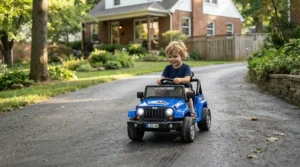
Ground clearance rarely makes it into the bold bullet points on a product listing, but it’s often the actual reason a ride-on gets stuck on terrain that looks perfectly manageable. Most 12V ride-ons sit with roughly 2-3 inches of clearance under the chassis, while dedicated all-terrain models like the Razor Dirt Quad and the ANPABO Ford F-150 run noticeably higher, closer to 4-5 inches by comparison, specifically to clear roots, garden edging, and uneven mowing ruts.
The practical impact shows up in exactly the spots parents don’t anticipate: the transition from driveway to lawn, raised garden bed borders, and drainage dips that seem trivial on foot but become a hard stop for a low-slung vehicle. Reviewers consistently note that vehicles marketed as “all-terrain” but built on standard low-clearance frames tend to high-center — meaning the frame catches on a bump while all four wheels still technically touch ground, killing forward momentum entirely.
If your yard has any raised beds, exposed roots, or a driveway-to-grass transition steeper than a gentle slope, prioritize ground clearance specifically, even over top speed or battery capacity. It’s the spec most likely to determine whether a vehicle actually delivers on the “all-terrain” label printed on the box.
12V Ride-On Car for 4 Year Old vs All-Terrain Options for 5 Year Olds
A lot of parents shopping for a 5 year old also have a younger sibling in mind, which raises a genuinely common question: does a 12V ride-on car for 4 year old kids overlap with what a 5 year old needs, or are these different purchases entirely?
The honest answer is partial overlap. A 12V ride-on car for 4 year old riders typically caps out around 2.5-3.7 mph, which is appropriately conservative for a smaller child still developing reaction time and steering coordination — several models in this roundup, including the Best Choice Products and Costzon ATVs, sit comfortably in that range and work for both ages depending on the individual child’s size and confidence. Where the split matters is weight capacity and terrain ambition: a 4 year old is lighter, so a 12V single-motor vehicle rarely feels underpowered for them the way it can for a bigger, more adventurous 5 year old pushing toward 45-50 lbs on thicker grass or a slight incline.
If you’re buying one vehicle to serve both kids across a couple of years, lean toward a model with a higher weight cap and a two-speed setting with a lockable low-speed mode — the Peg Perego John Deere Ground Force‘s gear lockout is a strong example of this approach done well. If you’re buying two separate vehicles at two different ages, it’s reasonable to start a 4 year old on a basic 12V model and graduate a 5 year old into a 24V or 4WD option once they’ve outgrown the lower speed ceiling.
Common Mistakes When Buying an All-Terrain Ride-On Car
The most common mistake is buying based on the vehicle’s photographed styling rather than its actual tire type and motor configuration — a rugged-looking plastic shell with smooth wheels underneath will disappoint on real grass regardless of how tough it looks in product images.
A second frequent misstep is ignoring weight capacity growth room entirely, buying strictly to a child’s current weight rather than projecting a year or two forward, which shortens the vehicle’s useful life considerably. A third is assuming “24V” alone guarantees better terrain performance — voltage matters less than whether that power is distributed across two or four motors, since a single-motor 24V vehicle can still struggle with traction on genuinely soft or sloped ground compared to a well-designed 4WD system. Finally, many parents underestimate charge time planning; an 8-12 hour charge cycle means a spontaneous “let’s ride” moment after school often isn’t possible unless the battery was charged the night before, which is worth factoring into weekday realism versus weekend expectations.
Long-Term Cost & Maintenance
The sticker price is only part of total cost of ownership here. Replacement batteries for 12V and 24V ride-ons typically run separately from the vehicle itself and become relevant after 1-2 seasons of regular use, since rechargeable battery packs degrade with charge cycles like any other battery. Budget models with smaller battery capacities may need replacement sooner than premium options with larger-capacity packs, so the cheaper upfront purchase isn’t always cheaper over a three-year horizon.
Tire replacement is the other recurring cost, particularly for pneumatic-tire models like the Razor Dirt Quad, where punctures from real off-road debris are a genuine possibility that solid EVA tires simply don’t face. On the flip side, vehicles with steel frames and minimal electronics — the Kid Trax Ram 3500 Dually being the clearest example in this roundup — tend to have fewer failure points overall, since there’s less circuitry to short out from moisture or dust exposure over multiple outdoor seasons.
Viewed through a cost-per-use lens, a premium option like the Peg Perego John Deere Ground Force, purchased once and used across a 3-7 age range with genuine growth room, can end up costing less per year of use than two sequential budget purchases for a child who outgrows a smaller vehicle within a single season.
FAQ
❓ What voltage ride-on is best for a 5 year old?
❓ Can a ride-on car for backyard grass handle a sloped yard?
❓ What tire tread type for grass and dirt works best?
❓ How much ground clearance does an all-terrain ride-on car need?
❓ How do I set up safe backyard play safety zones for a ride-on car?
Conclusion
Finding the right all-terrain ride-on car for 5 year old riders comes down to matching real terrain and real kid size to real specs, not just the most exciting product photo. Budget picks like the Best Choice Products 12V ATV and Costzon 12V ATV genuinely deliver for flat-to-moderate yards, the Kid Trax Ram 3500 Dually earns its keep on pure durability, and premium options like the Peg Perego John Deere Ground Force, ANPABO Ford F-150 24V 4WD, and Razor Dirt Quad justify their price tags with real 4WD torque, pneumatic traction, or multi-year build quality. Whichever you choose, pair it with a properly flagged backyard zone and a tire-tread type that actually matches your grass, and you’ll get years of genuine outdoor play out of it rather than a vehicle that stalls out the first time it hits real dirt.
Recommended for You
- Remote Control Car vs Self-Drive Car for Preschoolers: 7 Picks 2026
- Ride On Car For 3 Year Old: 7 Safe Picks Parents Love in 2026
- Push Car vs Battery Ride-On Car for Toddlers: 7 Best Picks 2026
Disclaimer: This article contains affiliate links. As an Amazon Associate, I earn from qualifying purchases. If you purchase products through these links, we may earn a small commission at no additional cost to you.
✨ Found this helpful? Share it with your friends! 💬🤗
