
In This Article
Picture a three-year-old who has never once gotten to decide, all on her own, “left” instead of “right.” Now picture the exact second she presses a switch and the world tilts toward the swing set instead of the sandbox — because she chose it, not her mom, not her therapist, her. That single moment is the whole point behind a ride-on car for preschooler with disability: not really a toy, more like a passport to a kind of independence most three-year-olds get handed for free and this particular group has had to work for.

So what is a ride-on car for preschooler with disability, exactly? It’s a standard, battery-powered toy vehicle — the kind you’d find at any big-box store — that’s been fitted with an easy-press activation switch, extra torso and hip support, or both, so a child with limited mobility, low muscle tone, or motor-planning challenges can drive it independently instead of being pushed. Researchers who tracked these modified vehicles in real homes found something families already suspected: kids who got one used it constantly, and their drive to move on their own grew right along with it, a pattern documented in a longitudinal study on modified ride-on car use in young children with disabilities.
Below, we’ve dug into seven real products — five base vehicles plus the two accessories that actually turn a store-bought toy into something a child with a disability can pilot — with honest pros, cons, and price ranges (never exact dollar figures, since Amazon’s prices shift week to week). We’ll also cover what occupational therapy recommendations typically look like for these builds, what a harness and seating support option actually needs to do structurally, and the mistakes that trip up nearly every first-time family.
Quick Comparison: Best Ride-On Cars at a Glance
Before the deep dive, here’s the short version for anyone in a hurry.
| Category | Pick | Best For |
|---|---|---|
| Best Overall Base Vehicle | Power Wheels Dune Racer | Easiest wiring access for a switch retrofit |
| Best for Tiny Preschoolers | Kid Trax Toddler Quad | Very low step-in height, low center of gravity |
| Best Budget Pick | Best Choice Products 2-Seater Land Rover | Wide bench seat for padding and a helper seat |
| Best Adaptive Switch | AbleNet Jelly Bean Switch | Lightest activation force on the market |
| Best Harness Upgrade | EZ-ON Vest | True torso and pelvic support beyond a stock belt |
Look closely and a pattern shows up fast: the “winning” pick almost never has the flashiest spec sheet — it has the widest seat, the simplest wiring, or the gentlest activation force, which matters more once you’re modifying rather than just driving out of the box. Budget-focused families should note that the base vehicle itself is often the cheaper half of this equation; the AbleNet Jelly Bean Switch and EZ-ON Vest together frequently cost as much as the car they’re going into.
💬 Just one click — help other parents find this guide too!😊
Top 7 Ride-On Cars and Adaptive Accessories for Preschoolers With Disabilities: Expert Analysis
1. Power Wheels Dune Racer — open frame built for easy switch wiring
The Fisher-Price Power Wheels Dune Racer has quietly become a favorite in the adaptive-mobility world, and it’s not by accident. Its open, buggy-style dash and simple foot-pedal circuit are exactly the kind of straightforward wiring that community rebuild programs look for. Running on a 12-volt battery with a bench-style two-seat layout, it gives you enough width to bolt in foam bolsters or pool-noodle padding along the hips without the child feeling boxed in.
Based on the spec comparison against other entry-level Power Wheels, the Power Wheels Dune Racer‘s pedal-and-relay setup is one of the simpler circuits to intercept with an external switch, which matters enormously if your family (or your child’s therapist) plans to do the modification yourselves rather than pay a specialist. It’s best suited to preschoolers who have decent head and trunk control but need an alternative to the foot pedal, since the accelerator was never designed with fine motor limitations in mind.
Reviewers consistently report that the plastic body holds up well to backyard use over a full season, though a handful mention the stock seatbelt is thinner than they’d like for a child who needs real trunk support — which is exactly why product #7 on this list tends to get paired with it.
Pros:
- ✅ Wide bench seat leaves room for padding or bolsters
- ✅ Simple pedal circuit is easier to intercept with a switch
- ✅ Sturdy plastic shell tolerates grass and gravel
Cons:
- ❌ Stock 2-point belt isn’t enough support on its own
- ❌ No parent remote control for override safety
Expect to pay somewhere in the $300–$400 range for the Power Wheels Dune Racer, and check current price and stock before you commit, since Power Wheels models rotate in and out fairly often. For a family planning a DIY or clinic-led switch conversion, this is one of the stronger dollar-for-dollar starting points on this list.

2. Kid Trax Toddler Quad — lowest step-in height for tiny riders
If your preschooler is smaller, younger, or has lower muscle tone, the seat height on a full-size Power Wheels can be a genuine barrier before you’ve even touched a switch. The Kid Trax Toddler Quad solves that with a low-slung, four-wheel ATV-style frame and a 6-volt motor tuned for a crawl-speed pace rather than a sprint.
What most buyers overlook about this model is that the low center of gravity isn’t just a toddler-safety feature — it also makes tip-over risk far less of a concern for a child who can’t always brace themselves if the vehicle catches on uneven ground. On paper, this means less supervision stress for parents during those first few outdoor sessions.
Aggregated reviewer sentiment tends to praise how forgiving the vehicle is on grass and how quickly toddlers get the hang of the simple forward-only pedal, while a common complaint in user reviews is that taller three- and four-year-olds outgrow it within a year.
Pros:
- ✅ Very low step-in height and center of gravity
- ✅ Slow, controlled top speed suits first-time drivers
- ✅ Compact size fits small yards and indoor spaces
Cons:
- ❌ Weight and height limits are reached quickly
- ❌ Narrower seat leaves less room for padding
Price typically lands in the $130–$200 range, making the Kid Trax Toddler Quad one of the more accessible entry points if you’re not sure yet whether a modified ride-on car is going to be the right fit for your child long-term.
3. Best Choice Products 2-Seater Land Rover — wide bench seat for extra padding
Budget matters, and the Best Choice Products 12V 2-Seater Land Rover consistently shows up as a value pick for good reason: a genuinely wide two-person bench seat at a price point well under most premium Power Wheels. That width is the whole story here.
What the spec sheet won’t tell you, but adaptive-toy workshop volunteers note, is that a bench built for two children happens to be exactly the right canvas for building out lateral trunk supports on one side while leaving the other side open for a sibling or a helper to ride along, which is a genuinely underrated use case for social play. The 12-volt motor and working headlights, locking doors, and Bluetooth speaker are nice touches, but they’re not really why this one earns a spot on this list — the seat geometry is.
Reviewers frequently mention that assembly takes a bit longer than expected and that the plastic feels a notch lighter-duty than Power Wheels, which tracks with the price gap.
Pros:
- ✅ Extra-wide bench seat ideal for padding and supports
- ✅ Lower price than most Power Wheels competitors
- ✅ Room for a sibling or peer to ride alongside
Cons:
- ❌ Plastic construction feels less durable long-term
- ❌ Assembly is more involved than single-seat models
Look for it in the $200–$300 range. For families prioritizing seat width over brand name, the Best Choice Products 2-Seater Land Rover is arguably the smartest budget allocation on this entire list, freeing up money for the switch and harness accessories instead.
4. Costzon 2-Seater Ride-On Truck — remote override for nervous first rides
Here’s a genuinely useful feature that a lot of buying guides gloss over: parent remote control. The Costzon 2-Seater Ride-On Truck ships with a 2.4GHz remote that lets a parent take the wheel — literally — while a child gets comfortable with the sensation of independent motion before switching to full switch-activated control.
Here’s what to weigh if you’re considering this one: for a preschooler who’s anxious about a new sensory experience, or a family whose occupational therapist wants a graded introduction rather than handing over full control on day one, that remote override is a genuine safety net, not a gimmick.
The dual-motor setup handles light inclines reasonably well, and reviewers note the ride feels noticeably smoother than lower-priced competitors, though a repeated theme in aggregated feedback is that battery life falls off faster once the remote-control mode is used heavily, since the parent is essentially driving the motors more continuously than a child pressing an intermittent switch would.
Pros:
- ✅ Parent remote allows a graded, low-stress introduction
- ✅ Dual motors handle mild inclines and grass
- ✅ Wide two-seat layout supports padding additions
Cons:
- ❌ Battery drains faster in heavy remote-control use
- ❌ Bulkier footprint needs more storage space
Expect a price in the $250–$350 range for the Costzon 2-Seater Ride-On Truck. This is the pick we’d steer toward if your child’s occupational therapy recommendations include a slow, staged transition to independent driving rather than an immediate jump to switch control.
5. Peg Perego John Deere Ground Force Tractor — toughest build for rough yards
Peg Perego has a well-earned reputation for building the sturdiest ride-on toys in this price tier, and the John Deere Ground Force Tractor is the brand’s flagship for outdoor durability. Based on the spec comparison against the plastic-heavy competition above, this tractor’s metal-reinforced frame and genuinely rugged tires are built to survive gravel driveways and uneven lawns in a way the budget models simply aren’t, which matters if your family’s usable outdoor space is anything but a flat driveway.
The trailer attachment point is a small but meaningful detail for sensory or cause-and-effect play — hauling toys around the yard gives a child a task, not just a direction to drive in.
Reviewers consistently single out the smoother ride quality on grass and gravel as the standout feature, though the higher price and heavier overall weight are the recurring trade-offs mentioned in aggregated feedback, and a few parents note the wider turning radius takes some getting used to in tighter spaces.
Pros:
- ✅ Reinforced frame and tires handle rough terrain
- ✅ Trailer attachment supports cause-and-effect play
- ✅ Smoothest ride quality of the picks on this list
Cons:
- ❌ Highest price point among the base vehicles here
- ❌ Wider turning radius needs more open space
Budget around $400–$550 for the Peg Perego John Deere Ground Force Tractor. If your preschooler’s play environment is a real backyard rather than a paved driveway, this durability premium tends to pay for itself within a season or two.
6. AbleNet Jelly Bean Switch — lightest-touch activation on the market
None of the five vehicles above do a child with limited hand strength or coordination any good without an accessible activation method, and this is where the AbleNet Jelly Bean Switch comes in. It’s an assistive-technology staple, not a toy accessory dressed up for this niche — the same switch shows up in classrooms and speech-therapy rooms across the country.
The 2.5-inch activation surface requires only a very light touch to trigger, and it connects through a standard 3.5mm mono jack, which happens to be the exact connection point that adaptive-toy workshops (like the university-run GoBabyGo program) wire directly into a ride-on car’s circuit board in place of the stock foot pedal.
What most buyers overlook is that the switch top itself is interchangeable — swap in a different color for visual tracking needs, or reposition the whole unit on a mounting arm as your child’s reach and posture change over the months. Aggregated reviews from occupational therapists and parents alike describe it as close to the industry standard for a reason: it’s simple, durable, and forgiving of imprecise motor control.
Pros:
- ✅ Extremely low activation force needed to trigger
- ✅ Interchangeable, high-visibility switch tops available
- ✅ Standard jack fits most switch-adapted wiring kits
Cons:
- ❌ Requires basic wiring knowledge or a helper to install
- ❌ Sold separately from any ride-on vehicle
Price generally falls in the $60–$90 range. Paired with almost any of the four vehicles above, the AbleNet Jelly Bean Switch is arguably the single highest-value item on this entire list — it’s the difference between a toy your child watches and one they actually drive.
7. EZ-ON Vest — hospital-grade torso support beyond a stock belt
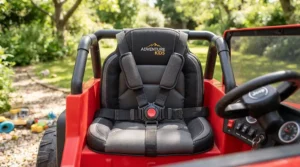
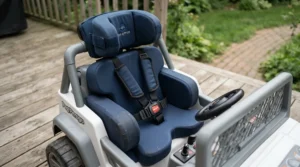
A stock two-point seatbelt was designed with a typically developing three-year-old in mind, and for a preschooler with low trunk tone, limited sitting balance, or a tendency to slump sideways, that’s simply not enough hardware. The EZ-ON Vest is a padded, adjustable torso harness originally built for wheelchairs and adaptive car seats, and it’s become a go-to positioning add-on for modified ride-on cars for exactly that reason.
Here’s what to weigh: it’s not a toy-aisle purchase, and it’s typically sourced through adaptive-equipment and medical-supply retailers rather than a standard toy listing, so availability and sizing charts are worth checking directly against your child’s torso measurements rather than guessing off a generic size label.
What the spec sheet won’t tell you, but occupational therapists note repeatedly, is that a properly fitted vest does double duty: it improves safety in the event of a tip or sudden stop, and it also improves postural control while driving, which in turn makes it easier for a child to coordinate the switch-pressing motion in the first place.
Pros:
- ✅ True torso and pelvic support beyond a lap belt
- ✅ Adjustable sizing accommodates growth over time
- ✅ Widely recommended in pediatric therapy settings
Cons:
- ❌ Not typically stocked by mainstream toy retailers
- ❌ Requires accurate torso measurement for proper fit
Expect a price range of roughly $150–$250 depending on size. Combined with any of the base vehicles above, the EZ-ON Vest rounds out what a genuinely safe, adaptive ride-on car for preschooler with disability actually requires — a vehicle, a switch, and support that keeps the child centered while they drive it.
Full Spec, Price & Value Comparison
| Product | Type | Price Range | Best For |
|---|---|---|---|
| Power Wheels Dune Racer | Base vehicle | $300–$400 | Easiest DIY switch conversion |
| Kid Trax Toddler Quad | Base vehicle | $130–$200 | Youngest, smallest riders |
| Best Choice Products 2-Seater Land Rover | Base vehicle | $200–$300 | Budget-conscious, wide-seat needs |
| Costzon 2-Seater Ride-On Truck | Base vehicle | $250–$350 | Graded, parent-assisted introduction |
| Peg Perego John Deere Ground Force Tractor | Base vehicle | $400–$550 | Rough or uneven outdoor terrain |
| AbleNet Jelly Bean Switch | Adaptive accessory | $60–$90 | Independent activation with low force |
| EZ-ON Vest | Harness accessory | $150–$250 | Trunk and pelvic positioning support |
Line these seven up side by side and the real budget conversation isn’t “which car” — it’s “car plus accessories.” A family choosing the Best Choice Products 2-Seater Land Rover at the low end can still land near the total cost of the Peg Perego tractor once the AbleNet Jelly Bean Switch and EZ-ON Vest are factored in, so it’s worth pricing the full bundle before falling in love with any single vehicle. The Kid Trax Toddler Quad stands out as the cheapest complete path to independent mobility for the youngest preschoolers on this list, precisely because its lighter weight and smaller frame need less structural reinforcement to begin with.

How to Choose a Ride-On Car for Preschooler With Disability
Picking the right base vehicle before you’ve bought a single switch or strap saves you money and heartbreak later. Here’s the order experienced adaptive-toy volunteers and therapists tend to work through:
- Match seat width to support needs first. A child who needs bolsters or lateral trunk supports needs several extra inches of bench width beyond what a typically developing toddler would use.
- Check step-in height against your child’s transfer ability. If a caregiver is lifting the child in and out every session, a lower vehicle like the Kid Trax Toddler Quad reduces strain on everyone involved.
- Confirm the wiring is switch-friendly before buying. Vehicles with a simple foot-pedal relay, like the Power Wheels Dune Racer, are generally easier and cheaper to convert than ones with complex electronic dashboards.
- Decide whether you need a parent-override remote. If your child’s occupational therapy recommendations call for a staged introduction, prioritize a remote-equipped model like the Costzon 2-Seater Ride-On Truck.
- Budget for the switch and harness as separate line items. Treat the AbleNet Jelly Bean Switch and EZ-ON Vest as core purchases, not optional extras, from the very beginning.
- Match the terrain to the tires and frame. Grass, gravel, and sidewalk cracks all favor a heavier-duty build like the Peg Perego John Deere Ground Force Tractor.
- Loop in a professional before finalizing electrical modifications. A physical or occupational therapist familiar with adaptive switch controls can flag positioning issues you might miss on your own.
Common Mistakes When Buying an Adaptive Ride-On Car
Even well-researched families tend to repeat a handful of avoidable errors. First, and most common: buying the vehicle before confirming it can actually be wired for a switch, which leaves families stuck retrofitting a dashboard that was never designed for it. Second, underestimating how much the seat width matters — a narrow single-seat car like some entry-level quads leaves almost no room for the padding a positioning plan actually calls for. Third, skipping the harness upgrade entirely because the stock seatbelt “looks fine,” when in practice a stock 2-point belt rarely provides the trunk control a child with low tone genuinely needs. Fourth, assuming a bigger, faster vehicle is automatically a better one — for a first-time rider, a slower top speed like the Kid Trax Toddler Quad‘s is a feature, not a limitation. And fifth, treating this as a one-time purchase rather than an evolving system; kids grow, skills change, and the switch position or vest sizing usually needs revisiting every few months.
Adaptive Ride-On Cars vs Traditional Power Wheelchairs
Families are often surprised to learn these two options aren’t really competing for the same job. A modified ride-on car for preschooler with disability is an inexpensive, low-commitment tool that’s easy to swap out as a child’s needs change, while a pediatric power wheelchair is a higher-cost, insurance-mediated, longer-term mobility device.
| Factor | Adaptive Ride-On Car | Pediatric Power Wheelchair |
|---|---|---|
| Typical Cost | A few hundred dollars total | Often several thousand dollars |
| Acquisition Time | Days to weeks | Months, often insurance-dependent |
| Portability | Light enough for a car trunk | Frequently requires a lift or ramp |
| Social Play Value | Looks and feels like a regular toy | Can read as more clinical to peers |
| Growth Runway | Outgrown within a year or two | Built to be reconfigured over years |
The written comparison matters more than the table alone: a ride-on car is best understood as a bridge, not a replacement. Many families use one specifically to build head, trunk, and cognitive readiness for powered mobility while the wheelchair-funding process (which can take a long time) plays out in parallel. Occupational therapists frequently recommend starting here precisely because there’s no insurance approval, prior authorization, or waiting list standing between a child and their first taste of self-directed movement.
What to Expect: Real-World Performance
Specs on a box only tell part of the story. In practice, a modified ride-on car for preschooler with disability behaves less like a toy and more like a very forgiving training wheelchair. Expect an adjustment period of a few sessions before a child fully connects “press switch, car moves” — that cause-and-effect link isn’t always instant, and that’s normal, not a sign the setup failed. Expect battery life in the range of half an hour to an hour of active play per charge, shorter if terrain is hilly or the child is still learning to release the switch between movements. Expect your first outdoor session to be shorter and more tentative than you imagined, and your fifth session to look nothing like your first, because confidence compounds quickly once a child realizes the car actually listens to them.
Occupational Therapy Recommendations: Why OT Input Matters
Nearly every credible resource on this topic — clinical researchers, university mobility labs, and grassroots build programs alike — recommends looping in an occupational or physical therapist before finalizing the setup, and it’s not just a liability disclaimer. Occupational therapy recommendations typically focus on three things a parent might not think to check: whether the child has enough head and trunk control to safely tolerate the vehicle’s motion, where exactly the switch should sit relative to the child’s strongest and most reliable movement pattern, and how the seating supports should be arranged to encourage good posture rather than just prevent falling. A therapist who’s seen dozens of these builds can often predict, from a five-minute evaluation, whether a child will do better with a hand switch near the steering wheel or a head-array switch mounted behind the headrest — a decision that’s genuinely hard to guess correctly from home. This is also where harness and seating support options get properly matched to a child’s specific diagnosis rather than a one-size-fits-all vest, since a child with low tone and a child with asymmetrical muscle tightness need meaningfully different support geometry.

Safety, Harnesses & Seating Support Options: Regulations and Best Practices
Every base vehicle on this list is required to meet the CPSC’s mandatory toy safety standard, which covers everything from stability testing to battery and charger safety — worth confirming on the box before you buy, especially with lesser-known brands. Beyond that baseline, families layering on adaptive equipment should follow a few consistent best practices: never leave a child unattended in a modified ride-on car regardless of how secure the harness and seating support options feel, always test the emergency stop or switch-release function before the first real drive, and re-check strap tension and vest fit every few weeks since preschoolers grow faster than most people expect. A ride-on car with extra safety harness for preschoolers is only as safe as its weakest attachment point, so any DIY strap or bolster addition should be checked by someone with mechanical or clinical training rather than eyeballed. Finally, keep the original manufacturer’s charger and never substitute a generic one, since charger mismatches are one of the more common overheating complaints in aggregated ride-on toy reviews.
Setting Up Your Adaptive Ride-On Car: A 30-Day Starter Guide
The first month sets the tone for whether this becomes a beloved part of your child’s routine or an expensive object gathering dust in the garage. Week one is about fit, not fun: get the vehicle, the switch, and the harness in the same room, and spend a session just sitting the child in the seat with the vehicle powered off, so the sensory experience of the seat itself isn’t tangled up with the surprise of sudden movement. Week two introduces motion in the smallest possible doses — a few feet at a time, ideally with a Costzon 2-Seater Ride-On Truck-style remote override on hand if you have one, so a parent can catch and correct without the child feeling out of control. Week three is when most families notice the shift from “tolerating” to “requesting” the car, and this is the right moment to start varying terrain slightly — a slightly bumpier patch of yard, a gentle slope — to build tolerance for the real world beyond a flat driveway. Week four is maintenance week: recheck the switch mounting for any looseness, confirm the harness hasn’t shifted out of proper position as the child has adjusted their sitting posture, and log battery run-time so you know what a full charge realistically buys you going forward. A common first-30-days mistake is over-scheduling drive sessions before the child’s stamina catches up — ten focused minutes several times a week beats one exhausting hour-long outing.
Real Families, Real Rides: Matching the Right Ride-On Car to Your Child
Consider three composite profiles built from the kinds of cases occupational therapists and adaptive-toy workshops describe repeatedly. First, a two-and-a-half-year-old with spina bifida who has strong upper-body strength but no functional leg movement: a lightweight, low base vehicle like the Kid Trax Toddler Quad paired with the AbleNet Jelly Bean Switch mounted near the steering wheel tends to be the fastest path to independent driving, since her hand strength alone is enough to press the switch reliably. Second, a four-year-old with cerebral palsy affecting trunk control on one side: the wider Best Choice Products 2-Seater Land Rover gives room for an asymmetrical bolster setup plus the EZ-ON Vest, addressing the lean before it becomes a driving obstacle. Third, a three-year-old with a sensory processing difference who’s cautious about new movement experiences: the Costzon 2-Seater Ride-On Truck‘s parent remote lets a caregiver introduce motion gradually over several sessions rather than handing over full control immediately, which tends to build trust faster than an all-or-nothing approach.
Common Problems & Solutions for First-Time Adaptive Ride-On Car Families
Problem one: the child presses the switch but nothing happens on the first few tries. Solution: check the mono-jack connection and confirm polarity before assuming the switch itself is faulty — loose wiring is the more common culprit. Problem two: the vehicle tips slightly on uneven ground. Solution: widen the wheelbase where possible, lower tire pressure slightly if applicable, and avoid slopes until trunk control improves. Problem three: the harness slips during a longer session. Solution: recheck sizing against current torso measurements rather than the size chart used at purchase, since preschoolers change shape quickly. Problem four: the child loses interest after the novelty wears off. Solution: introduce simple tasks — hauling a small trailer, “driving” to retrieve a toy — rather than open-ended free-roam time. Problem five: battery life feels shorter than advertised. Solution: cold weather and hilly terrain both reduce runtime meaningfully, so track charge cycles across a few sessions before concluding the battery itself is defective.
Price Range & Value: What You’re Really Paying For
| Product | Price Range | Value Verdict |
|---|---|---|
| Kid Trax Toddler Quad | $130–$200 | Best entry point for the youngest riders |
| Best Choice Products 2-Seater Land Rover | $200–$300 | Strongest value for seat width per dollar |
| Costzon 2-Seater Ride-On Truck | $250–$350 | Worth it for the parent-remote safety net |
| Power Wheels Dune Racer | $300–$400 | Solid middle ground for DIY conversions |
| Peg Perego John Deere Ground Force Tractor | $400–$550 | Justified only if terrain is genuinely rough |
Looking at value rather than sticker price alone, the Best Choice Products 2-Seater Land Rover delivers the most usable seat real estate for the money, while the Peg Perego John Deere Ground Force Tractor‘s premium only pays off if your family’s outdoor space actually demands that level of durability. Don’t let the highest price tag on this list convince you it’s automatically the right pick — for a paved driveway and a mild climate, that premium is mostly wasted.
Frequently Asked Questions
❓ What is the best ride-on car for a preschooler with a disability?
❓ How much does an adaptive ride-on toy for special needs preschooler cost?
❓ Can any ride-on car be fitted with adaptive switch controls?
❓ Do occupational therapists recommend specific ride-on cars for kids with disabilities?
❓ Where can I find a ride-on car with extra safety harness for preschoolers?
Conclusion
A ride-on car for preschooler with disability isn’t really about the car at all — it’s about handing a small person the steering wheel to their own curiosity, months or years before the traditional mobility-equipment timeline would allow it. Across the seven picks here, the pattern holds steady: seat width, wiring simplicity, and honest harness support matter more than horsepower or brand prestige. Whether you land on the budget-friendly Best Choice Products 2-Seater Land Rover, the rugged Peg Perego John Deere Ground Force Tractor, or a completely different combination built around the AbleNet Jelly Bean Switch and EZ-ON Vest, the real win is the same one researchers keep documenting: a child who gets to move because they decided to, not because someone else did the deciding for them. Loop in an occupational therapist where you can, budget for the accessories from day one, and expect the first few sessions to look messier than the fifth — that’s not failure, that’s exactly how this is supposed to go.
Recommended for You
- Best All-Terrain Ride-On Car for 5 Year Old: 7 Picks (2026)
- Remote Control Car vs Self-Drive Car for Preschoolers: 7 Picks 2026
- Ride On Car For 3 Year Old: 7 Safe Picks Parents Love in 2026
Disclaimer: This article contains affiliate links. As an Amazon Associate, I earn from qualifying purchases. If you purchase products through these links, we may earn a small commission at no additional cost to you.
✨ Found this helpful? Share it with another family who needs it! 💬🤗
