
In This Article
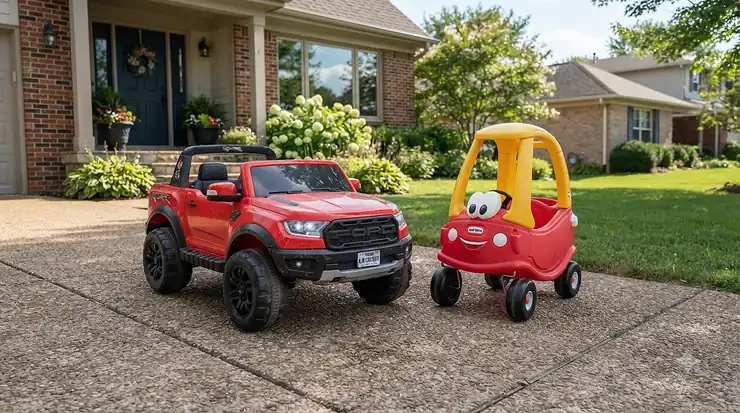
Standing in the toy aisle with a toddler tugging your sleeve, you’ve probably asked yourself the same question thousands of parents wrestle with every spring: push car vs battery ride-on car for toddlers — which one actually earns its spot in your garage? A push car is a foot-powered, adult-guided or self-propelled vehicle with no motor, while a battery ride-on car uses a rechargeable 6V or 12V battery to move the child under their own steering control. Both categories are wildly popular, but they solve different problems at different ages, and the “best” choice depends less on marketing and more on your toddler’s balance, your living situation, and how much supervision you can realistically give.
Here’s what nobody tells you at the store: the flashiest battery-powered SUV replica isn’t automatically the better buy for a 14-month-old who’s still wobbly on two feet. Meanwhile, a simple push car can quietly outperform a $200 electric ride-on when it comes to building the leg strength toddlers need before they’re ready for independent walking outdoors. According to the developmental milestones that most children reach by 2 years of age tracked by the Centers for Disease Control and Prevention, movement skills like running and climbing are still very much in progress — which matters enormously for which ride-on category is genuinely appropriate.
In this guide, we’ll break down seven real, currently available push cars and battery ride-on cars, compare them head-to-head, and walk through exactly how to match a ride-on to your toddler’s age, apartment size, and personality — whether you’re shopping for a rough-and-tumble toddler or a toddler who wants everything themed to their favorite show.
Quick Comparison: Push Car vs Battery Ride-On Car for Toddlers
| Feature | Push Cars | Battery Ride-On Cars |
|---|---|---|
| Typical age range | 12 months–4 years | 18 months–5 years |
| Power source | Child’s legs or adult push handle | 6V or 12V rechargeable battery |
| Noise level | Near-silent (some have horn/sound buttons) | Motor hum plus lights/music, often 60-90 dB |
| Price range | Roughly $40–$150 | Roughly $100–$400+ |
| Best for | Indoor/apartment use, early walkers, budget shoppers | Backyards, driveways, kids who’ve mastered walking |
Looking at the table, push cars clearly win on price, noise, and how early you can introduce them, while battery ride-on cars deliver more “wow factor” and independence once a toddler has the coordination to steer and brake safely. If your household is apartment-based or your child is under two, the push car column is where most of your shopping should happen; once a toddler is a confident walker with some understanding of cause-and-effect, the battery ride-on column starts making a lot more sense.
💬 Found a favorite already? Save this guide and share it with another parent who’s stuck in the same toy-aisle dilemma!
Top 7 Push Cars and Battery Ride-On Cars for Toddlers: Expert Analysis
We researched real, currently sold products spanning both categories — budget, mid-range, and premium — so you can compare apples to apples instead of guessing from a glossy box.
1. Little Tikes Cozy Coupe — the gender-neutral classic that never goes out of production
The Little Tikes Cozy Coupe opens this list because it’s arguably the most recognized toddler push car in American backyards, and for good reason. It expands on the standout feature immediately: there’s no battery, no charging, and almost nothing to break, which is exactly why it’s survived for decades.
The molded one-piece plastic body includes working doors, a steering wheel, a horn, a fake ignition key, and a removable floorboard so a smaller toddler can scoot with their feet while a taller one can lift the panel and walk normally underneath. Weight capacity sits around 50 lbs, which comfortably covers most kids from roughly 18 months through age 4 or 5.
Based on the spec comparison with pricier options on this list, the Little Tikes Cozy Coupe is the go-to pick for parents who want zero maintenance and maximum durability — this is a toy that regularly gets handed down between siblings and still holds up. Reviewers consistently report that the doors are the first thing to loosen with heavy use, but the core chassis rarely cracks even after years outdoors.
Pros:
- ✅ No battery, charging, or moving mechanical parts to fail
- ✅ Available in gender-neutral red/yellow plus themed color variants
- ✅ Extremely stable wide base resists tipping
Cons:
- ❌ Doors and hinges can loosen with rough daily play
- ❌ No handle for parent-assisted pushing on uneven ground
Priced in the mid-$50s to mid-$70s range depending on the color variant, the Little Tikes Cozy Coupe remains one of the best value-per-dollar toys in either category — check current price before buying, since retailers rotate promotions often.

2. Step2 Whisper Ride Cruiser — best for apartment hallways and quiet naptime schedules
The Step2 Whisper Ride Cruiser leads with its defining feature: engineered “whisper” wheels designed specifically to roll quietly across hardwood, tile, and sidewalk without the clatter typical of hard plastic casters.
It functions as a genuine stroller substitute, complete with a seatbelt, a working horn, under-hood storage for snacks or a sippy cup, and a rated capacity of about 50 lbs for ages roughly 1.5 to 4 years. The parent push handle detaches once your toddler is ready to self-propel with their feet.
What most buyers overlook about this model is that the quiet-wheel design isn’t just a nice-to-have — for families in condos or apartment buildings with downstairs neighbors, it directly solves the noise complaint that comes with harder-wheeled competitors. Reviewers consistently note the ride is noticeably smoother and quieter than the classic Cozy Coupe style, though a few mention the seatbelt buckle feels flimsy compared to a real stroller harness.
Pros:
- ✅ Whisper wheels genuinely reduce rolling noise indoors
- ✅ Doubles as a stroller alternative with seatbelt and storage
- ✅ Detachable parent handle adapts as toddler grows
Cons:
- ❌ Seatbelt buckle feels less secure than a stroller harness
- ❌ Bulkier footprint than the classic Cozy Coupe for small entryways
At around $100 to $130, the Step2 Whisper Ride Cruiser is a smart mid-range pick specifically for noise-sensitive households — check current price, as this model frequently rotates through seasonal sales.
3. Radio Flyer Busy Buggy — best for motor skill and sensory development
The Radio Flyer Busy Buggy stands out immediately for cramming 17 sensory activities — interlocking gears, folding mirrors, a working horn — into a single 3-in-1 push walker and ride-on car.
Rated for ages 1 to 3 and a 42 lb capacity, this model is deliberately built to transition with a toddler: it starts as a walker toddlers can lean on while cruising furniture-free, then converts into a seated ride-on once they’re steadier. An anti-tip feature widens the stance to reduce rollover risk during the wobbliest walking-practice months.
Here’s what the spec sheet won’t tell you, but developmental context does: interactive gears and mirrors aren’t just entertainment — they reinforce cause-and-effect learning and fine motor coordination at exactly the stage the CDC’s 2-year milestone checklist flags for skills like trying switches, knobs, and buttons on a toy. Reviewers consistently describe the walker mode as genuinely useful for babies who are cruising but not yet confident walking solo, though several note the sensory panel’s plastic gears can feel a bit stiff for the smallest hands.
Pros:
- ✅ 3-in-1 design adapts from walker to full ride-on car
- ✅ 17 sensory features encourage fine motor practice
- ✅ Anti-tip wide stance for unsteady new walkers
Cons:
- ❌ Gears and knobs can feel stiff for the youngest users
- ❌ Bulkier than single-purpose push cars once converted
Typically priced in the $90 to $120 range, the Radio Flyer Busy Buggy delivers strong value for parents specifically prioritizing developmental play over pure aesthetics — prices may vary by retailer.
4. Radio Flyer 4-in-1 Stroll ‘N Trike — best long-term value that grows with your child
The Radio Flyer 4-in-1 Stroll ‘N Trike earns its spot by doing something most push cars can’t: converting through four distinct stages, from a parent-steered stroller for a 9-month-old all the way to an independent pedal trike for a preschooler.
Early on, a canopy and full harness let a baby ride facing the parent; later stages remove the canopy, add a push handle, and eventually let an older toddler pedal and steer independently. This effectively replaces a stroller, a push car, and a first tricycle in one purchase.
Based on the spec comparison against single-stage push cars, the value math here favors families who want one long-lasting product rather than replacing toys every six months as their child grows. What most buyers overlook is that reconfiguring between stages takes a few minutes of tool-free assembly work, which some parents find fiddly the first time. Reviewers consistently praise the multi-year lifespan, while a recurring complaint is that the recline/canopy stage feels heavier to push than a true stroller.
Pros:
- ✅ Four growth stages from infant stroller to pedal trike
- ✅ Reduces the need to buy multiple separate ride-on stages
- ✅ Storage basket adds practical everyday utility
Cons:
- ❌ Heavier to push than a dedicated stroller in early stages
- ❌ Stage conversions require occasional tool-free reassembly
Expect a price in the $110 to $150 range, positioning the Radio Flyer 4-in-1 Stroll ‘N Trike as a premium push-category pick — check current price, since this model is frequently bundled with seasonal promotions.
5. Kid Trax Toddler Disney Cars Quad Ride-On (Lightning McQueen) — best budget entry into battery power
The Kid Trax Toddler Disney Cars Quad Ride-On is the most budget-friendly true battery vehicle on this list, running on a single 6V rechargeable battery with a max weight capacity around 45 lbs for ages roughly 1.5 to 3.
Top speed on a 6V system is intentionally slow — generally under 2.5 mph — which is exactly the point for a first-time battery ride-on: it gives a toddler the thrill of “driving” without the acceleration or braking demands of a faster 12V machine. The included charger and simple forward-only or forward/reverse drive keep the learning curve minimal.
On paper, this means a toddler gets the independence and imaginative-play payoff of a themed licensed vehicle without the price tag or speed risk of bigger battery ride-ons. Reviewers consistently note the licensed Lightning McQueen graphics are a huge hit with fans of the franchise, though several mention the plastic tires can feel a bit noisy and buzzy on concrete compared to rubber-tired competitors.
Pros:
- ✅ Lowest price point of any battery-powered option here
- ✅ 6V top speed is genuinely toddler-safe and easy to control
- ✅ Licensed character theme drives strong toddler engagement
Cons:
- ❌ Plastic wheels are noticeably noisier on hard pavement
- ❌ Battery runtime is shorter than 12V competitors
Generally priced in the $100 to $140 range, the Kid Trax Toddler Disney Cars Quad Ride-On is a sensible first battery car — always check current price, since Kid Trax rotates licensed character availability seasonally.

6. Best Choice Products Kids Electric Ride-On Truck — best gender-neutral budget battery pick
The Best Choice Products Kids Electric Ride-On Truck leads with a genuinely useful spec: a 34.5-inch body on a 6V battery capable of roughly 3.1 mph, giving slightly more presence and speed than a typical toddler quad without tipping into “too fast” territory.
The truck body style — rather than a licensed character shell — makes this one of the more gender-neutral toddler toys in the battery category, appealing equally to kids who aren’t fixated on a specific movie or show. Standard features include working headlights, a horn button, and a simple two-speed or single-speed drive system depending on the exact trim.
What most buyers overlook about generic-brand ride-ons like this one is that the value proposition isn’t just price — it’s flexibility, since a neutral truck design tends to hold a toddler’s interest longer than a licensed character they’ll eventually outgrow emotionally. Reviewers consistently mention that assembly is quick and the ride is stable on grass and smooth pavement alike, while a recurring complaint is that the horn and light effects can drain the battery faster than expected.
Pros:
- ✅ Gender-neutral truck design outlasts licensed-character trends
- ✅ 3.1 mph top speed with stable, wide wheelbase
- ✅ Quick tool-light assembly out of the box
Cons:
- ❌ Lights and sound effects noticeably shorten battery life
- ❌ Fewer premium extras (no parent remote on base trim)
Typically priced around $100 to $160, the Best Choice Products Kids Electric Ride-On Truck is a strong pick for parents who want battery power without paying for a licensed badge — prices may vary at the time of research.
7. Mercedes-Benz G63 Kids Ride-On Car — best premium pick with parental control
The Mercedes-Benz G63 Kids Ride-On Car rounds out the list as the premium option, running on a 12V battery system and licensed from the real Mercedes-Benz G-Wagon body design, complete with LED headlights and built-in music playback.
The standout feature that separates this from budget battery cars is the included parental remote control, which lets an adult override steering and throttle entirely — critical for toddlers who are just starting to grasp forward/reverse control but aren’t ready to be fully autonomous. A soft-start acceleration curve also prevents the sudden lurch that startles younger drivers.
Here’s what most spec sheets bury in the fine print: a parental remote genuinely changes the safety calculus for a 2-year-old driver, letting a parent stop the vehicle instantly rather than shouting instructions the toddler can’t yet process quickly. Reviewers consistently praise the realistic styling and remote-override feature, though several note the higher 12V top speed still requires close supervision on anything but a flat, obstacle-free driveway.
Pros:
- ✅ Parental remote overrides steering and speed for safety
- ✅ Soft-start acceleration reduces sudden jolts
- ✅ Licensed styling with working LED lights and music
Cons:
- ❌ Highest price point of any product on this list
- ❌ 12V speed still demands close, active supervision
Expect a price in the $250 to $400 range depending on trim and retailer, making the Mercedes-Benz G63 Kids Ride-On Car the splurge pick for families who want both realism and a genuine safety backstop — check current price, as licensed models fluctuate with promotional cycles.
Setting Up Your Toddler’s New Ride-On: A 30-Day Practical Guide
Getting a ride-on right isn’t just about the unboxing moment — the first month determines whether it becomes a daily favorite or a garage-corner regret. Start by fully charging any battery model for the manufacturer’s recommended window (often 18 hours for a first charge) before your toddler ever sits in it, since an undercharged battery leads to sluggish performance that can feel like a defective toy.
For the first week, supervise every single ride at arm’s length regardless of whether it’s a push car or a battery model — toddlers routinely misjudge stopping distance and furniture corners during this adjustment period. Set clear “driving zones” (a hallway, a flat patio) so your toddler learns boundaries before you expand their range. For battery vehicles, practice the forward/reverse switch and horn together as a game; this builds the same cause-and-effect confidence the Radio Flyer Busy Buggy‘s sensory panel is designed to teach.
A common first-30-days mistake is over-charging: leaving a battery plugged in well past the recommended window shortens its lifespan. Set a phone reminder instead of guessing. By day 30, most toddlers have settled into either confidently steering solo or still preferring an adult’s guiding hand — both are completely normal, and neither means you bought the wrong ride-on.

Real-Life Scenarios: Matching the Right Ride-On to Your Toddler
Specs only tell half the story. Here’s how three common household situations actually play out.
The ride-on car for small apartments toddlers actually use without noise complaints
If you’re raising a toddler in a two-bedroom apartment with neighbors below, a ride-on car for small apartments toddlers can realistically use is almost always a push car with quiet wheels rather than a battery model. The Step2 Whisper Ride Cruiser was built for exactly this scenario — hardwood-friendly wheels, no motor hum, and a compact enough footprint to store behind a couch. Battery ride-ons, even indoors, introduce motor noise and require far more floor space to turn safely.
The ride-on car for 2 year old girl who wants to match her favorite show
For a ride-on car for 2 year old girl who’s deep into princess or animal-themed play, the Little Tikes Cozy Coupe‘s princess variant or a themed 6V quad like the Kid Trax line hits the sweet spot between imaginative play and age-appropriate speed. At this age, weight capacity and low top speed matter more than styling, so resist the pull toward a faster 12V car until she’s closer to age 3.
The ride-on car for 2 year old boy obsessed with trucks and speed
A ride-on car for 2 year old boy who’s constantly narrating “vroom vroom” during walks is a strong candidate for the Best Choice Products Kids Electric Ride-On Truck — the neutral truck body satisfies the vehicle obsession without locking into a single licensed character he might outgrow by his third birthday. If he’s not walking confidently yet, though, a push car remains the safer starting point regardless of gender or theme preference.
How to Choose Between a Push Car and a Battery Ride-On Car for Toddlers
- Check walking confidence first. If your toddler still holds furniture to cruise, a push car (or a walker-mode hybrid like the Radio Flyer Busy Buggy) builds the right muscles before a motor does the work for them.
- Measure your available space. Apartments and small yards favor push cars or 6V quads; only choose a 12V model like the Mercedes-Benz G63 Kids Ride-On Car if you have a driveway or flat, fenced yard.
- Decide how much control you need to retain. A parental remote, as on the Mercedes-Benz G63, is worth the premium if you want the ability to instantly stop the vehicle.
- Set a realistic budget band. Push cars generally cost less upfront and have nothing to replace; battery models add ongoing costs like replacement batteries every couple of years.
- Consider noise tolerance. Thin apartment walls or a napping sibling make quiet-wheel push cars the pragmatic default.
- Weigh licensed themes vs. longevity. A character-specific 6V quad delights today but may feel dated in a year; a neutral design like the Best Choice Products truck tends to age better.
- Confirm the weight and age rating matches your child now — not “eventually.” Buying ahead of your toddler’s current size increases tip-over risk rather than “growing into it” safely.
Following the CPSC’s mandatory ASTM F963 toy safety standard, which governs ride-on and similar toys, is a useful baseline — legitimate products sold by major retailers are already certified, but double-checking age and weight labels against your specific child still matters more than the certification badge alone.
Push Car vs Battery Ride-On Car: Motor Skill Development Benefits
The motor skill development benefits of each category aren’t identical, and understanding the difference helps explain why pediatric occupational therapists so often recommend starting with a push car. A push car requires a toddler to generate their own forward force with their legs, which directly reinforces the same large-muscle patterns behind independent walking and running. A battery ride-on, by contrast, replaces that leg-driven propulsion with a motor, shifting the developmental payoff toward fine motor and cognitive skills — steering precision, reaction time, and understanding cause-and-effect from buttons and pedals.
Neither is developmentally “wrong,” but sequencing matters. Introducing a push car first, then transitioning to a battery ride-on once your toddler already runs and climbs confidently, mirrors the natural progression pediatric guidance describes. Reviewers of walker-hybrid push cars like the Radio Flyer Busy Buggy frequently mention noticeable improvements in a toddler’s confidence walking unassisted within weeks — an outcome that’s consistent with, though not formally validated by, general developmental expectations for this age range.
Noise Level Considerations for Apartments
Noise level considerations for apartments deserve more attention than most product listings give them. Battery ride-on cars combine a running motor with sound-effect speakers, horn buttons, and sometimes built-in music — and children instinctively hold speakers close to their ears or bodies, amplifying perceived volume well beyond arm’s-length measurements. Independent testing summarized by the American Academy of Audiology has found that many commercially available toys exceed safe exposure recommendations even at a child’s approximate arm’s length, which is worth remembering before assuming a “fun sound” feature is harmless.
Practically, this means two things for apartment-dwelling families. First, prioritize push cars or 6V ride-ons with a physical volume control or mute option over louder 12V models with built-in speakers. Second, if you already own a noisier battery ride-on, simply turning off the sound effects (or removing the sound module’s battery, if separate) preserves the ride experience while cutting the single biggest source of noise complaints from downstairs neighbors — and your own toddler’s ears.

Gender-Neutral vs Themed Toddler Toys: What Actually Matters
The gender-neutral vs themed toddler toys debate shows up constantly in this category, since both push cars and battery ride-ons are sold in everything from generic red-and-yellow to fully licensed Disney or Mercedes-Benz branding. A 2024 developmental review on gendered toy marketing concluded that gender-neutral toys carry real advantages for children’s sense of self-identity beyond binary categories, and that removing rigid gender-coding supports more open-ended, exploratory play.
In practice, this doesn’t mean themed toys are harmful — a toddler thrilled by their favorite character is still getting the same motor and cognitive benefits either way. What it does mean is that if you’re buying for a sibling group, a future hand-me-down, or simply want a toy with a longer emotional shelf life, a neutral option like the Little Tikes Cozy Coupe‘s classic colorway or the Best Choice Products Kids Electric Ride-On Truck tends to stay relevant longer than a single-character license your toddler may age out of emotionally within a year or two.
Common Mistakes When Buying a Push Car or Battery Ride-On Car
Even well-researched parents fall into a few predictable traps. First, buying “for the next size up” — a 12V car rated for age 3+ handed to a barely-walking 18-month-old — dramatically increases tip-over and collision risk rather than offering good long-term value. Second, ignoring surface compatibility: a battery car built for pavement will struggle and drain quickly on thick grass or gravel, frustrating both parent and child.
Third, skipping the weight limit check — toddlers cluster around very different weights at the same age, and exceeding a rated capacity strains the motor or chassis regardless of age label. Fourth, underestimating battery maintenance: letting a 6V or 12V battery sit fully drained for weeks between uses shortens its usable life significantly. Finally, choosing based purely on looks rather than your child’s current walking ability is the single most common mismatch we see — the flashiest option in the store aisle isn’t automatically the right one for a toddler who’s still finding their feet.
Long-Term Cost, Maintenance & Safety Compliance
| Category | Push Cars | Battery Ride-On Cars |
|---|---|---|
| Upfront cost | Around $50–$150 | Around $100–$400+ |
| Ongoing costs | Essentially none | Replacement battery every 1–3 years, roughly $30–$60 |
| Maintenance | Occasional wheel/hinge cleaning | Charge cycle discipline, battery storage care |
| Certification | ASTM F963 toy standard | ASTM F963 plus battery/electrical requirements |
The table above makes the total cost of ownership gap fairly clear: a push car’s near-zero maintenance keeps its lifetime cost close to the sticker price, while a battery ride-on typically needs at least one replacement battery over several years of regular use. That said, the Mercedes-Benz G63 Kids Ride-On Car‘s parental remote can offset some of that added cost by extending the safe usable age range, since a parent can keep supervising active driving even before a toddler is ready for full independent control.
On the compliance side, any push car or battery ride-on sold by a major U.S. retailer should already meet the mandatory ASTM F963 toy safety standard enforced by the Consumer Product Safety Commission, covering everything from small-parts hazards to structural stability. It’s still worth registering your product with the manufacturer, since that’s how you’ll be notified directly if a recall is ever issued for your specific model.

Frequently Asked Questions
❓ Is a push car or battery ride-on better for a 1 year old?
❓ What age should a toddler switch from a push car to a battery ride-on car?
❓ Are battery ride-on cars safe for toddlers indoors?
❓ How loud are battery ride-on cars for toddlers?
❓ Do push cars help with walking and motor skills?
Conclusion
There’s no single winner in the push car vs battery ride-on car for toddlers debate — the right choice depends on where your toddler is developmentally, how much space and quiet your household can offer, and whether you’re buying for right now or trying to future-proof for the next two years. Younger toddlers, apartment dwellers, and budget-conscious families tend to land happily with a push car like the Little Tikes Cozy Coupe or the noise-friendly Step2 Whisper Ride Cruiser. Confident walkers with backyard space to explore, meanwhile, often graduate smoothly into a 6V or 12V battery ride-on like the Kid Trax Toddler Disney Cars Quad Ride-On or the premium, parent-controllable Mercedes-Benz G63 Kids Ride-On Car.
Whichever category you land on, prioritize the age and weight rating over the styling, check the noise level if you live in close quarters, and remember that the “best” ride-on is simply the one that matches your toddler’s current abilities — not the one with the flashiest box art.
✨ Don’t Miss These Exclusive Deals!
🔍 Take your toddler’s playtime to the next level with these carefully selected picks. Click on any highlighted item to check current pricing and availability. These ride-ons will help create authentic outdoor adventures your family will love!
Recommended for You
- Battery-Powered Toddler Car: 7 Best Picks & Buying Mistakes (2026)
- 6V Ride-On Car for 1 Year Old: 7 Best Safe Picks for 2026
- 12v vs 24v Ride On Car: 7 Best Picks & The Real Winner (2026)
Disclaimer: This article contains affiliate links. As an Amazon Associate, I earn from qualifying purchases. If you purchase products through these links, we may earn a small commission at no additional cost to you.
✨ Found this helpful? Share it with your friends! 💬🤗
