
In This Article
What is an adult ride-on car? It’s a battery-powered, seated or sit-down electric vehicle built for riders over roughly 180 pounds. It’s a go-kart-style machine, not a toy truck. Think drift carts, collapsible karts, and off-road buggies with real motors, real brakes, and weight ratings north of 220 pounds.
Here’s the funny part. For years, grown-ups who wanted this kind of fun had two options: a gas kart that screamed like a leaf blower, or a kids’ Power Wheels with a 110-pound limit and a smirking toddler’s dignity. Now there’s a middle lane. Brushless motors got cheaper. Lithium packs replaced some of the lead-acid bricks. Suddenly an adult ride-on car can live in a garage corner instead of a trailer.
But the market is messy. Listings borrow words like “adult” and “XL” and “2000W” without saying what they mean. This guide cuts through it. It covers seven real models, from a budget adult electric ride-on vehicle to a premium 72V rocket. It also covers price tiers, storage, upkeep, and safety. You’ll see what each spec means in practice, not just what it says on the box.
A note on scope: I’m focusing on adult-capable electric karts and seated ride-ons, plus one folding option, not 12V toy cars. Reviews cited are aggregated sentiment from public listings, not my own testing.
Adult Ride-On Car Quick Comparison
Here’s the whole field at a glance. Prices are ranges only and shift constantly, so check current price before you buy.
| Model | Type | Top Speed | Rider Limit | Price Range | Best For |
|---|---|---|---|---|---|
| Razor E300S | Seated electric scooter | Up to 15 mph | 220 lb | Around $230–$270 | First-timers on a budget |
| Hover-1 Journey Max | Folding stand-up | Up to 19 mph | 264 lb | Mid-$200s to low-$300s | Apartment dwellers |
| Razor Crazy Cart XL | Drift kart | Up to 14 mph | 240 lb | Roughly $800–$1,100 | Driveway drifting |
| EISYROOD 2000W Electric Go Kart | Off-road kart | Up to 30 mph (claimed) | Verify on listing | Check current price (mid tier) | Backyard speed |
| Segway Ninebot Gokart Kit | Modular conversion | Up to 15 mph | 220 lb | Around $1,000 kit only | Existing Ninebot owners |
| Segway Ninebot Gokart Pro | Collapsible kart | Up to 23 mph | 220 lb | Roughly $1,700–$2,300 | Trunk-friendly performance |
| Zyliathor 72V 3000W | Off-road kart | 45+ mph (claimed) | Verify on listing | Upper tier, check current price | Experienced riders |
Read the table as a ladder of commitment. The Razor E300S and Hover-1 Journey Max are the “try it without wrecking your budget” rungs. The Razor Crazy Cart XL is the fun-per-dollar middle, while both Segway options trade money for engineering polish and portability. The Zyliathor 72V 3000W sits at the top for people who already know what a hydraulic disc brake is. Note the asterisk on speeds: “claimed” means the seller’s number, not a verified one.
💬 Just one click — help others make better buying decisions too!😊
Top 7 Adult Ride-On Cars: Expert Analysis
1. Razor E300S — cheapest way to sit down and go
The standout here is simplicity. The Razor E300S is a seated 24V electric scooter rated for teens and adults up to 220 pounds, with a top speed of up to 15 mph. There’s no assembly puzzle and no app. You sit, twist, and go.
What does that mean in practice? Fifteen miles per hour feels brisk when your backside is eight inches off the pavement. It’s also fast enough for a campus loop or a long driveway, and slow enough that a beginner won’t panic. Based on the spec comparison, this is the entry point for anyone testing whether a budget adult electric ride-on vehicle suits their life.
Owners of seated Razors tend to praise the dead-simple controls, while the usual complaints involve modest range and tire wear. I couldn’t verify a clean aggregate review set for this exact listing, so treat that as general category sentiment. It isn’t a folding design, so measure your storage first. The seat makes it bulkier than a stand-up scooter.
Pros:
- ✅ Seated, beginner-friendly riding position
- ✅ 220-lb rating covers most adults
- ✅ Simple controls, minimal setup
Cons:
- ❌ Range is modest for longer rides
- ❌ Doesn’t fold for tight storage
Price range: around $230–$270. Verdict: strong value if you want a gentle first step.
2. Hover-1 Journey Max — folds flat, runs long
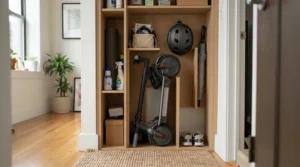
Here the headline is the 26-mile claimed range paired with a one-motion fold. The Hover-1 Journey Max packs a 900W dual brushless motor, 8.5-inch air-filled tires, and a 264-lb rider limit. It tops out at about 19 mph. Be clear on one thing: it’s a stand-up scooter, not a seated car. It earns its spot as the folding electric ride-on for adults pick.
Why that matters: 264 pounds is a generous ceiling, and dual motors usually mean steadier hill climbing than single-motor competitors at this price. The air-filled tires soak up cracks better than solid ones, though there’s no suspension. One reviewer on a major retail listing complained about that, plus a folding joint that loosened after a year of daily use. The listing itself shows roughly 4.4 stars across more than four thousand ratings.
Honest take: it’s the right answer if your priority is carrying it up stairs or tossing it in a trunk. It’s the wrong answer if you want to sit.
Pros:
- ✅ Folds quickly for trunks and closets
- ✅ High 264-lb rider limit
- ✅ Disc brake and dual motors for control
Cons:
- ❌ No suspension on rough pavement
- ❌ Fold joint may loosen with heavy use
Price range: mid-$200s to low-$300s. Verdict: excellent value for portability.
3. Razor Crazy Cart XL — the drift machine grown-ups actually fit in
The star feature is the drift bar. Lift it and the rear wheels slide into spins; drop it and you’ve got a conventional go-kart. The Razor Crazy Cart XL uses a 500W motor and a 36V pack (three 12V sealed lead-acid batteries). It does up to 14 mph for about 40 minutes and carries riders up to 240 pounds.
Fourteen miles per hour sounds slow until you’re rotating at it, three inches off the ground. The steel frame is the real adult upgrade over the original kids’ Crazy Cart. Owner reports mention it shrugs off hard knocks. One reviewer reported hitting speeds near 13 mph with a 220-lb rider and called the cart very tough. Another noted the pack lost power after roughly six months of constant use.
Space matters, though. Owners suggest you want at least a two-car-driveway’s worth of flat pavement to really enjoy it. It also weighs well over 100 pounds, so it isn’t a carry-it-up-the-stairs vehicle. This is where the storage and portability trade-offs start to bite.
Pros:
- ✅ Drift bar delivers a genuinely unique ride
- ✅ Tough steel frame for adult weight
- ✅ Foot-pedal throttle feels intuitive
Cons:
- ❌ Heavy and bulky to store or transport
- ❌ Lead-acid packs wear out over time
Price range: roughly $800–$1,100. Verdict: the best fun-per-dollar in this guide.
4. EISYROOD 2000W Electric Go Kart — mid-tier speed for backyards
The hook is raw power for the money. The EISYROOD 2000W Electric Go Kart advertises a 2000W brushless motor, up to 30 mph, a steel tubular frame, and hydraulic or rear disc braking. Depending on the tire option, dimensions run about 53 by 35 inches up to 56 by 40 inches.
What does 30 mph mean on a kart this size? A lot. Your seat sits inches off the ground, so speed feels doubled. That’s thrilling on private land and genuinely hazardous without a helmet. Based on the spec comparison, the brushless motor should need less maintenance than brushed alternatives, and the 8-inch-tire version should cope better with grass and gravel.
Here’s the catch: weight ratings vary across listings and roundups, with some claiming it supports adults above 190 pounds. Verify the exact capacity on the listing you buy. I also couldn’t verify a trustworthy review aggregate, so I’m not going to invent one. Buy from a seller with a clear return policy, because kart-class imports vary in quality control.
Pros:
- ✅ Brushless motor with serious claimed speed
- ✅ Steel frame suits taller riders
- ✅ Hydraulic or disc braking options
Cons:
- ❌ Rider limit varies by listing
- ❌ Brand support is harder to judge
Price range: check current price; this sits in the mid tier. Verdict: good power-per-dollar if you do your homework.
5. Segway Ninebot Gokart Kit — turn a scooter into a kart
The big idea is modularity. The Segway Ninebot Gokart Kit converts a compatible Ninebot S or S-Max into a sit-down kart, carrying up to 220 pounds. Paired with an S-series unit it hits about 15 mph (up to 23 mph with the S-Max, per retailer specs) and roughly 9 miles of typical range. The kit alone weighs about 61 pounds.
Why that matters: you’re not buying a dedicated vehicle, you’re buying a mode. If you already own a compatible Ninebot, this is the cheapest way into Segway-grade drive hardware. If you don’t, the math changes fast because the drive unit is the expensive part. The kit also includes a hand brake as redundancy for the electronic brake, which is a smart safety touch.
Honest caveat: compatibility is narrow (Ninebot S, S-Max, and certain S-Pro models), and some newer or older units aren’t supported. I found no review data worth citing for the kit itself.
Pros:
- ✅ Reuses hardware you may already own
- ✅ Hand brake backs up electronic braking
- ✅ Adjustable fit for 4’5″ to 6’3″ riders
Cons:
- ❌ Narrow scooter compatibility list
- ❌ Total cost jumps if you need a drive unit
Price range: around $1,000 for the kit only; bundles with a drive unit run noticeably higher. Verdict: smart if you already own the base.

6. Segway Ninebot Gokart Pro — collapsible, quick, and polished
The standout is the collapse-for-trunk design. The Segway Ninebot Gokart Pro pairs a rear-drive layout (about 40/60 front-to-rear weight) with four speed modes, topping out near 23 mph. Typical range is about 15.5 miles, payload is 220 pounds, and net weight is about 113 pounds.
Those four modes are the real feature. ECO limits you to about 5 mph, so a nervous first-timer can learn in a parking lot, and the top mode unlocks the full 23 mph. A frame that adjusts for riders from roughly 4’5″ to 6’3″ means household sharing works. It also climbs slopes up to about 15 percent, so don’t plan on steep hills.
Compared with the Razor Crazy Cart XL, this is faster, more refined, and far easier to haul. It costs roughly double. I couldn’t verify strong review aggregates, so judge it on the engineering and brand support.
Pros:
- ✅ Four speed modes grow with your skill
- ✅ Collapses to fit most vehicle trunks
- ✅ Engine-sound speakers add personality
Cons:
- ❌ Pricey compared with drift carts
- ❌ Limited ground clearance for rough terrain
Price range: roughly $1,700–$2,300. Verdict: the premium pick for trunk-friendly performance.
7. Zyliathor 72V 3000W — the 72V “are you sure?” option
The headline is brute force. The Zyliathor 72V 3000W advertises a peak output around 10.8 kW, shaft drive, dual rear hydraulic discs, 19×7-8 tires, and roughly 37 miles of range. Listing variants claim top speeds anywhere from 45 to 62 mph, so treat the highest number as a marketing ceiling. Some roundups cite a 600-lb load capacity, which would fit two adults. Verify that on your listing.
Why this matters: shaft drive removes the chain maintenance of cheaper karts, and hydraulic discs stop a fast machine far better than cable brakes. But speed is the point, and speed demands respect. A 45 mph kart a few inches off the ground is closer to a motorsport than a toy. Helmet, gloves, and private land aren’t optional.
Honest take: this is for experienced riders who already know their limits. Review aggregates for this brand are inconsistent across listings, so I’m not summarizing sentiment.
Pros:
- ✅ Shaft drive reduces chain upkeep
- ✅ Hydraulic discs suit high speeds
- ✅ Long claimed range for backyard days
Cons:
- ❌ Speed claims vary by listing
- ❌ Too much machine for beginners
Price range: upper tier; check current price. Verdict: premium power for riders who’ve earned it.
Top 7 Adult Ride-On Cars: Spec Comparison
| Model | Power / Battery | Range | Folds or Collapses? | Best For |
|---|---|---|---|---|
| Razor E300S | 24V seated | Modest | No | Casual seated riding |
| Hover-1 Journey Max | 900W dual brushless | Up to 26 mi | Yes, folds | Commuters and apartments |
| Razor Crazy Cart XL | 500W / 36V lead-acid | About 40 min | No | Drift fans |
| EISYROOD 2000W Electric Go Kart | 2000W brushless | Verify listing | No | Backyard speed |
| Segway Ninebot Gokart Kit | Uses Ninebot drive | About 9 mi | Extends/retracts | Scooter owners |
| Segway Ninebot Gokart Pro | 432 Wh pack | About 15.5 mi | Collapses | Trunk-hauling riders |
| Zyliathor 72V 3000W | 72V, ~10.8 kW peak | Claimed 37 mi | No | Experts only |
Looking at the comparison, range and portability pull in opposite directions. The Hover-1 Journey Max wins on both, but only because it isn’t a seated kart. Among true karts, the Segway Ninebot Gokart Pro is the only one that pairs decent range with a collapsible frame. If the Zyliathor 72V 3000W‘s claimed range holds up, it wins on pure distance but loses on portability. Match the column that matters most to your life, not the one with the biggest number.
How to Choose an Adult Ride-On Car
Choosing well is mostly about honesty regarding your space and your skill. Walk through these seven steps in order.
- Check your weight and height first. Add a 20-percent cushion to the rider limit, because manufacturers rate on ideal conditions. Exceeding limits cuts performance and speeds wear.
- Decide where you’ll ride. Pavement favors drift karts and Segway designs, while grass and gravel favor larger tires and ground clearance.
- Measure your storage. A cart over 100 pounds isn’t going upstairs, and you’ll feel that on day three.
- Pick a speed ceiling. Fifteen mph is plenty for beginners, and anything past 30 mph demands protective gear and private land.
- Compare battery chemistry. Lead-acid is cheaper and heavier, and lithium is lighter but demands careful charging.
- Look for independent safety certification. UL marks on the electrical system signal tested charging and battery behavior.
- Confirm warranty and support. A 90-day warranty is common, and anything shorter is a red flag.
Notice what’s missing: top speed as step one. Speed is the least useful spec for first-time buyers.
Price Tiers in the Adult Ride-On Market
Understanding price tiers in the adult ride-on market saves you from paying for features you won’t use. Think of it as four rungs.
| Tier | Typical Range | What You Get | Main Trade-Off |
|---|---|---|---|
| Entry | Around $230–$400 | Seated or folding scooters like the Razor E300S and Hover-1 Journey Max | Modest range, little suspension |
| Mid | Roughly $700–$1,200 | Drift carts and 2000W-class karts like the Razor Crazy Cart XL and EISYROOD 2000W Electric Go Kart | Weight, brand support varies |
| Upper-mid | Roughly $1,000–$2,300 | Segway kits and the Segway Ninebot Gokart Pro | Higher cost for portability |
| Premium | Upper range, up to the mid-$3,000s for top models | 72V power like the Zyliathor 72V 3000W | Safety and skill demands |
Here’s the pattern. Between entry and mid, you buy size and fun. Between mid and upper-mid, you buy engineering, portability, and software. Above that, you buy speed, and speed is the one thing that raises your risk instead of your comfort. For most adults, the sweet spot sits at the top of the mid tier. Going up the price tiers in the adult ride-on market only makes sense if you’ve outgrown the tier below it.
Budget Adult Electric Ride-On Vehicle: What You Actually Get
A budget adult electric ride-on vehicle is realistically a seated scooter or a folding stand-up, not a kart. Under about $400, you’re shopping models like the Razor E300S and Hover-1 Journey Max. That’s perfectly fine, as long as you know the trade-offs.
What you gain: low risk, easy storage, and a speed that won’t send you to urgent care. What you give up: suspension, long range, and the “wow” factor. Cheap lead-acid packs also fade faster than lithium, so a budget adult electric ride-on vehicle can feel great in month one and sluggish in month eighteen.
Here’s what to weigh before spending even a little. Does it carry your weight with a cushion? Is the battery replaceable? Is there a real warranty? Budget buyers often get burned by no-name imports with inflated wattage claims. A confirmed brand with a 90-day warranty beats a mystery 3000W listing at the same price.
My advice: treat the cheapest tier as an experiment. If you ride it twice a week for a month and want more, you’ve earned the upgrade. If you ride it twice and forget it, you saved real money.
Folding Electric Ride-On for Adults: Convenience vs. Comfort
A folding electric ride-on for adults answers one problem, which is space. The Hover-1 Journey Max shows the upside: a one-motion fold, 264-lb rating, and strong claimed range. Heavier mobility options like the Journey Adventure Scooter (a four-wheel travel scooter with a 300-lb capacity and about 12.4 miles of range) disassemble into five parts, with the heaviest around 33 pounds.
But folding has costs. Hinges are wear points, and one reviewer noted a fold joint loosening after about a year. Seated comfort also suffers, because a stand-up folder isn’t a seated kart. If you want to sit, look at disassembling scooters rather than flat-folding ones.
Questions to ask: How much does it weigh when folded, since lifting 35 pounds into a trunk differs from lifting 20? Does the latch feel tight or wobbly in reviews? Can you replace the folding clamp? A folding electric ride-on for adults earns its keep if you carry it weekly. If it lives in a garage, you’re paying for flexibility you won’t use.
Storage and Portability Trade-Offs
Every adult ride-on car sits somewhere on a spectrum between “fun to ride” and “fun to store.” The storage and portability trade-offs are bigger than most buyers expect.
At one end, a Razor Crazy Cart XL weighs well over 100 pounds, and at the other, a folding scooter fits a closet. In between, the Segway Ninebot Gokart Pro collapses for trunks, though at roughly 113 pounds you’ll still want a ramp or a second person. Honestly, weight is the hidden spec. Listings brag about wattage and hide the number you’ll feel every weekend.
Measure three things: your garage corner, your car trunk opening, and your lifting limit. Also think about charging. Lithium packs prefer cool, dry rooms, and leaving them in a hot car shortens their life. When you weigh the storage and portability trade-offs, a slightly slower, smaller machine often gets ridden twice as often.

Cost of Accessories and Upkeep
The sticker price is only the opening bid. The cost of accessories and upkeep can add 15 to 30 percent over the first year, depending on how hard you ride.
Budget for these:
- Safety gear: a certified helmet, gloves, and pads are non-negotiable on anything past 15 mph.
- Tires: drift tires on the Segway Ninebot Gokart Pro wear fast by design.
- Batteries: lead-acid packs on the Razor Crazy Cart XL are replaceable but add up over years.
- Charger and cables: only buy manufacturer-approved replacements.
Lithium care matters. Battery University’s guidance on prolonging lithium-based batteries notes that heat and sitting at full charge both age cells faster. In practical terms, don’t store a fully charged pack in a hot garage. Think of the cost of accessories and upkeep as part of the purchase, not an extra, and the bill stops feeling like a surprise.
Adult Ride-On Car vs. Alternatives
How does an adult ride-on car compare with the other ways to get your electric fix? Here’s the short version.
| Option | Strength | Weakness | Best For |
|---|---|---|---|
| Adult ride-on car (karts, seated ride-ons) | Fun, stable, low to the ground | Bulky, limited public use | Private-property thrills |
| Electric scooter | Portable, commuter-friendly | Stand-up fatigue | Short trips |
| Gas go-kart | Longer run time, raw power | Noise, fuel, maintenance | Open land, tinkerers |
| E-bike | Road-legal in most places | Higher price for quality | Daily transport |
In plain English, an adult ride-on car trades practicality for joy. A scooter beats it for commuting, while an e-bike beats it for errands. A gas kart wins on run time but loses on neighbors. If your goal is “have a blast on weekends,” the ride-on wins. If your goal is “replace my car,” look elsewhere.
Safety, Regulations, and Compliance Guide
Fun is only fun if you walk away. Start with the electrical system. Regulators have been blunt about it. The Consumer Product Safety Commission has urged manufacturers and retailers to meet voluntary safety standards, because lithium-ion thermal runaway is behind many deadly fires. Their advice: choose products certified by independent labs.
The rules are also moving. In June 2026, the CPSC published a proposed safety standard for lithium-ion batteries in micromobility products. As proposed, it would point to existing UL standards. It’s a proposal, not final law, so don’t treat it as settled. Not every kart is covered either, since some fall under motor-vehicle authority and some use lead-acid packs.
Practical checklist: look for UL certification on the electrical system, never charge unattended, and use only the charger that came with it. Wear a helmet. Check local rules too, because most karts are for private property, not streets.
Practical Usage Guide: Setup and Your First 30 Days
The first month decides whether your adult ride-on car becomes a favorite or a garage ornament. Treat it like a new car: break it in deliberately.
Day 1: Charge before you ride. Many manufacturers recommend an initial full charge of about 8 to 12 hours. Read the manual twice, because the first read is for the steps and the second is for the warnings.
Week 1: Learn in the slowest mode. On a Segway Ninebot Gokart Pro, that’s ECO at about 5 mph. On a Razor Crazy Cart XL, keep the drift bar down until braking feels automatic.
Weeks 2–3: Check the basics weekly. Look at tire pressure or wear, loose bolts, and cable condition. Wipe off grit before it works into joints.
Week 4: Test your range honestly. Ride a real route, note the distance at 50 percent battery, and plan future rides around that number rather than the brochure.
Common first-month mistakes: charging immediately after a hot ride, riding on wet pavement with weak brakes, and ignoring a wobbly steering link. Fix small things early, because small things become expensive things.
Real-World Scenarios: Which Adult Ride-On Car Fits You?
Numbers are abstract. People aren’t. Here are three profiles matched to models, with reasoning.
The apartment commuter. Imagine someone living on the third floor with a 2-mile campus commute, no garage, and a budget under $400. The Hover-1 Journey Max fits: it folds, carries up to 264 pounds, and fits under a desk. A seated kart would be a nightmare on those stairs.
The suburban weekend driver. Picture a homeowner with a two-car driveway, a teen who wants to share, and about $1,000 to spend. The Razor Crazy Cart XL suits this household: it’s tough, endlessly entertaining, and fits a garage corner. The trade-off is weight, which makes it a stay-home toy.
The traveling enthusiast. Now consider someone who hauls gear to a friend’s lot every few weekends and has roughly $2,000. The Segway Ninebot Gokart Pro collapses into a trunk and offers adjustable speed modes for mixed skill levels. If they already own a Ninebot, the Segway Ninebot Gokart Kit may do the same job for less.
Each profile pairs frequency, space, and budget with a model. Start with your own three answers.
✨ Don’t Miss These Exclusive Deals!
🔍 Take your weekend fun to the next level with these carefully selected rides. Click on any highlighted product name to check current pricing and availability. These machines will help you create the kind of memorable, grin-inducing afternoons your whole family will love!
FAQ
❓ Can I ride an adult ride-on car on public roads?
❓ How long does an adult ride-on car battery last before replacement?
❓ What's the difference between a drift kart and a standard electric go-kart?
❓ Is a folding electric ride-on for adults safe to charge indoors?
❓ How much should I budget for gear and maintenance each year?
Conclusion
An adult ride-on car isn’t one product, it’s a ladder. At the bottom, the Razor E300S and Hover-1 Journey Max give you low-risk fun and easy storage. In the middle, the Razor Crazy Cart XL delivers the best smile-per-dollar, and the EISYROOD 2000W Electric Go Kart offers claimed speed if you vet the listing carefully. Higher up, the Segway Ninebot Gokart Kit and Segway Ninebot Gokart Pro sell polish and portability, and the Zyliathor 72V 3000W sells raw power to people who’ve earned it.
The honest recap: match the machine to your space first, your skill second, and your budget third. Remember the five pressure points: budget adult electric ride-on vehicle limits, the appeal of a folding electric ride-on for adults, the shape of price tiers in the adult ride-on market, the storage and portability trade-offs, and the cost of accessories and upkeep. Buy for the life you actually have, wear the helmet, and charge like you mean it.
Recommended for You
- Off-Road Electric Vehicle For Adults: 7 Proven Picks (2026)
- Adult Electric Go-Kart Vs Mini Bike: 7 Best Picks (2026)
- Electric Scooter Alternative Ride-On For Teens: 7 Proven Picks 2026
Disclaimer: This article contains affiliate links. As an Amazon Associate, I earn from qualifying purchases. If you purchase products through these links, we may earn a small commission at no additional cost to you.
✨ Found this helpful? Share it with your friends! 💬🤗
