
In This Article
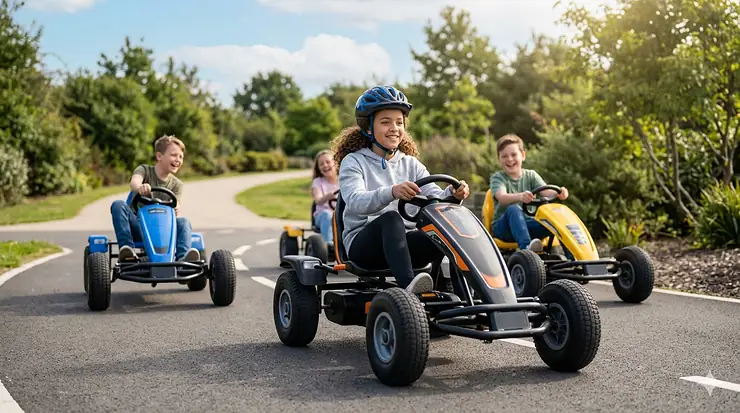
Here’s a problem every parent hits at some point: your kid turns eight, nine, ten — and suddenly the battery-powered Jeep from three birthdays ago is an embarrassment. They want something with real speed, real drift, real feel. They want to be impressed by their own toy, not just tolerated by it.
That’s exactly where ride on toys for older kids step in — and the good news is, this category has exploded. We’re talking electric go-karts that drift sideways through your driveway, dirt bikes that chew through gravel with purpose, and licensed speed machines wearing the McLaren badge. These are not the wobbly, 3-mph push-mobiles of early childhood. These are mature kid vehicles with dual motors, adjustable frames, and enough torque to produce genuine, squeal-worthy fun.
But here’s what the product pages won’t tell you: not every “8+” label actually delivers an experience built for older kids. Some are dressed-up toddler toys with higher weight limits. Others are genuinely excellent. Knowing the difference takes more than scanning bullet points — it takes understanding what an 8-to-12-year-old actually needs from an advanced ride-on: speed that respects their developmental confidence, controls they can actually master, and a frame that doesn’t make a 90-pound kid feel like they’re riding a clown car.
I’ve dug deep into the current Amazon catalog to find seven real products — with real specs and real customer feedback — that genuinely deliver for big kids. Whether you’re looking for ride on toys for big kids 10+ who want serious speed, or an 8-year-old taking their first confident spin on something electric, this guide cuts through the noise. Let’s get into it.
Quick Comparison: Top 7 Ride On Toys for Older Kids at a Glance
| Product | Motor | Max Speed | Age Range | Weight Limit | Best For |
|---|---|---|---|---|---|
| Razor Crazy Cart | 250W | 12 mph | 9+ | 140 lbs | Drifting & tricks |
| Razor MX350 Dirt Rocket | 24V chain-driven | 14 mph | 8+ | 140 lbs | Off-road adventures |
| First Ride On McLaren Go Kart | Dual 250W, 36V | ~15 mph | 6–12 | ~120 lbs | Licensed premium fun |
| 350W 16 MPH Drift Go Kart | 350W | 16 mph | 8–12 | 187 lbs | High speed & big kids |
| Hikole Electric Go Kart | 300W, 24V | 8.5 mph | 6–12 | 110 lbs | Growing kids, safety-focused |
| MUKIDY 24V Kid Go Kart | 2×150W, 24V | 8.1 mph | 6–12 | 110 lbs | Budget starter pick |
| Nasitip 24V Dual 300W Go Kart | 2×300W, 24V | 8.1 mph | 6+ | 155 lbs | Mid-range all-rounder |
Reading between the lines here: Speed and motor wattage don’t tell the full story. The Razor Crazy Cart tops this list for experience despite sitting mid-pack on raw speed, because the Drift Bar transforms what “going fast” even means. Conversely, the 350W 16 MPH model is the fastest thing on this list but requires a child confident enough to handle it responsibly. Budget buyers should note that the MUKIDY and Hikole models sacrifice motor headroom for affordability — fine for beginners, limiting for kids who’ll outgrow “careful mode” in six months.
💬 Just one click — help others make better buying decisions too! 😊
✨ Don’t Miss These Exclusive Deals!
🔍 Take your kid’s outdoor fun to the next level with these hand-picked ride-ons. Click any highlighted product name to check current pricing and availability on Amazon. These picks will have your child outside and off the couch — and that’s a win for everyone! 😊
Top 7 Ride On Toys for Older Kids — Expert Analysis
1. Razor Crazy Cart — The Original Drifting Machine
The Razor Crazy Cart isn’t a go-kart that happens to drift. It’s a drifting machine that happens to be shaped like a go-kart. That distinction matters enormously.
At its core, it runs a high-torque 250W chain-driven motor powered by a 24-volt dual battery system, reaching speeds of up to 12 mph with 40 minutes of continuous run time. What makes it genuinely special for older children is the patented Drift Bar — a lever that switches between standard go-kart mode and full Crazy Cart mode, letting the rear casters spin independently. The result? Controlled sideways chaos: forward, backward, diagonal, spinning-in-place. A concrete driveway becomes a drift circuit.
In my experience, this is the product that makes a 10-year-old forget their phone exists for two solid hours. The powder-coated steel frame, pneumatic front tire, and bucket seat are built to absorb the kind of punishment that comes with a kid discovering physics for the first time. The foot-pedal variable-speed system is intuitive, and the 140 lb weight limit means it comfortably covers the full 8–12+ age range.
Customers consistently rave about the drifting mechanics, with one parent calling it “the first outdoor toy in years that my 11-year-old actually asked to go outside for.” The only real complaint? The sealed lead-acid batteries add significant weight, and recharge time runs 8–12 hours.
✅ Best-in-class drifting experience
✅ 40-minute run time on a charge
✅ Steel frame with real build quality
❌ Heavy to move around (not lightweight)
❌ Long recharge window
Price range: around $270–$330 | Verdict: The benchmark advanced ride-on for kids who want control over chaos. Worth every dollar.
2. Razor MX350 Dirt Rocket — Built for the Kid Who Thinks Sidewalks Are Boring
The Razor MX350 Dirt Rocket is the one when your child has decided that paved surfaces are beneath them. Designed for ages 8 and up, this scaled-down electric motocross bike runs a 24V chain-driven system topping out at 14 mph — fast enough to feel genuinely thrilling but governed enough for responsible parents to sleep at night.
What most buyers overlook about this model is the tire spec: 12-inch pneumatic knobby tires. Those aren’t decorative. They grip dirt, soft terrain, and muddy patches the way a smooth plastic wheel simply cannot. The twist-grip throttle mirrors a real motorcycle’s feel, which means kids aren’t just riding a toy — they’re learning fine motor throttle control. Razor keeps the geometry authentic: the frame geometry, riding posture, and control layout mirror real youth motocross bikes far more than competing electric models do.
At 140 lbs max weight and 30 minutes of ride time at full speed, it’s designed for the serious adventurer, not the casual once-a-week rider. It handles grass transitions with ease, and Razor’s brand reputation means parts and support are genuinely available — something lesser-known brands can’t promise.
Customers report their kids cycling back inside only to charge it, then immediately heading back out. A common note: it runs quiet enough for neighborhood use without drama.
✅ Real off-road knobby tires — not a smooth-surface-only machine
✅ Authentic motocross riding posture builds real skills
✅ Razor’s established brand support network
❌ 30-minute run time feels short once kids are hooked
❌ Not great for concrete-only environments
Price range: around $280–$320 | Verdict: The top pick for outdoor, terrain-hungry kids. The tire quality alone separates this from the competition.
3. First Ride On Licensed McLaren Electric Go Kart — When the Badge Actually Means Something
Slapping a licensed logo on a go-kart is easy. Engineering one that actually justifies the McLaren name requires more — and this model makes a reasonable case for itself.
Dual 250W motors backed by a 36V 9Ah battery deliver a noticeably punchier ride than the common 24V setups at this price point. The 36V architecture means better low-end torque — that initial surge when a kid plants the throttle feels snappier and more satisfying than comparable 24V machines. The adjustable frame (three positions spanning roughly 5.9 inches) is a genuine feature, not a marketing afterthought; it physically extends the wheelbase to accommodate growth, which matters for a product you’d like to survive more than one birthday.
The electronic braking system and responsive steering make drifting controlled rather than terrifying, and the TPR front tires pair with PA nylon rear tires for balanced paved-surface performance. Built around a sturdy steel frame with an adjustable seatbelt, it’s thoughtfully engineered for the parent who cares as much about durability as their kid cares about the logo on the nose cone.
Parents praise the realistic aesthetic and note that it draws neighborhood attention in the best possible way. The primary critique involves setup time — expect 45–60 minutes of assembly.
✅ 36V system delivers noticeably more punch than 24V alternatives
✅ Adjustable frame genuinely grows with the child
✅ Premium McLaren aesthetic that kids actually care about
❌ Assembly takes patience
❌ Nylon rear tires limit off-road capability
Price range: around $380–$460 | Verdict: The premium pick for families who want performance AND presence. The 36V spec justifies the price over cheaper 24V rivals.
4. Electric Go Kart 350W 16 MPH with Length Adjustment — Fastest on This List, and It Shows
Here’s where we separate the speed-tolerant parents from the rest. 16 mph in a go-kart for a kid is fast. Not “feels fast” — actually fast. The single 350W motor powering this machine makes it the highest-speed option on this entire list, and it pairs that with an adjustable length (four positions from 32″ to 44″), a 187 lb weight limit, and a 14.3-inch wide seat that comfortably accommodates older, larger children who’ve aged out of smaller frames.
What I’d tell any buyer: the three-speed switch (high/medium/low) is not a gimmick here — it’s essential. Start your kid on low. Let them earn medium. High is genuinely reserved for the confident, experienced rider. The dual EVA front tires and nylon rear tires produce strong drifting capability, and the slow-start function prevents the kind of launch surprises that end rides early.
The steel frame adds reassuring rigidity, and at a maximum load of 187 lbs, this is one of the few go-karts on this list that won’t become age-limited by year two. For bigger kids 10+ who’ve been frustrated by lower-spec machines, this is the serious upgrade.
Customer reviews highlight the speed as the standout feature — kids love it, and parents advise firmly establishing low-speed-only zones for first sessions.
✅ Fastest option on the list at 16 mph
✅ 187 lb weight limit accommodates bigger, older kids
✅ Four-level adjustable length extends usable life
❌ High speed demands strong parental supervision early on
❌ Not recommended as a first ride-on for beginners
Price range: around $220–$290 | Verdict: The best option for confident older kids who’ve outgrown “casual” speeds. Start on low mode, always.
5. Hikole Electric Go Kart for Kids — The One Built to Grow With Them
If there’s a single product on this list designed with parental anxiety in mind, it’s the Hikole. And that’s a compliment — because anxiety about electric vehicles for kids is entirely reasonable, and Hikole systematically addresses it.
The 24V 300W motor reaches 8.5 mph — not the fastest on this list, but the three-speed mode means parents can start children on a genuinely slow setting and graduate them upward with confidence. The three-stage adjustable seat (20.75″ to 26.5″) is the standout spec: it physically grows with the child, covering ages 6 through 12 in a single product. The 3-point seatbelt, reinforced steel frame, emergency brake, four EVA tires, and low center of gravity designed to prevent rollover during sharp turns add up to a safety profile that’s noticeably more comprehensive than most competitors.
The dual-pedal system (accelerator and brake as independent pedals) is worth singling out. Most budget go-karts rely on foot pedal and steering only. Independent brake pedal control teaches real driving intuition — a skill that has legitimate carryover value as kids grow. The built-in speaker, music playback, and realistic engine sounds are bonuses that 8-year-olds absolutely care about.
Customers consistently describe easy assembly and praise the safety features. Common feedback: it’s better suited for younger kids in the 8–10 range than true tweens.
✅ 3-stage seat adjustment grows with the child
✅ Independent accelerator and brake pedals — real driving mechanics
✅ Comprehensive safety design: belt, emergency brake, low COG
❌ 110 lb weight limit may feel limiting for bigger 10–12-year-olds
❌ 8.5 mph ceiling will frustrate speed-seeking older kids
Price range: around $180–$250 | Verdict: The smart long-term purchase for parents who want one vehicle to carry a child from ages 6 to 12 safely.
6. MUKIDY 24V Kid Go Kart — The Budget Entry Point That Doesn’t Embarrass Itself
Let’s be real: $400+ go-karts aren’t in every household’s budget, and not every kid needs the top-tier option. The MUKIDY does something valuable — it delivers an honest, functional electric go-kart experience without fictional promises.
The 24V system with dual 150W motors (300W combined) tops out around 8.1 mph across two speed settings (3.1–8.1 mph). The 7Ah battery provides 1–2 hours of run time, which is genuinely generous at this price point and actually longer than some pricier competitors. Four PVC rubber wheels handle smooth pavement competently, and the seatbelt plus slow-start function cover the basics of child safety.
What you’re giving up at this price: the weight limit sits at 110 lbs, the frame isn’t adjustable, and the 150W motors will feel noticeably less punchy than the 300W dual-motor setups on pricier options. For an 8–9-year-old new to electric ride-ons, that gap is largely invisible. For a 12-year-old who’s been riding for three years? They’ll feel the ceiling almost immediately.
Customers generally describe it as excellent value for the price, with particular praise for the run time and simple setup. The consensus: great starter, not a long-term investment.
✅ 1–2 hour battery run time stands out at this price tier
✅ Simple, approachable controls for beginners
✅ Good honest value — does what it claims
❌ 110 lb weight limit and non-adjustable frame limit longevity
❌ Motor power won’t satisfy experienced young riders
Price range: around $140–$195 | Verdict: The right call for parents testing the waters with electric ride-ons before committing to a premium model.
7. Nasitip 24V Dual 300W Go Kart — The Mid-Range Sweet Spot
The Nasitip sits in that productive middle ground where the specs are genuinely impressive but the price hasn’t crossed into “birthday splurge” territory. Dual 300W brushless motors (600W combined) push the kart to 8.1 mph, with high/low speed switching giving parents meaningful control over the experience. The 24V 9Ah battery is one of the larger capacity options in this segment, translating to sustained performance rather than gradually degrading speed as charge drops.
The 155 lb weight limit outclasses most budget competitors and keeps this option relevant for kids well into their 10–12-year range. EVA front tires handle shock absorption, while the nylon rear tires deliver the drift behavior older kids want. The seat width (14.3 inches) is generous — actually wide enough for most adult-sized tweens to sit comfortably without feeling squeezed.
What most buyers overlook about this model: the brushless motor spec. Brushless motors run cooler, last longer, and deliver more consistent power output than brushed alternatives at this price tier. Over 18 months of regular use, that durability difference becomes significant. Nasitip has focused on making a motor that holds up, not just one that sounds impressive in a listing.
Customer feedback highlights the authentic go-kart feel and praises the drifting performance on smooth driveways. A few reviews flag assembly taking 45–60 minutes.
✅ Brushless dual motors — longer lifespan than brushed alternatives
✅ 155 lb weight limit suits bigger kids in the 10–12 range
✅ Strong mid-range value for the spec sheet
❌ 8.1 mph top speed won’t thrill speed-hungry older kids
❌ Assembly requires patience and proper tool setup
Price range: around $200–$265 | Verdict: The most defensible mid-range choice — better durability engineering than most in this price bracket.
How to Set Up and Maximize Your Kid’s New Electric Ride-On (First 30 Days)
Getting the machine is step one. Getting it set up correctly — and building riding skills systematically — is what separates a toy that lasts two years from one that sits in the garage by March.
First charge matters more than you think. Every lithium and sealed lead-acid battery in this category benefits from a complete initial charge before first use. Ignore the “80% charged on delivery” assumption. Plug in for the full recommended duration (8–12 hours for most models here) to establish proper battery cell conditioning. Skipping this genuinely shortens long-term battery life.
Start on the lowest speed setting. Every kart on this list includes speed modes. Use the lowest. Let your child figure out the steering radius, throttle sensitivity, and brake response in a controlled environment before unlocking higher speeds. Two or three sessions in low mode before advancing is the right progression — it builds real handling confidence rather than adrenaline-dependent reflexes.
Set a clear riding surface for the first week. Flat concrete or a smooth driveway is ideal. Avoid wet surfaces, grass, and gravel until your child is comfortable with the controls. Some parents mark out a simple circuit with sidewalk chalk — even a basic oval teaches entry speed, turn radius management, and braking points.
Maintenance after every 5–10 hours of use: Check tire inflation (for pneumatic models), wipe down the frame to prevent corrosion, and inspect the seat belt clip for debris. Inspect the battery terminals for corrosion quarterly. EVA tires don’t need inflation — but do check for cracking if the kart is stored outside.
Storage tip: Never store a fully discharged battery. Charge to approximately 50–60% if storing for longer than two weeks. Dead-cell battery replacement is the most common repair this category generates — and it’s entirely avoidable.
Real-World Scenarios: Which Ride-On Fits Your Family?
Not every child — or family — needs the same thing. Here’s how I’d match these products to specific situations.
The “My kid lives outside” family: You’re looking at the Razor MX350 Dirt Rocket. If your backyard includes grass, gravel, or any terrain variation at all, the pneumatic knobby tires on the MX350 are the deciding factor. Every smooth-wheel go-kart here will bog down on grass. The MX350 won’t. Pair it with a quality helmet and knee pads, set a circuit on your property, and prepare for requests to extend riding time every single session.
The “My driveway IS the track” family: The Razor Crazy Cart. Flat concrete, smooth pavement, and a family that values technique over terrain. The Drift Bar gives a paved driveway more replay value than any other product on this list — the learning curve is genuine, and the skill ceiling is high enough that your 10-year-old can still be improving their drift technique at 13.
The “We want something that lasts several years” family: Hikole’s three-stage adjustable seat and the McLaren’s adjustable frame both offer genuine longevity. If your child is 8 now and you want one product to carry them to 12, the Hikole is the safer bet below $250. The McLaren’s 36V performance makes it worth the premium if budget allows.
The “This is our first electric vehicle” family: MUKIDY. Simple, honest, forgiving. Let your child build confidence and interest before investing in a higher-spec option. Many parents report buying the budget option first, then upgrading 18 months later — which is actually a sensible approach when you’re not sure how serious the interest will be.
The “My kid is bigger and faster than most” family: The 350W 16 MPH model. If your 11-year-old has already maxed out two previous ride-ons and needs something with genuine speed headroom, this is the honest recommendation. Supervise the first several sessions closely, and enforce the low-speed learning period regardless of how much pushback you get.
How to Choose Ride On Toys for Older Kids: 6 Criteria That Actually Matter
1. Match the motor to the child’s experience level
A 300W+ motor in the hands of a child who’s never operated an electric vehicle is a recipe for a quick crash and a shelved toy. Match the wattage to your child’s demonstrated confidence, not just their age.
2. Weight limit ≠ max rider weight
Treat the stated weight limit as the realistic upper bound, not the design sweet spot. A 110 lb kart carrying a 108 lb child is operating at the edge of its design parameters. Choose a model where your child’s weight sits at 60–75% of the limit for optimal performance and longevity.
3. Adjustable frames cost more and are worth it
A fixed-frame go-kart for an 8-year-old will feel cramped by 10. Adjustable-length and adjustable-seat models cost 15–25% more but extend the useful life by 2–3 years. On a per-year basis, they’re almost always the better value.
4. Battery chemistry and capacity outlast motor specs in long-term satisfaction
The motor number sounds impressive in the listing. The battery capacity determines how long the fun lasts. Prioritize 9Ah over 7Ah, and check charging time — 8–12 hours is standard, but some budget models require a full overnight charge for only 45 minutes of use.
5. Tire type determines terrain, full stop
EVA and nylon tires: smooth pavement only. Pneumatic knobby: grass, dirt, gravel, pavement. If your child will ride anywhere other than a driveway, pneumatic tires aren’t optional — they’re the purchase decision.
6. Safety certifications matter for peace of mind
Look for CPSC compliance and ASTM F963 adherence. These aren’t bureaucratic checkboxes — the U.S. Consumer Product Safety Commission’s toy safety standards mandate third-party lab testing specifically designed to catch the hazards that matter most in electric ride-on vehicles. Products from established brands like Razor carry these certifications as a baseline.
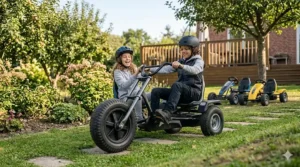
Common Mistakes When Buying Advanced Ride-Ons for Big Kids
Mistake #1: Buying the “fastest” option as a first purchase. Speed is addictive in toy marketing copy. But a child’s first experience with an electric go-kart should build control skills, not maximum velocity tolerance. Start conservative. The speed ceiling can always be unlocked later.
Mistake #2: Ignoring the terrain at home. It seems obvious, but thousands of parents buy smooth-tire go-karts for homes with grass yards. Check your actual riding environment before committing to a tire type.
Mistake #3: Treating the weight limit as aspirational. It isn’t. The frame, motor, and battery are all sized to the stated limit. Operating consistently at or near the maximum degrades every component faster than normal use.
Mistake #4: Skipping safety gear because “it’s just a toy.” At 12–16 mph on a hard surface, a spill without a helmet is an ER visit. The CPSC recommends certified helmets for all riding toys, and knee/elbow pads eliminate the scrapes that otherwise end ride sessions prematurely.
Mistake #5: Purchasing based on looks alone. Licensed vehicles (McLaren, Lamborghini, Mercedes branding) command premium prices. Some of them back the badge with real engineering. Others are standard hardware wearing a famous name. Check the motor wattage, battery capacity, and frame material before the aesthetics.
Mistake #6: Underestimating assembly time. Most of these products arrive 70–80% assembled. The remaining 20% takes 30–90 minutes. Plan accordingly — launching a Christmas morning only to spend two hours with an Allen wrench while an excited child hovers is a preventable disappointment.
Features That Actually Matter (And the Ones That Don’t)
🏁 Features that genuinely improve the experience:
- Adjustable frame/seat length — extends product life significantly
- Variable speed modes — enables safe skill progression
- Brushless motors over brushed — noticeably longer motor lifespan
- Pneumatic tires on the front — even one pneumatic tire meaningfully smooths rough surface riding
- Independent brake pedal — teaches real vehicle intuition
📦 Features that are mostly marketing:
- Bluetooth speaker quality — every go-kart speaker sounds roughly the same: mediocre
- LED lighting — genuinely fun for the first week, then largely ignored
- “Realistic engine sounds” — charming for five minutes; kids care about actual performance far more
- Color options beyond two or three — rarely influences satisfaction after the first ride
Safety, Standards, and What Parents Need to Know
Ride on toys for big kids operate at genuine speeds on real surfaces. That warrants treating them with the same safety mindset as a bicycle or skateboard — not a toy car for a four-year-old.
The standard governing children’s toys in the U.S. is ASTM F963, a mandatory safety specification enforced by the CPSC and applicable to all toys designed for children under 14. For electric ride-ons, this covers electrical safety, structural integrity, and proper age grading. Any product sold through major platforms like Amazon should comply — and most products from recognizable brands do.
At the household level, practical safety means:
- Helmet, every ride. A CPSC-certified bicycle helmet is the minimum. A full-face helmet is appropriate for anything above 10 mph.
- Closed-toe shoes, always. Sandals and go-karts are an injury waiting to happen.
- Designate a riding zone. Driveways bordering active streets need a clear boundary system — a physical barrier, a marked stop line, or a direct supervision rule.
- No riding after dark without lights and supervision. Most of these vehicles lack adequate lighting for low-visibility conditions.
- Seatbelt means buckled. Not optional, not “just for the first ride.” Every ride.
The American Academy of Pediatrics consistently recommends that parents supervise ride-on vehicle use and ensure riding surfaces are away from vehicle traffic — particularly relevant for kids who want to take their go-kart further than the driveway.
FAQ — Ride On Toys for Older Kids
❓ What age is appropriate for electric go-karts and advanced ride-on toys for big kids 10+?
❓ How long do batteries last on ride on toys for big kids 8-12, and how should I maintain them?
❓ What is the weight limit for ride on toys for older kids, and why does it matter?
❓ Can mature kid vehicles handle surfaces other than pavement, like grass or gravel?
❓ Are ride on toys for older kids safe, and what safety gear do kids need?
Conclusion
The world of ride on toys for older kids has genuinely matured — in the best possible way. What was once a market crowded with repackaged toddler vehicles has become a legitimate space for advanced ride-ons that deliver real speed, real engineering, and real outdoor experience for kids who’ve aged past “gentle” fun.
The Razor Crazy Cart remains the experience king — nothing delivers the same kind of grinning, skill-building chaos on a driveway. The MX350 is the pick for kids who want terrain, not just pavement. The McLaren commands its premium with a 36V system that punches above its price class. And the 350W 16 MPH model is simply the honest answer when a bigger, older kid needs genuine speed headroom.
For families shopping on a tighter budget, the MUKIDY and Hikole options prove that “affordable” doesn’t have to mean “disappointing.” Match the product to the child, not the marketing pitch.
One final thought: the best ride on toy for big kids isn’t necessarily the most powerful one on this list. It’s the one that matches your child’s current confidence level while leaving room to grow. Buy for skill progression, not just top specs, and you’ll land on a product that earns its shelf space for years rather than weeks.
✨ Ready to Pick the Perfect Ride-On?
🔍 Click any product highlighted in this guide to check current pricing and availability on Amazon. These ride-ons are flying off shelves — don’t wait too long to grab your top pick! 🚀🏁
Recommended for You
- 7 Best Ride On Toys for Big Kids: Ultimate 2026
- 7 Best Ride On Toys for 12 Year Olds – 2026
- Best Ride On Toys for 10 Year Olds – Top 7 Picks 2026
Disclaimer: This article contains affiliate links. As an Amazon Associate, I earn from qualifying purchases. If you purchase products through these links, we may earn a small commission at no additional cost to you.
✨ Found this helpful? Share it with your friends! 💬🤗
