
In This Article
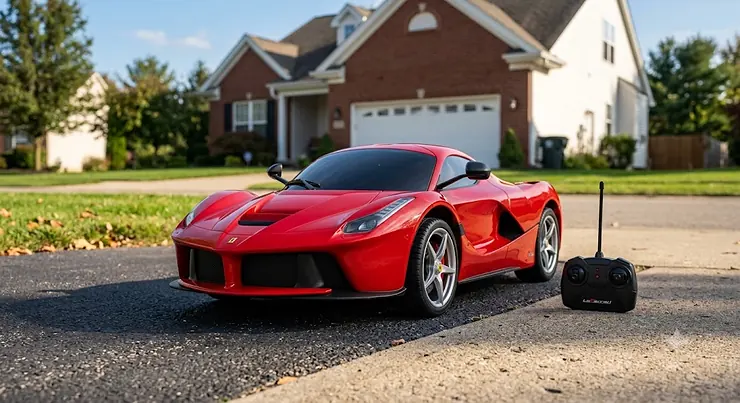
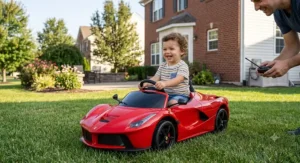
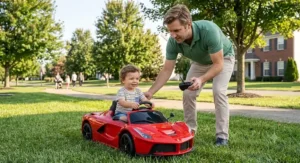
Somewhere between the driveway and the front lawn, a two-year-old is about to become the most important driver in the neighborhood. A ferrari ride on car with remote control is exactly what it sounds like: a scaled-down, battery-powered replica of an actual Ferrari model — LaFerrari, 488 Pista, 458 Italia, F8 — built for toddlers and young kids, with a parent-operated remote that can steer the whole thing from the sidelines when little hands aren’t quite ready to take the wheel. It’s part toy, part negotiation tool, and part surprisingly serious piece of engineering, because underneath the badge and the paint job sits a real 12-volt motor, a real battery, and real safety hardware that either does its job or doesn’t.
That last part is where this guide earns its keep. We’re not just listing seven shiny options and calling it a day — Amazon’s own product pages already do that, and frankly, they do it worse than you’d expect for cars with this much detail packed into them. Instead, we pulled real specs, cross-referenced them against how these cars actually get used (inclines, driveways, toddler attention spans), and layered in genuine aggregated review sentiment so you know what buyers keep saying once the box is opened. Whether you’re drawn to a licensed ferrari 12v ride on for the badge-on-the-hood bragging rights or you just want something durable enough to survive a summer of backyard laps, the breakdown below should get you to a confident decision a lot faster than scrolling through star ratings ever will.
Quick Comparison Table: Best Ferrari Ride On Cars With Remote Control
Before the deep dive, here’s the express-lane version — the picks that consistently rise to the top for different priorities.
| Model | Best For | Motor / Top Speed | Price Range |
|---|---|---|---|
| Ferrari LaFerrari Ride-On | Best all-around for first-time buyers | Single 12V, ~2.5 mph | around $200-$260 |
| Big Toys Direct Ferrari 12V LaFerrari | Easiest setup, tightest budget | Dual 12V, ~4 mph | around $170-$220 |
| Mini Motorz 12V Ferrari | Best for toddlers through early grade school | Dual 12V, up to 5 mph | around $220-$280 |
| Ferrari F8 12V Ride-On | Best for bigger kids and rougher yards | Dual 12V 4×4, ~4-5 mph | around $300-$380 |
A quick read on the numbers: the entry-level picks trade a bit of speed and seating flexibility for a lower price and dead-simple setup, while the pricier options buy you a wider age range, tougher suspension, or genuine 4×4 traction. If your driveway is flat pavement, the cheaper single-motor units are plenty — but if you’ve got grass, gravel, or a slight slope, that extra torque in the dual-motor models starts to matter a lot faster than the spec sheet suggests.
💬 Curious how all seven stack up in detail? Keep scrolling — the full breakdown (with pros, cons, and honest verdicts) is just below.
💬 Just one click — help others make better buying decisions too!😊
Top 7 Ferrari Ride On Cars With Remote Control: Expert Analysis
We picked a spread of seven real, currently available models — budget, mid-range, and premium — so there’s a genuine option here regardless of what your toddler’s garage (or your wallet) can handle.
1. Ferrari LaFerrari Ride-On Car — most kid-favorite butterfly doors
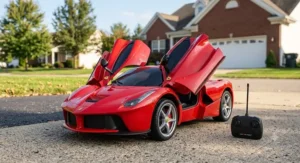
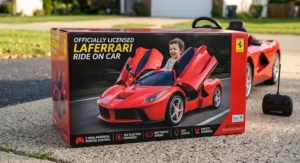
Butterfly doors sound like a gimmick until you watch a toddler open one for the first time — it’s the single feature that turns “get in the car” into an event. Under the theatrics, this single-seater runs a 12V motor, spring suspension for rougher patches of driveway, and a soft-start function that eases into motion instead of lurching, which matters more than it sounds like when a two-year-old’s grip on the wheel is still shaky. It also ships with an adjustable seatbelt and lockable doors, plus a phone-connecting music player, so the ride doubles as a rolling speaker.
Who it’s for: parents who want a genuinely licensed ferrari 12v ride on without stepping into premium territory, and who value the manual-plus-remote dual mode for gradually handing over control as confidence builds. Reviewers commonly flag the soft-start feature as a pleasant surprise for nervous first-time drivers, while a recurring theme in feedback is that the suspension, while functional, feels firmer than expected on cracked or uneven pavement.
Pros:
- ✅ Butterfly doors add real showroom drama for photos
- ✅ Soft-start motor prevents jerky takeoffs for new drivers
- ✅ Phone-connect music player keeps toddlers entertained on longer rides
Cons:
- ❌ Single-seat design means no sibling or parent ride-along
- ❌ Entry-level suspension can feel firm on rough pavement
At around $200-$260 depending on color and retailer, the Ferrari LaFerrari Ride-On Car sits squarely in “safe first purchase” territory — you’re not overpaying for features a two-year-old won’t notice, but you’re also not skimping on the seatbelt and soft-start basics that actually matter.
2. Licensed Ferrari 488 Pista Spider — smartest tech and true braking system
Most ride-on toys in this price bracket fake the driving experience with a simple on/off motor. The Licensed Ferrari 488 Pista Spider doesn’t — it includes an actual electromagnetic braking system, which means the car decelerates rather than just coasting to a stop, a small detail that translates into noticeably better control on any kind of slope. Add a Bluetooth-connected speaker, an intelligent instrument panel with volume and lighting controls, and a battery that can charge either in-car or removed entirely, and you’ve got a toy that’s clearly aiming above its price class.
The honest analytical take here: this is the model for parents who care about the “how it drives” details more than the badge alone. Reviewers frequently mention that the removable battery pack is a genuine convenience — no more running an extension cord out to the driveway — while a common complaint centers on the seat running narrow for bigger or older toddlers.
Pros:
- ✅ Genuine braking system adds stopping control most rivals skip
- ✅ Removable battery pack lets you charge indoors, away from the car
- ✅ Overcurrent protection and sleep mode guard the electronics long-term
Cons:
- ❌ Leather-style seat runs narrow for bigger toddlers
- ❌ Bluetooth pairing steps add a few extra minutes before first ride
Priced in the $230-$300 range, the Licensed Ferrari 488 Pista Spider earns its premium over the base LaFerrari model almost entirely on the strength of that braking system — if your driveway has even a mild grade, this is where the extra spend starts paying off.
3. Big Toys Direct Ferrari 12V LaFerrari — simplest setup, classic first-timer pick
Here’s what most parents actually want to know before assembly night: how long is this going to take? The Big Toys Direct Ferrari 12V LaFerrari arrives 95% pre-assembled, with the manufacturer citing roughly 30 minutes from box to first drive. That’s a meaningfully different experience than wrestling with an instruction booklet at 8 p.m. the night before a birthday. It runs dual rear motors plus a separate steering motor for the remote, an F1-style steering wheel, and a genuine gear shifter — small touches that make the driving experience feel more mechanical than a simple push-button toy.
Based on the spec comparison against pricier options here, this model trades some ceiling — its 55-lb weight capacity is the lowest in this roundup — for genuine value and simplicity. What most buyers overlook is that the three available color options (red, yellow, black) make it an easy gifting choice without sacrificing the licensed detailing that makes these toys feel special in the first place.
Pros:
- ✅ Ships 95% assembled — dashboard lights up in under 30 minutes
- ✅ F1-style steering wheel and gear shifter mimic real driving cues
- ✅ Three color options make gifting easy for any toddler’s taste
Cons:
- ❌ 55-lb weight limit tops out sooner than heavier-duty rivals
- ❌ No Bluetooth — MP3 aux cable only for music
Typically listed in the $170-$220 range, the Big Toys Direct Ferrari 12V LaFerrari is the value pick of this list — ideal if your child is squarely in the 2-4 age bracket and you want licensed styling without premium-tier pricing.
4. Mini Motorz 12V Ferrari Ride-On Car — widest age range and weight capacity
Most ride-on toys quietly assume your kid will outgrow them within a year. The Mini Motorz 12V Ferrari Ride-On Car pushes back on that assumption with a stated 1-6 year age range and a 77-lb weight capacity — noticeably higher than most competitors in this list. Leather-style seating, dual 12V motors, and a wireless remote round out the package, alongside a straightforward 8-hour charge cycle.
What the spec sheet won’t tell you, but reviewers note, is that the wider seat and higher weight ceiling make this one of the few models here that genuinely works for an older sibling to “borrow” occasionally without immediately maxing out the hardware. The trade-off is charge time: an 8-hour cycle means this isn’t a car you can top off during naptime and have ready for an afternoon drive.
Pros:
- ✅ Highest weight capacity in this roundup at 77 pounds
- ✅ Widest age range (1-6) stretches the toy’s useful life
- ✅ Dual 12V motors handle mild inclines without bogging down
Cons:
- ❌ 8-hour charge time means planning rides a day ahead
- ❌ 5 mph top speed still needs constant adult supervision
Priced around $220-$280, the Mini Motorz 12V Ferrari Ride-On Car is the pragmatic long-game choice — pay a bit more up front, get more years of use out of the same purchase.
5. Ferrari LaFerrari FXX K 12V — most realistic gear-shifting experience
If your toddler already narrates their own pit stops, the Ferrari LaFerrari FXX K 12V is built for that kid specifically. It includes a genuinely three-position gear stick, real forward and reverse gears, a Bluetooth parental remote (smoother and less laggy than the basic 2.4GHz units found on cheaper models), keyless push-button start with engine sound effects, and functioning wing mirrors. This is the model that leans hardest into “realistic driving experience” rather than “toy with a Ferrari sticker.”
Here’s what to weigh: the gull-wing doors, while visually striking, only open a small gap — more aesthetic flex than functional entry point, so don’t expect them to make loading a squirming toddler any easier. On the plus side, the Bluetooth remote genuinely does feel more responsive for parental takeovers, which matters most in the early weeks when a child is still learning to steer in a straight line.
Pros:
- ✅ Three-position gear stick makes shifting feel genuinely mechanical
- ✅ Bluetooth remote gives smoother parental takeover than basic 2.4GHz units
- ✅ Wing mirrors and keyless start add showroom-level realism
Cons:
- ❌ Gull-wing doors open only a small gap, mostly cosmetic
- ❌ Remote needs 2 AA batteries not included in the box
At the premium end — roughly $280-$360 depending on trim — the Ferrari LaFerrari FXX K 12V is aimed at parents who want the forward and reverse gears experience to feel as close to “real” as a toy legally can.
6. Ferrari Style 458 Italia Ride-On — best dual-battery runtime for backyard laps
Two rechargeable 12V battery packs instead of one is a genuinely useful engineering choice, even if it’s easy to skim past on a spec sheet. The Ferrari Style 458 Italia Ride-On uses that dual-battery setup alongside two 12V motors, a foot-pedal accelerator (a nice touch for teaching real throttle control rather than just a button), two forward speeds plus reverse, and a top speed near 4 mph.
Reviewers commonly point out that the foot-pedal accelerator, paired with the remote override, creates a genuinely gradual learning curve — kids start slow, build confidence, and parents keep a safety net the entire time. The catch is charge math: two batteries sound like double the runtime, but real-world play sessions still land around 2-3 hours total, which is respectable but not dramatically ahead of single-battery competitors once you account for both packs needing a recharge eventually.
Pros:
- ✅ Two swappable battery packs extend total daily playtime
- ✅ Foot-pedal accelerator teaches real throttle control, not just buttons
- ✅ Four color choices, including a sharp gold finish
Cons:
- ❌ 2-3 hour runtime per charge trails single-battery competitors on paper
- ❌ Dual battery system adds extra charging cables to keep track of
Generally found in the $240-$300 range, the Ferrari Style 458 Italia Ride-On rewards families who plan on frequent, shorter play sessions rather than one marathon backyard cruise.
7. Ferrari F8 12V Battery-Operated Ride-On — toughest all-terrain suspension for bigger kids
Grass, gravel, mild dirt paths — most ride-ons quietly assume you’ll stick to the driveway, and their motors and suspension are tuned accordingly. The Ferrari F8 12V Battery-Operated Ride-On is the exception here, with genuine 4×4 dual-motor drive and four-wheel suspension built to handle uneven ground without stalling out or jarring the rider. It’s also rated for a wider age bracket (3-8 years), plus Bluetooth music and LED lighting.
Based on the spec comparison, this is the clear pick if your “driveway” is actually a sloped, semi-landscaped backyard rather than flat concrete. What most buyers overlook is that 4×4 systems draw more current than two-wheel-drive setups, so while the F8’s suspension and traction are the best in this roundup, expect runtime to trend a bit shorter per charge than the simpler single-motor models above.
Pros:
- ✅ True 4×4 drive tackles backyard grass and gravel paths
- ✅ Four-wheel suspension smooths out bumps other models transmit
- ✅ Age range up to 8 gives older siblings a turn too
Cons:
- ❌ Bigger footprint needs more garage or storage space
- ❌ 4×4 power draw can shorten runtime versus 2WD models
At roughly $300-$380, the Ferrari F8 12V Battery-Operated Ride-On is the premium, go-anywhere pick — worth the jump if pavement isn’t really part of your daily terrain.
Ready to Give Your Toddler Their First Supercar?
🔑 From budget-friendly classics to 4×4 premium builds, there’s a licensed ferrari 12v ride on here for every driveway (or backyard). Click any model above to check current pricing and availability before you commit!
Practical Usage Guide: Setup, First Rides & the First 30 Days
Getting one of these out of the box is only half the job — the first month of ownership is where most of the avoidable mistakes happen. Start with a full charge before the first drive, even if the packaging suggests it’s ready to go; a partially charged pack straight out of the box tends to underperform and can shorten long-term battery health. During assembly, double-check that the seatbelt anchor points are fully seated, since these are frequently the last thing tightened and the first thing forgotten.
For the actual first ride, keep the car in remote mode for at least the first few sessions, even if your child insists they’ve got it. Letting a toddler get a feel for the accelerator and steering while you retain override control via the parental remote control builds confidence without the stakes of an unsupervised first attempt near the curb or the garden bed. A common mistake in the first 30 days is charging the battery after every single short ride — most manufacturers recommend charging only when the pack is meaningfully depleted, since frequent partial charges can wear down capacity faster over time. Wipe down the undercarriage after wet-grass rides, and store the car somewhere shaded; direct sun fades paint and can degrade plastic trim faster than the durability ratings imply.
Real-World Scenarios: Matching Families to the Right Ferrari Ride-On
Picture three different driveways. First: a first-time toddler, flat pavement, parents who want something simple and safe to introduce the concept of “driving.” The Big Toys Direct Ferrari 12V LaFerrari or the Ferrari LaFerrari Ride-On Car both fit here — simple setup, manageable speed, soft-start motors that won’t startle a nervous two-year-old.
Second: a family with two kids spanning a few years apart, wanting one car that survives both phases. The Mini Motorz 12V Ferrari Ride-On Car, with its wider 1-6 age range and 77-lb capacity, stretches further across that gap than most single-purpose models. Third: a backyard with a slope, loose gravel, or grass that turns to mud after rain — here, the Ferrari F8 12V Battery-Operated Ride-On‘s 4×4 drive and reinforced suspension genuinely earn their higher price tag, where a pavement-only model would likely bog down or strain its motor. Matching the terrain and the age spread to the car, rather than just the badge on the hood, is what actually determines whether a purchase feels worth it a year later.
Ferrari Ride On Cars for Toddlers: What to Look For
A ferrari ride on car for toddlers needs a slightly different checklist than one built for a 6-year-old, and it’s worth being specific about why. Toddlers have less developed core strength and slower reaction times, so soft-start motors (which ease into acceleration instead of jumping to full power) aren’t a nice-to-have — they’re closer to essential. Look for a low top speed ceiling, ideally under 3 mph for children under three, and prioritize models with a functioning parental remote control that lets you intervene immediately rather than shouting instructions from ten feet away.
Seat depth and side bolstering matter more than most toy listings mention, since a too-large seat lets a small child slide around during turns, undermining even a well-designed seatbelt. Among the seven models above, the Ferrari LaFerrari Ride-On Car and Big Toys Direct Ferrari 12V LaFerrari are the most toddler-appropriate on pure size and speed grounds, while heavier, faster options like the Ferrari F8 are better suited once a child has a season or two of ride-on experience already under their belt.
How to Choose a Licensed Ferrari 12V Ride On
Cutting through marketing language, here’s the actual decision framework that matters:
- Confirm it’s genuinely licensed. A licensed ferrari 12v ride on should carry official badging and branding rights — this affects build quality expectations and resale value, not just bragging rights.
- Match top speed to age. Under 3 mph for toddlers under three; up to 5 mph is reasonable once a child has real steering experience.
- Check weight capacity with room to grow. Buying at the exact current weight limit means outgrowing the toy within a year.
- Prioritize the parental remote. A responsive, low-lag remote is the single biggest safety feature — test the range and responsiveness claims against your actual driveway or yard size.
- Look at terrain compatibility. Dual-motor and 4×4 models handle grass, gravel, and mild inclines; single-motor models are best reserved for flat pavement.
- Review battery and charge time honestly. An 8-hour charge cycle isn’t a dealbreaker, but it does mean planning ahead rather than expecting same-day availability.
- Verify the seatbelt and door-lock hardware. These are the features most likely to get skipped over in a glossy product photo but matter most in daily use.
Parental Remote Control Explained: Forward, Reverse & Take-Over Modes
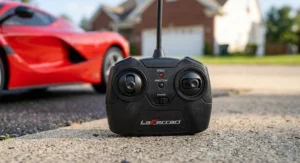
The parental remote control is arguably the single most important safety feature across every model on this list, and it’s worth understanding how it actually works rather than assuming all remotes function identically. Most units operate on a 2.4GHz frequency and allow a parent to override the child’s steering wheel input entirely, directing the car forward, backward, left, or right regardless of what the child is doing with the in-car controls. Premium models, like the Ferrari LaFerrari FXX K 12V, use Bluetooth-based remotes instead, which tend to have less input lag — a genuinely meaningful difference if you’re trying to make a fast correction near a driveway edge or a flower bed.
Forward and reverse gears deserve their own mention, since not every model handles them the same way. Some use a simple button toggle, while others — like the Ferrari LaFerrari FXX K 12V with its three-position gear stick — replicate an actual gear-shifting motion. For very young drivers, a car that requires the remote to fully lock out manual reverse until a parent enables it (a feature increasingly common on newer models) adds a meaningful layer of protection against a toddler accidentally backing into a driveway or a sibling.
Common Mistakes When Buying a Ferrari Ride On Car
The most common misstep is buying based on top speed alone, treating a higher mph figure as automatically “better,” when in practice a toddler under three has no business at anything above 3 mph regardless of what the car is capable of. A close second: skipping the weight capacity check entirely, which leads to a toy being outgrown within a single season rather than the two-to-three years most parents expect from a purchase this size.
Parents also frequently underestimate charge time as a real-world factor — an 8-hour charge cycle sounds abstract until you’re standing in the garage at 9 a.m. with a fully drained battery and a birthday party in an hour. Finally, many buyers assume “remote control” means identical functionality across every model, when in reality range, responsiveness, and whether reverse can be fully parent-locked vary meaningfully between a basic 2.4GHz unit and a Bluetooth-based system like the one on the Ferrari LaFerrari FXX K 12V.
Ferrari Ride On Car vs Traditional Pedal Cars and Power Wheels
| Feature | Ferrari Ride-On (Remote) | Classic Pedal Car | Generic Power Wheels (No Remote) |
|---|---|---|---|
| Parental override | Yes, via remote | No | Rarely, model-dependent |
| Licensed branding | Yes | Usually no | Sometimes |
| Typical top speed | 2.5-5 mph | Human-powered only | 2-5 mph |
| Battery required | Yes | No | Yes |
The comparison above makes the core trade-off obvious: a pedal car requires zero charging and zero remote logistics, but it also offers zero parental override if a toddler heads somewhere they shouldn’t. A generic, unlicensed Power Wheels-style vehicle often matches the speed range of a Ferrari ride-on, but frequently skips the parental remote control feature entirely, leaving supervision purely physical. For families who specifically want the safety net of remote takeover plus the licensed styling that makes gifting more exciting, the ferrari ride on car with remote control category is doing something neither alternative fully covers on its own.
What to Expect: Real-World Performance
Spec sheets tend to describe a best-case scenario — flat ground, full charge, ideal temperature. Real driveways rarely match that. Expect actual runtime to land closer to 1-2 hours of continuous play per charge on most single-battery models here, even when marketing copy suggests longer, simply because stop-start toddler driving (lots of starts, stops, and idle time) draws power differently than a lab test. Expect the remote’s effective range to be shorter outdoors, particularly with basic 2.4GHz units, if there’s a house wall or a parked car between you and the vehicle.
On the plus side, the soft-start motors found across most of these seven picks perform close to their marketing promise — the transition from stopped to moving is noticeably gentler than older, cheaper ride-on toys from years past, and it’s one of the areas where genuine engineering improvement is obvious the moment you watch a toddler take off in one for the first time.
Safety Seat Belts & Remote-Control Compliance Guide
Every model in this roundup includes some form of safety seat belt, but “includes a seatbelt” and “includes a seatbelt that’s actually adjusted correctly” are two different things — and the gap between them is where most preventable incidents happen. Battery-powered ride-on toys sold in the U.S. fall under the Consumer Product Safety Commission’s toy safety framework, which covers requirements for battery-operated toys and includes mandated instructional literature covering safe assembly and use — read it, even though almost nobody does. Before every ride, check that the seatbelt sits low across the hips rather than the stomach, confirm the buckle clicks fully rather than just resting closed, and make sure door locks (where present) are actually engaged rather than just visually closed.
On the remote side, treat the parental remote control as a supervision tool, not a substitute for standing nearby. Even with reliable range and low lag, a remote can’t react to a curb, a sibling darting into the path, or a driveway slope as fast as a parent standing within arm’s reach can. The CPSC’s ride-on toy recall history is worth a periodic glance — recalls in this category have historically involved issues like foot pedals continuing to engage after release, which is exactly the kind of mechanical failure a nearby adult catches faster than a remote ever could.
Long-Term Cost & Maintenance: Batteries, Chargers & Repairs
The sticker price is rarely the full cost of ownership here. Replacement 12V battery packs, needed roughly every 1-2 years of regular use depending on charge habits, typically run in the $30-$60 range — a modest but real recurring cost worth budgeting for. Always use the charger that shipped with the car rather than a generic substitute; mismatched voltage or amperage is one of the more common (and avoidable) causes of premature battery failure across this entire product category.
Tires, especially on models used regularly on grass or gravel, wear faster than pavement-only use would suggest, and replacement wheel sets are usually available directly from the manufacturer or a compatible parts retailer for a fraction of the original purchase price. Storing the car indoors or under a cover between seasons meaningfully extends the life of both the paint and the plastic body panels — UV exposure is the quiet enemy of every ride-on toy’s exterior, regardless of how premium the finish looks on day one.
FAQ
❓ What age is a ferrari ride on car with remote control good for?
❓ Can parents control a Ferrari ride on car remotely at all times?
❓ How fast do Ferrari ride on cars go?
❓ Is a Ferrari ride on car with remote control worth the price?
❓ Do Ferrari ride on cars need adult assembly?
Conclusion
Seven models, three price tiers, and one consistent takeaway: the best ferrari ride on car with remote control for your family depends far more on your driveway, your child’s age, and your patience for charge times than it does on which supercar badge looks coolest in photos. Budget-focused buyers get real value from the Big Toys Direct Ferrari 12V LaFerrari or the Ferrari LaFerrari Ride-On Car, families wanting longevity should lean toward the Mini Motorz 12V Ferrari Ride-On Car, and anyone dealing with grass, gravel, or slopes should strongly consider the Ferrari F8 12V Battery-Operated Ride-On‘s 4×4 setup. Whichever you choose, treat the seatbelt, the remote’s supervisory role, and the charge cycle as the real specs that matter — everything else is just very well-designed styling on top of solid engineering. Kids benefit developmentally from active, outdoor play of exactly this kind, a point early-childhood education researchers have long emphasized — so once you’ve picked the right model, the best next step really is just getting outside and letting the first lap happen.
✨ Find the Perfect Ferrari Ride-On for Your Family
🚦 Compare the seat belts, gears, and remote features one more time, then grab the model that fits your toddler’s age and your yard best — happy (safe) driving!
Recommended for You
- Licensed Lamborghini Ride On Aventador: 7 Best Picks (2026)
- Lamborghini Ride On Car For Kids: 7 Best Picks Reviewed (2026)
- Charger for Ride On Toys: 7 Best Picks That Actually Work (2026)
Disclaimer: This article contains affiliate links. As an Amazon Associate, I earn from qualifying purchases. If you purchase products through these links, we may earn a small commission at no additional cost to you.
✨ Found this helpful? Share it with fellow parents! 💬🤗
