
In This Article
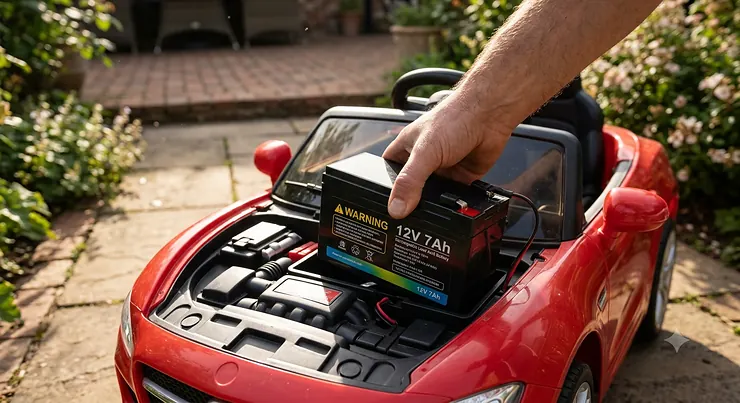
Somewhere in your garage right now, there’s a Power Wheels Jeep sitting dead in the corner like a beached whale, and your kid is standing over it with the particular betrayed expression only a six-year-old can produce. You’ve been there. Everyone with a driveway and a small child has been there. A battery for ride on toys is the rechargeable power pack — usually 6V, 12V, or 24V — that drives the motor, lights, and sound system in a kids’ electric ride-on vehicle, and it’s almost always the first thing to fail, long before the wheels or the plastic body ever wear out. That’s actually good news: it means the fix is usually a $40-$150 swap, not a funeral for the whole toy.
This guide skips the vague “check your local retailer” advice and gets specific. We researched real, currently available batteries — OEM originals, budget lead-acid kits, and lithium upgrades — and broke down what each one actually does differently once it’s bolted into the battery tray. You’ll see honest tradeoffs (lithium isn’t automatically “better,” it’s better for certain households), real aggregated review sentiment where it exists, and a decision framework so you’re not guessing at 9pm the night before a birthday party. The CPSC publicly tracks recalls and safety warnings for children’s products, including this category, and we’ll flag the safety context that matters before you click “buy.”
Quick Comparison Table
| Voltage | Typical Age Range | Runtime | Best For |
|---|---|---|---|
| 6V | 1-3 years | 30-45 min | Toddlers, slow speeds (2-3 mph) |
| 12V | 3-7 years | 45-90 min | Most Power Wheels-style vehicles |
| 24V | 6+ years | 60-120 min | Big-kid UTVs, dune buggies, faster rides |
If you’re staring at a dead battery for ride on toys and aren’t sure which row applies to you, check the sticker on your existing battery or the toy’s manual before ordering — voltage mismatches are the single most common return reason reported by sellers in this category. A 6V pack won’t move a 12V-rated motor with any authority, and forcing a higher-voltage battery into a lower-voltage system risks frying the wiring harness. Runtime also scales with amp-hours (Ah), not just voltage, so two 12V batteries can behave very differently depending on their Ah rating — more on that in the product breakdowns below.
💬 Found a battery match already? Skip ahead to the full product lineup below and start comparing specs side by side.
💬 Just one click — help others make better buying decisions too!😊
Top 7 Batteries for Ride On Toys: Expert Analysis
1. Fisher-Price Power Wheels 12-Volt 12-Ah OEM Rechargeable Battery — the safest drop-in match for genuine Power Wheels
If your ride-on is an actual Fisher-Price Power Wheels vehicle, this is the battery engineered specifically for it — no adapter harness, no guessing about connector shape.
This is a 12V, 12Ah sealed lead-acid pack built to the exact specifications Power Wheels vehicles expect, which matters more than it sounds like it should: mismatched connectors and undersized fuses are a common cause of “new battery, still won’t drive” complaints. At 12Ah, it offers a meaningful step up over the older 9.5Ah gray batteries some households are replacing, translating to noticeably longer backyard sessions before the next charge. Based on the spec comparison with third-party alternatives, the appeal here isn’t raw power — it’s fit-and-forget reliability, which matters most to parents who don’t want to troubleshoot wiring on a Saturday morning.
Battery for ride on toys shoppers replacing an original Power Wheels pack consistently gravitate toward the OEM option first, and reviewers frequently note straightforward installation with no rewiring required. A common complaint in user reviews across this battery type is the mandatory 18-hour initial charge time, which catches first-time buyers off guard when they expect same-day play.
Pros:
- ✅ Exact OEM fit for Fisher-Price Power Wheels vehicles
- ✅ Internal self-resetting fuse for overcurrent protection
- ✅ 12Ah capacity outperforms older 9.5Ah factory packs
Cons:
- ❌ Requires the original Power Wheels charger, sold separately
- ❌ Heavier than lithium alternatives at a similar capacity
Expect a price in the $45-$65 range for this pack. Given its plug-and-play compatibility, it’s a strong value pick specifically for households staying within the Power Wheels ecosystem rather than mixing brands.
2. Mighty Max Battery 12V 7Ah Replacement Kit with Harness — best budget swap-in for tight-tray vehicles
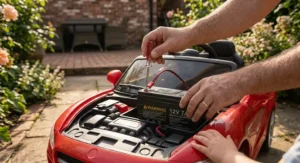
This one throws in the wire harness and fuses along with the battery itself, which quietly solves the most annoying part of a DIY replacement.
At 12V and 7Ah, this is a smaller-capacity pack than most on this list, but the tradeoff is a compact footprint that fits battery trays where a bulkier 12Ah unit simply won’t close the lid. What most buyers overlook about this model is that the included harness — with its 12 AWG wire and multiple fuses — eliminates a second purchase that catches a lot of first-time battery swappers off guard. It’s aimed squarely at budget-conscious parents replacing a smaller original battery rather than upgrading runtime.
Aggregated feedback for Mighty Max’s ride-on line frequently highlights easy connector matching and dependable charge retention in storage, though buyers should note capacity is modest compared to 12Ah and 15Ah options elsewhere on this list.
Pros:
- ✅ Wire harness and fuses included in the kit
- ✅ Compact size fits smaller original battery trays
- ✅ Budget-friendly price point for occasional riders
Cons:
- ❌ Shorter runtime than higher-Ah alternatives
- ❌ Lead-acid weight and eventual capacity fade over time
Pricing typically lands under $50, making this the pick for families who just need the toy running again without overthinking it.
3. Schumacher Charge ‘n Ride TB3 12V 9.5Ah Rechargeable Battery — most trusted name for a straightforward, no-drama replacement
Schumacher built its reputation on automotive chargers, and that engineering pedigree shows up here as a battery that just works without fuss.
The TB3 delivers 12V at 9.5Ah, matching the original spec used in many Fisher-Price Advanced Series vehicles, with a quick-connect harness that attaches in seconds rather than requiring tools. Here’s what to weigh: this isn’t the highest-capacity option on the list, but it’s engineered to work with the stock Power Wheels charger while also being compatible with Schumacher’s own CR7 universal charger, giving buyers a fallback if the original charger dies too. That dual-charger compatibility is a genuinely practical touch most toy-specific batteries skip entirely.
Reviewers consistently note the replaceable fuse as a standout safety feature, since it protects against the overcurrent events that quietly kill cheaper batteries within a season.
Pros:
- ✅ Compatible with both OEM and Schumacher CR7 chargers
- ✅ Quick-connect harness needs no tools to install
- ✅ Replaceable fuse guards against overcurrent damage
Cons:
- ❌ 9.5Ah capacity trails newer 12-15Ah competitors
- ❌ Lead-acid chemistry means gradual capacity loss with age
Expect a price in the $40-$60 range, positioning it as a mid-tier pick that trades peak runtime for charger flexibility and brand trust.
4. Hicrank 12.8V 12Ah LiFePO4 Lithium Power Wheels Battery (Charger Included) — best lithium upgrade for noticeably peppier acceleration
This is where families start to feel a real difference in how the toy drives, not just how long it runs.
Built on lithium iron phosphate (LiFePO4) chemistry rather than lead-acid, this 12.8V, 12Ah pack ships with its own charger and Power Wheels-compatible connector, so there’s no separate purchase required to get moving. On paper, this means roughly double the usable cycle life of a comparable lead-acid battery — LiFePO4 chemistry is widely recognized for its low toxicity and long cycle life relative to older lithium-ion formulations, which is exactly why it’s become the go-to choice for ride-on toy upgrades. What the spec sheet won’t tell you, but manufacturer claims and early adopter feedback suggest, is a noticeably quicker off-the-line acceleration feel compared to lead-acid at the same nominal voltage, since lithium packs sustain voltage better under load.
Buyers researching this swap should also weigh in the compatibility caveat: it’s built for gray-battery Power Wheels systems and explicitly not compatible with orange-top battery vehicles, so double-check your connector before ordering.
Pros:
- ✅ Charger and connector included, ready to install
- ✅ LiFePO4 chemistry rated for 2,000+ charge cycles
- ✅ Noticeably stronger sustained power under load
Cons:
- ❌ Not compatible with orange-top Power Wheels batteries
- ❌ Higher upfront cost than comparable lead-acid packs
Prices generally sit in the $80-$110 range. For families who cycle through batteries every season, the higher cycle life often pencils out to better long-term value despite the steeper sticker price.
5. SEFEPODER 12V 20Ah LiFePO4 Lithium Battery — longest lasting ride on toy battery in this lineup by capacity
If your kid treats the backyard like a rally stage and drains batteries in under an hour, this is the pack built for that exact problem.
At 12V and a substantial 20Ah, this is roughly double the capacity of the standard OEM Power Wheels battery, translating into meaningfully longer ride sessions before a recharge is needed. Based on the spec comparison against the rest of this lineup, the 20Ah rating combined with LiFePO4 chemistry makes this the strongest case for the “longest lasting ride on toy battery” title here — both in single-charge runtime and in total lifespan across hundreds of charge cycles. Manufacturer documentation notes the built-in battery management system (BMS) protects against overcharge, overdischarge, and short circuits, addressing exactly the failure modes that shorten cheaper batteries’ lives.
The tradeoff worth flagging honestly: this battery is explicitly not rated for ATV applications per manufacturer specs, so it’s a fit for standard ride-on cars and trucks rather than every vehicle type on the market.
Pros:
- ✅ 20Ah capacity roughly doubles standard runtime
- ✅ Built-in BMS protects against common failure modes
- ✅ LiFePO4 chemistry supports thousands of charge cycles
Cons:
- ❌ Not rated for ATV-style ride-on vehicles
- ❌ Premium pricing relative to lead-acid alternatives
Expect to pay in the $100-$140 range. For heavy daily use — think multiple kids sharing one vehicle, or a household near a large yard — this is the option least likely to leave you recharging mid-play.
6. Veleylr 24V 12Ah Lithium Battery for Kids Ride-On Cars & Power Wheels — best pick for big-kid 24V UTVs and off-road-style rides
Once kids outgrow the 12V world, this is the upgrade path that keeps pace with faster, heavier vehicles like UTVs and dune-buggy-style ride-ons.
This 24V, 12Ah lithium pack is designed as a lighter, longer-lasting swap for the lead-acid batteries that typically ship with 24V ride-on UTVs, and manufacturer specs claim it weighs roughly a third of a comparable lead-acid unit — a meaningful difference when a parent is the one lifting the vehicle in and out of storage. Reviewers consistently note the higher energy density translates to extended play sessions compared to the stock lead-acid pack it replaces, though it’s worth being precise here: this battery is strictly a 24V product and explicitly should not be paired with 12V systems or wired in series/parallel configurations outside manufacturer guidance.
It’s compatible with a range of 24V UTV-style ride-ons, including certain licensed models, but voltage and connector verification before purchase is non-negotiable given the strict system-matching requirements lithium packs demand.
Pros:
- ✅ Roughly one-third the weight of comparable lead-acid packs
- ✅ Higher energy density extends play sessions
- ✅ Includes matching charger and Anderson-style plug
Cons:
- ❌ Strictly 24V only — no cross-voltage flexibility
- ❌ Series/parallel multi-battery setups are not supported
Pricing typically falls in the $90-$130 range, which is competitive for a lithium 24V pack and a reasonable premium over a stock lead-acid replacement.
7. Energizer EN5-12 12V 5Ah Sealed Lead Acid AGM Battery — the closest thing to a universal battery for ride on toys
This one isn’t marketed as a toy battery at all — it’s a general-purpose 12V AGM battery, and that’s precisely what makes it a flexible option for oddball or discontinued ride-on models.
At 12V and 5Ah, the Energizer EN5-12 is a smaller-capacity AGM battery originally built for applications like garage door openers and alarm panels, but its standard sealed lead-acid form factor and terminal layout make it adaptable to ride-on toys that use generic 12V connections rather than a brand-specific plug. Here’s what to weigh: because it’s AGM, it shares the maintenance-free, spill-proof construction of the broader valve-regulated lead-acid battery category, where a limited amount of electrolyte is absorbed in a plate separator rather than sitting as free liquid — that makes lead-acid batteries safe to mount at odd angles inside a toy’s chassis. That’s genuinely useful when you’re improvising a fit for a battery for ride on toys that no longer has a manufacturer-supported replacement.
Because it’s not toy-specific, buyers should expect to source or adapt their own wire harness and connector, which adds a small amount of DIY work compared to plug-and-play options.
Pros:
- ✅ Generic 12V AGM design fits many discontinued models
- ✅ Maintenance-free, spill-proof sealed construction
- ✅ Trusted brand with wide retail availability
Cons:
- ❌ Requires separate harness/connector sourcing in most cases
- ❌ Lower 5Ah capacity means shorter runtime
This battery generally sits in the $20-$35 range, making it the cheapest entry point on this list and a smart pick when brand-specific replacements are unavailable or discontinued.
Top 7 Products: Specs & Value Comparison
| Product | Voltage/Capacity | Chemistry | Price Range | Best For |
|---|---|---|---|---|
| Fisher-Price OEM Battery | 12V 12Ah | Lead-Acid | $45-$65 | Genuine Power Wheels owners |
| Mighty Max 7Ah Kit | 12V 7Ah | Lead-Acid | Under $50 | Tight battery trays, budget swaps |
| Schumacher TB3 | 12V 9.5Ah | Lead-Acid | $40-$60 | Charger flexibility |
| Hicrank LiFePO4 | 12.8V 12Ah | Lithium | $80-$110 | Acceleration + cycle life |
| SEFEPODER LiFePO4 | 12V 20Ah | Lithium | $100-$140 | Longest single-charge runtime |
| Veleylr 24V Lithium | 24V 12Ah | Lithium | $90-$130 | Big-kid UTVs, lighter weight |
| Energizer EN5-12 | 12V 5Ah | AGM Lead-Acid | $20-$35 | Universal/DIY compatibility |
Looking at the table, the split is really about chemistry and use case rather than any single “best” answer: the Fisher-Price OEM Battery and Schumacher TB3 win on plug-and-play trust, while the SEFEPODER LiFePO4 and Hicrank LiFePO4 justify their higher price with dramatically longer cycle life. Budget-conscious buyers replacing a small original pack should look at the Mighty Max 7Ah Kit or Energizer EN5-12, while anyone with a 24V vehicle has essentially one lane here: the Veleylr 24V Lithium.
Practical Usage Guide: Battery Maintenance for Kids Vehicles
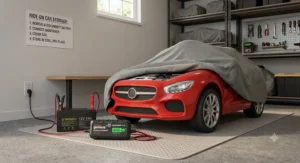
Getting a new battery for ride on toys is only half the job — how you treat it in the first 30 days largely determines whether it lasts one season or three. Start with the initial charge: most manufacturers, OEM and third-party alike, specify an 18-hour first charge regardless of how “full” the indicator light claims to be, and skipping this step is the single most common reason new batteries underperform. After that, charge after every use rather than waiting for a full drain — deep discharges are hard on both lead-acid and lithium chemistries, though lithium tolerates it noticeably better.
Battery maintenance for kids vehicles also means respecting storage conditions. Cold garages slow chemical reactions and can mask a battery as “dead” when it’s simply too cold to deliver current; bringing it indoors for a few hours before troubleshooting saves a lot of unnecessary returns. During off-season storage — winter, typically — top off the charge every 30-60 days rather than letting it sit fully depleted, since a completely discharged lead-acid battery can sulfate and lose capacity permanently within weeks. Wipe terminals with a dry cloth periodically, and never use a charger from a different voltage system, even “just this once” — that’s the fastest way to cook a control board.
One optimization trick most listings don’t mention: label the charge date on your battery with a piece of tape. It sounds trivial, but it turns “when did we last charge this thing?” from a guessing game into a five-second glance, and it meaningfully reduces both over- and under-charging mistakes across a season of use.
Real-World Scenarios: Matching the Battery to Your Family
The suburban toddler household. If you’re a parent with a two-year-old and a 6V or entry 12V Power Wheels-style vehicle used mostly on the driveway a few times a week, a straightforward lead-acid option like the Schumacher TB3 or the OEM Fisher-Price pack is genuinely the right call. You don’t need lithium’s cycle life if the toy sees light, occasional use — you’d be paying a premium for capacity you’ll rarely tap.
The big backyard, multiple-kids household. If you’re managing two or three children who all want turns in the same ride-on across a full afternoon, runtime is your bottleneck, not price. The SEFEPODER 12V 20Ah lithium pack’s extended single-charge capacity directly solves the “it died after 40 minutes and now everyone’s crying” scenario that smaller batteries create.
The off-road, big-kid UTV family. If your child has graduated to a 24V UTV-style vehicle and rides it on grass, gravel, or light trails, the Veleylr 24V Lithium battery’s lighter weight and stronger sustained output under load make a real difference in both handling and how easy the vehicle is for a parent to move and store.
How to Choose Ride On Toy Battery: 6 Expert Criteria
- Match the voltage exactly. Check your original battery’s label or the toy’s manual — 6V, 12V, and 24V systems are not interchangeable without vehicle modification.
- Check the amp-hour (Ah) rating. Higher Ah means longer runtime per charge; if your current battery leaves your kid stranded mid-yard, this is the number to increase.
- Confirm connector type. Power Wheels alone has used multiple connector styles across product generations — gray-top and orange-top batteries are not interchangeable.
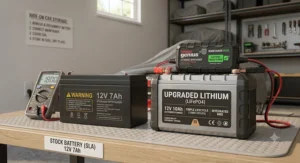
- Decide between lead-acid and lithium. Lead-acid is cheaper upfront; lithium costs more but delivers longer cycle life and lighter weight, which matters for lifting and storage.
- Verify physical dimensions. A battery that’s electrically compatible but physically too large won’t close the battery compartment — measure before ordering.
- Factor in charger compatibility. Some batteries include a charger; others require you to reuse the original or buy one separately, which changes the real total cost.
Common Mistakes When Buying a Battery for Ride On Toys
The most expensive mistake shoppers make is guessing the voltage instead of checking it. A parent under time pressure — birthday party in two days — often orders based on the toy’s brand name alone, assuming “Power Wheels means 12V,” when plenty of Power Wheels vehicles actually run 6V or use less common connector types. The fix is embarrassingly simple: read the sticker on the current battery before buying anything.
A second common misstep is buying the cheapest available option without checking Ah rating, then being disappointed by a 20-minute runtime. Price and capacity move together for a reason, and going low on Ah to save $15 often means buying twice within a year — which erases the savings and then some.
A third mistake, particularly with lithium upgrades, is assuming any 12V lithium battery is a drop-in replacement. Voltage-specific charging profiles matter with lithium chemistry in ways they don’t with lead-acid; using a mismatched charger can trigger the battery management system’s protective shutdown or, in worse cases, degrade the cells prematurely.
Longest Lasting Ride On Toy Battery: Lithium vs Lead-Acid Lifespan
This is where the honest math actually favors lithium for high-use households, even with the higher sticker price. A typical sealed lead-acid battery in this category is rated for somewhere between 100 and 300 full charge cycles before capacity noticeably degrades, while LiFePO4 batteries are widely recognized industry-wide for their long cycle life, low toxicity, and high safety profile relative to other lithium chemistries — commercial LiFePO4 packs are commonly rated well beyond 2,000 cycles. In practical terms, if your household charges a ride-on battery roughly once a week during play season, a lead-acid pack might need replacing every one to two years, while a comparable LiFePO4 battery could realistically outlast the toy itself.
The value/ROI math looks like this: a $50 lead-acid battery replaced every 18 months costs roughly $33 a year in battery spend alone, plus the hassle of reordering. A $100 LiFePO4 battery lasting 5+ years works out closer to $20 a year — cheaper in the long run despite costing double upfront. The catch, and it’s a real one, is that lithium packs are pickier about charger compatibility and voltage matching, so the savings only materialize if you buy the correct pack the first time.
Ride On Toy Battery Replacement: Step-by-Step
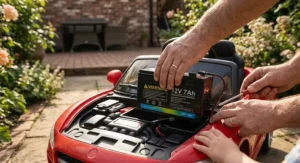
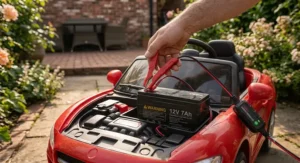
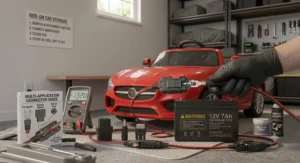
Ride on toy battery replacement is rarely as intimidating as it looks from the outside. First, flip the vehicle to expose the battery compartment — usually secured with a single screw or a simple latch. Second, disconnect the old battery’s connector by squeezing the release tab rather than yanking the wires, which prevents connector damage. Third, remove the old battery and check for corrosion on the tray itself; a quick wipe with a dry cloth prevents that issue from affecting the new battery’s contacts.
Fourth, before installing, confirm the new battery’s connector matches — this is the moment to catch a gray-top/orange-top mismatch before it becomes a return hassle. Fifth, seat the new battery securely, reconnect the harness until you hear or feel the click, and close the compartment. Sixth, and often skipped: give the new battery its full initial charge — typically 18 hours — before the first ride, even if the toy technically powers on sooner. Skipping this step is a leading cause of batteries that seem to “underperform” right out of the box.
Safety, Regulations & Battery Disposal Guide
Battery safety in ride-on toys isn’t just theoretical caution — it’s an active area of regulatory attention. The CPSC maintains an ongoing public database of recalls and safety warnings (linked earlier in this article) covering children’s products, including battery-related fire and ingestion hazards, and it’s worth a quick search for your specific model before and after purchase. Lithium battery packs, while generally safe when used as designed, can pose overheating risks if damaged, charged with an incompatible charger, or exposed to extreme heat, so always use the charger specified for that exact battery.
Disposal matters more than most parents realize. Lead-acid batteries are classified as hazardous waste in the U.S. and cannot legally go in household trash in most states; the EPA-documented lead-acid battery collection network relies on retailers and recyclers to keep lead out of landfills, and nearly any retailer that sells replacement lead-acid batteries is required to accept old ones for recycling. Lithium batteries need separate handling too — never toss a lithium pack in regular trash or recycling bins, since punctured lithium cells can ignite. Most municipal household hazardous waste centers accept both chemistries; a quick call ahead confirms they’ll take yours.
✨ Don’t Miss These Exclusive Deals!
🔍 Take your ride-on battery upgrade to the next level with these carefully selected products. Click on any highlighted item to check current pricing and availability. These batteries will help you create smooth, reliable playtime your kids will love!
Replacement Batteries for Electric Toys: 6V vs 12V vs 24V Explained
A battery for ride on toys is fundamentally defined by its voltage class, and understanding the practical difference between them saves a lot of buyer’s remorse. 6V systems are built for the youngest riders — think 1-3 year olds — moving at a gentle 2-3 mph, and they’re intentionally underpowered as a safety feature, not a limitation. 12V systems are the workhorse of the category, powering most Power Wheels-style vehicles for ages 3-7 at speeds around 3.5-5 mph, and they represent the largest share of replacement batteries for electric toys sold today. 24V systems step things up meaningfully, aimed at bigger kids in UTV-style or dune-buggy vehicles capable of higher speeds and rougher terrain.
The practical takeaway: never assume compatibility across these tiers. A 24V battery physically may not even connect to a 12V system due to differing connector standards, and even where it could be forced, doing so risks serious damage to the motor and control electronics. When shopping for replacement batteries for electric toys, voltage is the first filter, Ah rating is the second, and everything else — chemistry, brand, price — comes after those two are locked in.
Features That Actually Matter (And Those That Don’t)
Marketing copy on toy batteries loves to highlight things that barely affect real-world performance, so let’s separate signal from noise. What actually matters: Ah capacity (directly determines runtime), chemistry (lithium vs lead-acid affects lifespan and weight), connector compatibility (determines whether it fits at all), and the presence of a built-in BMS on lithium packs (protects against the failure modes that shorten battery life). What matters far less than it sounds: battery color (purely cosmetic, despite gray-vs-other-color sometimes being marketed as a feature), and claimed “instant charge” marketing language, since virtually every battery in this category still benefits from a full initial charge regardless of what the box implies.
One feature that’s genuinely underrated: included wire harnesses. A battery priced $10 cheaper but missing the harness can end up costing more once you buy connectors separately — always check what’s actually in the box before comparing prices.
FAQ
❓ What voltage battery does my ride on toy need?
❓ How long does a battery for ride on toys typically last?
❓ Can I use a universal battery for ride on toys instead of a brand-specific one?
❓ How do I know when it's time for ride on toy battery replacement?
❓ Are lithium replacement batteries for electric toys worth the extra cost?
Conclusion
At the end of the day, choosing the right battery for ride on toys comes down to three questions: what voltage does your vehicle actually need, how much runtime does your family realistically use in a session, and how much are you willing to pay upfront for long-term savings versus a cheaper short-term fix. Households replacing a genuine Power Wheels battery will usually do best sticking close to OEM specs like the Fisher-Price 12V 12Ah pack or the Schumacher TB3, while families dealing with frequent, heavy use have real financial and practical reasons to consider a lithium upgrade like the SEFEPODER 12V 20Ah or, for 24V vehicles, the Veleylr 24V Lithium.
None of these choices are wrong so much as they’re matched to different situations — a toddler’s driveway cruiser doesn’t need the same battery as a backyard shared by three kids racing until dinner. Whichever direction you go, the maintenance habits matter as much as the purchase: charge fully before first use, avoid deep discharges, store thoughtfully in winter, and dispose of old batteries responsibly rather than in the regular trash. Do that, and whichever battery you pick should keep your kid’s ride-on running for seasons, not weeks.
Recommended for You
- Ride On Horse Toy Battery Operated: 7 Best Picks 2026
- John Deere Ride On Toys Battery Powered: 7 Best Picks (2026)
- 7 Best Motorized Ride On Toys in 2026
Affiliate Disclosure: This article contains affiliate links. As an Amazon Associate, I earn from qualifying purchases. If you purchase products through these links, we may earn a small commission at no additional cost to you.
✨ Found this helpful? Share it with your friends! 💬🤗
