
In This Article
Stand in the ride-on toy aisle for five minutes and you’ll notice something strange: every box screams about LED headlights, Bluetooth speakers, and a paint job slicker than the actual car in your driveway. Nobody puts the number that actually matters in big letters on the front.

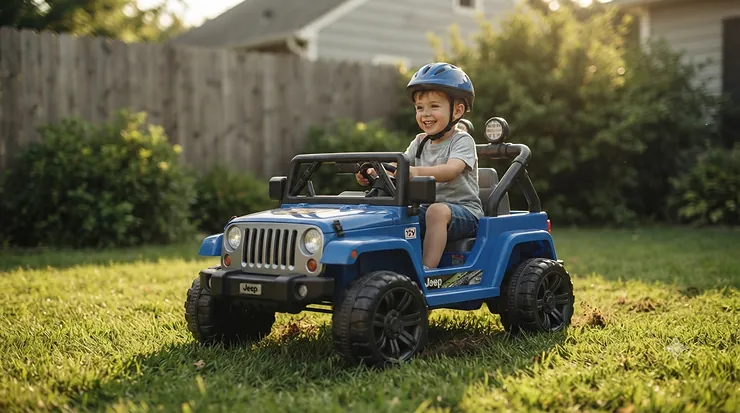
That number is voltage. A ride on toy voltage guide is simply a breakdown of how 6V, 12V, and 24V battery systems translate into real-world speed, torque, and run time, so you can match the machine to the kid instead of the kid to the marketing. Electric current, in the simplest terms, is the movement of charge carriers through a circuit, and voltage is the electric potential difference that pushes that current along — basically, the bigger the number, the harder the electrical “push.” More push means more speed and torque, which is exactly why a 6V toddler car crawls at toddler pace while a 24V truck can fishtail on wet grass if you’re not paying attention.
I’ve read more ride-on toy listings this month than any reasonable adult should, and the pattern is consistent: parents buy on looks, then message customer service three weeks later asking why the “fast” car won’t go up their driveway. Voltage is the fix for that. Get it right and you get years of backyard joy. Get it wrong and you get a sulking five-year-old or, worse, a startled two-year-old who just discovered what 5 mph feels like.
Quick Comparison: 6V vs 12V vs 24V Ride On Toys at a Glance
Before we get to specific products, here’s the cheat sheet every parent actually needs.
| Voltage | Typical Age | Top Speed | Best Terrain | Best For |
|---|---|---|---|---|
| 6V | 1–3 years | 1–2.5 mph | Driveway, sidewalk, indoors | First-time drivers, gentle introductions |
| 12V | 3–6 years | 2–3.7 mph | Driveway, light grass | Most families — the “sweet spot” tier |
| 24V | 5–8 years | 4–6 mph | Grass, gravel, mild slopes | Confident kids, siblings sharing a ride |
Voltage determines the power output of a ride-on’s motor, which directly shapes top speed, torque, and how long a charge lasts, and 6V models are aimed at ages 1 to 3 for first-time riders on smooth, indoor or driveway surfaces, while 12V is the most popular tier for ages 3 to 6, and 24V is built for ages 5 to 8 who’ve outgrown the slower stuff and want real outdoor performance. The jump from 12V to 24V isn’t subtle, either — 6V models run 1–2 mph with light plastic builds, 12V models hit 2–3 mph with sturdier construction and basic remote control, and 24V models reach 5–6 mph with dual motors and enough torque to handle grass and slight inclines without bogging down.
💬 Just one click — help others make better buying decisions too!😊
✨ Don’t Miss These Exclusive Deals!
🔋 Take your kid’s backyard adventures to the next level with these voltage-matched ride-ons below. Click any highlighted pick to check current pricing and availability — these picks help you avoid the “too fast, too soon” mistake every parent dreads! 😊
Top 7 Ride On Toy Picks by Voltage: Expert Analysis
I sorted these into budget, mid-range, and premium for each voltage tier, because the “best” 12V car for a cautious toddler and the “best” 12V car for a kid who already drives like they’re auditioning for NASCAR are two completely different machines.
1. Huffy Lightning McQueen 6V Ride-On (Budget 6V)
The Huffy Cars Lightning McQueen 6V Ride-On Toy Car is the gateway drug of ride-on toys — the one that turns a kid who’s never driven anything into a kid who suddenly has opinions about steering. It’s built for ages 3 to 7, tops out at 2.5 mph, and runs on a rechargeable 6V battery with wide traction tires.
Here’s what the spec sheet doesn’t say outright: 2.5 mph isn’t a typo, it’s the entire point. At that pace, you can supervise comfortably while pushing a stroller with your other hand, which is more than you can say for most 12V cars. The foot pedal accelerator is genuinely kid-simple — press to go, lift to stop, no learning curve required. The catch reviewers flag most often: there’s no remote control option, so once your toddler is rolling, you’re guiding by voice, not joystick. For a first car, that’s a feature disguised as a limitation — it forces independence early, on a speed that can’t really hurt anyone.
✅ Pros: Dead-simple controls, licensed character design kids actually recognize, light enough to carry up a porch step
❌ Cons: No parental remote, battery life shortens noticeably after a season of daily use
Price range: typically $100–$140. Verdict: if your kid’s first word was practically “vroom,” this is the lowest-risk way to find out if they mean it.

2. Best Choice Products 6V ATV Quad (Budget 6V Alternative)
If your toddler is more “off-road explorer” than “race car driver,” the Best Choice Products 6V Kids Ride On ATV Quad swaps the foot pedal for a thumb-button accelerator built into the handlebars — and that small change matters more than it sounds.
It’s built tough with realistic ATV styling, runs on a long-lasting 6V battery good for 1–2 hours per charge, rolls on large treaded wheels with 4-wheel suspension, and tops out around 1.8 mph. The push-button setup means kids who aren’t quite coordinated enough to manage a foot pedal and steering wheel simultaneously can still drive solo — they just squeeze and go. Weight capacity sits at 44 lbs, so this stays a true toddler vehicle rather than something your kid will be folded into by age five.
Customer feedback is split mostly along the assembly axis — some parents find it together in ten minutes, others wrestle with the instructions for a Saturday afternoon. Once built, though, the consensus is that the battery genuinely outlasts expectations for the price point.
✅ Pros: One-button operation suits younger toddlers, treaded tires grip grass surprisingly well, lightweight for transport
❌ Cons: Assembly instructions get mixed reviews, max speed feels slow once your kid gains confidence
Price range: typically $70–$100. Verdict: the cheapest real entry point into powered ride-ons, and a smart pick if you’re not sure your toddler will even like driving yet.
3. Best Choice Products 12V Ride-On Car with Parent Remote (Mid-Range 12V)
This is the workhorse of the category — the Best Choice Products 12V Kids Electric Vehicle Toy Ride On Car with parent remote control, and it’s probably the single most-bought style of ride-on in America right now for a reason.
It includes manual driving via pedal and a parent remote with forward/reverse controls, plastic wheels paired with a spring suspension system for a 2.8 mph max speed, an AUX outlet for music, and a 61-lb weight capacity. That 2.8 mph ceiling is the smart part — fast enough to feel like a real upgrade from a 6V toy, slow enough that the included parent remote is genuinely useful as a safety net rather than a gimmick. The spring suspension also does real work here: it’s the difference between a smooth glide over a cracked sidewalk and a kid bouncing out of their seat.
What stands out in practice is the dual-mode setup. A nervous three-year-old can ride passenger-style while you drive by remote, then graduate to the pedal themselves a few months later without buying a new car. That’s the kind of “grows with the kid” value that’s hard to put a number on.
✅ Pros: Remote doubles as a genuine safety override, suspension smooths out rough pavement, AUX port keeps long driveway loops entertaining
❌ Cons: Plastic wheels can feel slick on wet grass, single-rider seat means siblings will fight over it
Price range: typically $140–$190. Verdict: the safest “default” choice if you want one car that handles both the nervous-toddler phase and the confident-preschooler phase.
4. ANPABO Licensed Mercedes-Benz G63 12V (Premium 12V)
For parents who want the ride-on equivalent of a status symbol — and let’s be honest, some of us just want our kid’s toy to look as good as our actual car — the ANPABO Licensed Mercedes-Benz G63 12V Ride on Car earns its premium price tag on engineering, not just badge appeal.
It’s powered by two 35W motors and an upgraded 12V 7Ah battery — about 55% more capacity than the standard 12V 4.5Ah found on most competitors — and tops out around 3 mph, with a 2.4GHz parental remote that delivers full monitoring and instant response, plus a dedicated emergency brake button. What most buyers overlook about the battery upgrade: a 55% larger capacity doesn’t just mean longer drives, it means the motor isn’t straining as hard at the end of a session, which is usually when cheaper batteries start sagging in power and the car noticeably slows down mid-play.
A built-in battery-level display and low-battery voice prompt round out the kind of thoughtful detail you don’t notice until you’re the parent who forgot to charge a competitor’s car and got a dead toy at 9 a.m. on a Saturday.
✅ Pros: Genuinely stronger battery life than most 12V rivals, soft-start prevents jerky takeoffs, real Mercedes licensing means the details (grille, badge) actually match
❌ Cons: Premium price for a 12V tier car, single-seat design despite the SUV looks
Price range: typically $180–$240. Verdict: best for families who want one excellent 12V car rather than cycling through cheaper ones every year.
5. Peg Perego John Deere Ground Force 12V Trac tor with Trailer(Premium / Most Durable)
This one breaks the mold entirely — it’s not a car, it’s a working tractor, and the Peg Perego John Deere Ground Force 12V Ride-On Tractor with Trailer is the closest thing to a multi-year investment in this whole list.
It’s made in the USA with heavier-duty materials built to outlast competitors, backed by a 2-year warranty, accommodates kids ages 3 to 7 with an 85-lb weight capacity, and includes a working FM radio plus a realistic 3-gear shift offering forward, reverse, and two speeds at 2¼ and 4½ mph. That 85-lb capacity is the real headline — most 12V ride-ons cap out around 60–66 lbs, which means kids age out of them by kindergarten. This one is built to still be hauling sticks and rocks in the detachable trailer when the same kid starts first grade.
Parents control top speed through a second-gear lockout, so a nervous parent of a 3-year-old can lock the tractor at the slower setting and unlock the faster one years later — no new purchase required. Reviewers consistently flag the build quality as the standout, with several noting the tractor survived multiple kids and several seasons of yard abuse.
✅ Pros: Genuinely USA-made durability, gear lockout extends usable years, detachable trailer adds real imaginative play value
❌ Cons: No seat belt included on this model, assembly takes real patience the first time
Price range: typically $300–$350. Verdict: the “buy it once” option if you have a yard and a kid who’ll use it for years, not months.
6. ANPABO Licensed Ford F-150 24V 2-Seater (Big Kids, All-Terrain)
Once a kid outgrows 12V, the ANPABO Licensed Ford F-150 24V 2-Seater Ride on Car is where things get genuinely impressive — and where the “12V or standard 24V struggle on grass” complaint finally gets solved.
It runs a true 24V 4WD system with four 100W motors, carrying two children up to 130 lbs combined uphill and over gravel, grass, or mud, with a controlled top speed of 4.3 mph, and a 24V 7Ah battery — 50% larger than the standard 5Ah — good for 70 to 130 minutes depending on load and terrain. The 4WD detail is the part that actually separates this from most “24V” competitors, which are often still 2-wheel drive and spin out the moment grass gets damp. Four independent motors mean each wheel finds its own grip, which is the difference between climbing a small backyard slope and getting stuck halfway up it.
The parent remote has a 65-foot range, which in practice means you can supervise from a lawn chair instead of jogging alongside. One recurring theme in owner feedback: this thing is heavy and won’t fit through a standard doorway fully assembled, so plan storage before it arrives, not after.
✅ Pros: True 4WD handles real outdoor terrain, 2-seater ends sibling arguments, remote range is genuinely long
❌ Cons: Bulky to store and move solo, turning radius is wide for tight spaces
Price range: typically $380–$450. Verdict: best for families with real yard space and two kids who refuse to share one seat.
7. LIGIANT R9 24V 4-Seater Golf Cart (Family / Multi-Kid)
For households with three or four kids — or a steady stream of cousins on weekends — the LIGIANT R9 24V 4-Seater Ride on Golf Cart solves a problem most ride-ons don’t even attempt to address.
It runs on a 24V 7Ah battery with two speed settings from 1.86 to 4.35 mph, built for kids ages 3 to 8, with 4 seat belts, 2 rear anti-roll wheels, and spring suspension for stability on uneven ground, and a maximum combined capacity of 264 lbs across all four riders. That anti-roll wheel detail matters more on a 4-seater than almost anywhere else — with four kids’ weight distributed unevenly (because someone always leans), the extra stability hardware is what keeps this from tipping on a turn instead of just looking nice on a spec sheet.
A detachable awning is a small touch that does real work on sunny afternoons, and the 1.86 mph low setting is genuinely slow enough for a toddler to ride safely as a passenger while older siblings handle the driving.
✅ Pros: Fits up to 4 kids at once, anti-roll wheels add real stability, low-speed setting works for mixed-age siblings
❌ Cons: Large footprint needs serious storage space, four kids’ worth of wear adds up on the upholstery over time
Price range: typically $350–$420. Verdict: best for big families or households that double as the neighborhood’s unofficial ride-on hub.
Top 7 Ride On Toy Voltage Comparison Table
| Product | Voltage | Top Speed | Weight Cap. | Best For | Price Range |
|---|---|---|---|---|---|
| Huffy Lightning McQueen | 6V | 2.5 mph | ~50 lbs | First-time drivers | $100–$140 |
| BCP ATV Quad | 6V | 1.8 mph | 44 lbs | Younger toddlers | $70–$100 |
| BCP 12V w/ Remote | 12V | 2.8 mph | 61 lbs | Most families | $140–$190 |
| ANPABO Mercedes G63 | 12V | 3 mph | 66 lbs | Style + battery life | $180–$240 |
| Peg Perego John Deere | 12V | 4.5 mph | 85 lbs | Long-term durability | $300–$350 |
| ANPABO Ford F-150 | 24V | 4.3 mph | 130 lbs (2 kids) | Outdoor terrain | $380–$450 |
| LIGIANT R9 Golf Cart | 24V | 4.35 mph | 264 lbs (4 kids) | Big families | $350–$420 |
Looking at this side by side, the pattern is obvious once you see it laid out: weight capacity climbs almost in lockstep with voltage, which makes sense — more power exists specifically to move more weight over rougher ground. If your family’s biggest constraint is “I have three kids and one driveway,” the LIGIANT or the ANPABO F-150 solve that math directly; if it’s “I have one toddler and zero patience for assembly drama,” the Huffy or the BCP 12V are the lower-stress bets.
How to Choose Ride On Toy Power for Your Child
Here’s the honest, no-fluff version of how to pick:
- Start with age, not ambition. A 2-year-old doesn’t need 24V no matter how “advanced” they seem — their balance and reaction time haven’t caught up yet.
- Check your terrain. Pure driveway and sidewalk? 12V is plenty. Grass, gravel, or a sloped yard? You’ll want 24V and ideally 4WD.
- Count the riders. One kid, one seat. Two or more kids who’ll fight over turns, budget for a 2-seater or 4-seater from the start — it’s cheaper than buying twice.
- Prioritize the remote over the paint job. A parental remote control is the single biggest safety upgrade you can buy, more valuable than lights, music, or styling.
- Match weight capacity to growth, not just current size. Buy a few pounds of headroom so the toy lasts more than one summer.
- Look for soft-start technology. It ramps power up gradually instead of lurching, which matters a lot for a kid who’s never felt acceleration before.
- Plan for storage before purchase. 24V vehicles, especially 2- and 4-seaters, are genuinely large — measure your garage or shed first.
Ride On Toy Voltage by Age: A Quick Reference
If you want the shortest possible version of this entire guide, here it is: 6V suits ages 1–3 with very slow speeds around 1–2 mph and a light plastic build, 12V suits ages 3–5 with more speed around 2–3 mph and better construction, and 24V suits ages 4–8 where speeds jump to 5–6 mph with powerful dual motors and enough torque for grass and slight inclines.
Age ranges overlap on purpose — a confident, coordinated 4-year-old might be ready for 12V earlier than a cautious 5-year-old, and that’s fine. Most ride-on cars overall are designed for children aged 3 to 7, though models with remote controls can be used safely with kids as young as 2, because the remote effectively removes the child’s own judgment from the safety equation entirely. Use age as a starting filter, then let temperament — not birthday — make the final call.
Battery Power Guide by Child’s Age: Run Time and Realistic Expectations
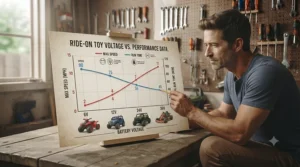
Run time is the detail nobody mentions until the battery dies mid-backyard-Olympics. Generally, lower-voltage toddler toys sip power slowly because the motors barely work hard, while higher-voltage 24V trucks burn through capacity faster because they’re doing actual work — climbing, hauling two kids, fighting grass resistance.
In practice, expect 6V toys to run somewhere around 1–2 hours per charge for light toddler use, 12V cars to land in the 40-minute to 2-hour range depending on terrain and rider weight, and 24V vehicles to run anywhere from about 70 minutes to over 2 hours depending on how many kids are aboard and how hilly the yard is. The ANPABO Ford F-150, for instance, runs 70 to 130 minutes depending on load and terrain — that’s a real-world range, not a marketing number, because two kids on a grassy slope draws far more current than one kid on flat pavement. Charge overnight, every time, and your kid will never know the difference between a fully optimized battery routine and a slightly neglected one — until the day it suddenly matters.
Setting Up Your New Ride-On: A Practical Usage Guide
Getting a ride-on from box to backyard smoothly comes down to a few habits nobody tells you on day one.
First charge matters more than you think. Most rechargeable batteries in this category want a full, uninterrupted first charge — often 8 to 12 hours — before their very first use, even if the box implies it’s ready to go. Skipping this step is the single most common reason a “broken” new toy turns out to just be undercharged.
Assembly cushions save your knees and your floor. Several of the products above ship with the motor axle, steering column, and wheels separate. A folded towel or yoga mat under your workspace prevents scratched floors and sore knees during the 20–40 minutes most models take to assemble.
Test indoors before the grand backyard debut. Run the car a few feet on a flat surface first to confirm forward, reverse, and the brake all respond correctly — far easier to troubleshoot in a living room than to discover a wiring issue mid-driveway with an audience of disappointed cousins.
Common 30-day mistakes: leaving the battery plugged in continuously after it’s full (shortens lifespan), letting the battery fully drain repeatedly before recharging (also shortens lifespan), and storing the toy outside uncovered through a rainy week.
Real-World Scenarios: Matching Voltage to Your Family
The cautious-toddler household: One 2-year-old, mostly driveway and sidewalk, parents who want full control. The Huffy 6V or BCP 6V ATV fits — slow enough that supervision feels relaxed rather than vigilant.
The growing-preschooler household: A 4-year-old who’s already mastered a tricycle and wants more. The BCP 12V with remote or the ANPABO Mercedes G63 bridges the gap — fast enough to feel like a real upgrade, with a remote that still lets a nervous parent intervene instantly.
The big-yard, multi-kid household: Three kids, a sloped half-acre, weekend cousin visits. This is exactly the LIGIANT 4-seater’s use case — one vehicle, four seat belts, no fighting over turns, and enough power to handle uneven grass without complaint.
The long-game household: Parents who want one purchase that survives from age 3 to age 7 without an upgrade. The Peg Perego John Deere’s gear-lockout feature and 85-lb capacity were built for exactly this scenario.
Ride On Toy Voltage Chart: Performance Side-by-Side
| Metric | 6V | 12V | 24V |
|---|---|---|---|
| Typical Speed | 1–2.5 mph | 2–4.5 mph | 4–6 mph |
| Typical Run Time | 1–2 hrs | 40 min–2 hrs | 70 min–2+ hrs |
| Terrain Capability | Pavement, indoors | Pavement, light grass | Grass, gravel, mild slopes |
| Typical Riders | 1 | 1 (rarely 2) | 1–4 |
| Remote Standard? | Rarely | Usually | Almost always |
The chart makes one thing obvious that the marketing copy tends to bury: remote control availability tracks voltage almost as tightly as speed does. A parental remote control gives you full override of steering, speed, and braking from up to 30 feet away — a meaningful safety tool, not just a convenience feature, especially for kids under 6. By the time you’re shopping 24V, a missing remote should be treated as a dealbreaker, not a minor omission.
Which Voltage Ride On Toy Is Best? The Honest Answer
There isn’t a universal “best” — there’s a best-for-your-situation, and it usually comes down to two questions: how old is the kid, and how rough is the ground they’ll be driving on. If you genuinely can’t decide between two adjacent tiers, the safer move is almost always to size down rather than up. A 12V car that feels slightly “easy” for a confident 5-year-old causes zero problems. A 24V truck that’s slightly too much for a cautious 4-year-old can cause a scary afternoon and a kid who refuses to get back in.
Common Mistakes When Buying a Ride On Toy by Voltage
Buying for the box art, not the backyard. A licensed sports car looks thrilling on the shelf; it’s useless if your yard is mostly slope and the car is 2-wheel drive.
Skipping the weight capacity check. Kids grow fast. A car rated for 50 lbs feels roomy at age 3 and cramped by age 5 — buy a little headroom.
Assuming higher voltage is automatically “better.” A 24V truck on a tiny apartment patio is overkill and genuinely harder to store, charge, and maneuver than a 12V car suited to the space you actually have.
Ignoring remote range. A 15-foot remote range sounds fine until your kid drives confidently toward the far end of the yard and you’re suddenly jogging to keep up.
Forgetting to check for open recalls. It only takes a minute, and it’s worth doing every single time before you buy or hand a ride-on down to a younger sibling.
What to Expect: Real-World Performance on Grass, Gravel, and Driveways
Spec sheets describe ideal conditions; backyards rarely cooperate. On flat pavement, every voltage tier performs close to its advertised top speed. The moment grass enters the picture, hard plastic wheels start losing meaningful traction, while EVA rubber tires provide superior grip, a quieter ride on pavement, and better shock absorption compared to hard plastic wheels — which is exactly why the premium picks in this guide lean on EVA or treaded tires rather than skipping the upgrade.
Gravel is the great equalizer that separates marketing claims from reality: a 12V single-motor car will often spin one wheel uselessly while the other sits still, whereas true 4WD 24V vehicles distribute torque across all four wheels and simply keep moving. If gravel or a sloped lawn is part of your daily reality rather than an occasional adventure, that 4WD detail is worth paying extra for — it’s the difference between “drives everywhere” and “drives on the driveway only.”
Features That Actually Matter (And Those That Don’t)
Actually matters: Soft-start technology, which accelerates the car gradually instead of jerking forward, preventing scares and reducing motor wear. Also genuinely useful: a parental remote with a real emergency-stop button, suspension (spring or independent), and a battery-level indicator so you’re not guessing.
Mostly marketing: Working LED headlights are a nice touch that extends play into early evening, and Bluetooth or MP3 connectivity does add real enjoyment, but neither affects safety or longevity. Engine sound effects and horn buttons fall in the same bucket — delightful, disposable, not decision-critical.
Genuinely matters more than people expect: tire material. The jump from hard plastic to EVA or treaded rubber changes how the toy performs on literally every surface except a perfectly smooth driveway, which is a bigger functional difference than most of the multimedia features combined.
Long-Term Cost and Maintenance: Batteries, Chargers, and Replacement Parts
The sticker price is rarely the full cost. Most lead-acid 12V and 24V batteries in this category have a realistic lifespan of 1–3 years depending on charging habits, and replacement batteries typically run $25–$60 depending on capacity — a small cost relative to the toy itself, but worth budgeting for if you’re keeping a vehicle through multiple kids or multiple summers.
Chargers rarely fail, but pairing a non-factory charger with the battery is a common cause of overheating complaints in customer reviews across this category — always stick with the original or a manufacturer-approved replacement. Tires and steering linkages are the other predictable wear point on anything used several times a week outdoors; budget a little flexibility into year two or three for a $10–$20 part rather than assuming the whole vehicle needs replacing.
Looked at over a 3-year window, the durable, higher-upfront-cost picks — the Peg Perego tractor, the ANPABO 4WD truck — often work out cheaper per year of use than a budget car that needs full replacement after eighteen months of heavy backyard duty.
Safety, Regulations, and Compliance: What CPSC Wants You to Know
This is the section to actually read, not skim. Battery-operated toys must meet requirements that prevent children from accessing the battery during play, include proper labeling, and ensure the battery doesn’t overheat, with additional requirements for any included chargers, according to the U.S. Consumer Product Safety Commission. Ride-on toys specifically must meet stability requirements and must not collapse under an overload test — which is exactly why weight capacity numbers aren’t a suggestion, they’re a tested safety threshold.
Real-world injury data backs up why this matters: toy-related injuries send more than 150,000 U.S. kids to the ER every year, and with ride-on speeds now climbing to 6 mph and voltages up to 24V, a modern ride-on functions closer to a light electric vehicle than the foot-powered plastic cars many parents grew up with. Loading a child older than the recommended age range onto a toddler-rated vehicle isn’t a minor shortcut — one CPSC dataset found that an over-age rider raises the center of gravity and roughly triples rollover odds.
Before buying secondhand, gifting a hand-me-down, or even buying new, it’s worth a quick check of the CPSC’s riding toy recall page — recalls on this category aren’t rare, and they’re searchable by brand in under a minute.
Complete Electric Car Voltage Comparison: Benefits vs Traditional Ride-Ons
| Factor | Foot-Powered / Pedal Cars | Battery-Powered Ride-Ons (6V–24V) |
|---|---|---|
| Physical effort | High — builds leg strength | Low — kid steers, doesn’t pedal hard |
| Top speed | Limited by kid’s leg power | Consistent, motor-controlled |
| Parental override | None | Remote control on most 12V/24V models |
| Terrain flexibility | Struggles on grass/slopes | Scales with voltage and motor count |
| Realistic lifespan | Very long, few failure points | 1–3 years per battery, longer with care |
Battery-powered ride-ons trade a bit of physical-activity benefit for something pedal cars simply can’t offer: a parental safety override and the ability to actually handle real outdoor terrain rather than just rolling across a flat patio. If your family already gets plenty of pedal-bike and scooter time, leaning into a voltage-based ride-on for backyard play isn’t a downgrade — it’s just a different kind of fun, with an off-switch you control from across the yard.
FAQ: Your Ride On Toy Voltage Questions Answered
❓ Which voltage ride on toy is best for a 2-year-old?
❓ Can I put a 24V battery in a 12V ride on toy?
❓ How long does a 24V ride on toy battery last per charge?
❓ Do all ride on toys need a parental remote control?
❓ What's the safest voltage for siblings of very different ages to share?
Conclusion: The Voltage That’s Actually Right for Your Kid
If you take one thing from this entire guide, make it this: voltage isn’t a marketing spec, it’s the actual physics governing how fast, how far, and how safely your kid will move. Six volts for a first-time toddler driver. Twelve volts for the confident preschooler who’s ready for real speed without real danger. Twenty-four volts for the kid (or kids) who’ve earned outdoor terrain and a bit of genuine torque.
None of the seven picks above are wrong choices — they’re just matched to different kids, different yards, and different stages of parental nerve. The Huffy and the BCP ATV quad get nervous first-timers rolling safely. The BCP 12V and ANPABO Mercedes split the difference between safety and excitement for the preschool years. The Peg Perego tractor plays the long game. The ANPABO F-150 and LIGIANT golf cart exist for families who’ve got the yard — and the kid count — to justify real power.
Buy for the kid you have today, not the kid you imagine in two years, and check that weight capacity one more time before you click order.
✨ Don’t Miss These Exclusive Deals!
🔍 Take your search for the perfect ride-on to the next level with the seven picks above. Click any highlighted pick to check current pricing and availability — these voltage-matched picks help you skip the guesswork and get straight to backyard fun your family will love! 😊
Recommended for You
- 7 Best 48V Ride-On Toys for Kids in 2026
- 6V vs 12V Ride On Toys for Beginners: 7 Best Picks You Won’t Regret (2026)
- Best 6V Battery for Ride On Toys: 7 Top Picks That Last in 2026
✨ Found this helpful? Share it with your friends! 💬🤗
