
In This Article
Somewhere between “outgrew the Power Wheels” and “old enough for a real dirt bike,” there’s a gap. Your kid wants speed. You want them to still have all their fingers by dinner. That gap is exactly where 48v ride on toys live, and it’s a louder, faster, more opinionated category than most parents expect walking in
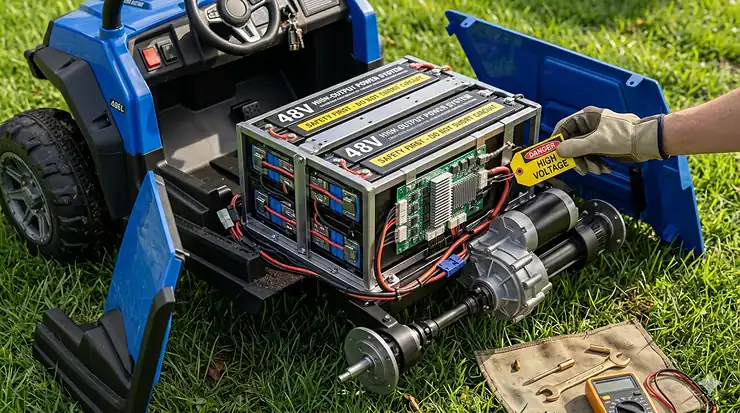
Here’s the short version: 48v ride on toys are battery-powered go-karts, UTVs, and dirt bikes built around a 48-volt power system — the same voltage tier used in a lot of electric mopeds and entry-level e-bikes. That’s roughly double the punch of a typical 24v ride-on car and enough to actually move a kid (or a lighter teenager) at speeds that feel like a real vehicle instead of a glorified scooter.
The jump from 24v to 48v isn’t just “twice as fast.” It changes the whole engineering conversation — frame materials, brake type, suspension, even how the manufacturer talks about age range. A 24v car is built to survive a toddler ramming it into a fence. A 48v go-kart is built to survive an 11-year-old taking a corner too hot on gravel. Different problems, different solutions.
I went looking for what’s actually sitting on Amazon’s shelves right now in this category — not hypothetical specs from a press release, but real listed models with real motor ratings and real weight limits. Below you’ll find seven of them, organized loosely from “entry-level go-kart” to “okay, this one’s basically a teenager’s first motorcycle.” There’s a comparison table up next if you want the 30-second version, and a deeper breakdown after that for anyone who wants to actually understand what they’re buying before they hand over a credit card number.
Quick Comparison: 48V Ride-On Toys at a Glance
| Model | Motor | Top Speed (Adjustable) | Best For |
|---|---|---|---|
| HOVER HEART Electric Go Kart EA500-RA | 1000W brushless | 7 / 15 / 20 mph | First-time go-kart buyers |
| FRP Baja-X Electric Go Kart | 1000W brushless | 13 / 16 / 20 mph | Heavier or older kids (up to 175 lbs) |
| MotoTec 48V Pro Electric Dirt Bike | 1500–1800W lithium | 5–31 mph (fully adjustable) | Riders who’ll grow into more power |
| MotoTec Raider Kids UTV | 1200W shaft-drive | 8 / 15 / 23 mph | Low-maintenance off-roading |
| X-PRO Drax Lite Electric Dirt Bike | 1200W hub motor | 3 speed modes | Smaller riders moving up from 36V |
| Hover Heart Electric UTV (X-Large) | 1000W brushless | Adjustable, chain-driven | Rougher terrain, bigger frames |
| X-PRO 2000W Electric Dirt Bike | 2000W lithium | 15 / 22 / 40 mph | Teens and young adults only |
A pattern shows up fast here: the karts and UTVs cluster around 1000–1200 watts with parent-adjustable speed caps, while the dirt bikes climb higher in both wattage and top speed — and that 40 mph ceiling on the X-PRO 2000W is a real outlier, not a typo. If you’re buying for a kid under 12, you’re almost certainly shopping the top half of this table, not the bottom.
💬 Just one click — help others make better buying decisions too! 😊
✨ A Quick Note Before You Keep Scrolling
If you’ve already got a frontrunner from the table above, jump straight to its full writeup below. If you’re still narrowing things down, the “How to Choose” section further down walks through the questions that actually matter — age, terrain, and how much you trust the parental speed lock to stay locked.
Top 7 48V Ride-On Toys: Real Models, Real Specs
1. HOVER HEART Electric Go Kart EA500-RA
The HOVER HEART Electric Go Kart EA500-RA is the closest thing this category has to a default starter pick, and the spec sheet explains why pretty quickly.
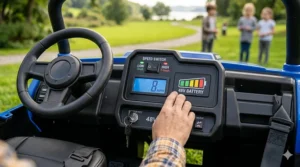
It runs a 1000W brushless motor off a 48V battery, with a tubular steel frame, upper roll bar, and side nerf bars doing the structural heavy lifting. The brushless detail matters more than it sounds — brushed motors wear down internal contacts over years of stop-start kid driving, while brushless setups run cooler and quieter with less mechanical drama. The included parental key locks top speed at 7, 15, or 20 mph, which is the real safety feature here, not the seatbelt. A hydraulic rear disc brake handles stopping power, a notable step up from the drum brakes you’ll find on bargain-bin 24V karts.
What most buyers overlook: 13-inch pneumatic tires ride noticeably softer over lawn ruts and gravel than the solid plastic wheels on cheaper go-karts, which translates directly into fewer bone-jarring bumps for a kid still learning to anticipate terrain.
This is best suited to a family buying their first “real” go-kart — parents who want the 7 mph setting available on day one and the 20 mph setting waiting for when the kid earns it.
✅ Brushless motor needs minimal long-term maintenance
✅ Three-tier parental speed lock genuinely limits top speed
✅ Hydraulic disc brake outperforms drum brakes at this price point
❌ Lead-acid battery adds noticeable weight versus lithium competitors
❌ Steel frame requires occasional rust-prevention upkeep if stored outdoors
Pricing on this one tends to land in the lower-to-middle range for the category — check current price and availability, since stock and color options shift often.
2. FRP Baja-X 48V 1000W Brushless Electric Go Kart
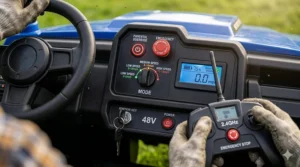
The FRP Baja-X goes head-to-head with the HOVER HEART on paper — same 1000W brushless motor, same 48V system — but two details set it apart: a higher 175 lb weight capacity and forward/reverse functionality built in from the start.
That weight capacity is the real story. Most 48V karts in this price bracket cap out around 150–165 lbs, which quietly excludes a lot of bigger 12-year-olds and smaller teens. FRP built this one to keep working as the rider grows, rather than becoming a hand-me-down problem in eighteen months. The three-speed parental control (13/16/20 mph) skews slightly faster at its lowest setting than the HOVER HEART’s, which is worth knowing if you’re buying for a more cautious first-timer.
In my read of how these steel-frame karts hold up over time, the reverse gear is the feature that actually gets used daily — not for racing, but for the unglamorous job of backing out of a garage corner without a three-point turn.
This fits families with an older or larger kid who’s been turned away from other 48V karts on weight limits alone.
✅ 175 lb weight capacity, above category average
✅ Forward and reverse standard
✅ High-tensile steel frame rated for rougher use
❌ No published lithium option — runs on the heavier lead-acid pack
❌ Minimum speed setting (13 mph) is fast for true first-timers
Expect a price range similar to the HOVER HEART, generally landing in the low-to-mid hundreds.
3. MotoTec 48V Pro Electric Dirt Bike (1500W/1800W Lithium)
This is the one that actually grows with the kid, and that’s the whole pitch behind the MotoTec 48V Pro Electric Dirt Bike.
Instead of a fixed speed cap, it uses two separate adjustment dials: one for top speed (anywhere from 5 mph up to 31 mph) and one for throttle response (from a sluggish 1-second ramp to an instant .2-second snap). That’s a genuinely different design philosophy than the karts above — rather than locking a number and unlocking it later, you’re tuning the bike’s entire personality to match a rider’s confidence in real time. A lithium battery pack (specs vary slightly by listing, generally in the 13–15.6Ah range) keeps the bike lighter than its lead-acid competitors and gets you somewhere between 9 and 16 miles per charge depending on rider weight and terrain — manufacturer figures vary across listings, so treat that as a realistic range, not a guarantee.
Front and rear suspension plus an IPX6 water-resistance rating round it out, meaning puddle splashes and damp grass won’t end the ride early.
Best suited to a parent who wants to buy one bike and keep it relevant for three or four years of skill progression, rather than upgrading models every season.
✅ Adjustable top speed AND throttle response — genuinely grows with the rider
✅ Lithium battery is lighter than lead-acid competitors in this class
✅ Front and rear suspension with IPX6 water resistance
❌ Premium price tier compared to the go-karts above
❌ Real-world range estimates vary noticeably across sources
This sits firmly in the mid-to-premium price bracket — check current pricing, as lithium-powered models fluctuate more than lead-acid ones.
4. MotoTec Raider Kids UTV (48V 1200W)
The MotoTec Raider Kids UTV swaps the chain-drive setup found on most karts for a shaft drive, and that single engineering choice changes the maintenance conversation entirely.
Chain drives need periodic lubrication and occasional tensioning; shaft drives mostly don’t. For a vehicle that’s going to sit in a garage getting used sporadically, that’s a real practical advantage most spec sheets bury under flashier bullet points. The Raider runs a 48V 1200W permanent-magnet DC brushless motor pulling power from four 12V/12Ah sealed lead-acid batteries (48V 12Ah total), with a proper F/N/R gear selector and three speed tiers — 8, 15, and 23 mph. A steel roll cage, seat belt, and dual front/rear shocks round out the safety package, and the manufacturer rates it for riders 13 and up, max weight 165 lbs.
What the spec sheet doesn’t emphasize: a 15-degree climbing angle and 5-inch ground clearance mean this thing is built for actual yard terrain — slopes, ruts, uneven grass — not just flat driveway loops.
This is the pick for families with real off-road space (a yard, a field, rural property) who want something closer to a mini-UTV experience than a kart.
✅ Shaft drive needs far less maintenance than chain-drive competitors
✅ Three-speed range (8–23 mph) covers beginner through confident riders
✅ 15-degree climbing angle and 5″ ground clearance handle real terrain
❌ Recommended for age 13+, ruling out younger kids
❌ Heavier overall package due to four-battery lead-acid setup
Pricing lands in the upper-mid range for this category, reflecting the UTV-style build.
5. X-PRO Drax Lite 1200W Electric Dirt Bike
If the MotoTec Pro above feels like overkill, the X-PRO Drax Lite is the more proportionate option for a kid stepping up from a 36V bike for the first time.
It uses a peak 1200W 48V hub motor — simpler mechanically than a chain-driven setup, since there’s no chain to maintain or derail — paired with a 48V/10.4Ah lithium battery good for roughly 20 miles per charge and about a 6-hour recharge. A built-in charge indicator light is a small but genuinely useful touch; it’s the difference between guessing and knowing when the bike’s actually ready to ride. Ten-inch pneumatic tires with front and rear shock absorbers smooth out grass and dirt paths, and dual disc brakes give it real stopping power for the size class.
The hub motor’s simplicity is the headline feature here. Fewer moving parts means fewer things to break when a kid inevitably lays the bike down learning to corner.
Best suited to younger or smaller riders making their first jump into 48V territory without needing the Pro’s full power ceiling.
✅ Hub motor design means fewer mechanical failure points
✅ Lithium battery with visible charge indicator
✅ Dual disc brakes at a mid-tier price point
❌ Less powerful than the MotoTec Pro for riders who outgrow it quickly
❌ 10″ tires are smaller, less capable on rough terrain than 13″+ options
This generally prices below the MotoTec Pro, in a more accessible mid-range bracket.
6. Hover Heart Electric UTV, X-Large Steel Frame (1000W)
The Hover Heart Electric UTV X-Large takes the brand’s go-kart formula and stretches the frame, aiming squarely at bigger kids and rougher ground.
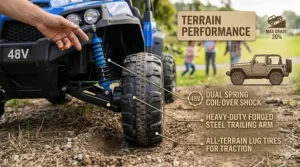
It keeps the 1000W 48V brushless motor and adjustable parental speed control from the standard go-kart line, but adds full suspension and off-road-rated tires, plus a notable drivetrain detail: power runs to both rear wheels through a non-slip rear axle, rather than the single-wheel-drive setup that’s common on cheaper karts in this price range. That distinction matters most on loose surfaces — grass, dirt, gravel — where single-wheel-drive karts tend to spin out one tire while the other sits idle.
A hydraulic rear disc brake and a 90-day limited warranty (covering electrical and vehicle parts, though not tire wear) back it up.
This fits families whose “driveway” is actually a yard, a farm, or anywhere with loose or uneven ground that would frustrate a standard single-drive go-kart.
✅ Dual-wheel rear drive outperforms single-drive karts on loose terrain
✅ Full suspension plus off-road tires
✅ Hydraulic disc brake for real stopping power
❌ 90-day warranty is shorter than some lithium-powered competitors
❌ X-Large frame may be oversized for smaller kids
Price-wise, expect this to sit a notch above the standard-size go-karts due to the larger frame and drivetrain upgrade.
7. X-PRO 2000W 48V 20.8Ah Electric Dirt Bike
Last on the list, and it’s a genuine outlier: the X-PRO 2000W Electric Dirt Bike isn’t really a “kids’ toy” in the way the other six are — it’s positioned for teens and adults, and the spec sheet backs that up loudly.
A 2000W motor (peaking near 4000W on some trims) draws from a substantial 48V/20.8Ah lithium battery, the largest pack on this list, rated for up to 35 miles per charge. Front and rear suspension — including a rear air shock — and a high-density, non-slip seat support riders up to 265 lbs. Three speed modes top out at 15, 22, and a genuinely fast 40 mph in the highest setting.
That 40 mph ceiling is the one number on this entire list that deserves a flashing caution sign. This bike crosses fully out of “ride-on toy” territory into “lightweight electric motorcycle,” and it should be treated, supervised, and gear-equipped that way — full helmet, real motorcycle-rated protective gear, not a bike helmet and a prayer.
Appropriate only for older teens with prior riding experience, ridden exclusively in controlled, private settings.
✅ Largest battery and longest range on this list (up to 35 miles)
✅ 265 lb weight capacity fits teens and smaller adults
✅ Three distinct speed modes for skill progression
❌ 40 mph top speed is genuinely dangerous for younger or inexperienced riders
❌ Not appropriate for kids under early/mid teens regardless of marketed range
This sits at the top of the price spectrum for the category, reflecting both the battery size and motor output.
Getting the Most Out of a 48V Ride-On: Setup, Charging, and the First 30 Days
The first charge matters more than people think. Most 48V lead-acid systems want a full 8-hour charge before the first ride, even if the box says it arrived “partially charged” — running it dry on day one shortens battery life down the road. Lithium packs (like the ones in the MotoTec Pro and X-PRO models) are more forgiving but still benefit from a full initial charge rather than a quick top-off.
For the first few rides, leave the parental speed lock at its lowest setting regardless of how confident your kid claims to be. Nearly every documented injury pattern with these vehicles traces back to a rider exceeding their actual skill level in week one, not a mechanical failure. Bump the speed cap up gradually — weekly, not daily — once braking and steering become automatic instead of deliberate.
Tire pressure is the most-skipped maintenance step. Pneumatic (air-filled) tires on these karts and bikes lose pressure slowly over weeks, and underinflated tires both reduce range and increase rollover risk in tight turns. A $10 bike pump with a gauge solves this in under a minute, monthly.
Who’s This Actually For? Three Realistic Scenarios
The cautious first-timer (age 8–10, suburban driveway): Start with one of the entry-level go-karts — the HOVER HEART EA500-RA or FRP Baja-X — and leave the speed lock on its lowest setting for at least a month. The disc brakes and roll bar matter more here than top speed ever will.
The acreage kid (age 11–14, real yard or rural property): The MotoTec Raider UTV or the Hover Heart X-Large UTV make more sense than a street-style kart. Climbing angle, ground clearance, and dual-wheel drive matter far more than top-speed numbers when the terrain is uneven.
The motorsport-curious teen (15+, prior riding experience): The MotoTec Pro dirt bike’s adjustable throttle response lets an experienced young rider actually feel the difference between settings, which a flat speed-cap kart can’t replicate. The X-PRO 2000W belongs in this category too, but only for older, more experienced teens given that 40 mph ceiling.
Common Problems (And How to Avoid Them)
Problem: The battery dies faster every season. This is almost always a charging-habit issue, not a defect. Charge after every ride rather than waiting until the battery’s fully drained — deep-discharge cycles degrade both lead-acid and lithium packs faster than partial-charge habits.
Problem: The kart pulls to one side on grass or gravel. Single-wheel-drive karts (common on budget models) will do this by design when one tire loses traction. If your terrain is consistently loose or uneven, a dual-drive model like the Hover Heart X-Large UTV solves this structurally rather than requiring you to avoid certain surfaces.
Problem: The kid keeps “accidentally” maxing out the speed lock. Several of these models use a removable physical key for speed control specifically so a determined kid can’t override it through the dashboard. If yours doesn’t, store the speed-setting tool somewhere the rider can’t access independently.
How to Choose a 48V Ride-On Toy: 7 Questions to Ask First
- What’s the actual weight capacity, and where does your kid fall on it? A rider near the upper weight limit will see reduced speed and range — buy headroom, not a perfect fit.
- Does the terrain demand suspension and ground clearance, or just a flat driveway? Flat pavement doesn’t need a UTV’s 5-inch clearance; a bumpy yard does.
- Is the speed control a removable physical key, or a digital setting a curious kid could find? Physical keys are harder to override.
- Lithium or lead-acid? Lithium is lighter and charges faster; lead-acid is cheaper upfront but heavier and slower to recharge.
- What’s the manufacturer’s minimum recommended age, and does it match your actual kid — not your kid’s maturity level, which is a different metric?
- Single-wheel-drive or dual-wheel-drive? Matters enormously on grass, gravel, or dirt; matters less on pavement.
- What does the warranty actually cover? Most exclude tire wear and cosmetic damage — check what’s left.
48V vs. 36V vs. 24V: What the Voltage Jump Actually Buys You
Voltage alone doesn’t determine speed — motor wattage and gearing matter just as much — but it sets the ceiling for how much power a system can realistically deliver without overheating. A 24V system tops out comfortably around 5–8 mph in most consumer ride-ons; that’s the toddler-and-young-kid tier. Step up to 36V and you’re generally looking at 8–12 mph territory, the realistic range for kids around 6–10. The jump to 48V is what unlocks the 15–30+ mph range seen throughout this list, which is also why 48V models almost universally ship with mandatory parental speed locks — the manufacturers know exactly how much more dangerous this tier becomes without one.
Common Mistakes Parents Make When Buying a 48V Ride-On
The most frequent mistake isn’t underestimating speed — it’s overestimating how quickly a kid will respect the speed lock once they realize it exists. Buying “for growth” and skipping the low-speed settings entirely is a close second; nearly every model on this list includes a genuinely slow setting specifically so riders can build muscle memory for braking and steering before speed enters the equation. The third common mistake is buying based on top-speed marketing numbers alone without checking weight capacity — a 20 mph rating means nothing if your kid is twenty pounds over the limit and the motor’s straining to compensate.
Safety, Regulations & What CPSC Actually Says
Ride-on toys sold in the U.S. fall under ASTM F963, the mandatory toy safety standard enforced by the Consumer Product Safety Commission, which sets requirements for things like battery containment, stability, and overload testing. But there’s an important wrinkle specific to this category: the CPSC explicitly notes that certain larger or faster “ride-on toys” can legally cross into the all-terrain vehicle (ATV) classification instead, which is regulated separately under different federal rules. The bigger UTV-style and high-speed dirt bike models on this list sit closer to that line than a basic go-kart does.
The agency’s own battery safety guidance is worth a read too — it specifically flags battery-powered ride-on toys as a documented source of overheating and fire-related recalls over the years, which is the practical argument for using only the charger that shipped with your unit and never leaving a charging battery unattended overnight.
State laws on minors operating off-road vehicles, go-karts, and minibikes vary significantly — some states require helmets for any motorized ride-on toy regardless of speed, others only regulate above certain CC/wattage thresholds. It’s worth a five-minute search for your specific state before assuming “it’s just a toy” exempts you from local rules, particularly for the higher-powered dirt bikes on this list.
🔧 One More Thing Before You Check Out
Helmets and basic pads aren’t optional extras for anything on this list — they’re table stakes the moment a vehicle can clear 15 mph. Budget for safety gear at the same time you budget for the kart itself.
Long-Term Cost & Maintenance: What Checkout Doesn’t Tell You
The sticker price is the smallest number you’ll spend on one of these over its lifespan. Replacement batteries for lead-acid systems typically need swapping every 1–3 years depending on charging discipline, and that’s a real recurring cost worth budgeting for upfront rather than discovering in year two. Pneumatic tires eventually need replacing — usually excluded from warranties, as several listings above note explicitly — and chain-drive models need occasional lubrication that shaft-drive and hub-motor models simply skip. Lithium-powered models cost more initially but tend to need less mid-life maintenance, which is worth weighing against the higher purchase price rather than dismissing as “just more expensive.”
Frequently Asked Questions
❓ How fast do 48v ride on toys go?
❓ What age is appropriate for a 48v ride on toy?
❓ Are 48v ride on toys legal to drive on public streets?
❓ Is lithium or lead-acid better for 48v ride on toys?
❓ How long does a 48v ride-on toy battery last per charge?
Final Verdict
Buying in the 48V category isn’t really about finding the “best” model — it’s about matching a specific vehicle’s engineering decisions to your specific kid’s size, terrain, and trust level. A cautious 9-year-old on a suburban driveway has almost nothing in common, vehicle-wise, with a confident 14-year-old on five acres of farmland, even though both are shopping the same voltage tier.
If you only remember one thing from this whole guide, make it this: the parental speed lock is the actual safety feature, not the seatbelt or the roll bar. Use it, and use it conservatively for longer than feels necessary. Every model above earned its spot on this list, but none of them is safer than the adult holding the speed key.
🏁 Ready to Pick One?
The breakdown above should narrow things to one or two realistic options based on your kid’s age, weight, and where you’ll actually be riding. Check current pricing and availability on whichever model fits — stock and color options shift fast in this category.
Recommended for You
- 6V vs 12V Ride On Toys for Beginners: 7 Best Picks You Won’t Regret (2026)
- Best 6V Battery for Ride On Toys: 7 Top Picks That Last in 2026
- 7 Best Cheap 6V Ride On Toys in 2026 — Real Deals Toddlers Will Love
Disclaimer: This article contains affiliate links. As an Amazon Associate, I earn from qualifying purchases. If you purchase products through these links, we may earn a small commission at no additional cost to you.
✨ Found this helpful? Share it with another parent who’s about to get talked into a go-kart purchase. 💬
