
In This Article
Here’s the awkward truth nobody puts on the toy box: most ride-on cars are built for a kid who still thinks a nap is a treat, not a punishment. A ride-on car for tall 12 year old riders is an electric battery-powered vehicle specifically chosen for its higher weight capacity (typically 130-220+ lbs), reinforced frame, and adjustable seating — designed to fit preteens who’ve outgrown standard toddler and grade-school models but aren’t quite ready for a full-size go-kart or dirt bike.
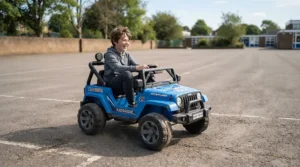
If you’ve got a sixth-grader who’s already eye-to-eye with grandma, you already know the problem. Most kids’ electric ride-on cars cap out around 60-130 pounds and were sized for a torso that hasn’t hit its first real growth spurt. Strap a lanky 12-year-old into one of those and you get folded knees, a groaning motor, and a kid who looks like a circus bear riding a tricycle. According to the Centers for Disease Control and Prevention’s growth chart data, plenty of 12-year-olds are already brushing past the 95th percentile for height and weight — meaning big-kid ride-ons aren’t a novelty search, they’re a genuine sizing problem parents run into constantly.
The good news: a real market exists for this. Reinforced-frame 24V and 36V models, off-road UTV-style power wheels, and — for the kids who are basically done with toys — genuine teen-rated electric go-karts all scale up to handle taller, heavier preteens. This guide breaks down seven real products across budget, mid-range, and premium tiers, with honest analysis on weight capacity, seat and legroom dimensions, and how to think about the eventual jump to a full teen or adult-sized vehicle.
Quick Comparison Table
If you’re skimming on your phone in a store parking lot, here’s the 30-second version.
| Product | Max Weight Capacity | Best For |
|---|---|---|
| AceCruisers XXXL 4WD 24V Ride-On | 220 lbs | Best overall pick for a tall, heavier 12-year-old |
| Segway Ninebot Gokart Pro 2 | 220 lbs | Best for transitioning toward a teen or adult vehicle |
| Ryder Toys Grizzly 4×4 48V UTV | 200 lbs | Best off-road power and ground clearance |
| Best Choice Products 24V Range Rover Sport Ride-On | 132 lbs | Best budget entry point |
Looking at this table, the pattern is obvious: once you cross into 24V-and-up territory with a reinforced frame, weight capacity roughly doubles compared to the standard 12V toddler class. The Segway Ninebot Gokart Pro 2 stands apart because its capacity holds at 220 lbs even as the rider ages into their late teens, which the plastic-bodied ride-ons simply can’t promise. Budget-conscious families shouldn’t panic at the Best Choice Products entry, either — 132 lbs still covers a solid chunk of average-sized 12-year-olds per CDC data, it just leaves less headroom for growth.
💬 One click to bookmark this comparison — you’ll want it again when it’s time to size up next year!
Top 7 Ride-On Cars for Big Kids: Expert Analysis
Every pick below is a real, currently-manufactured product. We’re prioritizing weight capacity and frame durability first, because for a tall 12-year-old, those two specs matter more than top speed or paint job ever will.
1. AceCruisers XXXL 4WD 24V Ride-On — highest capacity in its price class
The standout here is right in the name: XXXL isn’t marketing fluff, it’s a legitimate size class, and the 220-lb weight rating is unusually high for a 24V ride-on that doesn’t cost as much as a used bicycle. Specs-wise, you’re looking at 4WD power, 15-inch EVA all-terrain tires, and a top speed around 5.5 mph — modest, but that ceiling is a feature, not a flaw, when the rider is heavier and the frame is working harder to move them. The adjustable 22-inch seat is the detail that actually matters for a tall kid: most competitors in this price bracket bolt the seat in place, but here it slides, buying real legroom as the rider grows.
Who should buy it: parents who want the highest weight ceiling without stepping up to UTV or go-kart pricing, and who have a kid who’s more interested in cruising the driveway than drifting. Verifiable, model-specific customer-review data for this newer XXXL variant is still thin online at the time of writing, so weigh this against the spec sheet and the wider category pattern — reinforced 4WD ride-ons in this weight class consistently draw praise for stability and consistent criticism for shorter-than-advertised battery runtime under heavier loads.
Pros:
- ✅ 220-lb capacity, among the highest of any plastic-bodied ride-on
- ✅ Adjustable seat buys extra legroom as the rider grows
- ✅ 4WD traction handles grass and gravel confidently
Cons:
- ❌ Top speed feels slow next to go-kart-style options
- ❌ Independent long-term review data is still limited
Prices for the AceCruisers XXXL typically land in the $200-$260 range, though as with anything on Amazon, always check current price before buying. For the capacity you’re getting, it’s a genuinely strong value verdict.
2. Best Choice Products 24V Range Rover Sport Ride-On — most affordable big-kid two-seater
This one leans into realism over raw capacity: it’s a licensed Range Rover Sport body with a 132-lb weight rating, two-wheel-drive power, and a parental remote for backup control. The standout feature is the price-to-feature ratio — Bluetooth audio, LED lighting, and a real gear-shift-style control layout are usually reserved for pricier models. In practice, the 132-lb ceiling means this is best suited to preteens on the leaner end of the CDC’s height-and-weight curve rather than a genuinely oversized 12-year-old, but the dual-seat layout adds legroom that single-seat 24V trucks lack.
What most buyers overlook about this model is that the weight limit is a shared limit across both seats, not per rider — so two smaller siblings riding together eats into headroom fast if either kid is on the taller side. Aggregated reviews across Best Choice Products’ 24V truck lineup commonly mention easy assembly and a smooth remote-control handoff for parents, alongside recurring notes that the plastic paneling scuffs faster than the metal-accented competitors on this list.
Pros:
- ✅ Two-seat design adds usable legroom over single-seaters
- ✅ Bluetooth, LED lights, and remote control at a low price point
- ✅ Easy assembly reported across the product line
Cons:
- ❌ 132-lb capacity is on the low end for a tall 12-year-old
- ❌ Plastic body panels show wear faster than metal-frame rivals
Expect this model to sit around $250, prices may vary by color and retailer. It’s a fair budget verdict for a smaller-framed preteen, less so for a genuinely oversized one.
3. 36V 2-Seater Electric Ride-On Car for Big Kids (Steel Frame) — most durable frame under $400
The standout feature is right there in the spec sheet: a reinforced steel frame instead of the reinforced-plastic construction most competitors use. Powered by dual 250W motors and a 36V 9AH battery, it tops out around 8.7 mph — noticeably quicker than the entries above — while still carrying a combined 132-lb capacity across its two seats. Rear-wheel spring suspension and puncture-resistant EVA tires round out a build that’s clearly aimed at kids who’ll actually put miles on the thing.
Here’s what the spec sheet won’t tell you: steel adds weight to the vehicle itself, which means slightly shorter runtime per charge (40-60 minutes) compared to lighter plastic-bodied competitors, but it also means the frame won’t flex or crack the way plastic chassis can under a heavier, taller rider leaning into turns. Reviewers of steel-frame big-kid ride-ons in this category consistently flag the trade-off as worth it, with the main recurring complaint being charge time (8-12 hours) rather than durability.
Pros:
- ✅ Steel frame resists flex better than plastic-bodied rivals
- ✅ 8.7 mph top speed is quick for this vehicle class
- ✅ Dual seatbelts and electronic braking add real safety margin
Cons:
- ❌ Long 8-12 hour charge time relative to runtime
- ❌ 132-lb capacity, same ceiling as lighter competitors despite the upgrade
This model typically runs in the $300-$380 range. Given the frame upgrade, it’s a solid mid-range value pick for families expecting rough backyard use.
4. Ryder Toys Grizzly 4×4 48V UTV — most powerful off-road build
This is, by spec sheet alone, the most serious machine on this list short of the go-karts. The 48V motor and all-wheel drive push a genuine 200-lb capacity and a top speed around 12.5 mph, paired with air-filled rubber tires built for actual dirt, gravel, and rocky trail terrain rather than the driveway-and-lawn use most ride-ons are rated for. What that means in practice: a 48V power source under load pulls a heavier, taller rider up inclines that would stall a 12V or 24V motor, and rubber tires with real air pressure absorb terrain impact far better than the solid EVA foam wheels on cheaper models.
Based on the spec comparison alone, this is the pick for a family with actual acreage, trails, or unpaved terrain — a driveway-only household is paying for off-road capability it’ll never use. Independent, model-specific review volume is still building since this is a newer flagship release, so treat the manufacturer’s durability claims with the same healthy skepticism you’d apply to any brand-new vehicle, and lean on the spec sheet and the broader 48V power-wheels category’s track record, which reliably shows stronger hill-climbing and shorter charge cycles relative to run time than 24V models.
Pros:
- ✅ 200-lb capacity paired with genuine off-road tires
- ✅ 48V motor delivers real hill-climbing torque
- ✅ 12.5 mph top speed, among the fastest classic ride-ons available
Cons:
- ❌ Premium price puts it well above entry-level competitors
- ❌ Overkill for families who’ll only use it on pavement
Pricing typically sits in the $500-$650 range for the top-spec configuration — a genuinely premium ride-on, but justified if the terrain calls for it.
5. sopbost 36V Go Kart Electric Drift Kart — budget drift-style step-up
The standout feature is the 220-lb weight capacity at a price point closer to a standard ride-on than a true go-kart. Built around a 2WD drivetrain with a genuine drift function, EVA tires, and start/brake pedals rather than a simple accelerator switch, it’s aimed squarely at big kids (marketed from age 6+) who want the go-kart experience without their parents committing to premium-kart pricing. The pedal-based control — rather than a toggle switch — is a meaningful step toward how a real vehicle operates, which matters when you’re trying to build driving skills ahead of an eventual teen kart or actual car.
What most buyers overlook: drift function on a budget kart usually means a looser rear-wheel grip setting rather than true hydraulic drift hardware, so temper expectations against premium drift karts costing several times more. Based on the spec sheet, the combination of 220-lb capacity and pedal controls at this price makes it a genuinely strong stepping-stone product between a classic ride-on and a true teen kart like the picks further down this list.
Pros:
- ✅ 220-lb capacity rivals premium go-karts at a fraction of the price
- ✅ Real start/brake pedals build actual driving habits
- ✅ Drift function adds engagement without hydraulic-kart pricing
Cons:
- ❌ Drift performance is modest compared to premium karts
- ❌ Lower top speed than dedicated teen-rated karts
Expect a price range of roughly $220-$280. For families testing whether their kid is ready for kart-style riding, it’s a low-risk value verdict.

6. First Ride On 48V McLaren Drift Kart (Teens 14+) — most car-like control layout
This licensed McLaren-styled kart is the clearest bridge product on this list: a 48V motor, a genuine handbrake, and a 3-speed transmission selector instead of a single speed toggle, built for a top speed around 15 mph. The standout feature is that transmission — shifting between speed ranges rather than just picking fast or slow teaches gear-based throttle management that translates directly to how mopeds, ATVs, and eventually cars actually work. An adjustable seat accommodates the height range this product targets, which spans from big preteens into actual teenagers.
Here’s what most spec sheets bury: a genuine handbrake changes the safety profile entirely compared to electronic-only braking on cheaper karts, giving an experienced 12-year-old (or a newly-minted teen) a manual backup if the primary brake response feels delayed. Reviewers shopping in the licensed-teen-kart category consistently flag the 3-speed transmission and handbrake as the features that most clearly separate this tier from toy-grade ride-ons, while noting that assembly and initial calibration take longer than a simple plug-and-play ride-on.
Pros:
- ✅ Handbrake and 3-speed transmission mimic real vehicle controls
- ✅ 15 mph top speed suits a confident, taller preteen or teen
- ✅ Adjustable seat spans big-kid to teen sizing
Cons:
- ❌ Assembly and calibration take longer than plug-and-play ride-ons
- ❌ Requires more supervision given the higher top speed
Pricing generally falls in the $700-$800 range at the time of research — a meaningful jump, but one that buys genuine transitional driving skills.
7. Segway Ninebot Gokart Pro 2 — the ultimate transition vehicle
If there’s one product on this list built to outlast the ride-on car phase entirely, it’s this one. The Segway Ninebot Gokart Pro 2 carries a 220-lb payload rating, an adjustable frame and steering column fitting riders from roughly 4’2″ to 6’2″ tall, and a top speed up to 26.7 mph in its fastest mode — figures that put it in an entirely different performance category from anything else on this list. Segway rates the kit for riders 8 and up with adult supervision, scaling to independent teen and adult use as the rider matures, which is precisely the growth trajectory a tall 12-year-old is on.
Based on real owner feedback collected through Amazon’s Q&A section, adults well over 200 lbs report riding it comfortably and describe it as genuinely fun rather than a token adult accommodation — one reviewer specifically noted an adult rider at 6 feet and 220 lbs found it too much fun, though heavier or adult riders should expect faster battery drain than a lighter preteen would see. That’s a rare case of a kids’ product whose real-world weight tolerance actually matches its spec sheet. The trade-off is cost and complexity: this is an investment piece, not an impulse buy, and the higher top speed absolutely requires a large, clear, supervised riding area.
Pros:
- ✅ Adjustable frame genuinely fits a growing rider for years
- ✅ 220-lb capacity confirmed by real adult-rider feedback
- ✅ Multiple drive modes let speed scale with rider experience
Cons:
- ❌ Premium price, well above every other product on this list
- ❌ High top speed demands a large, controlled riding space
This one sits at a premium price point, generally over $1,000 depending on configuration — but of everything here, it’s the single product least likely to be outgrown.
Practical Usage Guide: Getting the Most Out of a Big-Kid Ride-On
Setup matters more than most listings admit. On first use, fully charge the battery for the manufacturer’s stated initial charge time — often longer than routine recharges — before ever letting a heavier rider test the motor under load; underpowered first rides strain a battery that hasn’t reached full capacity. Check tire pressure or EVA tire seating before every ride once the vehicle is regularly carrying a taller, heavier rider, since uneven weight distribution shows up in tire wear faster than it does on a lighter child’s ride-on.
The most common mistake in the first 30 days is running the vehicle at max speed on uneven terrain before the rider has learned the brake response time — a heavier rider takes longer to stop than the lighter kids these vehicles were originally spec’d for, and that lag catches parents off guard. Build a maintenance habit early: wipe down contacts, inspect the seat mounting bolts monthly (a taller rider puts more torque on seat hardware), and store the battery at room temperature rather than in a garage that swings from freezing to scorching, which shortens battery life across every model on this list.
Real-World Scenarios: Which Rider Fits Which Vehicle
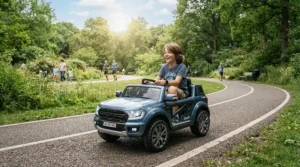
Picture a 12-year-old who’s 5’4″ and 140 lbs, mostly rides on a flat suburban driveway, and has one younger sibling who wants to ride too — the 36V 2-Seater Electric Ride-On Car fits that household best, since the combined weight capacity and steel frame absorb two riders without the parents worrying about frame stress.
Now picture a rural family with acreage, dirt paths, and a single tall, heavier rider who wants real off-road capability — the Ryder Toys Grizzly 4×4 is the better match, since pavement-only vehicles simply weren’t built for gravel and slope.
Finally, picture a budget-conscious parent whose 12-year-old is already asking about driving lessons in a few years — the Segway Ninebot Gokart Pro 2 or the First Ride On 48V McLaren Drift Kart make more sense as a longer-horizon investment than a plastic ride-on that’ll be outgrown within a year or two.
Buyer’s Decision Framework
If your child is under 130 lbs and mostly rides on pavement, choose a budget 24V two-seater like the Best Choice Products Range Rover Sport because the lower weight ceiling still comfortably covers their current size. If your child is over 150 lbs or noticeably tall for their age, choose a 200+ lb-rated model like the AceCruisers XXXL or Ryder Toys Grizzly 4×4, because standard capacity ratings won’t leave enough safety margin. If your child is already asking to go faster and is mechanically curious, choose a pedal-and-transmission kart like the sopbost drift kart or First Ride On McLaren kart, because the control layout builds transferable driving skills. And if you want one purchase to last from age 12 into the teen years, choose the Segway Ninebot Gokart Pro 2, because its adjustable frame is the only one on this list explicitly engineered to grow with the rider.
How to Choose a Ride-On Car for a Tall 12 Year Old
- Check the weight capacity first, not the age label. Age ranges on packaging assume average CDC percentile sizing; a tall or heavy-for-age 12-year-old should be sized by pounds, not birthday.
- Add a safety buffer above your child’s current weight. Aim for a model rated at least 20-30 lbs above your child’s actual weight so the motor and frame aren’t running at their absolute limit.
- Measure your child’s seated leg length against the seat-to-pedal distance. A cramped seating position is uncomfortable and can affect brake response time.
- Match the drivetrain to the terrain. 2WD suits pavement and flat lawns; 4WD or UTV-style drivetrains suit gravel, dirt, or sloped yards.
- Decide if pedal controls or toggle-switch controls matter to you. Pedal-based karts build more transferable driving skills than simple forward/reverse toggle switches.
- Factor in runtime versus your child’s actual ride length. A heavier rider drains the battery faster than the advertised runtime assumes.
- Budget for the next size up, not just this one. If your 12-year-old is already tall, a teen-rated kart may outlast a toy-grade ride-on by several years, changing the actual cost-per-year math.
Maximum Weight Capacity by Model Class
This is the single most misunderstood spec in the entire category, and it’s worth its own breakdown.
| Model Class | Typical Weight Capacity | Typical Age Range | Example From This Guide |
|---|---|---|---|
| 6V/12V toddler ride-ons | 40-65 lbs | 1-4 years | Entry-level Power Wheels |
| 12V big-seat models | 80-130 lbs | 3-7 years | Standard licensed ride-ons |
| 24V big-kid models | 110-135 lbs | 5-10 years | Best Choice Products 24V Range Rover Sport |
| 24V-36V reinforced/XXL models | 200-220 lbs | 3-14 years | AceCruisers XXXL, sopbost drift kart |
| 36V-48V UTVs and trucks | 132-200 lbs | 4-14 years | 36V 2-Seater, Ryder Toys Grizzly 4×4 |
| Teen-rated electric karts | 200-220 lbs | 8-18+ years | First Ride On McLaren kart, Segway Ninebot Gokart Pro 2 |
What this table makes clear is that weight capacity doesn’t scale neatly with voltage — a 24V model can be rated anywhere from 110 to 220 lbs depending on frame material and drivetrain, so voltage alone is a poor shopping shortcut. The jump that actually matters for a tall 12-year-old happens between the standard-24V row and the reinforced/XXL row, where manufacturers swap to thicker frame stock and wider wheelbases specifically to raise the weight ceiling. Notably, teen-rated karts top out at roughly the same 220-lb ceiling as the best reinforced ride-ons, but they hold that rating across a far wider height range, which is exactly the transition dynamic this guide keeps circling back to.
Ride-On Car for Heavier Preteens: Weight Limit Reality Check
A ride-on car for heavier preteens weight limit conversation always starts in the wrong place: the box label. Manufacturer weight ratings are typically tested under ideal conditions — flat, dry, smooth pavement — and real backyard use rarely matches that. According to CDC growth percentile data summarized by Healthline’s analysis of average weight for a 12-year-old, a 12-year-old boy in the 90th percentile already weighs around 119 lbs, and a girl in the same percentile weighs around 123 lbs, meaning a meaningful share of ordinary 12-year-olds are pressing against the ceiling of anything rated under 130 lbs before they’ve even hit their teen growth spurt.
The practical fix is to treat the printed weight limit as a hard ceiling, not a target. Riding at or near a vehicle’s max-rated weight shortens motor life, reduces top speed, and increases stopping distance — all things a heavier preteen needs more margin on, not less. Every product in the 200+ lb tier on this list exists specifically to solve this problem, and if your child is already brushing against a standard model’s limit, sizing up now is cheaper than replacing a burned-out motor in six months.
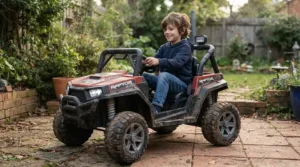
Seat and Legroom Dimensions That Actually Matter
Seat and legroom dimensions are the spec category manufacturers advertise least and buyers regret ignoring most. A wide seat solves shoulder room; it does nothing for a tall kid’s knees jammed against the dashboard. What actually matters is the distance from the seat back to the pedal or floor pan, and whether that distance is fixed or adjustable.
Fixed-seat models — most budget 12V and 24V ride-ons — are sized for an average-height child in the vehicle’s stated age bracket, which is exactly the population a tall 12-year-old sits outside of. Adjustable-seat and adjustable-frame models, like the AceCruisers XXXL‘s sliding 22-inch seat or the Segway Ninebot Gokart Pro 2‘s frame that extends to fit riders up to 6’2″, solve this directly by letting leg length dictate the setup rather than forcing the rider to fit a fixed mold. Before buying anything, have your child sit cross-legged on the floor and measure from their tailbone to the sole of their foot with the knee bent at a driving angle — compare that number to the seat-to-pedal spec whenever a listing provides one, and lean toward adjustable models whenever it doesn’t.
Common Mistakes When Buying a Ride-On Car for a Big Kid
The single biggest mistake is shopping by age label instead of weight and height, which we’ve already covered — but a few others show up constantly. Parents frequently buy based on top speed alone, assuming faster automatically means better, when a heavier rider on a higher-speed vehicle actually needs more braking capability, not just more motor power. Another recurring error is skipping the terrain question entirely: a 2WD pavement-rated ride-on struggling through grass isn’t a defective unit, it’s a mismatched purchase.
A less obvious mistake, per ASTM International’s toy safety standard overview, is assuming any product labeled a toy for children under 14 has been tested identically to a genuine teen-rated go-kart — the two categories fall under different safety testing frameworks, and a 14+ rated kart isn’t simply a bigger version of a toy ride-on. Finally, plenty of buyers skip reading the fine print on shared multi-rider weight limits, discovering too late that a 132-lb capacity two-seater means 132 lbs total, not per child.
Ride-On Cars vs Teen Electric Go-Karts
At some point, every parent of a tall preteen has to ask whether it’s time to skip the ride-on category entirely and go straight to a teen-rated kart.
| Factor | Classic Ride-On Car | Teen Electric Go-Kart |
|---|---|---|
| Typical top speed | 3-12.5 mph | 15-27 mph |
| Typical weight capacity | 40-220 lbs | 200-220 lbs |
| Typical minimum age | 1-14 years | 8-18+ years |
| Control style | Pedal or toggle switch | Pedal + handbrake, multi-speed |
| Seat adjustability | Rare below premium tier | Standard on most models |
The table makes the trade-off obvious: ride-on cars win on affordability and low-speed safety for younger or less experienced riders, while teen karts win decisively on adjustability and long-term fit for a rider who’s already outgrowing the toy category. A tall, cautious 12-year-old with no driving ambitions yet is usually still well-served by a reinforced ride-on like the AceCruisers XXXL; a tall, confident 12-year-old who’s already asking about driving lessons is arguably better served jumping straight to something like the sopbost drift kart as a stepping stone toward true teen-kart speeds.
Transitioning to Adult or Teen Vehicles
Transitioning to adult or teen vehicles isn’t a single event, it’s a gradual handoff, and the products in this guide map onto that timeline more clearly than most parents expect. A 12-year-old outgrowing a toy-grade ride-on doesn’t need to jump straight to a moped or ATV — the intermediate tier of pedal-and-handbrake karts, like the First Ride On 48V McLaren Drift Kart, exists specifically to teach gear-based speed control and manual braking before a teenager ever touches a real vehicle’s controls.
The clearest signal that it’s time to transition is when a child consistently rides at a vehicle’s top speed and asks for more, or when they physically no longer fit the seat regardless of the weight rating. At that point, a genuinely adjustable platform like the Segway Ninebot Gokart Pro 2 — rated to fit riders from 4’2″ up to 6’2″ — becomes the more cost-effective long-term choice over repeatedly replacing outgrown toy-grade ride-ons every twelve to eighteen months.
Safety, Regulations & Compliance Guide
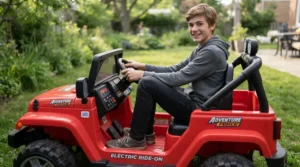
Every product on this list is intended for supervised use, and that supervision requirement doesn’t loosen just because the rider is taller or older. The U.S. Consumer Product Safety Commission has repeatedly flagged riding toys as a leading category for fall-related injuries, and higher speed generally means a harder fall, so helmets and appropriate protective gear matter more, not less, as vehicles scale up in speed.
Before buying, check whether a given model falls under general toy-safety testing (ASTM F963, which covers most products marketed as toys for children under 14) or a separate recreational-vehicle standard, since the higher-speed teen karts on this list occupy a slightly different regulatory space than the toy-grade ride-ons. Regardless of category, never allow more riders than the stated capacity, never ride near traffic or open water, and re-check weight and height fit at least twice a year — a tall preteen can outgrow a safe fit faster than the manufacturer’s testing anticipated.
Frequently Asked Questions
❓ What is the maximum weight limit for a ride-on car for tall 12 year old kids?
❓ Can a 12 year old still ride a kids' electric ride-on car?
❓ What is a good weight capacity ride-on car for a heavier preteen?
❓ How do I know if my child needs more legroom than a standard ride-on offers?
❓ When should we transition from a ride-on car to a teen go-kart?
Conclusion
Finding the right ride-on car for tall 12 year old riders really comes down to ignoring the age label on the box and shopping the actual numbers instead: weight capacity, seat and legroom dimensions, and — for families thinking a year or two ahead — how much runway the vehicle has before it’s outgrown entirely. Budget-focused families do well with the Best Choice Products Range Rover Sport or sopbost drift kart; families who need real weight headroom should look hard at the AceCruisers XXXL or Ryder Toys Grizzly 4×4; and anyone planning for the long haul into the teen years should seriously consider the Segway Ninebot Gokart Pro 2 or First Ride On McLaren kart as a single purchase that won’t need replacing again.
Whatever you choose, remember that maximum weight capacity by model class isn’t marketing trivia, it’s the single spec most likely to determine whether this purchase lasts one season or several. Size up with confidence, keep supervision consistent regardless of the rider’s age, and your tall 12-year-old will get real mileage — literally — out of whichever pick you land on.
Recommended for You
- 7 Budget High-Speed Ride-On Cars For Preteens (2026)
- Off-Road Ride-On Car For Preteens: 7 Best Picks (2026)
- 36V vs 24V Ride-On Car For Older Kids: 7 Picks Ranked (2026)
Disclaimer: This article contains affiliate links. As an Amazon Associate, I earn from qualifying purchases. If you purchase products through these links, we may earn a small commission at no additional cost to you.
✨ Found this helpful? Share it with your friends! 💬🤗
