
In This Article
Picture a 15-year-old, a gravel lane, and a machine that leaps off the line without a single drop of gasoline. That’s the pitch, and it’s a good one. An off-road electric vehicle for teenagers is a battery-powered UTV, ATV, or go-kart built for trails, fields, and private land, with a frame, speed limiter, and rider rating sized for older kids and young adults rather than toddlers or full-grown farmhands. Choosing the right off-road electric vehicle for teenagers, though, is trickier than any shopping page admits.
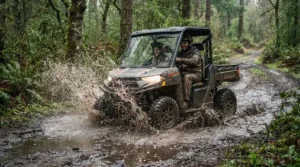
Here’s the problem. Marketing labels blur together: the same 48V side-by-side is a “kids’ ride-on” on one page and an “adult off-road vehicle” on the next. A side-by-side (UTV) seats riders next to each other inside a roll-cage structure and steers with a wheel, while an ATV is straddled like a motorcycle. Weight ratings contradict each other from listing to listing. And a shiny 3000W number says nothing about whether your six-foot sophomore will actually fit.
So this guide does the unglamorous work. I dug through manufacturer specs, retailer listings, and published safety guidance to shortlist seven real machines, from a budget quad in the high-$500s to a full-size mini jeep near $4,000. Every pick gets plain-English interpretation, an honest look at what reviewers report (or a frank note when the review pool is thin), and a verdict on who it suits. Whether you’re weighing an electric UTV for teenagers, a go-kart, or a quad, you’ll see which trade-offs are real. One promise: I haven’t ridden any of these, so you won’t find invented test-drive stories. Just specs, sources, and straight reasoning.
Quick Comparison Table: Off-Road Electric Vehicle for Teenagers Shortlist
| Model | Type | Motor / Voltage | Listed Rider Capacity | Best For |
|---|---|---|---|---|
| MotoTec Raider | UTV | 1200W / 48V | 165 lb | Mid-size teens who want a roll cage |
| QEASET 48V UTV | UTV | 1000W / 48V | Confirm on listing | Budget side-by-side with speed keys |
| Venom E Grizzly 1500W | ATV | 1500W / 48V | About 330 lb (150 kg) | Older, larger teens on trails |
| Freddo Beast XL | 4-seat buggy | 600W / 48V | 330 lb combined | Group rides on mild ground |
| QEASET 48V Electric Go-Kart | Go-kart | 1000W / 48V | Confirm on listing | Speed fans on open, smooth ground |
| Droyd Animal | Youth ATV | 500W / 36V | 143-165 lb (varies by listing) | Smaller, younger teens |
| Venom Safari 3000W | Mini jeep | 3000W / 60V | Confirm on listing | Older teens on private land |
The rider-capacity column is where this shortlist gets interesting. The Venom E Grizzly 1500W and the Freddo Beast XL both advertise about 330 lb, but one is a single-rider quad and the other spreads that figure across four seats. Meanwhile, the Droyd Animal is the only pick built mainly for younger, smaller riders, so bigger teens should look higher up the table.
💬 Just one click — help others make better buying decisions too!😊
Top 7 Options for an Off-Road Electric Vehicle for Teenagers: Expert Analysis
1. MotoTec Raider — roll cage and full suspension
Most listings for an electric UTV for teenagers brag about speed. The MotoTec Raider brags about structure, with a steel tubular frame, roll bar, seat belt, and dual shocks at both ends.
A 1200W brushless shaft-drive motor pulls from four 12V/12Ah sealed lead-acid batteries (48V total), with three speed steps of roughly 8, 15, and 23 mph. In practice, the 8 mph step is the one to lock in for a beginner. Shaft drive means no chain to tension or lube. Riders are rated up to 165 lb and 5’10”, so this suits mid-sized teens, while taller ones will feel cramped. With 5 inches of ground clearance, 15 x 5.0-6 tires, and a claimed 15-degree climbing angle, think fields, fire roads, and packed trails rather than boulders.
Here’s what the spec sheet won’t shout: braking comes from one foot-operated hydraulic disc on the rear axle, so stopping on loose gravel deserves practice before speed. At 196 lb, it’s also a chore to recover from a bog.
Reviews are thin. The only buyer review I found on a major retailer listing was positive, noting a rear tire that arrived flat but inflated without trouble. That’s one anecdote, not a consensus.
Pros:
- ✅ Roll bar and seat belt come standard
- ✅ Dual front and rear shocks for bumpy ground
- ✅ Shaft drive removes chain upkeep
Cons:
- ❌ Rear-only foot-operated hydraulic disc brake
- ❌ Short 60-day parts warranty
Expect around $1,400-$1,600 depending on the assembly option. That’s fair value if rollover protection matters to you. Check current price.
2. QEASET 48V UTV — budget side-by-side with speed keys
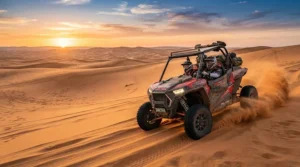
The QEASET 48V UTV is the cheapest way into a true side-by-side layout on this list, and its parental speed keys are the real headline.
A 48V 1000W brushless motor and sealed lead-acid battery deliver a 15 mph top speed and a claimed 60-90 minutes of run time. The keys cap speed at 7, 11, or 15 mph, so a nervous 13-year-old and a confident 16-year-old can share one machine at different settings. Steel frame, shock absorbers, disc brakes, and an adjustable seat cover the basics. A sibling Amazon listing for a similar QEASET 48V UTV also mentions a 5-point harness, forward-neutral-reverse switching, and a 90-day limited warranty that excludes tire wear.
Now the analysis. That 15 mph ceiling is a feature for beginners and a limit for thrill-seekers. The marketing is also inconsistent: one retailer calls it an adult vehicle, another pitches it as a child’s first ride-on. Treat that as a cue to confirm the rider weight rating before buying, because I couldn’t find it stated clearly.
I couldn’t verify meaningful buyer-review sentiment, so I won’t characterize it. Look for real owner photos and post-delivery notes before ordering.
Pros:
- ✅ Three-step speed key: 7, 11, or 15 mph
- ✅ Steel frame with shocks and disc brakes
- ✅ Claimed 60-90 minutes per charge
Cons:
- ❌ Rider weight rating not clearly stated
- ❌ Lead-acid pack is heavier than lithium
Retailer listings sit around $1,000-$1,200 after markdowns, and some add $150-$300 in separate shipping, so compare delivered cost. It’s strong value if the rating checks out. Prices may vary.
3. Venom E Grizzly 1500W — 330-lb rating for bigger teens
The Venom E Grizzly 1500W is the muscle car of the quads here, and it’s built to be grown into rather than outgrown.
Its 1500W brushless motor runs a 48V lead-acid system through a rear shaft drive with a differential, so there’s no exposed chain. The frame has a 28.5-inch seat height, a 39-inch wheelbase, and 19-inch knobby tires, which the maker compares to a 125cc gas ATV. Load rating is about 150 kg (roughly 330 lb). A governor plug caps speed at around 9 mph (15 km/h). Unplugged, it reaches about 19-20 mph. One roundup notes that most electric quads sold through Amazon are youth models capped at 66-165 lb, so this rating is unusual.
The catch is age. The Consumer Product Safety Commission says riders under 16 belong on youth-model ATVs, and this one is billed as adult-capable. Treat it as a 16-plus machine.
Independent review data was scarce; most pages I found were seller copy. Replacement parts are a bright spot: the maker lists a spare 48V pack around $600, a controller near $300, and a charger near $100.
Pros:
- ✅ Roughly 330 lb rated load leaves headroom
- ✅ Rear shaft drive with hydraulic braking
- ✅ Governor plug caps top speed
Cons:
- ❌ Too large for younger teens
- ❌ Lead-acid pack, claimed ride time near two hours
Listings I found put it near the $2,000 mark, though US pricing varies. Check current price.
4. Freddo Beast XL — four seats, 330 lb combined
The Freddo Beast XL is the odd one out, a four-seat dune buggy built for a teen and their crew rather than a solo rider.
A 600W brushless motor with a true differential runs on two 24V 14Ah batteries (48V). Top speed is about 11.2 mph, with a claimed 50-70 minutes per charge. You also get full suspension, tubeless air tires, key start, a pedal brake, and adjustable leather seats. It’s rated for ages 14 and up. If you want a ride-on vehicle for teens with high weight limit headroom, this one delivers, but read the fine print: 330 lb is a combined figure across all seats, not one big rider.
Here’s the honest analysis. Freddo’s own site calls these toys, not real off-road machines. That fits the numbers: 600W and 11 mph suits lawns, gravel, and park paths, not mud or steep hills. The “world’s fastest” tagline is relative to kids’ ride-ons, not to the UTVs on this list.
Testimonials on retailer pages are glowing but few and unverified, so treat them as marketing-adjacent.
Pros:
- ✅ Seats four with a 330 lb combined rating
- ✅ True differential and full suspension
- ✅ Tubeless air tires for a softer ride
Cons:
- ❌ 11.2 mph top speed limits rough-terrain fun
- ❌ Maker labels it a toy, not an off-road machine
I couldn’t verify a current price range in my research, so check current price before budgeting.
5. QEASET 48V Electric Go-Kart — quickest on open ground
The QEASET 48V Electric Go-Kart trades ground clearance for pace, topping out at 20 mph.
A 1000W brushless motor on a 48V system drives 13-inch all-terrain tires, with a high-tensile steel frame, 4-point seat belt, and hydraulic disc brake. The parental key selects 7, 15, or 20 mph. Compared with the UTVs above, the appeal is a low center of gravity that corners flat and feels sporty. The trade-off shows up in the UTV vs go-kart off-road capability debate: karts sit low, and the listing doesn’t state ground clearance, a notable omission.
My read: this suits a teen who wants speed on packed dirt, grass tracks, or gravel lots, not one crossing ruts and roots. The listing also doesn’t mention a roll cage, so the seat belt is your main restraint.
I couldn’t verify buyer sentiment for this model, so I’m not characterizing it. Rider weight rating isn’t clearly stated either.
Pros:
- ✅ 20 mph top speed with a three-step key
- ✅ 4-point seat belt
- ✅ Hydraulic disc brake and 13-inch all-terrain tires
Cons:
- ❌ Ground clearance and rider rating not clearly listed
- ❌ No roll cage mentioned in the listing
I couldn’t confirm pricing. Comparable 1000W electric go-karts from other brands list around $1,250-$1,500, a useful benchmark. Check current price.
6. Droyd Animal — lithium battery on a budget quad
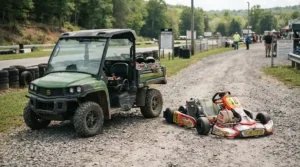
The Droyd Animal is the value pick for younger teens, one of the few sub-$650 quads with a lithium iron phosphate (LFP) battery.
A 36V 500W brushless motor drives the rear wheels by chain, with a parental key for 10 or 15 mph. You also get dual suspension, disc brakes, pneumatic tubeless tires, and a top storage case. Claimed ride time is about 60 minutes, or roughly 8-10 miles. Listings disagree on details: capacity appears as 143, 150, or 165 lb, and battery size appears as both 8Ah and 15Ah.
Here’s what matters. This is a youth quad rated for ages 6 and up, so it fits smaller teens best. One owner review on a retailer page said a 9-year-old weighing about 87 lb barely fit, with knees near the front fenders, and bottomed out the shocks by rocking. That reviewer’s takeaway is worth heeding: a 145-lb rating on paper doesn’t mean it feels right for a big kid.
Pros:
- ✅ LFP lithium battery in a budget quad
- ✅ Parental key: 10 or 15 mph
- ✅ Dual suspension and disc brakes
Cons:
- ❌ Small frame, so older teens outgrow it quickly
- ❌ Weight rating and battery specs vary by listing
Expect around $550-$650. It’s good value for a 12-13-year-old, poor value for a tall 16-year-old.
7. Venom Safari 3000W — full-size mini jeep near 35 mph
The Venom Safari 3000W is the premium pick, and it plays a different game entirely.
A 3000W motor on a 60V 32Ah lead-acid battery pushes it to about 35 mph, with an automatic transmission, reverse, and Rabbit/Turtle speed modes. Ground clearance is 10 inches, double the MotoTec Raider, on 20.5×8-10 tires, backed by disc brakes and upgraded suspension. It seats two under a roll bar and roof, and LED lights, turn signals, and a digital display are included. Claimed range is around 22 miles (35 km). The retailer describes it as suitable for adults and older teens.
On paper, this is the most capable machine here for rough ground, and the tire and suspension specs for rough terrain back that up. But 35 mph is more than three times the speed of the Freddo Beast XL. I found no parental speed-key, so Turtle mode is the only built-in brake on enthusiasm. This is a 16-plus machine for supervised riding on private land.
I couldn’t verify meaningful buyer reviews, so I’m making no claims about owner sentiment.
Pros:
- ✅ 10-inch clearance and 20.5×8-10 tires
- ✅ Roll bar, roof, and seating for two
- ✅ Automatic transmission with a low-speed mode
Cons:
- ❌ 35 mph top speed is too much for novices
- ❌ Premium price with a lead-acid battery
Expect roughly $4,000-$4,300 and a 1-year limited warranty. It’s worth it only if you truly need the clearance and two seats. Check current price.
Top 7 Specs and Price Ranges at a Glance
| Model | Battery | Top Speed | Tires / Clearance | Price Range | Best For |
|---|---|---|---|---|---|
| MotoTec Raider | 48V 12Ah sealed lead-acid | 8 / 15 / 23 mph | 15 x 5.0-6; 5 in | $1,400-$1,600 | Roll-cage seekers |
| QEASET 48V UTV | Sealed lead-acid | 7 / 11 / 15 mph | Deep-tread all-terrain; size not listed | $1,000-$1,200 | Budget UTV buyers |
| Venom E Grizzly 1500W | 48V lead-acid | About 9 (governed) / 19-20 mph | 19 in knobby | Near $2,000 (verify) | Taller teens, 16+ |
| Freddo Beast XL | 2 x 24V 14Ah | 11.2 mph | Tubeless air; size not listed | Not verified | Group riding |
| QEASET 48V Electric Go-Kart | Not listed | 7 / 15 / 20 mph | 13 in all-terrain | Not verified | Open-ground speed |
| Droyd Animal | 36V LFP | 10 / 15 mph | Pneumatic tubeless; size not listed | $550-$650 | Small young teens |
| Venom Safari 3000W | 60V 32Ah lead-acid | About 35 mph | 20.5×8-10; 10 in | $4,000-$4,300 | Older teens, big terrain |
I left out star ratings deliberately, because I couldn’t verify consistent review data for most of these models. Looking across the table, the MotoTec Raider and QEASET 48V UTV bracket the sensible middle, while the Venom Safari 3000W costs about three times as much for clearance and speed most teens don’t need. If your budget is tight, the Droyd Animal works only when the rider is small enough for it.
How to Choose an Off-Road Electric Vehicle for Teenagers
Here’s the direct answer: choose the smallest machine your teen fits comfortably that still meets their weight, terrain, and age needs, then cap its speed. Work through these steps in order.
- Start with age, not horsepower. Penn State Extension’s youth ATV guide explains that CPSC treats 90cc-and-up ATVs as adult-size and suggests riders be 16 or older. Electric models have no cc rating, so apply the same logic to frame size and power.
- Check weight and height ratings with headroom. Add gear weight and stay well under the limit, since range and braking degrade near the ceiling.
- Pick the vehicle type. UTVs offer roll bars and seat belts, karts offer speed on smooth ground, and quads offer agility but demand more skill.
- Insist on a speed limiter. Keys, governors, and low-speed modes let one machine grow with the rider.
- Inspect tires, suspension, and clearance. These decide whether the vehicle handles your terrain or just looks like it can.
- Weigh battery chemistry and parts availability. Lithium is lighter, while lead-acid is cheaper to replace, but either way confirm replacement packs exist.
- Confirm where you’ll ride. Private land, state rules, and landowner permission come before checkout.
Ride-On Vehicle for Teens with High Weight Limit: Reading the Numbers Honestly
Shopping for a ride-on vehicle for teens with high weight limit ratings means learning to distrust a single number. First, ask whether the capacity is per rider or combined. The Freddo Beast XL lists 330 lb across four seats, while the Venom E Grizzly 1500W lists about 330 lb for one rider. Those aren’t equivalent.
Second, capacity isn’t fit. A compact youth quad rated for 250 lb can still be too small for a large teen’s knees, reach, and seat position. The Droyd Animal shows this in its own listings, which range from 143 to 165 lb, with one reviewer reporting shocks bottoming out on a much lighter child.
Third, weight affects performance. Heavier riders shorten battery range, soften braking, and stress suspension. So if your teen is near a listed limit, step up a size rather than hoping the numbers hold. When a ride-on vehicle for teens with high weight limit claims sounds too generous for the motor wattage, cross-check speed, brakes, and frame size before trusting it.
UTV vs Go-Kart Off-Road Capability: Which Handles Rough Ground Better?
Short answer: UTVs win on rough ground, karts win on smooth speed. The UTV vs go-kart off-road capability gap comes down to clearance, suspension travel, and structure. The MotoTec Raider offers 5 inches of clearance and dual shocks at both ends, and the Venom Safari 3000W offers 10 inches. The QEASET 48V Electric Go-Kart lists 13-inch all-terrain tires but no clearance figure.
| Feature | UTV | Go-Kart | ATV (Quad) |
|---|---|---|---|
| Ground clearance | Moderate to high | Low | Moderate |
| Rollover protection | Roll bar common | Belt only, usually | None |
| Passengers | Side by side | Usually one | Usually one |
| Handling feel | Stable, car-like | Sporty, low | Agile, rider-dependent |
| Best For | MotoTec Raider, Venom Safari 3000W | QEASET 48V Electric Go-Kart | Venom E Grizzly 1500W, Droyd Animal |
Looking at the table, UTVs give newer riders the most forgiveness. A roll bar and belt matter more than raw power when a teen misjudges a rut. Karts reward smooth surfaces and punish washouts, so keep them on packed ground. Quads offer the most agility but the least protection, which is why age and training matter most there.
Tire and Suspension Specs for Rough Terrain: What Actually Matters
Tire and suspension specs for rough terrain decide how a machine feels far more than wattage does. Start with tire notation. On the MotoTec Raider, 15 x 5.0-6 means roughly 15 inches tall, 5 inches wide, on a 6-inch rim. The Venom Safari 3000W runs a taller, wider 20.5×8-10, which explains why it clears obstacles the Raider can’t.
Next, tire construction. Pneumatic tubeless tires, as on the Droyd Animal and Freddo Beast XL, absorb bumps better than the hard foam wheels common on cheap ride-ons. Knobby tread, like the Venom E Grizzly 1500W‘s 19-inch tires, bites loose dirt but wears faster on pavement.
Suspension is the other half. Dual shocks front and rear, as on the MotoTec Raider, spread impacts. But shock travel is finite: the Droyd Animal owner review noted bottoming out at a low rider weight. Ground clearance completes the picture. Five inches handles ruts, while ten handles logs and rocky washes.
Electric UTV for Teenagers: Who It Fits Best
An electric UTV for teenagers suits three types of rider. First, the nervous beginner, aged 12-14, who benefits from a roll bar, belt, and speed key. The QEASET 48V UTV and MotoTec Raider both fit that description. Second, the sibling-sharing family: one machine, different speed settings. Third, the teen who does farm or property chores and needs a stable, two-seat platform.
It suits others less well. Very tall teens will outgrow the MotoTec Raider‘s 5’10” rating. Speed-hungry riders may find 15 mph dull, so the go-kart or a quad fits better. And for an off-road electric vehicle for teenagers who are 17 and heading toward adult size, the Venom Safari 3000W or Venom E Grizzly 1500W offers longer-term room. Basically, match the vehicle to the rider’s next two years, not just this summer.
Safety Gear for Off-Road Riding: The Non-Negotiable Kit
Even a 15 mph machine can hurt someone who’s dressed for the mailbox. Good safety gear for off-road riding is boring, cheap by comparison, and decisive. Nemours KidsHealth’s teen ATV safety guide recommends helmets with full face shields that meet Department of Transportation standards, and shatterproof goggles rather than sunglasses if the helmet lacks a visor.
Here’s a solid baseline kit:
- Helmet: full-face, DOT-certified, snug and level, replaced after any serious impact
- Eye protection: shatterproof goggles or a visor
- Gloves and boots: over-the-ankle footwear with grip
- Clothing: long pants and long sleeves, even in summer
- Belts: always buckled in UTVs and karts, every ride
Add a personal rule: no passengers unless the vehicle is designed for them, and no riding at night. Nemours also notes that teens shouldn’t give rides even on two-person machines.
Age Limits and Rules for an Off-Road Electric Vehicle for Teenagers
Rules for an off-road electric vehicle for teenagers vary by state, but the safety baseline is consistent. The CPSC advises that riders under 16 drive only age-appropriate youth models, never adult ATVs. It also recommends helmets, protective gear, hands-on training, and staying off paved roads. The agency estimates about 94,700 off-highway-vehicle injuries were treated in US emergency departments in 2022, a sobering reminder that “electric” doesn’t mean “harmless.”
Practically, that means three checks. Confirm the manufacturer’s age label, since the Droyd Animal targets ages 6-plus while the Venom E Grizzly 1500W and Venom Safari 3000W target older or adult riders. Look up your state’s youth-operation and safety-certificate rules, some of which apply from age 16. And confirm where riding is legal, because most of these machines are private-land vehicles, not street-legal ones.
Long-Term Cost and Maintenance of an Off-Road Electric Vehicle for Teenagers
The sticker price is only chapter one. Battery chemistry shapes the long-term math. Lead-acid packs, used in the MotoTec Raider, QEASET 48V UTV, Venom E Grizzly 1500W, and Venom Safari 3000W, are cheaper up front but heavier. LFP lithium, like the Droyd Animal‘s, is lighter and typically more forgiving of storage.
Replacement parts tell the real story. For the Venom E Grizzly 1500W, the maker lists a spare pack near $600, a controller near $300, and a motor with gearbox near $500. So a battery replacement can approach a third of the vehicle’s cost.
Here’s a hypothetical: a $1,500 machine ridden 40 weekends a year for three seasons costs about $12 per outing before batteries. That beats most paid activities. Maintenance stays modest, mostly tires, brakes, shocks, and connections. Keep batteries from sitting depleted, since long discharge shortens their life.
Practical Guide: Setting Up and Surviving the First 30 Days
Your first month sets the habits. Follow this sequence:
- Assemble carefully. Many units ship 70-90% assembled, and paid assembly is optional on some. Recheck every bolt after the first ride.
- Charge fully per the manual and use only the supplied charger.
- Check tire pressure. The flat tire on one MotoTec Raider review shows it’s worth checking before day one.
- Set the lowest speed key. Leave it there for the first several rides.
- Build a practice zone. Flat, open, no obstacles, so braking and turning become instinct.
- Log each ride. Note battery drain and any odd noises.
Common first-month mistakes include leaving the battery drained, using the wrong charger, overloading the frame, and skipping brake checks. Adding a weekly 5-minute inspection catches most problems early.
Real-World Scenarios: Matching Three Teen Riders to the Right Machine
These are illustrative profiles, not real people.
Scenario 1: the 13-year-old on two flat acres. About 100 lb, weekend rides, budget under $650. The Droyd Animal at its 10 mph setting fits: small frame, lithium battery, parental key. Expect roughly an hour per charge, and expect to outgrow it in a season or two.
Scenario 2: two brothers and a cousin on a family farm. Ages 14 and 16 plus a younger cousin, dirt lanes, mild slopes, budget near $1,500, rides most weekends. The MotoTec Raider gives whoever’s driving a roll bar and belt, while the Freddo Beast XL hauls the whole crew across gentle ground. Everyone wears proper safety gear for off-road riding regardless.
Scenario 3: the 17-year-old on ranch hills. 6’1″, 190 lb, riding three to four days a week, budget $2,000-$4,000-plus. The MotoTec Raider‘s 5’10” limit rules it out. The Venom E Grizzly 1500W suits solo trail riding, and the Venom Safari 3000W suits two-seat outings, with speed discipline.
Problem-to-Solution Guide: Fixing Common Off-Road Electric Ride Headaches
Problem: range collapses on hills. Drop to a lower speed step, remove cargo, and plan loops that finish near home. Rider weight and inclines both shorten battery life.
Problem: a flat or soft tire on delivery. Check pressure before the first ride. One MotoTec Raider buyer reported exactly this and fixed it with air.
Problem: shocks bottom out. The Droyd Animal owner review points to a size mismatch. Move to a larger machine rather than riding harder.
Problem: the teen wants more speed. Use the keys as a reward ladder: 7 mph, then 11, then 15 after demonstrated skill. Never remove a limiter to end an argument.
Problem: winter storage. Keep the battery charged periodically during long storage, and store it dry and indoors where possible.
FAQ
❓ How much does a good off-road electric vehicle for teenagers cost?
❓ Can an adult ride the same electric UTV for teenagers?
❓ Are these vehicles street legal?
❓ Which battery type is better, lead-acid or lithium?
❓ How long does a charge last on an off-road electric ride?
Conclusion
Here’s the honest summary. The best off-road electric vehicle for teenagers isn’t the fastest or the biggest. It’s the one that fits your teen’s size, age, and terrain, with a speed limit that grows alongside their skill.
For most mid-sized riders, the MotoTec Raider offers the best balance of structure and price, though its 5’10” limit matters. The QEASET 48V UTV is the budget route once you confirm its rating. If you need a ride-on vehicle for teens with high weight limit headroom, look at the Venom E Grizzly 1500W for solo riders or the Freddo Beast XL for groups on mild ground. Speed lovers on smooth ground may prefer the QEASET 48V Electric Go-Kart, smaller teens can start on the Droyd Animal, and the Venom Safari 3000W suits older riders on big private land. Whatever you choose, an electric UTV for teenagers works best when paired with proper gear, training, and rules.
✨ Ready to Ride Smarter?
🏁 Click any highlighted product name above to check current pricing and availability, then pair your pick with a helmet, goggles, and a clear set of house rules. Your teen’s first great off-road summer starts with a smart choice!
Recommended for You
- Go-Kart Vs Mini Electric Car For Teens: 7 Best Picks (2026)
- Ride-On Car For Tall 12 Year Old: 7 Big-Kid Picks For 2026
- 7 Budget High-Speed Ride-On Cars For Preteens (2026)
Disclaimer: This article contains affiliate links. As an Amazon Associate, I earn from qualifying purchases. If you purchase products through these links, we may earn a small commission at no additional cost to you.
✨ Found this helpful? Share it with your friends! 💬🤗
