
In This Article
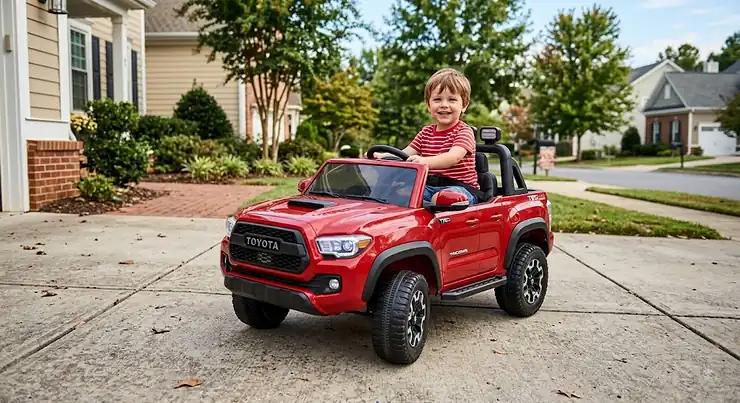
A toyota tacoma ride on car for kids is a scaled-down, battery-powered replica of Toyota’s real pickup, built with a working steering wheel, foot pedal, headlights, and (on most models) a parent-operated remote so grown-ups can step in when little legs get tired. It’s the kind of gift that makes a five-year-old feel like the mayor of the driveway. If you’ve spent any time scrolling toy listings, you already know the category is crowded — half a dozen brands slap “officially licensed Toyota Tacoma” on boxes that look nearly identical from the thumbnail, and the real differences only show up once you dig into motor wattage, suspension type, and how the doors actually latch.
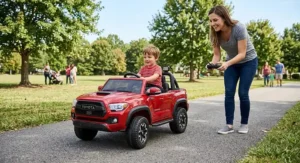
That’s the gap this guide fills. Rather than repeating spec sheets you could find on any retailer page, we pulled together seven real, currently available models — spanning entry-level 12V runabouts to two-seater 24V trucks — and broke down what each one actually delivers once the batteries are charged and the neighborhood kids show up. We’ll cover a licensed toyota ride on truck at every price tier, dig into what makes a toyota tacoma trd ride on version different from the standard trim, and get honest about which features (durable plastic body panels, working LED taillights, EVA foam tires) are worth paying extra for and which are marketing garnish. Outdoor, ride-based play also happens to be one of the simplest ways families build in the daily movement pediatric researchers keep asking for, which is worth remembering the next time your kid begs for “five more minutes” in the driveway.
Quick Comparison Table
| Model | Voltage | Top Speed | Best For |
|---|---|---|---|
| Garvee Officially Licensed Toyota Tacoma 12V Kids Ride On Car | 12V | ~2-2.5 mph | Budget-conscious first-timers |
| uhomepro Licensed Toyota Tacoma Ride on Car | 12V | ~2 mph | Families wanting ASTM-certified peace of mind |
| Kimbosmart Licensed Toyota Tacoma Ride-On Car | 12V | 3.5 km/h (~2.2 mph) | Toddlers who love opening/closing doors |
| Blitzshark 12V Kids Ride on Car Licensed Toyota Tacoma | 12V | ~2.5 mph | Rougher backyard terrain, dual-motor pull |
| ENYOPRO Officially Licensed Toyota Tacoma TRD Pickup | 12V | 1.4-2.8 mph | TRD-trim fans, safety-feature shoppers |
| Kidzone 12V Ride-On Truck Licensed Toyota Tacoma | 12V | 1.5-2.6 mph | Bluetooth/audio-focused families |
| WISAIRT 24V Ride On Car Licensed Toyota Tacoma 2-Seater | 24V | 1.86-5 mph | Two kids, longer driveways, older toddlers |
Looking at the spread, voltage tells you less than it seems to — most of these 12V trucks cap out in a nearly identical 1.5-2.8 mph band, so the real differentiators are suspension quality, certification, and whether a second kid gets a seat. The WISAIRT 24V Ride On Car Licensed Toyota Tacoma 2-Seater stands apart simply because it’s built for two riders and a genuinely faster top end, while the ENYOPRO Officially Licensed Toyota Tacoma TRD Pickup earns its spot for buyers who specifically want the TRD badge and extra circuit protection. If your driveway is flat and your kid is under four, the horsepower race barely matters.
💬 Just one click — help other parents make a smarter pick too!😊
Top 7 Toyota Tacoma Ride On Cars for Kids: Expert Analysis
1. Garvee Officially Licensed Toyota Tacoma 12V Kids Ride On Car — most widely stocked entry point
The Garvee Officially Licensed Toyota Tacoma 12V Kids Ride On Car is the one you’ll bump into first, since it sits on shelves at both Target and Home Depot, and that retail footprint matters more than it sounds — wide availability usually means easier returns and faster replacement parts. Toyota Tacoma-style boxes are almost always about the same, but Garvee’s is one of a handful sold through big-box retailers rather than exclusively online, which tends to correlate with tighter quality control.
Spec-wise it runs a 12V battery with a listed 2-4 km/h top speed (roughly 1.2-2.5 mph) and includes the parent remote control that’s become standard across this category — a feature that matters more than it sounds once a toddler realizes the pedal makes the truck go and promptly floors it toward the flower bed. Based on the retail listings, this model leans toward younger toddlers rather than aggressive backyard drivers, given its modest top speed.
Because it’s sold through mainstream retailers rather than niche toy sites, aggregated buyer feedback tends to focus on assembly time and how sturdy the plastic feels out of the box — themes that show up repeatedly across this entire product category, not unique complaints. If you want a licensed toyota ride on truck without hunting through a marketplace of look-alikes, this is the low-friction choice.
Pros:
- ✅ Sold through major retailers for easy returns
- ✅ Parent remote control included standard
- ✅ Straightforward assembly per listing details
Cons:
- ❌ Top speed on the slower end of the category
- ❌ Limited color options compared to rivals
Priced typically in the $220-$260 range at the time of research, it lands mid-pack — not the cheapest toy truck on the internet, but you’re paying partly for the retail backing.
2. uhomepro Licensed Toyota Tacoma Ride on Car — ASTM F963-certified build
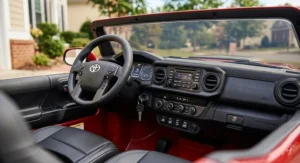
The uhomepro Licensed Toyota Tacoma Ride on Car leads with something that should matter more to parents than it usually does: explicit ASTM F963 certification listed right in the product description, rather than a vague “safety tested” claim. That’s the toy-safety standard mandated by the Consumer Product Safety Improvement Act, and a manufacturer stating it outright is a small but real signal of transparency.
Beyond the paperwork, it packs the now-familiar combo of MP3 playback, FM radio, front-and-rear four-wheel setup, and a one-button start that toggles forward and reverse. What stands out on paper is the “flash drive port,” a detail that’s easy to skim past but useful if you’d rather load a kid’s own playlist than rely on FM static. The wear-resistant wheel claim is common marketing language across this category, so treat it as a baseline expectation rather than a standout feature.
A recurring theme in owner discussions of this style of ride-on is that the remote’s one-key lock function — letting parents disable the vehicle entirely — gets flagged as genuinely useful for nap-time standoffs, not just a bullet point on the box.
Pros:
- ✅ ASTM F963 certification explicitly stated
- ✅ MP3, AUX, and flash-drive audio options
- ✅ Remote lock function for parent control
Cons:
- ❌ Battery runtime not clearly specified upfront
- ❌ Fewer color/trim variants than bigger brands
Expect a price in the low-to-mid $200s. Given the certification transparency, it’s a solid value pick if compliance documentation is your priority.
3. Kimbosmart Licensed Toyota Tacoma Ride-On Car — realistic opening doors and headlights
Sold through Magic Cars, the Kimbosmart Licensed Toyota Tacoma Ride-On Car puts its emphasis on the theater of pretend driving: two doors that genuinely open and close, plus working LED headlights that switch on with the ignition rather than staying permanently lit. That combination sounds minor until you watch a three-year-old insist on “unlocking” the truck before every trip around the yard — the ritual is half the fun at this age.
Top speed clocks in at 3.5 km/h (about 2.2 mph), which is conservative even by this category’s cautious standards, and the seat comes with an adjustable belt rather than a fixed one, so it can grow with your kid over a season or two. What most buyers overlook about slower-speed models like this one is that the reduced top end isn’t a flaw for toddlers under four — it’s closer to a feature, since it buys parents an extra beat of reaction time before “go” turns into “gone.”
Magic Cars backs the truck with a one-year bumper-to-bumper warranty, though tires and batteries are explicitly excluded as wear items — worth knowing before you assume everything’s covered.
Pros:
- ✅ Fully functional opening doors
- ✅ Working LED headlights on ignition
- ✅ One-year warranty on core components
Cons:
- ❌ Slower top speed than most competitors
- ❌ Battery and tires excluded from warranty
Price sits in the roughly $200-$250 window depending on active promotions, positioning it as a solid mid-range pick for the door-and-lights experience specifically.
4. Blitzshark 12V Kids Ride on Car Licensed Toyota Tacoma — dual-motor power for uneven ground
The Blitzshark 12V Kids Ride on Car Licensed Toyota Tacoma is one of the few 12V models in this lineup running dual motors instead of one, paired with a thickened iron structural frame rather than an all-plastic chassis. In practice, dual motors on a 12V platform won’t turn your driveway into a rally stage, but they do mean less bogging down when a kid drives off pavement onto grass or gravel — a common failure point for single-motor budget trucks.
The seat measures a genuinely spacious 15.75 inches, which matters more as kids age past the toddler bracket, and the truck is rated for riders up to 66 pounds, giving it real staying power through the preschool years rather than a single growth-spurt summer. Based on the spec sheet, battery life runs 1-2 hours per full 8-10 hour charge — on the shorter end for the category, so plan charging around nap time rather than expecting all-day play.
A remote-mounted emergency brake button is a small but genuinely useful safety detail; it lets a parent kill momentum instantly rather than fumbling for a standard stop command, which matters most in the first week before a toddler learns the pedal isn’t a toy within a toy.
Pros:
- ✅ Dual motors handle uneven terrain better
- ✅ Spacious 15.75-inch seat, 66-lb capacity
- ✅ Emergency brake button on the remote
Cons:
- ❌ Battery life shorter than average (1-2 hrs)
- ❌ Iron-reinforced frame adds noticeable weight
At around $230-$280, it’s priced for what it delivers: more structural durability than the plastic-only competition, at a modest premium.
5. ENYOPRO Officially Licensed Toyota Tacoma TRD Pickup — the toyota tacoma trd ride on pick
If your kid (or you) specifically wants the TRD badge, the ENYOPRO Officially Licensed Toyota Tacoma TRD Pickup is the clearest toyota tacoma trd ride on option currently on the market, marketed explicitly under that trim name rather than a generic “Tacoma-style” label. TRD in the real automotive world stands for Toyota Racing Development and signals off-road-tuned trim — on a kids’ ride-on, that mostly translates to bolder graphics and trim badging rather than functional off-road hardware, and it’s worth setting that expectation early so nobody’s disappointed the “TRD” toy doesn’t actually climb rocks.
Functionally, it runs dual speeds plus reverse across a 1.4-2.8 mph range, foot-pedal-and-steering-wheel manual control, and a suspension wheel system paired with adjustable seat belts and lockable doors. What separates it from several competitors on paper is the stated overcharge and overload protection circuitry — a detail aimed squarely at parents who’ve read one too many news story about lithium battery mishaps, even though most of these ride-ons use sealed lead-acid batteries rather than lithium.
The listing also cites both ASTM and CPC certification, doubling down on the safety-first branding that seems to be this model’s core pitch versus rivals leaning harder into audio features.
Pros:
- ✅ Genuine TRD-trim branding and styling
- ✅ Overcharge/overload circuit protection
- ✅ Dual ASTM and CPC certification cited
Cons:
- ❌ “TRD” is cosmetic, not functional off-road
- ❌ Speed range on the modest side
Expect roughly $200-$250. If the TRD look is the whole point of the purchase, this is currently the most direct match for that specific ask.
6. Kidzone 12V Ride-On Truck Licensed Toyota Tacoma — Bluetooth-equipped for road-trip playlists
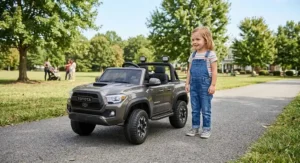
The Kidzone 12V Ride-On Truck Licensed Toyota Tacoma leans hardest into the entertainment side of the category, bundling Bluetooth alongside the usual FM radio, AUX, and USB inputs — a genuinely useful upgrade if your kid has opinions about music and you’d rather stream a playlist from your phone than dig for a flash drive. It also offers openable doors and an electric foot pedal, echoing features found on pricier trucks in this lineup.
Where it distinguishes itself functionally is the dual-mode speed system: three speeds available via the 2.4G remote, but only two when the child drives manually via pedal — a deliberate design choice that caps a solo toddler’s top speed below what a parent can unlock remotely for slightly older kids. That’s a thoughtful bit of graduated-independence engineering that not every competitor bothers with.
The available color range (including options like pink and green, per retailer listings) gives it broader appeal for families who want something other than the standard black or gray Tacoma look.
Pros:
- ✅ Bluetooth plus FM/AUX/USB audio options
- ✅ Graduated speed caps for manual vs. remote
- ✅ Wide color selection across retailers
Cons:
- ❌ Manual-mode top speed capped fairly low
- ❌ Some color variants priced higher than base
Pricing runs roughly $210-$260 depending on the color and current retailer promotions, putting it squarely in line with the rest of the mid-tier field.
7. WISAIRT 24V Ride On Car Licensed Toyota Tacoma 2-Seater — the premium two-kid option
Stepping up to 24V, the WISAIRT 24V Ride On Car Licensed Toyota Tacoma 2-Seater is built for a different use case entirely — two riders, dual motors, and a genuinely wider speed range of 1.86-5 mph that can accommodate an older, more confident driver alongside a younger sibling riding shotgun. The 4-wheel suspension is a meaningful step up from the spring-only setups on several 12V rivals here, smoothing out bumps that would otherwise rattle a single-seat truck.
Rated for ages 3-8, it has more runway than most 12V trucks that quietly get outgrown by kindergarten. The tradeoff is size and storage — a two-seater pickup replica takes up real garage space, and parents should measure their storage area before ordering rather than after the box arrives. Based on the spec comparison against the rest of this lineup, the jump from 12V to 24V is less about raw speed bragging rights and more about sustained power delivery when two kids’ combined weight is on board.
Because it’s a newer entrant in the licensed Toyota lineup, verified long-term review data is thinner than for the established 12V models — worth factoring in if a multi-year track record matters to your decision.
Pros:
- ✅ Two-seater layout for siblings or friends
- ✅ Wider 1.86-5 mph speed range
- ✅ Genuine 4-wheel suspension system
Cons:
- ❌ Larger footprint needs real storage space
- ❌ Fewer long-term reviews than older models
Expect a premium price range, generally $300-$400, reflecting the extra motor, battery capacity, and seating.
Practical Usage Guide: Setup, First 30 Days & Maintenance
Most of these trucks arrive semi-assembled, and manufacturers across the board estimate around 30 minutes to finish setup with basic tools — steering wheel, mirrors, and sometimes the seat need attaching. Before the first drive, fully charge the battery even if it shows partial charge out of the box; a shallow first charge cycle can shorten overall battery lifespan on sealed lead-acid packs, which is what most of these 12V and 24V trucks use.
In the first 30 days, resist the urge to hand over the remote and walk away. Every model here includes some form of parent override, but kids figure out the accelerator fast, and the emergency stop function only helps if you’re within reach of the controller. Once your child has the basics down, gradually shift from remote-led to pedal-led driving — several models, like the Kidzone 12V Ride-On Truck Licensed Toyota Tacoma, are built around exactly this kind of graduated independence.
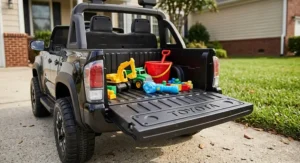
Maintenance is minimal but not zero. Wipe down durable plastic body panels after muddy sessions to prevent grit from working into door hinges and wheel axles, check tire tread every few months since most trucks use PP plastic wheels rather than true EVA foam tires (more on that distinction below), and store the battery indoors during freezing temperatures — cold weather is the single biggest silent killer of ride-on toy batteries.
Real-World Scenarios: Which Toyota Tacoma Ride-On Fits Your Family
The cautious first-timer: If your child just turned three and has never driven anything faster than a tricycle, prioritize a slower top speed and full remote control over horsepower. The Kimbosmart Licensed Toyota Tacoma Ride-On Car, with its conservative 2.2 mph ceiling and working doors to keep hands occupied during the learning curve, fits this profile well.
The two-kid household: Parents refereeing sibling turns every ten minutes should look hardest at the WISAIRT 24V Ride On Car Licensed Toyota Tacoma 2-Seater. Two seats eliminate the single biggest source of backyard conflict in this category — whose turn it is — and the wider speed range gives an older sibling room to actually enjoy driving rather than crawling along at toddler pace.
The budget-first buyer furnishing a big yard: If durability against grass, gravel, and the occasional curb matters more than audio bells and whistles, the dual-motor Blitzshark 12V Kids Ride on Car Licensed Toyota Tacoma earns its price with a reinforced frame built to survive rougher terrain than a smooth driveway.
Regular active, self-directed movement like this kind of driveway driving is exactly the sort of unstructured play researchers have linked to stronger gross motor and coordination outcomes in toddlers, so the “which truck” decision matters less than simply making sure the truck gets used regularly.
Problem → Solution: Common Ride-On Toyota Tacoma Issues
Problem: Battery drains faster than expected. Most 12V models here run 1-2 hours per charge, and cold weather or hilly terrain shortens that further. Solution: charge fully before every outing and consider a second battery pack if your child plays daily — several brands, including uhomepro and Kidzone, sell compatible replacement batteries separately.
Problem: Truck struggles on grass or slight inclines. Single-motor 12V trucks were designed primarily for flat pavement. Solution: if your yard has any real slope, prioritize dual-motor options like the Blitzshark 12V Kids Ride on Car Licensed Toyota Tacoma or step up to a 24V model with more torque headroom.
Problem: Toddler ignores the pedal and just wants remote control. This is developmentally normal at age three. Solution: let them ride passenger-style via remote for the first few sessions, then physically guide their foot to the pedal during short supervised bursts until muscle memory kicks in.
Problem: Plastic body panels scuff or crack after a fall season outdoors. Solution: durable plastic body panels hold up to sun and mild impact, but prolonged UV exposure does fade colors over a year or two — storing the truck in a garage or under a cover between uses meaningfully extends cosmetic life.
How to Choose a Licensed Toyota Ride On Truck
Picking the right licensed toyota ride on truck comes down to matching seven practical criteria to your child’s age, yard, and patience level:
- Age and weight fit — Check the manufacturer’s weight cap (commonly 44-66 lbs across this lineup) rather than just the age range, since kids vary widely in size.
- Voltage and speed range — 12V trucks suit toddlers just learning; 24V models like the WISAIRT 24V Ride On Car Licensed Toyota Tacoma 2-Seater suit confident preschoolers.
- Certification transparency — Prefer listings that explicitly cite ASTM F963, the mandatory U.S. toy safety standard, the way ASTM’s own safety announcement describes it, rather than vague “safety tested” language.
- Terrain compatibility — Match motor count and suspension type to your actual driving surface, not the marketing photos of smooth pavement.
- Remote-control range and override — A working emergency stop and reliable remote range matter more once your kid is fast enough to outrun your reflexes.
- Storage footprint — Single-seaters store far more easily than two-seaters like the WISAIRT; measure your garage or shed before ordering.
- Warranty scope — Read what’s actually covered; batteries and tires are frequently excluded, as with the Kimbosmart’s one-year warranty.
Toyota Tacoma TRD Ride On vs Standard Trim: What’s the Real Difference
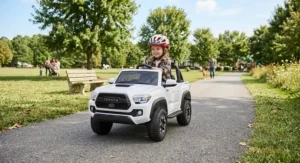
On the real truck, TRD (Toyota Racing Development) trim means upgraded suspension, off-road tuning, and aggressive styling. On a toyota tacoma trd ride on toy like the ENYOPRO Officially Licensed Toyota Tacoma TRD Pickup, the honest answer is that the difference is almost entirely cosmetic — bolder graphics, TRD badging, and marketing language borrowed from the adult vehicle, layered onto essentially the same 12V drivetrain used across this category.
That’s not a knock on the product; badge appeal is a completely legitimate reason to buy a toy, especially if your family already owns or admires the real Tacoma TRD. What buyers should avoid assuming is that the TRD name implies meaningfully different off-road capability, extra ground clearance, or a tougher suspension versus standard-trim competitors like the Kidzone 12V Ride-On Truck Licensed Toyota Tacoma. Judge the ENYOPRO on its stated safety features — dual certification and overcharge protection — rather than the TRD name alone, and you’ll make a clearer-eyed purchase decision.
Durable Plastic Body Panels vs EVA Foam Tires: Features That Actually Matter
Two phrases show up constantly in this product category, and they deserve separate scrutiny. Durable plastic body panels — typically a hard ABS or PP plastic shell — are genuinely important, since they take the brunt of curb bumps, sibling collisions, and general backyard abuse. Nearly every model in this roundup, from the Garvee Officially Licensed Toyota Tacoma 12V Kids Ride On Car to the uhomepro Licensed Toyota Tacoma Ride on Car, relies on this kind of shell, and thickness varies more than most listings admit.
EVA foam tires are a separate claim worth reading carefully. Based on the spec sheets gathered for this roundup, most Toyota Tacoma ride-ons — including every model featured here — actually use wear-resistant PP plastic or rubberized wheels rather than true EVA foam tires; foam tires are more common on higher-end ride-on categories like kids’ ATVs and some premium jeeps. If a listing specifically advertises EVA foam tires, verify it directly on the current product page rather than assuming it’s standard across the Tacoma lineup, since that feature isn’t universal here. What actually matters more day-to-day is whether the wheel has any suspension behind it — spring suspension, present on the Blitzshark and WISAIRT models, does more for ride comfort than tire material alone.
Working LED Taillights and Lighting Features: Hype vs Reality
Working LED taillights and headlights show up in almost every listing photo, and the honest reality is that lighting quality varies more than brightness specs suggest. Front LED headlights that activate with ignition — as seen on the Kimbosmart Licensed Toyota Tacoma Ride-On Car and the Kidzone 12V Ride-On Truck Licensed Toyota Tacoma — genuinely add to the pretend-driving experience, especially for evening driveway sessions.
Rear lighting claims deserve a slightly more skeptical read. Not every listing clearly documents whether “LED lights” means functional brake-style taillights that dim and brighten with speed changes, or simply always-on decorative LEDs molded into the tail panel. If working LED taillights specifically — meaning lights tied to braking or reversing, not just static illumination — matter to your child’s play experience, confirm the exact lighting behavior on the current product listing rather than assuming it from the marketing photo, since this is one of the areas where language across competing brands blurs together.
Toyota Tacoma Ride On Cars for Different Ages and Family Sizes
For toddlers around ages 2-3, prioritize slower top speeds and full remote override — models like the Kimbosmart Licensed Toyota Tacoma Ride-On Car fit this stage well, since the driving experience is still mostly parent-guided. Preschoolers aged 4-6 are typically ready for the standard 12V pedal-and-steering-wheel setup found across most of this lineup, where manual control becomes the primary mode and the remote shifts to a backup safety net.
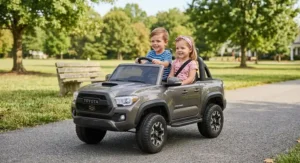
Families with two kids close in age should weight the decision toward the WISAIRT 24V Ride On Car Licensed Toyota Tacoma 2-Seater rather than buying two separate single-seaters — it’s a genuine space and cost efficiency, and research on toddlers’ play preferences suggests shared active play carries social benefits beyond the motor-skill gains of solo driving. Older siblings around ages 6-8 who’ve outgrown standard 12V speed ranges are really the primary audience for the 24V step-up, since most 12V trucks top out around 2.5-2.8 mph regardless of brand.
Long-Term Cost & Maintenance
The sticker price is only part of the ownership math. Replacement batteries for 12V ride-ons typically run separately from the initial purchase and should be budgeted for every 1-2 years of regular use, since sealed lead-acid batteries degrade with charge cycles regardless of how carefully they’re maintained. Tires, as with most ride-on toys, are treated as consumable wear items excluded from warranty coverage — the Kimbosmart’s one-year warranty explicitly carves this out, and it’s a fair assumption across the category rather than a unique gap.
Cost-per-use tends to favor the pricier options if your family gets multiple seasons out of the truck. A WISAIRT 24V Ride On Car Licensed Toyota Tacoma 2-Seater at a higher upfront price but a 3-8 age range spreads its cost over more years than a 12V truck that a single toddler outgrows by kindergarten. Total cost of ownership should factor in one likely battery replacement, occasional tire swaps, and the realistic play lifespan of two to four years for most households.
Common Mistakes When Buying a Licensed Toyota Ride On Truck
The most frequent misstep is buying strictly on age-range labeling without checking the weight cap — a tall three-year-old can exceed a truck’s 44-lb limit well before the “ages 3-6” label suggests it’s time to size up. A close second is assuming every listing photo’s lighting, door, or suspension features apply universally across brands; as covered above, working LED taillights and EVA foam tires are specific claims that don’t hold for every Tacoma-style model, so read each listing individually rather than pattern-matching from a competitor’s page.
Buyers also frequently underestimate storage footprint, especially with two-seater options, and skip verifying whether ASTM certification is explicitly stated versus implied. Finally, many parents skip test-charging the battery before the first big outing — starting a birthday party with a truck that’s only 40% charged is an avoidable disappointment.
Safety, Regulations & Compliance Guide for Battery-Powered Ride On Toys
Every battery-powered ride-on toy sold in the U.S. must comply with ASTM F963, the mandatory toy safety standard incorporated into federal law under the Consumer Product Safety Improvement Act. Per CPSC’s own toy safety guidance, certain battery-operated and ride-on toys carry additional labeling and instructional literature requirements beyond the base standard, which is part of why listings that explicitly cite ASTM F963 — like the uhomepro and ENYOPRO models featured here — deserve extra credit for transparency.
Beyond certification paperwork, practical safety comes down to supervision fundamentals: always use the seat belt even for short driveway loops, keep the remote within reach during a child’s first few weeks of independent driving, and avoid letting kids ride near streets, driveways with car traffic, or steep unpaved slopes regardless of the truck’s rated speed. Falls, unexpected acceleration, and interior impacts remain the most common injury mechanisms in this toy category, which is exactly why the emergency-stop features on models like the Blitzshark and remote-lock functions on the uhomepro aren’t just marketing flourishes — they’re genuinely functional safety layers.
✨ Don’t Miss These Exclusive Deals!
🔍 Take backyard playtime to the next level with a licensed Toyota Tacoma ride-on. Click on any highlighted model above to check current pricing and availability — these picks will help create authentic driving memories your family will love!
FAQ
❓ What age is a toyota tacoma ride on car for kids appropriate for?
❓ How fast do licensed Toyota Tacoma ride-on trucks go?
❓ Do these ride-on trucks have working LED taillights?
❓ Are Toyota Tacoma ride-on cars made with durable plastic body panels?
❓ Is the Toyota Tacoma TRD ride-on different from the standard version?
Conclusion
Shopping for a toyota tacoma ride on car for kids doesn’t have to mean guessing between nearly identical Amazon listings. Once you separate genuine differentiators — dual motors, certified safety documentation, two-seater capacity — from recycled marketing language like “realistic design” and “premium performance,” the choice gets a lot clearer. Budget-focused families do well with the widely stocked Garvee Officially Licensed Toyota Tacoma 12V Kids Ride On Car or the certification-forward uhomepro Licensed Toyota Tacoma Ride on Car, while households with two young drivers should seriously weigh the WISAIRT 24V Ride On Car Licensed Toyota Tacoma 2-Seater despite its higher price tag.
Whichever licensed toyota ride on truck you land on, the fundamentals matter more than any single feature: check the weight cap, verify ASTM certification is explicit rather than implied, and match top speed to your child’s actual driving confidence rather than the flashiest spec on the box. Do that, and any of the seven trucks covered here should earn its keep for a couple of very happy driveway seasons.
Recommended for You
- 7 Best GMC Sierra Ride On Truck Picks for Kids in 2026
- Ram Truck Ride On Toy With Trailer: 7 Best Picks for 2026
- Ford F150 Ride On Truck for Kids: 7 Real Picks for 2026
Disclaimer: This article contains affiliate links. As an Amazon Associate, I earn from qualifying purchases. If you purchase products through these links, we may earn a small commission at no additional cost to you.
✨ Found this helpful? Share it with your friends! 💬🤗
