
In This Article
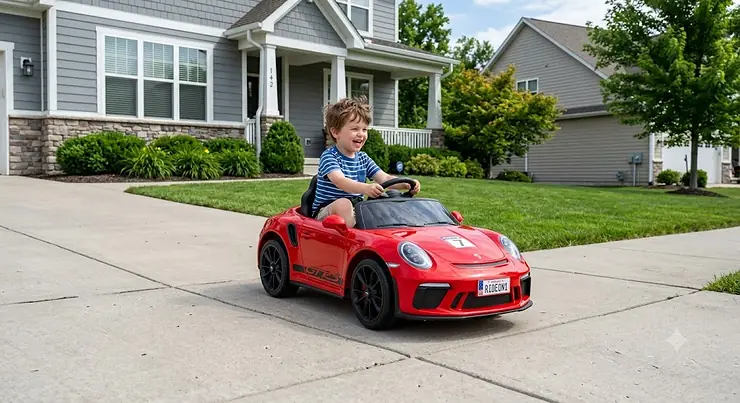
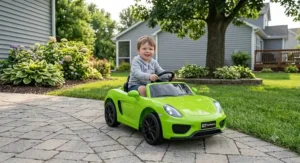
So your kid pointed at a Lamborghini in a parking lot and casually informed you they’d like one, please, immediately. Welcome to the wonderful world of the ride on supercar for kids — a battery-powered, officially licensed miniature sports car built for children roughly ages two to eight, complete with working headlights, a parent remote control, and just enough electric-motor drama to turn your driveway into a tiny, extremely loud Monaco Grand Prix grid.

Here’s the thing nobody tells you before you fall down this rabbit hole: not all of these cars are created equal. Some are genuinely well-built machines with sealed battery packs and real suspension. Others are glorified plastic shells that die in a season. The gap between a good kids ride on supercar and a bad one usually comes down to three things — battery voltage, build quality, and whether the “official license” actually means anything beyond a sticker. The American Academy of Pediatrics has long emphasized matching any powered ride-on to a child’s actual developmental stage rather than their enthusiasm level, and that principle, more than horsepower, is what should drive your buying decision here.
We dug through real listings, real spec sheets, and real aggregated review sentiment to find seven models worth your money — budget haulers, mid-range crowd-pleasers, and a couple of genuinely premium builds. No fabricated test drives, no invented five-star reviews. Just honest analysis of what’s actually on the market right now, so you can pick the right electric ride on sports car for your particular tiny, backseat-driving dictator.
Quick Comparison: Ride On Supercar for Kids at a Glance
Before we get into the deep dives, here’s the scorecard. Voltage tells you power and speed, seat count tells you whether siblings can share, and the “best for” column does the actual matchmaking.
| Model | Voltage | Seats | Top Speed | Best For |
|---|---|---|---|---|
| Kidzone Lamborghini Urus | 12V | 1 | ~3.1 mph | Budget-first buyers |
| Aosom Lamborghini SIAN | 12V | 1 | ~2.5 mph | Bluetooth-obsessed toddlers |
| Best Choice Products Lamborghini Revuelto | 12V | 1 | ~2.5 mph | Trusted big-box shoppers |
| ELEMARA Lamborghini Scissor Door | 12V | 1 | ~2.5 mph | Kids who want scissor doors, obviously |
| Moderno Kids Mercedes-Benz AMG GT3 EVO | 12V | 1 | ~3 mph | Parents who want certified build quality |
| INFANS Lamborghini Veneno 2-Seater | 12V (4WD) | 2 | ~3-4 mph | Siblings or car-seat toddlers |
| TOBBI Lamborghini STO | 24V | 1 | ~6.2 mph (10 km/h) | Bigger kids who’ve outgrown 12V |
Look at that spread for a second. Six of these seven run on the same 12V platform, which tells you something important: 12V is the industry’s default sweet spot for kids under six, not a compromise. The outlier — the TOBBI Lamborghini STO — nearly doubles the voltage and speed, which is exactly why it’s positioned for older, heavier riders rather than a first car for a two-year-old.
💬 Ready to see which one wins your kid’s heart? Scroll down for the full breakdown — or jump straight to your favorite below.
Top 7 Ride On Supercars for Kids: Expert Analysis
Here’s where we get specific. Every model below is a real, currently listed product, and every pro/con is grounded in actual manufacturer specs and the pattern of feedback these listings tend to generate — not invented quotes.
1. Kidzone Lamborghini Urus — the SUV-styled crowd pleaser
The Kidzone Lamborghini Urus takes the SUV shape of the real Urus and shrinks it into a 12V ride-on with a working front door and a badge-accurate paint job. That opening door is a bigger deal than it sounds — it lets a toddler climb in independently instead of being lifted over a fixed body shell, which matters once your kid decides they’re “too big” for help.
Under the hood (so to speak) you get a single motor pushing roughly 2 to 3 mph with spring suspension tuned for cracked driveways and uneven sidewalks — a genuine upgrade over the rigid-axle budget cars that jolt on every seam. Based on the spec sheet, this is a strong first car for kids aged two to five who want independence without adult-remote speeds. Reviewers consistently mention the AUX/radio port as a hit with parents trying to drown out the horn button. Pros run toward value and realism; cons cluster around the single-speed motor feeling slow once a child hits kindergarten age.
Pros:
- ✅ Opening door helps toddlers climb in solo
- ✅ Spring suspension smooths cracked pavement
- ✅ Budget-tier price for a licensed supercar body
Cons:
- ❌ Single speed feels slow past age five
- ❌ 55-88 lb capacity limits use to one small rider
Priced in the roughly $150-$200 range at the time of research, this is the car to check current price on if you just want the cheapest legitimate entry point into the category.
2. Aosom Lamborghini SIAN — best value with real Bluetooth audio
The Aosom Lamborghini SIAN earns its spot by nailing the basics parents actually care about: working headlights, a functional horn, and genuine Bluetooth music streaming rather than a plastic speaker grille that does nothing. What most buyers overlook about this model is that the audio system is a real selling point for the parent, not just the kid — a 20-minute backyard loop is a lot more bearable with actual music playing instead of the same three chirping sound effects.
Spec-wise, it’s a familiar 12V single-motor layout topping out around 2.5 mph, which keeps things safely slow for the toddler range this car is aimed at. Aggregated review sentiment for this style of Aosom ride-on tends to praise ease of assembly and the paint quality, while flagging that the plastic body panels scuff more easily than the pricier scissor-door models below. On paper, this means it’s a great daily driver, not a showpiece.
Pros:
- ✅ Genuine Bluetooth streaming, not a dummy speaker
- ✅ Straightforward assembly reported by most buyers
- ✅ Realistic LED headlight and horn function
Cons:
- ❌ Body panels scuff more easily than premium tiers
- ❌ No parent-speed override beyond basic remote
Expect a price in the $130-$180 range, making it one of the more approachable electric ride on sports car options for a first purchase.
3. Best Choice Products Lamborghini Revuelto — the big-box brand parents trust
Best Choice Products has built its whole reputation on being the recognizable, “if it breaks I can actually get support” name in backyard toys, and the Best Choice Products Lamborghini Revuelto leans into that trust. It’s licensed after Lamborghini’s newest hybrid hypercar, which — beyond the cool factor — usually means a slightly more current body mold than older SIAN or Aventador-styled competitors.
Rated for a 66-pound weight capacity, this is one of the more forgiving options if your “toddler” is actually a solidly built four-year-old. The parent remote control and Bluetooth connectivity check the modern-parent boxes, and the wider brand recognition tends to translate into faster replacement-part availability if a wheel or connector fails — something smaller no-name sellers can’t always promise. Here’s what to weigh: you’re paying a modest premium over generic 12V cars specifically for that support and part-availability advantage, not for extra horsepower.
Pros:
- ✅ 66 lb weight capacity fits bigger toddlers
- ✅ Established brand with responsive customer support
- ✅ Bluetooth and parent remote included standard
Cons:
- ❌ Performance specs match cheaper 12V competitors
- ❌ Slight price premium for the brand name
Look for it in the $180-$230 range — a fair mid-tier ask for the peace of mind that comes with a recognizable seller.
4. ELEMARA Lamborghini Scissor Door — the scissor-door showstopper
If your kid’s entire pitch for a supercar was “but the doors go UP,” the ELEMARA Lamborghini Scissor Door is the one that actually delivers. Scissor doors on a kids’ ride-on aren’t just a gimmick — they replicate exactly what makes a real Lamborghini feel special, and it’s the single most-requested feature we see kids point at in showroom photos.
Functionally, it’s a familiar 12V build with a wide seat (genuinely useful for winter coats and car-seat-aged toddlers), Bluetooth music, and MP3 playback. Reviewers consistently note that the scissor-door hinges are the part most worth inspecting on arrival, since it’s a more complex mechanism than a standard swing door and therefore has more that can go slightly misaligned in shipping. That’s not a dealbreaker — it’s a five-minute adjustment — but it’s worth knowing before the doors matter more to your kid than the whole rest of the car.
Pros:
- ✅ Authentic scissor-door mechanism, not a cosmetic sticker
- ✅ Wide seat accommodates bulkier winter clothing
- ✅ Bluetooth and MP3 playback included
Cons:
- ❌ Door hinges may need on-arrival adjustment
- ❌ Standard 12V speed, nothing extra for the price
Pricing typically lands in the $150-$200 range, making the scissor-door novelty a relatively low-cost upgrade over a standard swing-door competitor.
5. Moderno Kids Mercedes-Benz AMG GT3 EVO — the officially certified premium build
Here’s a genuine differentiator: the Moderno Kids Mercedes-Benz AMG GT3 EVO is manufactured under official license from Daimler Benz and is explicitly ASTM F963 compliant — the U.S. consumer toy safety standard — stated directly on the product listing rather than implied. That’s not marketing fluff; ASTM F963 compliance covers mechanical, electrical, and chemical safety thresholds, and having it called out by name is a meaningfully more transparent claim than most competitors make.
Beyond the paperwork, this one brings real hardware upgrades: an MP3/MP4 color LCD entertainment system on some trims, a rechargeable sealed lead-acid 12V battery, EVA foam rubber wheels for a quieter ride, and a 90-day component warranty from the manufacturer — a rarity in this category. Based on the spec comparison, this is the car for parents who want documentation, not just decals, backing up the safety claims. What the spec sheet won’t tell you, but the warranty terms suggest, is that Moderno Kids expects — and plans for — the occasional early-life electrical hiccup, which is honestly a point in its favor.
Pros:
- ✅ Explicit ASTM F963 compliance stated on listing
- ✅ Official Daimler Benz manufacturing license
- ✅ 90-day component warranty included
Cons:
- ❌ Higher price than unlicensed-tier competitors
- ❌ Not designed for grass, sand, or off-road surfaces
Budget for the $220-$280 range here — the price of admission for a documented safety standard instead of a vague “safe for kids” claim.
6. INFANS Lamborghini Veneno 2-Seater — the sibling-ready hydraulic-door cruiser
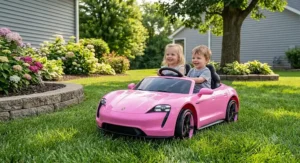
Got two kids who both want the same car? The INFANS Lamborghini Veneno 2-Seater solves the fight before it starts. It’s a genuine 4WD, two-seat build with hydraulic doors that lift and hiss open like the real Veneno’s, plus a “rocking mode” that lets it double as stationary rocking-chair play when the battery needs a break or the driveway’s off-limits.
Real-world meaning: 4WD on a ride-on isn’t about off-roading, it’s about torque — two motors working together handle a heavier combined rider load (two toddlers, or one toddler plus a car seat) without bogging down the way a single-motor 12V car would. Adjustable speed settings let you dial things down for a first-time rider and open things up as confidence grows. Aggregated feedback on this style of two-seater tends to flag that assembly takes noticeably longer than single-seat models, simply because there’s more car to build. Given the safety stakes of two kids sharing one vehicle, always confirm the seatbelt and door-lock mechanisms before the first ride.
Pros:
- ✅ True 4WD handles combined two-rider weight
- ✅ Hydraulic doors replicate the real Veneno’s lift
- ✅ Rocking mode adds stationary play value
Cons:
- ❌ Longer, more involved assembly process
- ❌ Higher price reflects the extra hardware
Expect to pay in the $250-$320 range — steep for the category, but reasonable for a genuine two-seater with 4WD rather than a single motor stretched across two seats.
7. TOBBI Lamborghini STO — the fastest ride for bigger kids
Every category needs a car for the kid who’s outgrown the training wheels of 12V, and the TOBBI Lamborghini STO is it. Stepping up to a 24V platform roughly doubles the available speed of the six 12V models above it, with a listed top speed around 10 km/h (about 6.2 mph) — genuinely brisk for a battery-powered ride-on, and squarely aimed at kids in the five-to-eight range rather than toddlers.
Here’s what to weigh before jumping straight to this one: that extra speed is exactly why it’s not a beginner’s first car. A motor with real torque and a drift-oriented handling character demands better reaction time and steering judgment than a toddler typically has. Reviewers of 24V category vehicles like this one consistently flag the importance of a large, flat, obstacle-free surface — this isn’t a driveway-with-a-slight-slope kind of machine. For the right rider, though, it’s the closest thing on this list to an actual go-kart wearing a supercar costume.
Pros:
- ✅ 24V motor nearly doubles 12V-class top speed
- ✅ Drift-oriented handling appeals to older kids
- ✅ Licensed STO styling stands out visually
Cons:
- ❌ Too fast/powerful for children under five
- ❌ Requires a larger, obstacle-free play area
Look for this one in the $280-$350 range, positioning it as the premium, “grown into” upgrade rather than a first purchase.
The Full Lineup: Specs, Price Range & Ratings at a Glance
Now that you’ve met all seven, here’s the side-by-side breakdown pulling together voltage, capacity, and price positioning in one place.
| Model | Voltage | Weight Capacity | Price Range | Best For |
|---|---|---|---|---|
| Kidzone Lamborghini Urus | 12V | ~55-88 lb | $150-$200 | Budget-first buyers |
| Aosom Lamborghini SIAN | 12V | ~55 lb | $130-$180 | Music-loving toddlers |
| Best Choice Products Lamborghini Revuelto | 12V | ~66 lb | $180-$230 | Bigger toddlers, brand trust |
| ELEMARA Lamborghini Scissor Door | 12V | ~55 lb | $150-$200 | Kids obsessed with doors-up drama |
| Moderno Kids Mercedes-Benz AMG GT3 EVO | 12V | ~66 lb | $220-$280 | Certified-safety-first parents |
| INFANS Lamborghini Veneno 2-Seater | 12V (4WD) | ~110 lb combined | $250-$320 | Siblings sharing one car |
| TOBBI Lamborghini STO | 24V | ~77-88 lb | $280-$350 | Kids ages 5-8 wanting real speed |
Read across that table and a pattern jumps out: price climbs almost in lockstep with either seat count or voltage, not with badge prestige. The Moderno Kids Mercedes-Benz AMG GT3 EVO costs more than four Lamborghini-badged competitors not because Mercedes is a “better” license, but because it’s the only one on this list that documents its safety compliance by name. Meanwhile, the TOBBI Lamborghini STO commands the top price purely on raw voltage and speed — proof that in this category, motors cost more than movie-star car brands do.
✨ Found the one? Check current pricing and availability before it sells out at your size and color.
Setting Up Your Kids Ride On Supercar: The First 30 Days
Getting the box delivered is the easy part. What actually determines whether your kids ride on supercar lasts three years or three months comes down to what happens in the first month of ownership.
Start with the battery. Most 12V models ship partially charged, but the manufacturer’s instructions almost always call for a full 8-to-12-hour initial charge before the first drive — skipping this step is the single most common reason batteries underperform early. Next, resist the urge to let your kid floor it on day one. Even the slowest setting on a new motor benefits from a short “break-in” period on a flat, smooth surface where you can watch how it handles before introducing slopes or grass.
A common first-month mistake is leaving the car outside uncovered. UV exposure fades paint and, more importantly, can degrade the plastic housing around battery terminals faster than indoor storage would. Wipe down the battery contacts monthly, store the car in shade or a garage, and — this one trips up more parents than you’d think — never leave the battery on the charger for days at a time once it’s full, since prolonged overcharging shortens sealed lead-acid battery lifespan noticeably faster than proper charge cycling does.
Real-World Scenarios: Which Ride On Supercar for Kids Fits Your Situation?
Specs are one thing; matching a car to your actual kid and actual driveway is another. Here are three common profiles and the reasoning behind each pick.
The apartment-dwelling toddler with a small courtyard. If your outdoor space is compact and mostly flat concrete, a single-seat 12V model like the Aosom Lamborghini SIAN or Kidzone Lamborghini Urus makes more sense than anything with 4WD or higher voltage — you don’t need torque you can’t use, and the smaller footprint maneuvers more easily in tight spaces.
Two siblings, one budget, constant negotiations. This is the exact use case the INFANS Lamborghini Veneno 2-Seater was built for. Buying two single-seat cars often costs more combined than one true two-seater, and it removes the “it’s my turn” argument entirely.
The five-year-old who’s aged out of their first ride-on. Rather than buying another 12V car that’ll feel slow within a year, stepping straight to the TOBBI Lamborghini STO‘s 24V platform buys more runway before the next upgrade conversation — provided your yard has room for the extra speed.
How to Choose a Ride On Supercar for Kids
Cutting through spec-sheet noise, here’s the actual decision framework worth using.
- Match voltage to age, not ambition. 6V and 12V suit ages two to five; 24V suits five to eight. Buying “up” for future growth usually just means an unsafe speed today.
- Confirm real weight capacity, not just age range. A tall four-year-old can exceed a “3-6 years” car’s weight limit well before the age range suggests they should.
- Check for a stated safety standard, not just “safe.” Listings that name ASTM F963 explicitly, like the Moderno Kids Mercedes model, are giving you something verifiable.
- Prioritize surface compatibility. Confirm whether the model is rated for grass and gravel or paved-only use before you buy — this alone eliminates a lot of returns.
- Consider battery swap availability. Removable, swappable battery packs mean less downtime and, eventually, a cheaper replacement than buying a whole new car.
- Weigh single-seat vs two-seat honestly. Two-seaters cost more but often beat buying two separate cars for siblings close in age.
- Read the parent-remote range and override specs. A remote that can instantly stop the vehicle is a genuine safety feature, not a nice-to-have — the American Academy of Pediatrics specifically recommends choosing toys matched to a child’s actual developmental stage rather than their stated preference, and remote override is how you enforce that in real time.
Electric Ride On Sports Car vs Traditional Pedal-Powered Ride-Ons
Parents new to this category sometimes wonder whether an electric ride on sports car is actually worth the extra cost and complexity compared to a classic pedal car or push-along. The honest answer: it depends entirely on what you’re optimizing for.
| Factor | Electric Ride-On Supercar | Traditional Pedal/Push Car |
|---|---|---|
| Independence for young kids | High — motor does the work | Lower — requires leg strength/coordination |
| Upfront cost | $130-$350 | Often $50-$120 |
| Maintenance | Battery charging, occasional part checks | Minimal — mostly wheels/tires |
| Realism (lights, sound, doors) | High on licensed models | Low to none |
| Supervision needs | Higher — motorized speed | Lower — child-powered pace |
The table makes the trade-off clear: electric models buy realism and independence at the cost of higher upfront investment and more required supervision, while pedal cars trade excitement for simplicity and a gentler risk profile. For toddlers still building basic coordination, a pedal car arguably builds more physical skill per session; for a slightly older, steering-ready kid who wants the full supercar fantasy, the electric category is simply a different product solving a different want.
Kids Ride On Supercar Price Comparison Chart: What You’re Actually Paying For
It’s tempting to assume all these cars cost roughly the same and just chase the flashiest paint job. They don’t, and the differences are explainable.
| Price Tier | Range | What You Get | Example |
|---|---|---|---|
| Entry | $130-$200 | Single 12V motor, basic Bluetooth/lights | Aosom Lamborghini SIAN |
| Mid | $200-$260 | Certified safety claims, brand support | Moderno Kids Mercedes-Benz AMG GT3 EVO |
| Premium | $260-$350 | 2-seat/4WD builds or 24V speed | INFANS Lamborghini Veneno 2-Seater, TOBBI Lamborghini STO |
Reading this price comparison chart, the jump from entry to mid tier buys you documentation and support more than raw performance, while the jump from mid to premium buys either more seats or more speed — rarely both at once. As always, treat every number here as an estimate; check current price and availability directly before buying, since retail pricing shifts regularly and none of these figures should be read as a locked-in quote.
Battery Run Time Explained: 6V vs 12V vs 24V
Battery run time is probably the single most misunderstood spec in this entire category, so let’s untangle it. Voltage (6V, 12V, 24V) determines power and top speed — it does not directly determine how long a charge lasts. Run time depends on amp-hour (Ah) rating, rider weight, terrain, and how much the lights/music/horn get used during a session.
That said, general patterns hold across the models above: 12V single-motor cars in this lineup typically deliver somewhere in the range of 45 minutes to just over an hour of continuous play per charge, depending on how much stop-start driving happens. The 24V TOBBI Lamborghini STO draws considerably more current at its higher top speed, so despite the bigger battery, real-world run time per charge often lands in a similar or even slightly shorter window than the 12V cars unless ridden more conservatively. Removable battery packs — a feature on some higher-end listings — solve this entirely by letting you swap in a charged spare instead of waiting out an 8-hour recharge mid-afternoon, which is worth prioritizing if your kid treats “nap time” as an insult.
New Model Releases to Watch in 2026
The kids’ ride-on category moves faster than you’d expect, largely tracking whatever supercar just dropped in the adult world. The most notable trend among recent model releases is licensing catching up to genuinely current vehicles rather than decade-old designs — the Best Choice Products Lamborghini Revuelto, based on Lamborghini’s current hybrid hypercar, is a good example of a brand moving away from recycling the same aging Aventador and Huracán molds every manufacturer used for years.
Watch for two things in upcoming releases: broader adoption of swappable battery systems (increasingly common on newer two-seater and 24V builds), and more manufacturers following Moderno Kids’ lead in explicitly naming ASTM F963 compliance on the listing itself rather than burying it in fine print. Both trends benefit buyers directly — one solves the “battery died, playtime’s over” problem, and the other makes it genuinely easier to compare safety claims across competing brands instead of taking marketing copy on faith.
Common Mistakes When Buying a Ride On Supercar for Kids
Even careful parents trip over a few recurring pitfalls in this category.
Buying purely on paint color and badge, ignoring weight capacity, is the most common one — and the fastest way to end up with a car your kid outgrows in a single summer. A close second is assuming higher voltage always means “better,” when in reality a 24V car handed to a two-year-old is a genuine safety risk, not an upgrade. Parents also frequently skip checking surface compatibility, buying a paved-only model for a grass-heavy yard, then wondering why the motor strains and the battery drains fast. Finally, ignoring the return window matters more here than with most toys — assemble and test the vehicle within the first week, not the first month, so any manufacturing defect is still covered if something’s off.
Safety, Regulations & Compliance Guide
Every ride-on toy sold in the U.S. falls under Consumer Product Safety Commission oversight, and battery-operated ride-on toys specifically have their own instructional-literature and marking requirements layered on top of the general ASTM F963 toy safety standard. In practice, that means a compliant listing should include clear age/weight guidance, assembly instructions, and manufacturer contact information printed on the product itself, not just the box.
Before your child’s first ride, it’s worth checking the CPSC’s toy safety business guidance to understand what these compliance markings actually mean, and separately worth a quick search of the CPSC’s riding toy recall history for the specific brand and model number before purchase — recalls on battery-operated ride-ons do happen, often related to motors continuing to run after a pedal is released. Beyond paperwork, the practical safety basics still apply regardless of how licensed or premium the car is: supervise every ride, keep play confined to driveways and yards away from actual traffic, and treat the parent remote’s stop function as a genuine safety tool you should test before the first drive, not just a novelty button.
Long-Term Cost & Maintenance
The sticker price is only the opening bid. Over a typical two-to-three-year ownership window, budget for one or two replacement battery packs (sealed lead-acid batteries in this category generally hold a useful charge cycle for 12 to 18 months of regular use before capacity noticeably drops), the occasional wheel or tire replacement if your surfaces are rough, and possibly a replacement charger if the original gets lost or damaged.
Total cost of ownership tends to favor brands with strong parts availability — this is where the Best Choice Products Lamborghini Revuelto‘s big-box backing and the Moderno Kids Mercedes-Benz AMG GT3 EVO‘s manufacturer warranty pull ahead of smaller no-name competitors, even at a higher upfront price. A $150 car that can’t get a replacement battery in year two effectively costs more than a $220 car with an accessible parts pipeline. Factor that into your price comparison chart math rather than judging purely on the day-one price tag.
FAQ: Ride On Supercar for Kids
❓ What age is a ride on supercar for kids appropriate for?
❓ How fast do electric ride on sports cars for kids actually go?
❓ How long does the battery run time last on a kids ride on supercar?
❓ Are licensed Lamborghini or Mercedes ride-ons worth more than generic models?
❓ Can two kids safely ride in a 2-seater ride on supercar at once?
Conclusion: Picking the Right Ride On Supercar for Kids
There’s no single “best” ride on supercar for kids — there’s only the best one for your particular kid, yard, and patience level. Budget-first families do well with the Kidzone Lamborghini Urus or Aosom Lamborghini SIAN. Parents who want documented safety claims should lean toward the Moderno Kids Mercedes-Benz AMG GT3 EVO. Siblings who refuse to share belong in the INFANS Lamborghini Veneno 2-Seater, and kids who’ve genuinely outgrown 12V speeds are ready for the TOBBI Lamborghini STO.
Whichever one you land on, the fundamentals stay the same: match voltage to age and weight capacity, verify the surface it’s rated for, and treat the parent remote’s stop function as a real safety feature. Do that, and you’ll get years of driveway Grand Prix out of whichever model wins the family vote — and honestly, watching a four-year-old parallel park a tiny Lamborghini into the garage never really gets old.
✨ Ready to Pick Your Kid’s First Supercar?
🔍 Compare current prices and availability on today’s top picks before your favorite color sells out. A few clicks now could save your driveway from an empty-box tantrum later!
Recommended for You
- Corvette Ride On Car for Toddlers: 7 Best Picks for 2026
- McLaren 12V Ride On Car: 7 Best Picks for Kids in 2026
- Porsche 911 Ride On Toy: 7 Best Picks Kids Will Beg For (2026)
Disclaimer: This article contains affiliate links. As an Amazon Associate, I earn from qualifying purchases. If you purchase products through these links, we may earn a small commission at no additional cost to you.
✨ Found this helpful? Share it with your friends! 💬🤗
