
In This Article
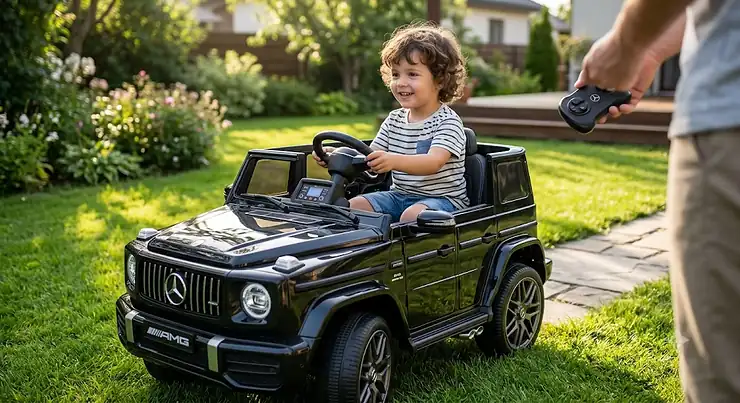
A mercedes benz ride on car for kids is a battery-powered, child-sized replica of a real Mercedes-Benz model — most often the G-Wagon — built with working headlights, a horn, a parent remote, and (on better models) opening doors and a suspension system. It’s a toy, not a vehicle, but it’s engineered to feel like the real thing from the driver’s seat down to the dashboard
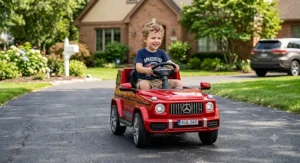
Here’s the thing nobody tells you before you start shopping: almost every one of these cars looks identical in the thumbnail photo. Same grille. Same glossy paint. Same “officially licensed” badge stamped in the corner. Scroll past the marketing, though, and the differences get real fast — a cheap 4.5Ah battery pack that dies in 30 minutes versus an upgraded 7Ah pack that goes twice as long, a flimsy plastic door hinge versus one that actually locks, a suspension system that’s mostly cosmetic versus one that smooths out a cracked sidewalk. Buy the wrong one and you’ll be untangling a tantrum in the driveway by week three.
We spent time digging through real product listings, spec sheets, and aggregated owner feedback across seven genuinely available models — from a $150-ish single-seat starter to a 24V two-seater with leather-style trim that could pass for a tiny luxury SUV. This guide breaks down what each one actually delivers, where the marketing oversells reality, and how to match a model to your kid, your driveway, and your budget. Below, you’ll find a quick comparison table, a full breakdown of all seven cars, and practical guides on setup, safety, and long-term cost — the stuff that doesn’t show up on the Amazon listing.
Quick Comparison Table
| Model | Voltage / Battery | Seating | Standout Feature | Best For |
|---|---|---|---|---|
| ANPABO Mercedes-Benz G63 | 12V 7Ah | 1 rider | Oversized battery for the price | Budget-conscious first-timers |
| TOBBI Mercedes-Benz AMG GT | 12V | 1 rider | ASTM-certified double doors | Safety-focused parents |
| TOBBI Mercedes-Benz SLC300 | 12V | 1–2 kids | Lockable double doors | Toddlers 3–6 |
| Costway Mercedes-Benz G63 | 12V 7Ah | 2 kids | Roomiest bench seat | Siblings who share |
| Aosom Mercedes-Benz G500 | 12V | 1 rider | CPSIA/ASTM-documented build | Safety-first shoppers |
| Freddo Toys G63 AMG 2-Seater | 24V 4×4 | 2 kids | Leather-style seat + real torque | Bigger yards, older kids |
| KidsVIP G63 4×4 | 24V | 2 kids | Eco-leather cabin, opening doors | Buyers who want the “real” feel |
Looking at the spread above, the jump from 12V to 24V is really the jump from “toy that rolls forward” to “toy that climbs a slight grade without groaning.” The ANPABO Mercedes-Benz G63 and TOBBI Mercedes-Benz AMG GT are the sensible entry points if your child is under 4 and your driveway is flat, while the Freddo Toys G63 AMG 2-Seater and KidsVIP G63 4×4 earn their higher price tags through real 4×4 hardware and leather-style seating that survives sun exposure better than vinyl. If two kids will be fighting over one car, skip the single-seaters entirely — the Costway Mercedes-Benz G63 solves that argument before it starts.
💬 Already comparing your favorites? Bookmark this table — you’ll want to scroll back to it.
Top 7 Mercedes Benz Ride On Cars for Kids: Expert Analysis
1. ANPABO Mercedes-Benz G63 — most battery for the money
The standout here is simple math: this model ships with a 12V 7Ah battery, which the manufacturer notes is roughly 55% larger than the 4.5Ah packs still common at this price point. In practice, that translates to noticeably longer play sessions before the low-battery warning kicks in and naptime negotiations begin.
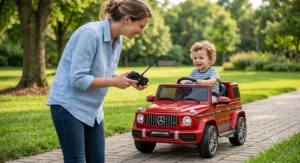
Two 35W motors push the car to about 3 mph, which is intentionally slow — this is a car built for a first-time driver, not a speed demon. The treaded wheels grip reasonably well on grass and asphalt alike, and the parent remote gives you a full override, not just a stop button, so you can steer a nervous 2-year-old around the mailbox instead of just braking them. Based on the spec sheet, this is the car for a parent who wants training wheels, not a sports car.
Aggregated listing feedback consistently flags the parent-remote mode as a highlight for first-time riders, particularly for kids too young to master the pedal-and-steering combo confidently. A recurring theme in buyer notes is that the “soft start” feature — which ramps up power gradually instead of lurching forward — meaningfully reduces the toppling-over moments that scare toddlers off ride-on toys for good.
Pros:
- ✅ Larger-than-average 7Ah battery for longer runtime
- ✅ Full parent remote override, not just emergency stop
- ✅ Soft-start motor reduces sudden jolts for beginners
Cons:
- ❌ Single-seat only, no sibling-sharing option
- ❌ Top speed of 3 mph may feel slow past age 5
Priced in the low-to-mid $100s at the time of research, this is one of the more approachable entry points in the category — check current price before buying, since ride-on toy pricing shifts with demand and holidays.
2. TOBBI Mercedes-Benz AMG GT — ASTM-certified double doors
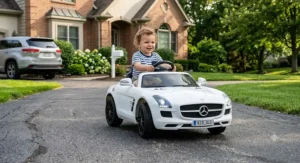
What jumps out immediately on this one is the double-door design paired with an explicit ASTM safety certification listed on the product page — a detail plenty of competitors leave vague. That’s not just a bullet point; it means the doors, latches, and general build were tested against the same F963 toy-safety framework we’ll cover later in this guide.
Under the hood, two 25W motors and a dual-battery setup deliver a top speed around 3.1 mph with a 60–80 minute runtime per charge, which is genuinely long for a 12V toy in this price bracket. The AMG GT bodystyle also means a lower, sportier profile than the boxier G-Wagon models, which matters if your kid has strong opinions about “the fast one.”
Here’s what the spec sheet won’t tell you outright: dual driving modes (pedal-and-wheel for the kid, 2.4GHz three-speed remote for you) make this one of the more flexible options for households with siblings of different confidence levels — the same car can be a slow crawler for a nervous 3-year-old and a slightly quicker cruiser for a bold 5-year-old, just by switching remote speed settings.
Pros:
- ✅ Documented ASTM safety certification
- ✅ Long 60–80 minute runtime per charge
- ✅ Three remote-control speed settings for different ages
Cons:
- ❌ Sportier body sits lower, less ground clearance
- ❌ Single-rider seat, not built for two
At a mid-range price — generally in the $150–$250 range depending on retailer promotions — this is a solid pick for parents who want documented certification, not just a licensing badge, on the box.
3. TOBBI Mercedes-Benz SLC300 — lockable doors for toddler wranglers
The lockable double doors and two-point safety belt are the headline feature, and honestly, they matter more than they sound. Any parent who’s chased a toddler out of a half-latched ride-on toy knows why a working door lock earns its own bullet point.
Spec-wise, dual 12V motors deliver a 1.86–3.1 mph range across two speeds, with a listed weight capacity around 66 lbs and a roughly one-hour charge-to-runtime ratio (an 8–12 hour charge for about an hour of play — plan around nap schedules accordingly). The wheels are rated for asphalt, wood flooring, brick, and grass, so this isn’t strictly an outdoor-only toy; some families run it through a finished basement in winter.
Reviewers and buyers repeatedly single out the safety-lock doors and two-point belt as the reason they chose this model over similarly priced competitors, especially for kids around ages 3–6 who are still testing boundaries. What most buyers overlook, though, is the 66-lb weight cap — it’s lower than some competitors’, so measure your child (and their winter coat) before assuming they’ll fit comfortably at age 6.
Pros:
- ✅ Lockable double doors plus two-point safety belt
- ✅ Works on multiple surfaces, indoors and out
- ✅ Two selectable speed settings for growing confidence
Cons:
- ❌ 66-lb weight limit is on the lower end
- ❌ Roughly 8–12 hour charge time for ~1 hour of play
Typically found in the mid-$200s range, it’s a strong middle-tier choice if door security is your top safety priority.
4. Costway Mercedes-Benz G63 — roomiest bench seat for two
This is the sibling-peace-treaty car. The oversized bench seat comfortably fits two kids under a combined 130-lb limit, with safety belts for each — a genuinely rare feature at this price tier, where most “2-seaters” are really one padded bench with room for a stuffed animal.
The four-wheel spring suspension system is worth calling out specifically, because it’s a real mechanical feature, not just marketing language — each wheel gets its own shock absorber, which noticeably smooths out cracked driveways and uneven lawns compared to fixed-axle competitors. Paired with a 12V 7Ah battery and a soft-start system, the ride stays controlled even when two kids are bouncing around in the back — sorry, front — seat.
Based on the double-open-door design and dual-media (FM/Bluetooth) setup, this model reads less like a toddler toy and more like a genuine “let the kids entertain themselves for 45 minutes” solution. The tradeoff is footprint: at roughly 56 inches long, this needs real garage or shed space, not a hall closet.
Pros:
- ✅ True two-kid bench seat with individual belts
- ✅ Real four-wheel independent spring suspension
- ✅ Double opening doors for easy loading and unloading
Cons:
- ❌ Large footprint (about 56 inches long) needs storage room
- ❌ Two riders means faster battery drain per session
Generally priced in the $250–$350 range, this is the pick when “one car, two kids” is a non-negotiable requirement.
5. Aosom Mercedes-Benz G500 — the safety-paper-trail option
What sets this one apart isn’t a flashy feature — it’s the explicit safety documentation. The listing states compliance with both CPSIA and ASTM F963 standards by name, rather than the vague “meets safety standards” language that’s common across this category. For a category built almost entirely on trust in a product page, that specificity matters.
Extra-wide wheels are the second standout, genuinely improving stability across grass, gravel, and uneven pavement compared to the narrower wheels on some 12V competitors. Two selectable drive speeds (1.8–3.3 mph) give you a wider range than most single-speed toddler cars, and the illuminated dashboard adds a small but real touch of realism that younger kids notice immediately.
Reviewers and buyers consistently point to the extra-wide wheels and lockable doors as the reasons they trust this one on uneven backyard terrain specifically, rather than just smooth driveways. Here’s what the spec sheet undersells: the dual-mode remote isn’t just a safety net for toddlers — plenty of parents use it to simply steer the car back toward the house when playtime is over, which sounds trivial until you’re standing in a yard at 5:45 PM.
Pros:
- ✅ Documented CPSIA and ASTM F963 compliance
- ✅ Extra-wide wheels improve rough-terrain stability
- ✅ Two distinct speed settings (1.8–3.3 mph)
Cons:
- ❌ Single-rider design, no bench-seat option
- ❌ Illuminated dashboard is cosmetic, not functional
Expect a price generally in the $200–$300 range depending on the retailer — check current price, as this one moves with seasonal promotions more than most.
6. Freddo Toys G63 AMG 2-Seater — real 4×4 with a leather-style seat
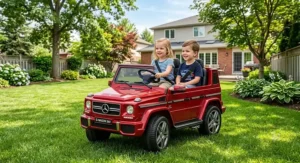
This is where the category stops feeling like a toy and starts feeling like a small vehicle. Four independent 45W motors give genuine 4×4 power, not just a marketing label, and the padded leather-style two-seater with adjustable belts is a tangible step up from the vinyl bench seats on the 12V models above.
The 24V system and EVA (foam-injected) tires are the two specs that matter most here. EVA tires don’t puncture, which is a real consideration if your “driveway” is actually a gravel-adjacent cul-de-sac, and the 24V setup means this car can handle a gentle incline that would stall a 12V single-motor toy dead in its tracks. Full LED lighting and a 2.4G remote with an emergency stop round out a build that’s clearly aimed at parents of slightly older kids (ages 3–8) rather than first-time toddler drivers.
Aggregated owner feedback is largely positive on ride quality and the 4×4 drivetrain, though a small number of reports flag stress on the axle hardware under heavier or rougher use — worth noting for families with an especially adventurous rider, and a good reminder to follow the weight limit closely rather than treat it as a suggestion. Reviewers also consistently praise the leather-style seat’s comfort over long play sessions, a detail that matters more than it sounds once you’ve watched a kid sit in a hard plastic bucket seat for 45 minutes straight.
Pros:
- ✅ True 4×4 drivetrain via four independent motors
- ✅ Puncture-resistant EVA tires for rough terrain
- ✅ Padded leather-style two-seater bench
Cons:
- ❌ Occasional owner reports of axle stress under heavy use
- ❌ Premium price bracket, roughly $500–$700 range
This one sits in the premium tier, generally in the $500–$700 range — a real jump from the 12V options, but justified if you want an actual 4×4 experience rather than a single-motor toy with 4×4 branding.
7. KidsVIP Mercedes-Benz G63 4×4 — the closest thing to a real cabin
The last car on this list earns its spot through cabin details most competitors skip entirely: two upgraded eco-leather seats with genuine 3-point seat belts (not the two-point straps common lower in this list), plus opening doors that actually function as doors — not just a painted-on panel.
Powered by an upgraded 24V battery system across four motors, this model runs 2–5 mph depending on terrain, with an upgraded suspension system specifically called out for stability on mixed surfaces. FM radio, Bluetooth, and USB input are standard here, which by this point in the lineup is expected rather than a bonus — but the branding detail and paint finish are noticeably more refined than the budget-tier models.
Buyer feedback across listings repeatedly highlights the realism of the branding and the comfort of the eco-leather seats as reasons families chose this over cheaper alternatives, with several owners specifically noting it “handles well on uneven backyard terrain” — a meaningfully different claim than “looks nice in photos,” and one grounded in the four-motor 4×4 setup rather than styling alone.
Pros:
- ✅ Genuine eco-leather seats with 3-point belts
- ✅ Real opening doors with authentic branding detail
- ✅ Upgraded suspension for mixed-terrain stability
Cons:
- ❌ Premium pricing, generally above $550
- ❌ Assembly reportedly takes about an hour
At the top of this list price-wise — commonly in the $550–$800 range depending on color and promotions — this is the pick for parents who want the full “mini luxury SUV” experience and are willing to pay for the cabin details that come with it.
✨ Found the one you like? Check its current price and availability before the color you want sells out.
Practical Usage Guide: Setup, First Rides, and Maintenance
Getting a new ride-on car right in the first 30 days prevents most of the frustration parents report later. Start with a full initial charge — most 12V and 24V models need 8–12 hours before the very first use, even if the battery shows partial charge out of the box. Skipping this step is the single most common reason a brand-new car seems “weak” in week one.
During assembly, torque the wheel bolts and mirror/antenna attachments by hand first, then snug them with a screwdriver — overtightening plastic thread mounts is a leading cause of early cracking. Once assembled, run the car in remote-only mode for the first few sessions so your child gets comfortable with the sound and motion before taking full pedal control.
For ongoing maintenance, recharge after every session rather than letting the battery fully drain, which extends the life of the sealed lead-acid pack found in most 12V and 24V ride-on toys. When a battery finally reaches end-of-life, don’t toss it in household trash — sealed lead-acid batteries are recyclable, and Call2Recycle maintains drop-off locations specifically for this battery type. A quick monthly check of door latches, seat belts, and wheel bolts catches most wear-and-tear issues before they become a mid-ride breakdown.
Real-World Scenarios: Matching the Car to Your Kid
The cautious 2-year-old in an apartment complex courtyard: Go with the ANPABO Mercedes-Benz G63 or TOBBI Mercedes-Benz AMG GT. Both keep top speed low, lean on parent-remote control as the primary mode, and don’t demand much storage space — critical when “the garage” is actually a hall closet.
Two siblings, ages 4 and 6, with a suburban driveway and a modest side yard: The Costway Mercedes-Benz G63 solves the sharing problem outright with its two-belt bench seat, and its independent suspension handles a cracked driveway seam better than fixed-axle single-seaters.
The confident 6-year-old with a big backyard and a slight grade to the fence line: This is where 24V matters. The Freddo Toys G63 AMG 2-Seater or KidsVIP Mercedes-Benz G63 4×4 deliver enough real torque to handle mild inclines and grass without stalling — something every 12V model on this list will struggle with past a gentle slope.
Problem → Solution: Fixing the Most Common Ride-On Complaints
Problem: Battery dies faster than expected. Solution: Recharge after every session instead of waiting for a full drain, and avoid running two kids in a single-seat car (weight strain shortens runtime significantly).
Problem: Doors won’t latch reliably. Solution: Check the latch mechanism monthly for grit or misalignment; models like the TOBBI Mercedes-Benz SLC300 and KidsVIP Mercedes-Benz G63 4×4 use lock-style latches that need periodic cleaning to keep functioning smoothly.
Problem: Car struggles on grass or a slight incline. Solution: This is almost always a 12V-vs-24V issue. If your yard isn’t flat, a single-motor 12V toy like the base ANPABO Mercedes-Benz G63 will underperform — a 4×4 24V model is the real fix, not a workaround.
Problem: Toddler keeps toppling the remote-control mode. Solution: Confirm the “soft start” feature is active (most models have it as default); it ramps acceleration gradually and eliminates the jolt that causes tip-overs in beginners.
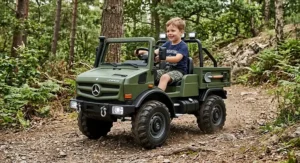
How to Choose a Licensed Mercedes Benz G Wagon Ride On
- Match voltage to terrain. Flat driveways and smooth patios are fine on 12V; grass, gravel, or any incline calls for 24V and multiple motors.
- Check the weight limit against your child’s actual weight, not their age. A 66-lb cap sounds generous until you factor in a winter coat and snow boots.
- Decide single-seat versus two-seat early. Retrofitting sibling-sharing onto a single-seat car isn’t possible — this decision has to happen at purchase.
- Prioritize documented safety certification over marketing language. Look for explicit mentions of ASTM F963 or CPSIA compliance, not just “safety tested.”
- Factor in charge time versus play time. An 8–12 hour charge for 45–60 minutes of play is standard — plan around nap or school schedules accordingly.
- Look for real suspension, not cosmetic shock-absorber shapes molded into the plastic. Independent spring suspension on all four wheels is a genuine performance feature.
- Budget for accessories separately. Replacement batteries, tires, and remote batteries aren’t always included in the base price and are worth checking before checkout.
Common Mistakes When Buying a Mercedes Ride On Car 12V
The most frequent mistake is buying based on photos alone rather than checking listed weight limits — a car that looks identical to a competitor’s can have a 20-lb difference in capacity. A close second is assuming “2-seater” always means two full seats with belts; some listings use the term loosely for a wide bench meant for one child plus a toy, so read the seating description carefully rather than trusting the word alone.
Parents also frequently underestimate charge time, expecting a quick top-up before an outing when most sealed lead-acid batteries genuinely need the full 8–12 hours. Finally, skipping the terrain check is common and costly — a 12V single-motor car purchased for a grassy, sloped backyard will underperform no matter how good the reviews are, because the issue is physics, not build quality.
Mercedes Ride On Car vs Traditional Battery-Powered Alternatives
Compared to generic, unbranded battery-powered ride-on toys, licensed Mercedes-Benz models generally deliver better-documented safety certification and more realistic detailing — opening doors, functioning dashboards, and branded styling that unbranded alternatives rarely bother with. That licensing and detail work adds cost, though, typically 15–30% more than a comparably specced generic model with the same battery and motor configuration.
Where generic alternatives sometimes win is repair-part availability; widely sold unbranded models occasionally have more generic replacement parts (batteries, tires) in stock at big-box retailers, while licensed models may need parts sourced directly from the manufacturer’s site. If realism and resale value matter to you, the licensed badge is worth the premium; if you’re optimizing purely for cost-per-hour-of-play, an unbranded 12V competitor with similar motor specs can close most of the gap.
Leather-Style Seats, Opening Doors, and Working Suspension: Which Features Actually Matter
Leather-style seat
A leather-style seat is really a padding-and-durability question dressed up as a luxury feature. On models like the Freddo Toys G63 AMG 2-Seater and KidsVIP Mercedes-Benz G63 4×4, the padded leather-style (or eco-leather) surface resists sun-fading and cracking better than the harder vinyl or bare plastic benches on entry-level 12V models — a real consideration if the car lives outside part-time. What it doesn’t do is make the car faster or more capable; treat it as a comfort and longevity upgrade, not a performance one.
Opening doors
Opening doors sound like a cosmetic flourish until you’re the one lifting a squirming toddler over a closed door frame in the rain. Functional opening doors — as opposed to painted-on door outlines — genuinely speed up loading and unloading, and on models with lockable latches (the TOBBI Mercedes-Benz SLC300, KidsVIP Mercedes-Benz G63 4×4) they double as a safety feature that keeps an unbuckled toddler from tumbling out mid-drive.
Working suspension
Working suspension is the feature most likely to be faked with molded plastic shapes that look like shock absorbers but don’t compress. Genuine independent spring suspension — present on the Costway Mercedes-Benz G63 and the two 24V premium models — visibly smooths a bumpy driveway or root-crossed lawn path, reducing the jolts that make toddlers grip the wheel white-knuckled. If your test-drive video (most listings include one) doesn’t show visible wheel travel over a bump, assume the suspension is decorative.
Mercedes Ride On Cars for Toddlers vs Older Kids
For toddlers around ages 1.5–3, prioritize low top speed, a strong parent-remote override, and a lower step-in height — the ANPABO Mercedes-Benz G63 and TOBBI Mercedes-Benz AMG GT fit that brief well. For kids ages 4–8, weight capacity and terrain capability matter more than beginner-friendliness; this is where the 24V, 4×4 models genuinely earn their higher price, since a 6-year-old pushing a single-motor 12V toy across grass will simply outgrow its capability within a season.
Long-Term Cost & Maintenance
The sticker price is only part of the total cost of ownership. Budget for a replacement 12V or 24V battery roughly every 1–2 seasons of regular use, plus occasional tire or latch hardware if the car sees rough terrain. Over a typical 2–3 year ownership window — the span most kids stay within the weight limit — total cost often lands 20–35% above the initial purchase price once you factor in a battery replacement and minor parts.
Viewed as cost-per-hour of entertainment across a few summers, even the premium $600-range models compare reasonably against other outdoor toys in the same price bracket, provided the battery is properly maintained (see the recharge-after-every-session tip above) rather than run to full depletion repeatedly, which shortens battery lifespan noticeably.
Safety, Regulations, and Compliance Guide
In the United States, ride-on toys fall under the mandatory toy safety standard ASTM F963, which is enforced by the Consumer Product Safety Commission under the Consumer Product Safety Improvement Act. The standard specifically addresses stability, restraint systems, and battery safety for ride-on toys, among other toy categories, and ASTM periodically revises the specification as new hazards or product categories emerge, according to ASTM International.
Practically, this means a genuinely compliant ride-on car should list its certification explicitly (as the Aosom Mercedes-Benz G500 and TOBBI Mercedes-Benz AMG GT do), rather than using vague “safety tested” language. Always use the provided seatbelt regardless of how short the ride, supervise outdoor sessions near driveways or streets, and check the manufacturer’s minimum age and maximum weight limits before every growth spurt — not just at purchase.
Frequently Asked Questions
❓
How fast does a mercedes ride on car 12v go?
❓ How long does the battery last on a single charge?
❓ Is a licensed mercedes benz g wagon ride on worth the extra cost over a generic model?
❓ What age is appropriate for a mercedes benz ride on car for kids?
❓ Do these ride-on cars work on grass and uneven terrain?
Conclusion
Across all seven models, the real decision isn’t “which one looks the nicest” — every licensed G-Wagon replica nails the visual details. It’s voltage matched to terrain, weight capacity matched to your actual kid, and safety certification you can verify rather than take on faith. Budget shoppers with flat driveways and younger toddlers do well with the ANPABO Mercedes-Benz G63 or TOBBI Mercedes-Benz AMG GT. Families splitting one car between siblings should look hard at the Costway Mercedes-Benz G63. And anyone with a real backyard, an older kid, and a bit more budget will get genuinely more capability out of the Freddo Toys G63 AMG 2-Seater or KidsVIP Mercedes-Benz G63 4×4 than any 12V toy can offer, leather-style seat and opening doors included.
Whichever one you land on, check current pricing before you commit — availability and promotions shift often in this category, and the “best” pick on paper is only the best deal if the price lines up with your budget on the day you buy.
✨ Don’t Miss These Exclusive Deals!
🚗 Ready to pick your favorite? Click through to check current pricing and availability on any of the seven models above before your top choice sells out. A great ride-on car turns an ordinary Saturday into the kind of afternoon your kid talks about at dinner!
Recommended for You
- Ride On Supercar for Kids: 7 Best Picks Reviewed (2026)
- Corvette Ride On Car for Toddlers: 7 Best Picks for 2026
- McLaren 12V Ride On Car: 7 Best Picks for Kids in 2026
Disclaimer: This article contains affiliate links. As an Amazon Associate, I earn from qualifying purchases. If you purchase products through these links, we may earn a small commission at no additional cost to you.
✨ Found this helpful? Share it with your friends! 💬🤗
