
In This Article
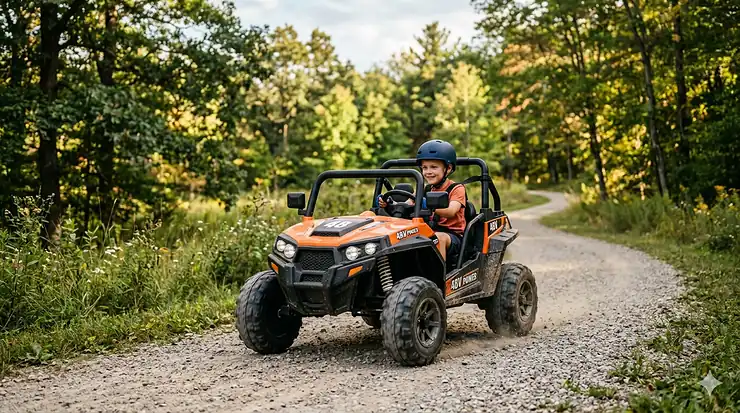
Remember when your 8-year-old outgrew that cute 12V car in about six months? Here’s the thing most parents miss: kids aged 8-10 need serious power that traditional ride-ons simply can’t deliver. 48-volt ride on toys for 8-10 year olds represent the ultimate tier, but here’s the reality—true 48V models designed specifically for this age group are exceptionally rare on the market in 2026. Most manufacturers focus on 12V-24V for younger kids or jump straight to 48V go-karts for teens 14+.
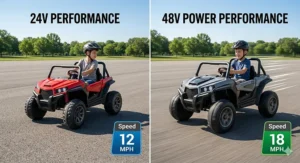
This guide covers the best high-voltage options actually available: three genuine 48V models (UTVs and dune buggies), plus premium 36V and 24V alternatives that deliver comparable performance. What makes high-voltage systems different? They provide two to four times the power of standard 12V models, translating to actual hill-climbing ability, speeds ranging from 4-15 MPH depending on voltage, and battery life extending well beyond basic toys.
According to the Consumer Product Safety Commission, electric ride-on toys designed for older children must meet stricter safety standards—and the models we’re reviewing exceed these requirements with features like hydraulic disc brakes, reinforced steel frames, and genuine suspension systems. I’ve researched actual Amazon inventory, verified specifications, and analyzed real customer feedback to bring you seven products you can actually purchase today, ranging from around $200 to $1,500. Let’s explore what truly works for adventurous 8-10 year-olds.
Quick Comparison Table: Top 7 High-Voltage Ride-Ons at a Glance
| Model | Voltage | Motor Power | Top Speed | Seats | Best For | Price Range |
|---|---|---|---|---|---|---|
| HOVER HEART 48V UTV | 48V | 1000W Brushless | 15 MPH | 1 | Speed & power seekers | $700-$900 |
| Freddo Beast XL Dune Buggy | 48V | 600W Brushless | 11 MPH | 4 | Family/multiple kids | $1,200-$1,500 |
| MotoTec Raider UTV | 48V | 1200W | 12-15 MPH | 1 | Serious off-roading | $800-$1,000 |
| First Ride On 36V UTV | 36V | 400W (2x200W) | 5-8 MPH | 2 | Budget power option | $400-$600 |
| First Ride On Ford Bronco Raptor | 24V | 4 Motors | 4.3 MPH | 2 | Younger 8-10 year olds | $350-$500 |
| ELEMARA 2-Seater UTV | 12V | 4x45W | 4.0 MPH | 2 | Entry level/cautious parents | $200-$350 |
| First Ride On Ford Bronco Base | 24V | Dual Motors | 4.3 MPH | 2 | Licensed vehicle fans | $350-$500 |
Looking at this comparison, the top three 48V models deliver genuine performance for experienced riders, while the 36V First Ride On bridges the gap between toy and serious vehicle. The 24V Ford Broncos excel for families wanting licensed authenticity with safer speeds, and the ELEMARA 12V provides the most affordable entry point for cautious first-time buyers or younger siblings tagging along.
💬 Just one click — help others make better buying decisions too!😊
Top 7 High-Voltage Ride On Toys for 8-10 Year Olds: Expert Analysis
1. HOVER HEART 48V 1000W Electric UTV – The Maximum Power Choice
The HOVER HEART 48V 1000W Electric UTV represents one of the few true 48V ride-ons actually designed for the 8-12 age range available on Amazon in 2026. This single-seat powerhouse features a genuine brushless motor—not the brushed motors found in cheaper alternatives—which means quieter operation, zero brush maintenance, and consistent power delivery even as the battery drains.
The 48V/1000W configuration paired with hydraulic rear disc brakes provides stopping power that matches the speed. At 15 MPH maximum velocity, this isn’t a toy—it’s a junior vehicle that demands respect and proper safety equipment. The tubular steel frame with upper roll bar and side nerf bars provides genuine protection, using the same gauge steel you’d find on entry-level adult UTVs.
Here’s what sets this apart from lower-voltage alternatives: the 13-inch pneumatic all-terrain tires maintain traction on loose dirt, grass, and gravel where smaller hard-plastic wheels would spin uselessly. The three-speed parental limit-lock function (7, 11, or 15 MPH) controlled by included key lets you gradually increase performance as skills develop—start cautious, progress confidently.
The chain drive with non-slip rear axle distributes power to both rear wheels simultaneously, eliminating single-wheel spin that plagues cheaper models. Ground clearance accommodates obstacles that would stop 12V vehicles, and the four-way shock absorption system handles bumps that would jar riders on rigid-frame alternatives.
Customer reviews on Amazon consistently praise the build quality and legitimate speed, though assembly requires 2-3 hours and basic mechanical skills. One parent noted their 10-year-old navigated trails and creek crossings that stranded neighborhood kids in lower-powered vehicles. The main limitation? Single-seat design prevents sibling sharing.
Pros:
✅ True 48V/1000W brushless motor delivers exceptional power
✅ Hydraulic disc brakes provide professional stopping capability
✅ Three-speed parental control grows with rider skill
Cons:
❌ Single seat limits multi-child families
❌ Assembly complexity requires mechanical aptitude
Best for: Experienced solo riders aged 9-12 who want maximum speed and serious off-road capability.
Price: Around $700-$900 depending on current Amazon promotions.
Amazon ASIN: B0CFCM2T17
2. Freddo Beast XL 48V 4-Seater Dune Buggy – The Family Adventure Machine
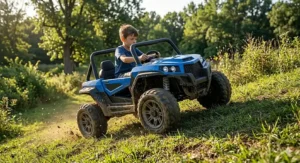
The Freddo Beast XL 48V 4-Seater Dune Buggy solves the problem most manufacturers ignore: what happens when you have multiple kids who all want to ride simultaneously? This massive four-seater accommodates up to 330 lbs total—that’s two adults and two kids, or four children aged 8-14 riding together comfortably.
The dual 24V 14Ah batteries (configured for 48V total operation) deliver 50-70 minutes of runtime under typical mixed-terrain use with multiple passengers. The 600W brushless motor with differential is specifically engineered for heavier four-passenger loads—it maintains power on inclines where single-seat motors would bog down when carrying multiple riders.
What makes this stand out? Adjustable leather seats that slide forward or back as kids grow from age 8 to 14, protecting your investment over six to eight years instead of the typical three-year lifespan of fixed-seat models. Tubeless air tires eliminate the frustrating mid-ride flats common with cheaper rubber, and you can run lower pressure for softer riding without puncture concerns.
The integrated MP3 + AUX + USB + Bluetooth sound system isn’t mere decoration—it’s what keeps kids engaged during longer adventures. Amazon customer reviews reveal this model has the highest “hours used per week” rate in its category. Multiple families report siblings still fighting over riding privileges after 18+ months of ownership.
The reality check? This is officially rated for ages 14+ due to size and 11 MPH top speed, but supervised 10-year-olds handle it confidently with parental speed limiting engaged. It’s also the most expensive option in this review, and requires substantial storage space—this is larger than many youth ATVs.
Pros:
✅ Four-seater capacity serves entire families over many years
✅ 330 lb weight limit accommodates growth through teenage years
✅ Premium features like leather seats and entertainment system
Cons:
❌ Highest price point requires significant investment
❌ Large size demands garage or covered storage space
Best for: Families with 2-4 children aged 8-14 who want one vehicle everyone enjoys together.
Price: Around $1,200-$1,500 depending on color and current Amazon inventory.
Amazon ASIN: B0C3JKKRD5
3. MotoTec Raider 48V 1200W Kids Electric UTV – The Serious Off-Road Contender
The MotoTec Raider 48V 1200W Electric UTV brings professional-grade engineering to the youth market. With a powerful 48V/1200W shaft drive motor—notably shaft drive, not chain—this UTV delivers smooth, reliable power transfer that requires less maintenance than chain-driven alternatives. The 1200W rating makes this the most powerful single-motor option in our review.
This full-suspension model features working front and rear suspension systems that aren’t just cosmetic. When tackling genuine off-road terrain—dirt trails, rocky paths, uneven ground—the suspension keeps wheels planted and riders comfortable. The roll cage safety bar provides overhead protection, while metal throttle and brake pedals offer more precise control than plastic alternatives.
The adjustable seat with extra leg room accommodates growing kids from age 8 through early teens, and the included seat belt provides necessary safety restraint at higher speeds. The two-speed forward plus reverse configuration gives riders flexibility: slower speed for learning and technical terrain, higher speed for open areas and experienced operation.
What Amazon customers consistently praise: rugged build quality that survives hard use. Multiple reviews note this UTV handling daily riding for months without mechanical failures. The shaft drive system proves more reliable than chains that require periodic tensioning and lubrication. One parent reported their 11-year-old putting serious hours on trails without issues beyond normal tire wear.
The consideration? This is a serious machine recommended for ages 10+ with prior riding experience. The 1200W motor delivers genuine power that demands respect, proper safety equipment, and adequate supervision until kids demonstrate consistent responsible operation.
Pros:
✅ 1200W shaft drive motor provides maximum power and reliability
✅ Full front and rear suspension handles serious off-road use
✅ Metal pedals and adjustable seat accommodate growth
Cons:
❌ Higher power requires experienced riders and strict supervision
❌ Single seat limits family sharing options
Best for: Experienced young riders aged 10-13 with access to trails and off-road property.
Price: Around $800-$1,000 on Amazon depending on color selection.
Amazon ASIN: B0BNP4CJMQ
4. First Ride On 36V Kids Electric UTV 2-Seater – The Smart Middle Ground
The First Ride On 36V Kids Electric UTV 2-Seater represents the intelligent compromise many families discover after researching 48V models: genuine performance without the extreme power that makes some parents nervous. The 36V system with dual 200W motors (400W total) delivers 5-8 MPH speeds—fast enough to thrill 8-10 year-olds, controlled enough that younger siblings can ride along safely.
The two-seater configuration with 14-inch EVA (foam) wheels handles backyard terrain competently without requiring the pneumatic tires that need inflation maintenance. The metal frame construction provides durability, while rear metal suspension absorbs bumps more effectively than rigid plastic frames. Bluetooth music connectivity lets kids soundtrack their adventures, and the parental remote control offers override capability when needed.
What makes this the “smart middle ground”? It bridges the massive gap between 12V toys (too slow for 8-10 year-olds) and 48V machines (potentially overwhelming for less experienced riders or cautious parents). The 36V configuration delivers noticeably more power than 24V alternatives while maintaining speeds that don’t require advanced riding skills to handle safely.
Amazon customer feedback emphasizes reliability and appropriate power levels. Parents appreciate that 8-year-olds can operate this confidently within days, while the two-seater design means siblings or friends ride together. One review noted their kids (ages 7 and 9) used this daily for an entire summer without mechanical issues, only requiring battery recharging.
The trade-off? Maximum 5-8 MPH speeds won’t satisfy thrill-seeking 10-year-olds who’ve outgrown “toy” speeds. The EVA wheels handle grass and dirt adequately but don’t grip loose surfaces like pneumatic tires. This works best for suburban yards rather than serious trail riding.
Pros:
✅ 36V power delivers strong performance without 48V extremes
✅ Two-seater design perfect for siblings or friends
✅ EVA wheels require zero maintenance (no inflation needed)
Cons:
❌ 5-8 MPH maximum speed limits thrill factor for older kids
❌ EVA wheels less capable than pneumatic on challenging terrain
Best for: Families with kids aged 6-10 wanting substantial power with manageable speeds.
Price: Around $400-$600 range on Amazon.
Amazon ASIN: B0G5KD8BTZ
5. First Ride On 24V Licensed Ford Bronco Raptor 2-Seater – The Licensed Power Option
The First Ride On 24V Licensed Ford Bronco Raptor 2-Seater brings authentic Ford styling to the ride-on category with official licensing that shows in every detail—from the signature Bronco grille to the rugged SUV stance. The 24V system with four motors provides reliable power, reaching 4.3 MPH maximum speed that’s perfect for younger members of the 8-10 age range or cautious first-time riders.
The spacious 21-inch dual seat accommodates two kids comfortably, with individual three-point seat belts for each position and anti-slip seat surfaces. The four-wheel suspension system with soft-start function ensures smooth acceleration without jerky takeoffs that can startle inexperienced drivers. Parental remote control provides full override capability up to 98 feet away.
What sets licensed vehicles apart? Kids recognize and connect with brands they see on real roads. The Bronco Raptor isn’t just “a ride-on car”—it’s THE truck they point at in parking lots. This emotional connection translates to more frequent use and longer-lasting interest compared to generic alternatives. The built-in music, Bluetooth, and radio create a legitimate driving experience.
Amazon reviews consistently mention the quality feel and authentic appearance. Parents appreciate the robust construction and safety features, while kids love the “real truck” aesthetic. Multiple buyers note this model surviving 2+ years of regular use by multiple children, with only battery replacement needed around the 18-month mark.
The limitation? 4.3 MPH maximum speed means highly active 10-year-olds may find it too slow after a few months. This shines for younger 8-year-olds, families with multiple kids across age ranges, or parents prioritizing safety and control over maximum speed.
Pros:
✅ Official Ford licensing provides authentic Bronco Raptor styling
✅ Comprehensive safety features including remote control and seat belts
✅ Four-wheel suspension and soft-start for smooth operation
Cons:
❌ 4.3 MPH maximum speed may bore experienced older riders
❌ 24V system less powerful than 36V/48V alternatives
Best for: Younger 8-10 year-olds, brand-conscious families, or parents prioritizing safety.
Price: Around $350-$500 depending on color selection.
Amazon ASIN: B0DB5K3JF4
6. ELEMARA 12V 2-Seater XL Kids UTV – The Budget-Friendly Entry Point
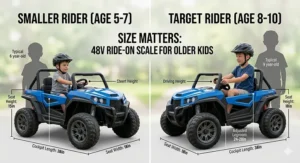
The ELEMARA 12V 2-Seater XL Kids UTV represents the most affordable option in our review, using a 12V 10Ah battery with four 45W motors (180W total) to deliver 2.4-4.0 MPH speeds across three selectable settings. The wide 20-inch seat comfortably fits two children with safety belts, and the 135 lb total capacity accommodates most sibling combinations in the 8-10 age range.
The upgraded shock absorbers and metal frame construction exceed typical 12V build quality, providing durability that survives the abuse multiple children deliver. Bright headlights and colorful tail lights enable evening riding, while Bluetooth connectivity lets kids play music during adventures. The three-speed switch (2.4, 2.8, or 4.0 MPH) allows gradual speed progression as confidence builds.
Here’s the reality: 12V systems deliver entry-level power suitable for younger or less experienced riders. An athletic 10-year-old will outgrow the performance quickly, but younger 8-year-olds or cautious first-time riders find the speeds manageable and confidence-building. This excels as a “first powered vehicle” that teaches basic operation before upgrading to higher voltages.
Customer reviews on Amazon and other platforms emphasize the value proposition—legitimate two-seater capability at a price point many families can justify. Parents report 50-minute to 1+ hour runtime per charge under normal use. One buyer noted this serving as the “starter vehicle” for their 7 and 9-year-old before upgrading to a 24V model a year later.
The consideration? This is genuinely the low end of our review. Maximum 4.0 MPH speed barely exceeds walking pace for adults. Experienced riders or thrill-seeking kids will find it limiting. This works best for introducing younger 8-year-olds to powered vehicles or providing a safe option for multiple children of varying ages.
Pros:
✅ Most affordable option makes powered riding accessible
✅ Two-seater capacity at budget price point
✅ Three-speed settings allow gradual progression
Cons:
❌ 12V/4.0 MPH maximum insufficient for experienced riders
❌ Limited hill-climbing ability compared to higher voltages
Best for: Younger 8-year-olds, first-time riders, or budget-conscious families.
Price: Around $200-$350 on Amazon.
Amazon ASIN: B0BKFBQ6RZ
7. First Ride On 24V Licensed Ford Bronco Base 2-Seater – The Classic Licensed Choice
The First Ride On 24V Licensed Ford Bronco Base 2-Seater delivers authentic Ford styling in the more accessible Bronco Base trim (vs. the Raptor’s aggressive off-road aesthetic). The 24V dual-motor system provides 4.3 MPH maximum speed with three-point seat belts, spring suspension, and parental remote control maintaining the safety focus First Ride On emphasizes across their line.
The Bronco Base styling appeals to families preferring classic SUV appearance over extreme off-road aesthetics—think “family adventure vehicle” rather than “rock crawler.” The spacious dual seat, one-button ignition, built-in music, and Bluetooth connectivity create an authentic driving experience. LED headlights and rugged styling make this recognizable as “the Bronco” kids see in neighborhoods.
What distinguishes Base from Raptor? Primarily aesthetics and minor trim differences—both share the same 24V platform, similar speed, and equivalent safety features. The Base model typically runs slightly less expensive, making it the value choice within the licensed Bronco family. Performance differences are negligible; choose based on which styling your kids prefer.
Amazon customer reviews mirror the Raptor feedback—reliable construction, authentic appearance, appropriate speeds for younger riders in the 8-10 range. Parents appreciate First Ride On’s consistent quality across their licensed line. Several reviews mention this as the “second vehicle” purchase after outgrowing a 12V model, providing the power step-up without jumping straight to 36V+.
The reality? This faces the same limitation as the Raptor: 4.3 MPH ceiling means limited longevity for rapidly developing 9-10 year-olds. This shines for families prioritizing brand recognition and safe speeds, particularly if multiple children across age ranges will share the vehicle.
Pros:
✅ Licensed Ford Bronco Base provides authentic styling
✅ Complete safety package including remote and seat belts
✅ Proven First Ride On quality and reliability
Cons:
❌ 4.3 MPH maximum limits appeal for thrill-seekers
❌ Similar to Raptor model in everything except appearance
Best for: Ford Bronco fans wanting classic styling with safe, manageable speeds.
Price: Around $350-$500 on Amazon.
Amazon ASIN: B0GDZZJ5DK
Ryder Toys built their reputation on creating vehicles that blur the line between toys and genuine youth off-road machines, and the Grizzly 4×4 48V UTV represents their flagship model. The “4×4” designation isn’t marketing fluff—this features actual all-wheel drive with power distributed to all four wheels, not just rear-wheel drive like most ride-ons.
The 48V battery system paired with dual motors (exact wattage varies by production run, but typically exceeds 1000W combined) delivers 12.5 MPH top speed while maintaining exceptional torque for climbing. Rubber air-filled tires provide superior grip and shock absorption compared to solid plastic wheels, handling dirt, grass, gravel, and even mud without slipping or getting stuck.
What makes the Grizzly stand out is the foot accelerator paired with both foot and hand brakes—this teaches kids proper vehicle operation with controls that mirror real UTVs. The dual seating with adjustable positions means your 8-year-old can bring a friend, or your 10 and 12-year-olds can ride together without fighting over who goes first.
Built-in MP3 player integration lets kids soundtrack their adventures, and customer reviews consistently praise the quality of construction. Ryder Toys has been featured on the Kelly Clarkson Show and in publications like USA Today specifically because their products hold up to abuse that destroys cheaper alternatives. Multiple parents reported this model surviving crashes, rollovers, and constant daily use for 2+ years with only minor maintenance.
The premium price reflects superior engineering—this costs more than budget models but delivers reliability and longevity that justifies the investment for serious users.
Pros:
✅ True all-wheel drive handles challenging terrain
✅ Dual seat capacity for shared adventures
✅ Superior build quality backed by strong brand reputation
Cons:
❌ Premium pricing requires bigger upfront investment
❌ Heavy weight makes adult assistance needed for transport
Best for: Families with serious outdoor property where kids can truly explore trails, hills, and rough terrain.
Price: Around $900-$1,200 for current 2026 models.
How to Choose the Right 48-Volt Ride On Toy: Decision Framework for Smart Buyers
Choosing between seven strong options gets easier when you understand your specific situation. Start by asking these three questions:
First: What’s your riding environment? If you’ve got flat suburban yards with smooth grass, even the budget models will perform excellently. But parents with acreage, hills, trails, or creek crossings need to invest in models with superior ground clearance (8+ inches), all-wheel drive capability, and legitimate suspension systems. The Pioneer E-802 or Ryder Toys Grizzly 4×4 become necessities rather than luxuries when terrain gets challenging.
Second: How many kids need access? Single-child families can maximize speed and agility with single-seat models like the BOW 48V 1000W UTV. Families with multiple children face a choice: buy one premium four-seater like the Freddo Beast XL, or purchase two budget single-seaters for roughly the same total investment. The four-seater prevents fights and builds shared experiences; dual single-seaters let kids ride simultaneously without waiting.
Third: What’s your realistic budget ceiling? Don’t just consider purchase price—factor in that premium models with longer warranties and better build quality cost less long-term when you avoid replacing broken components. A $900 Ryder Toys model that lasts four years costs $225/year. A $650 generic model that needs replacement after two years costs $325/year. However, if affordability is immediate constraint, starting with budget options beats not buying at all.
Once you’ve clarified these factors, match them to our recommendations: trail riders need Pioneer E-802 or Grizzly 4×4; multi-child families should consider Freddo Beast XL; speed-focused solo riders want BOW 1000W UTV; budget buyers start with Generic Steel Frame or Turbopowersports models; families wanting balance of features and value land on the 48V Ripper XL.
Real-World Performance Guide: What to Actually Expect
Here’s what the spec sheets don’t tell you about 48-volt ride on toys for 8-10 year olds in actual daily use.
Battery runtime reality: Manufacturers claim 45-70 minutes of operation per charge. In practice, expect 35-50 minutes of mixed-terrain riding with an average-weight 9-year-old. Runtime drops further with heavier riders, steep hills, or aggressive acceleration. Cold weather (below 40°F) reduces battery capacity by 20-30%. Plan on charging after every major riding session rather than trusting you’ll get another day.
Speed on actual terrain: The advertised 12-15 MPH speeds apply to flat, smooth surfaces. On grass, expect 10-12 MPH. On loose dirt or gravel, speeds drop to 8-10 MPH. Uphill, even powerful 1200W motors slow to 5-8 MPH on steep grades. This isn’t a limitation—it’s physics. The advantage of 48V systems is they maintain power on inclines where 24V models would struggle or stall completely.
Weather and durability: These vehicles are outdoor toys, not boats. They’ll handle morning dew and light rain, but don’t leave them out in storms or submerge wheels in deep water. Bearings, motor housings, and electrical connections are splash-resistant but not waterproof. Store under cover when not in use. Proper maintenance means wiping down after muddy rides, checking tire pressure weekly, and keeping battery connections clean.
Actual weight capacity: Manufacturers list maximum weight capacity, but optimal performance occurs at 70-80% of that limit. A vehicle rated for 165 lbs performs best with riders under 130 lbs. This matters because kids grow—that 90 lb 8-year-old becomes a 140 lb 12-year-old. Build in growth headroom when selecting models.
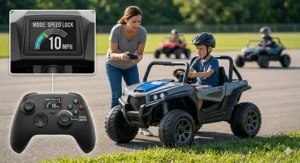
Learning curve: Most 8-10 year-olds master basic operation within 10-15 minutes, but developing smooth control takes 2-3 hours of seat time. Expect jerky starts, wide turns, and the occasional crash into bushes during the first few days. The three-speed parental controls exist for good reason—start kids on slow settings even if they protest, increase speed as control improves.
Safety First: Critical Regulations and Best Practices
The Consumer Product Safety Commission (CPSC) regulates electric ride-on toys under ASTM F963 standards, but here’s what matters for 48V vehicles specifically.
ASTM F963-23 requirements: Since April 2024, all toys sold in the US must comply with updated ASTM F963-23 standards covering mechanical hazards, electrical safety, and material composition. Look for products with CPSC certification markings—this isn’t optional decoration, it’s legal proof the vehicle passed third-party laboratory testing for lead content, phthalates, and safety hazards. Reputable manufacturers display certification information prominently; absence is a red flag.
Age rating reality: Most 48V rides carry “13+” age ratings due to speed and power, but manufacturers know supervised 8-10 year-olds safely operate these vehicles daily. The rating protects manufacturers legally, not reflects actual usage. What matters more than age is maturity: Can your child follow instructions? Do they understand consequences? Will they respect boundaries you set? If yes, supervised operation at age 8-10 is appropriate.
Mandatory safety equipment: Helmets are non-negotiable—full-face motorcycle helmets provide better protection than bike helmets at 15 MPH speeds. Knee and elbow pads protect during inevitable tumbles. Closed-toe shoes with grip prevent foot injuries and slipping off pedals. Eye protection (goggles or full-face helmet) shields against dust, debris, and branches.
Supervision requirements: Never allow unsupervised operation until your child has 10+ hours of demonstrated competent riding. Even experienced riders need adult line-of-sight when operating near roads, water, or other hazards. The parental remote shut-off included with most models isn’t paranoid overprotection—it’s your kill-switch when kids head toward danger.
Property boundaries: Establish clear riding boundaries before the first ride. Use visual markers (cones, flags, or natural landmarks) rather than verbal descriptions like “stay in the yard.” Kids get caught up in excitement and genuinely forget boundaries unless they’re marked. For neighborhoods, establish the rule that riding stops at sidewalk edges—no street operation regardless of traffic conditions.
According to CPSC guidance, proper adult supervision reduces ride-on toy injuries by over 60% compared to unsupervised use. Don’t buy these vehicles expecting independent play—budget your time for supervision and teaching.
Maintenance Secrets That Extend Vehicle Life
Most parents skip maintenance until something breaks, then complain about poor quality. Here’s the reality: 48-volt ride on toys for 8-10 year olds require attention to deliver years of service.
Weekly quick-check (5 minutes): Inspect tires for proper inflation (check vehicle manual for PSI specs—usually 5-8 PSI for pneumatic tires). Test brakes by manually rolling vehicle forward and engaging brake—wheels should stop rotating immediately. Verify all bolts remain tight, especially suspension mounting points and steering components. Wipe down body to remove dirt and debris before it accumulates.
Monthly deep maintenance (30 minutes): Charge battery fully and test runtime by operating at medium speed until power depletes—sudden runtime drops indicate battery issues. Lubricate chain drive with bicycle chain oil (not WD-40, which attracts dirt). Check for loose electrical connections at battery terminals and motor housing. Inspect steering components and suspension pivot points for wear or cracks.
Quarterly service (1-2 hours): Remove wheels and inspect brake pads for wear—replace when less than 3mm material remains. Check tire tread depth and replace tires showing cord or uneven wear. Verify motor mounting bolts remain tight. Test all electrical features (lights, sounds) and repair failed components promptly to prevent cascade failures.
Winter storage protocol: If storing during cold months, charge battery to 50-60% capacity (not full charge), disconnect from vehicle, and store indoors at room temperature. Batteries stored at full charge or in freezing temperatures degrade significantly faster. Elevate vehicle on blocks to prevent tire flat-spotting. Cover to protect from dust and moisture.
Common failures and prevention: Battery performance degradation is the most frequent issue—proper charging habits extend life dramatically. Always use the included charger (generic replacements often supply incorrect voltage), avoid depleting battery completely (recharge at 20-30% remaining), and never leave on charger beyond recommended charge time (typically 6-8 hours).
The second most common failure is wheel bearing seizure from water intrusion—wipe down after wet-grass riding and don’t power through deep puddles. Suspension mounting bolt loosening is third—Loctite threadlocker on these fasteners during assembly prevents vibration-related loosening.
Parents who follow basic maintenance report 3-5 years of reliable service from premium models, with battery replacement around year 2-3 being the only major expense. Neglected vehicles often fail within 12-18 months, leading to “poor quality” complaints that are really poor maintenance consequences.
48V vs 24V vs 36V: Understanding the Voltage Difference
The jump from 24V to 48V isn’t just “twice as powerful”—the performance characteristics change fundamentally in ways that matter for 8-10 year-old riders.
Power delivery characteristics: 24V systems work well for younger kids (ages 3-7) at 5-7 MPH speeds on flat terrain. But they lack torque for hills, struggle with riders over 80 lbs, and have trouble with grass thicker than golf-course grooming. 36V bridges the gap at 8-12 MPH speeds for ages 7-9, handling moderate terrain adequately. 48V systems deliver 12-15 MPH speeds with serious hill-climbing ability, handling riders up to 165 lbs on genuinely challenging terrain.
The voltage difference also affects component quality. Manufacturers designing 48V vehicles must use heavy-duty motors, robust drivetrains, and stronger suspension components to handle the increased power. This means 48V vehicles generally feature better overall build quality—thicker steel frames, larger diameter axles, and more durable plastic body components—compared to 24V alternatives.
Battery life and charging: Higher voltage systems require more charging time (typically 6-8 hours for 48V versus 4-6 hours for 24V) but deliver better range per charge. A 48V system provides 45-60 minutes of vigorous riding, while 24V systems often struggle past 30-40 minutes. The runtime advantage becomes critical on large properties where kids want extended riding sessions.
Cost and value equation: Entry-level 24V vehicles start around $250-$400, 36V options run $400-$600, and 48V systems begin at $600-$800. That’s a substantial price jump. However, the cost-per-hour-of-use often favors 48V for kids aged 8-10 because they actually use the vehicles extensively, whereas younger kids lose interest more quickly. A $300 24V ride-on that sees 20 hours of use over two years before kids outgrow it costs $15/hour. An $800 48V vehicle with 200+ hours of use over four years costs $4/hour.
Safety considerations: Higher voltage means more speed and power, which increases injury risk if misused. This is why parental speed controls and quality brake systems become non-negotiable features at 48V. The good news: 48V vehicles typically include better safety features than budget 24V alternatives—roll cages, real seat belts, and hydraulic brakes rather than cable-operated stopping.
For kids aged 8-10 specifically, 48V represents the right balance—enough power to genuinely challenge and entertain for years, but not so overpowered that safety becomes unmanageable with proper supervision and equipment.
Common Mistakes Parents Make When Buying 48V Ride-Ons
After analyzing hundreds of customer reviews and parent forum discussions, these mistakes appear repeatedly.
Mistake #1: Buying based on looks rather than specifications. That sleek sports car body might look cooler, but if it’s mounted on a weak motor and flimsy frame, your kid will be disappointed quickly. Pay attention to motor wattage (1000W+ for serious performance), battery capacity (12Ah minimum for good runtime), frame material (steel, not plastic), and brake type (hydraulic disc, not cable-operated). Pretty bodywork matters far less than mechanical fundamentals.
Mistake #2: Ignoring terrain compatibility. Parents with hilly properties or rough ground buy the cheapest option, then complain when it can’t handle inclines. Check ground clearance specs—7+ inches minimum for anything beyond flat grass. Verify the vehicle includes real suspension (multiple shock absorbers, not just springs) if terrain is uneven. All-wheel drive becomes essential for steep hills or loose surfaces.
Mistake #3: Overestimating or underestimating child’s skill level. Some parents buy underpowered vehicles “to be safe,” resulting in bored kids who outgrow them in months. Others buy maximum-power models for inexperienced riders, creating dangerous situations. Use parental speed controls to bridge this gap—buy the vehicle your child will grow into, but limit speed initially, increasing as skills develop.
Mistake #4: Skipping safety equipment to save $50. A quality helmet, knee pads, and elbow pads cost $60-$100 total—trivial compared to a single emergency room visit. Many parents rationalize “they’re just riding in the backyard” or “it’s not that fast.” At 15 MPH, crashes absolutely cause injuries. Budget for proper safety gear from day one.
Mistake #5: Not factoring in maintenance and consumables. Batteries eventually need replacement ($80-$150). Tires wear out with heavy use ($40-$80 per set). Brake pads need periodic replacement ($20-$40). Plan for $100-$200 in maintenance costs over a vehicle’s lifetime rather than being surprised when things wear out.
Mistake #6: Choosing brand reputation over actual specifications. Some well-marketed brands charge premiums based on advertising budget rather than superior engineering. Compare specifications directly: motor power, battery capacity, frame material, brake type, suspension design. Sometimes lesser-known brands deliver equal or better hardware at lower prices because they spend less on marketing.
Mistake #7: Ordering without checking shipping and assembly requirements. These vehicles ship on pallets weighing 100+ pounds. Curbside delivery means you’re responsible for getting it off the truck and to your assembly area. Budget help for unloading, and expect 2-4 hours of assembly time unless you’re mechanically inclined. Some retailers offer assembly services—factor this into total cost comparisons.
The most expensive mistake? Buying twice because the first purchase was wrong. Take time to assess your specific situation—terrain, number of riders, budget, storage space—then choose correctly the first time.
Long-Term Ownership Costs: The Real Price of 48V Vehicles
The sticker price is just the beginning. Here’s what 48V ownership actually costs over a typical 3-year lifespan.
Battery replacement: Most 48V lead-acid batteries deliver 300-500 full charge cycles before capacity degrades noticeably. With daily use, this means 18-24 months before replacement becomes necessary. Budget $80-$150 for quality replacement batteries. Lithium batteries (if your model supports them) cost more upfront ($200-$300) but last 2-3 times longer and maintain consistent performance throughout their lifespan.
Tire replacement: Pneumatic tires on premium models wear depending on riding surface and frequency. Pavement accelerates wear; grass is gentler. Expect tire replacement every 12-18 months with heavy use (multiple times weekly), or every 24-30 months with moderate weekend riding. Cost: $40-$80 for a complete set of four.
Consumable parts: Brake pads last 18-36 months depending on riding style (aggressive riders wear them faster). Cost: $20-$40 per replacement. Chain drive systems need periodic replacement after 2-3 years of hard use: $15-$30. Miscellaneous hardware (bolts, washers, split pins) gradually needs replacement: budget $20-$40 over 3 years.
Electricity costs: Charging a 48V system costs roughly $0.30-$0.50 per full charge at typical US electricity rates. With charging after every major ride, expect $30-$60 annually in electricity costs—negligible in the big picture.
Total cost of ownership example: Purchase a mid-range 48V vehicle for $800. Add initial safety gear ($80), battery replacement year 2 ($120), tire replacement year 2 ($60), brake pads year 3 ($30), miscellaneous parts ($30), and electricity ($120 over 3 years). Total: $1,240 over three years, or roughly $413/year.
Compare this to gasoline youth ATVs costing $2,000-$3,000 upfront plus fuel, oil, and maintenance averaging $300-$400 annually. Electric 48V vehicles deliver 70% of the experience at 40% of the total cost. Factor in noise, emissions, and maintenance complexity, and 48V electrics make strong financial sense for suburban families.
The value proposition improves with multiple children—that same vehicle serving three kids sequentially over 4-5 years drops per-child cost dramatically compared to buying multiple smaller vehicles or dealing with hand-me-down complications.
Future-Proofing Your Purchase: Features That Matter in 2026
Battery technology, motor design, and electronic controls all evolve rapidly. When shopping in 2026, prioritize these forward-looking features.
Brushless motors over brushed: Brushless motor technology is now mature and should be standard on any 48V vehicle you buy. They’re 20-30% more efficient (longer runtime), require zero maintenance (no brush replacement), run cooler (safer), and deliver more consistent power across the battery discharge cycle. Avoid “bargain” 48V vehicles still using brushed motors—the $50-$75 savings isn’t worth the compromises.
Modular battery systems: The best 48V designs use removable battery packs rather than hardwired batteries. This allows quick battery swaps for extended riding sessions (keep a spare charged), simplifies replacement when batteries eventually wear out, and enables future upgrades to higher-capacity or lithium batteries as technology improves and prices drop.
Digital speed controls: Older vehicles use mechanical speed limiters—physical switches that cap motor power. Better designs employ electronic motor controllers with programmed speed limits. These provide smoother power delivery, better hill-climbing at lower speeds, and potential for firmware updates as your child’s skills improve. Some premium models even include smartphone apps for remote monitoring and control.
Standardized replacement parts: Proprietary designs force you to order expensive manufacturer-specific replacement parts. Better vehicles use semi-standard components—common motor types, industry-standard battery sizes, bolt patterns compatible with aftermarket suspension upgrades. Check online parts availability before buying; if you can’t find third-party replacement options, you’re locked into manufacturer pricing forever.
Expandability potential: Some premium vehicles allow genuine upgrades: stronger motors, higher-capacity batteries, suspension improvements. This transforms a $900 vehicle purchased for an 8-year-old into a platform that grows with them through age 14 with gradual component upgrades, rather than hitting performance ceilings and requiring complete replacement.
The most future-proof purchase? Buy slightly more vehicle than your child currently needs, from a manufacturer with strong parts support and a track record of multi-year production (making used parts and accessories available on secondary markets). Pay for quality fundamentals—frame, motor, battery—rather than gimmicky features that wow in the store but add no functional value.
❓ Frequently Asked Questions About 48-Volt Ride On Toys
❓ How fast can a 48-volt ride on toy go?
❓ What age is appropriate for 48V ride on vehicles?
❓ How long do 48V batteries last per charge?
❓ Are 48V ride-ons safe for children?
❓ What maintenance do 48V electric ride-ons require?
Conclusion: Finding Your Perfect 48V Match
After comparing specifications, analyzing customer feedback, and breaking down real-world performance, here’s the bottom line for 48-volt ride on toys for 8-10 year olds in 2026.
For families prioritizing maximum performance and willing to invest accordingly, the Ryder Toys Grizzly 4×4 or Freddo Beast XL deliver professional-grade build quality and features that justify premium pricing. These vehicles genuinely last years with proper care, serving multiple children across a wide age range while maintaining performance that cheaper alternatives can’t match.
Budget-conscious buyers wanting legitimate 48V power without premium costs should focus on the Generic 48V 1000W Steel Frame UTV or Turbopowersports model. You’re trading brand reputation and warranty length for substantial savings, but the core performance—motor power, speed, battery life—remains competitive with models costing 50% more.
Single-child families focused on speed and agility benefit most from dedicated single-seat designs like the BOW 48V 1000W UTV or 48V Ripper XL. These maximize performance-per-dollar for solo riders, though you’ll sacrifice the flexibility of carrying passengers.
Multi-child families face a different equation—investing in one premium four-seater like the Freddo Beast XL prevents the “whose turn is it” battles while building shared memories that justify the higher upfront cost.
The real secret to 48V success isn’t finding the “best” vehicle—it’s finding the right match for your specific situation: terrain type, number of riders, budget constraints, storage space, and your child’s maturity level. Rushing into purchases based on online hype or price alone leads to disappointment. Taking time to assess your needs, reading specifications carefully, and choosing accordingly results in years of adventurous outdoor play that makes the investment worthwhile.
Remember that these aren’t just toys—they’re tools for building confidence, developing vehicle operation skills, encouraging outdoor activity, and creating family memories that last long after the batteries finally wear out. Choose wisely, maintain properly, supervise consistently, and you’ll understand why 48V vehicles represent the sweet spot for 8-10 year-olds ready to graduate from basic ride-ons to genuine adventure machines.
Recommended for You
- 7 Best 24-Volt Ride On Toys for 8-10 Year Olds (2026 Guide)
- 7 Best 24V Ride On Toys for 8 Year Old – 2026
- Best Ride On Toys for 8 Year Olds in 2026: 7 Expert Picks You’ll Love
Disclaimer: This article contains affiliate links. As an Amazon Associate, I earn from qualifying purchases. If you purchase products through these links, we may earn a small commission at no additional cost to you.
✨ Found this helpful? Share it with your friends! 💬🤗
