In This Article
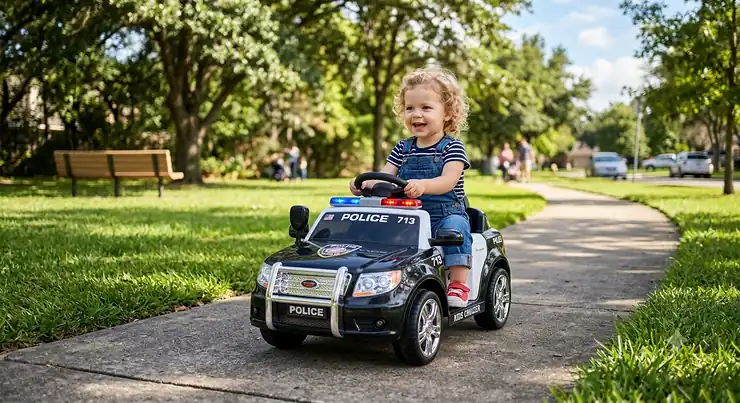
Somewhere between the toy aisle and the driveway, a tiny law enforcement career gets born. That’s the magic of a ride on police car for kids — it turns an ordinary Saturday into a full-blown patrol mission, complete with sirens, flashing lights, and a very serious four-year-old behind the wheel. A ride on police car for kids is a battery-powered ride-on toy styled like a real patrol vehicle, typically running on a 12-volt system with a parent remote override, LED lighting, and siren effects that make backyard cul-de-sacs feel like precinct territory.
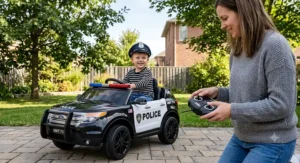
But here’s the part nobody tells you before you start scrolling listings at midnight: not all of these things are built the same. Some skimp on suspension. Some have remotes that lag half a second too long for comfort. Some look like a squad car and drive like a shopping cart with a delusion of grandeur. We spent real hours digging into specs, aggregated review patterns, and safety standards so you don’t have to gamble on a toy that’s going to sit in the garage after week two.
This guide breaks down seven genuinely solid options across budget, mid-range, and premium tiers, explains what actually matters when you’re choosing a ride on police car for kids (spoiler: it’s not the siren volume), and gives you the kind of practical, hands-on-adjacent advice Amazon’s five-bullet product description simply can’t. Consider this your unmarked car, quietly following the data before you commit.
Quick Comparison Table
Before we go deep on all seven, here’s the birds-eye view. Prices are shown as ranges only, since Amazon pricing shifts constantly — always check the current listing before buying.
| Product | Price Range | Seats | Best For |
|---|---|---|---|
| TOBBI 12V Police Ride-On | Budget ($150-$220) | 1 | Bluetooth music on a budget |
| Best Choice Products Police SUV | Budget ($160-$230) | 1 | Trusted brand, harness safety |
| ANPABO Licensed Ford Police Car | Budget-Mid ($180-$250) | 1 | Toddlers ages 2+ |
| Costzon Police Car Ride On | Mid ($190-$260) | 1 | Simple dual-control reliability |
| GarveeLife Police Car SUV | Mid ($200-$270) | 1 | Realistic megaphone play |
| JOYLDIAS 12V7AH Police Car | Mid-Premium ($230-$300) | 1 | Stability on rough terrain |
| Kiddokidz Dodge Durango Pursuit | Premium ($350-$450) | 2 | Siblings riding together |
Looking at the spread, you’ll notice the jump from single-seat runabouts to the two-seat Kiddokidz Dodge Durango Pursuit roughly doubles the investment — and that’s mostly because dual motors, a wider chassis, and licensed branding all cost real money to engineer. If you’ve got one kid and a modest budget, the TOBBI 12V Police Ride-On or Best Choice Products Police SUV cover the basics without gouging your wallet. If two siblings are going to fight over the same vehicle anyway, paying up for two seats up front is usually cheaper than buying, and later replacing, two separate cars.
💬 Ready to find your family’s perfect match? Scroll down to see full breakdowns of all 7 models below!
Top 7 Ride On Police Cars for Kids: Expert Analysis
Here’s the specs-at-a-glance table before we dig into each model individually.
| Product | Motor/Battery | Top Speed | Best For |
|---|---|---|---|
| TOBBI 12V Police Ride-On | 2x30W, 12V | 3.1 mph | Budget Bluetooth pick |
| Best Choice Products Police SUV | 12V, single motor | ~2.5 mph | Harness-equipped toddlers |
| ANPABO Licensed Ford Police Car | 12V | ~2.5 mph | Ages 2+ entry point |
| Costzon Police Car Ride On | 12V, dual motor | 3 speeds | Classic dual-control |
| GarveeLife Police Car SUV | 12V, 2.4G remote | 3 speeds | Megaphone realism |
| JOYLDIAS 12V7AH Police Car | 12V7AH, 6-wheel | 1.8-3.1 mph | Rough-terrain stability |
| Kiddokidz Dodge Durango Pursuit | Dual 390 motors | 3 speeds | 2-seat sibling rides |
A quick read of that table tells the real story: horsepower isn’t really the differentiator here — it’s wheel count, seating, and control redundancy. The JOYLDIAS 12V7AH Police Car trades outright speed for a 6-wheel footprint that shrugs off cracked driveways, while the Kiddokidz Dodge Durango Pursuit spends its extra motor power on hauling two kids instead of going faster. Now let’s get into what each of these actually feels like to own.
1. TOBBI 12V Police Ride-On Toy Electric Car — budget pick with Bluetooth and dual-motor power
The standout here is that this budget-tier cruiser doesn’t feel like a budget-tier cruiser once you factor in the Bluetooth speaker built into the dash. Under the hood, two 30-watt motors pull power from a 12V rechargeable battery, hitting a top speed around 3.1 mph with roughly 60 to 80 minutes of runtime per charge — plenty for an after-school patrol loop around the block. Spring suspension smooths out driveway cracks and curb transitions, which matters more than most parents expect until they watch a cheaper toy rattle a toddler’s teeth.
Based on the spec comparison, this is the pick for families who want the tech-forward extras (siren, intercom, Bluetooth streaming) without paying premium-tier prices, and who have one kid, not two, wanting the wheel. Reviewers consistently note the soft-start acceleration as a relief for nervous first-time drivers, since it ramps speed up gradually instead of lurching forward. Aggregated feedback across similar TOBBI listings also flags that the plastic body, while sturdy for the price, isn’t quite as thick-walled as the pricier ABS-bodied competitors — worth knowing if your child is rough on toys.
Pros:
- ✅ Built-in Bluetooth speaker for music and story playback
- ✅ Soft-start acceleration prevents sudden jerky movement
- ✅ Remote-priority override keeps parents in control instantly
Cons:
- ❌ Single-seat design won’t fit two riders
- ❌ Body plastic is thinner than premium ABS-bodied rivals
Expect this one to land in the $150-$220 range depending on retailer promotions — a genuinely strong value if Bluetooth audio is on your must-have list.
2. Best Choice Products 12V Electric Police Ride On SUV — trusted brand with seat-harness safety
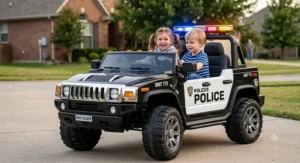
What most buyers overlook about this one is the seat harness — a detail some competing police-themed ride-ons skip entirely in favor of a simple lap belt. Best Choice Products built its reputation on accessible ride-on toys long before the police-themed niche exploded, and that experience shows in small but meaningful touches: locking doors, spring suspension, and a documented weight capacity so you know exactly when your child has outgrown it.
Here’s what to weigh: the AUX/Bluetooth audio setup and top speed are both slightly more modest than some rivals on this list, topping out closer to 2.5 mph, which actually works in your favor if your child is a first-time rider still getting comfortable with steering. Reviewers across the Best Choice Products lineup broadly describe the customer service and parts-replacement process as more responsive than many newer, lesser-known brands — a real consideration if something breaks during the warranty window. The 61 lb weight capacity is on the lower end of this list, so plan on this being a toddler-through-early-elementary vehicle rather than one that lasts all the way to age eight.
Pros:
- ✅ Seat harness adds an extra layer of restraint safety
- ✅ Locking doors prevent accidental mid-ride openings
- ✅ Established brand with accessible replacement parts support
Cons:
- ❌ 61 lb weight capacity limits how long it lasts
- ❌ Slower top speed than several competitors here
Price typically falls in the $160-$230 range, making it one of the more budget-friendly harnessed options on the market.
3. ANPABO Licensed Ford Police Car Ride On — best entry point for toddlers ages 2+
The short version: this is the one built specifically for the youngest recruits. Licensed Ford styling gives it a level of design authenticity you don’t get from generic “police-style” bodies, and the realistic LED siren flashing light paired with a working megaphone lets even a two-year-old feel like they’re running the show, safely tethered to a parent-controlled remote the entire time.
On paper, this means slower top speeds and a smaller footprint than the mid-range options on this list — which is exactly the point for a rider who’s still mastering basic steering coordination. The storage trunk is a genuinely clever touch for parents, since kids inevitably want to haul stuffed animals or snacks along for the ride, and having a dedicated compartment beats loose cargo bouncing around the footwell. What the spec sheet won’t tell you, but aggregated buyer feedback suggests, is that licensed designs like this one tend to hold resale value slightly better than unbranded lookalikes, since the officially licensed badge reassures secondhand buyers they’re getting the real thing.
Pros:
- ✅ Officially licensed Ford design adds authenticity
- ✅ Storage trunk keeps loose items contained during rides
- ✅ Ages 2+ rating makes it genuinely toddler-appropriate
Cons:
- ❌ Smaller size means kids outgrow it faster
- ❌ Modest top speed limits appeal past preschool age
Expect a price in the $180-$250 range — reasonable for a licensed toddler-first ride-on.
4. Costzon Police Car Ride On — best all-around dual-control classic
If you want the platonic ideal of “police ride-on toy, no frills, no drama,” this is it. Costzon built its version around dual control — kids drive manually with the steering wheel and foot pedal, or parents take over instantly using the 3-speed remote — and that redundancy is worth more than any flashy add-on when you’re supervising a first-time driver near a driveway slope.
Based on the spec comparison, the flashing siren lights, LED headlights, and police decals check every realism box a kid actually cares about, even without Bluetooth streaming or a megaphone attachment. What most buyers overlook about this model is how much the simplicity actually helps: fewer buttons and modes means less for a four-year-old to get confused by mid-ride. Reviewers consistently frame the ages 3-8 range as fairly accurate, noting the vehicle stays fun and functional well past the toddler stage, unlike some smaller units that get outgrown within a year.
Pros:
- ✅ Dual control lets parents take over instantly
- ✅ Realistic police decals and flashing lights kids love
- ✅ Ages 3-8 range gives it real longevity
Cons:
- ❌ No Bluetooth or megaphone feature included
- ❌ Basic horn/siren, less elaborate than premium rivals
You’ll typically find it priced in the $190-$260 range — solid mid-tier value for a dependable, no-nonsense build.
5. GarveeLife 12V Kids Ride On Police Car SUV — best megaphone and lighting realism
The megaphone is the star of the show here, and it’s not a gimmick — it’s the single feature kids reference most when describing why this one feels “real.” Paired with LED flashing lights and a 2.4G remote offering genuine parental control, the GarveeLife Police Car SUV leans hard into the role-play fantasy that makes this whole product category exist in the first place.
Here’s what to weigh: spring suspension smooths out yard bumps admirably, and the retractable handle makes it genuinely easier to haul the thing in and out of a garage than boxier competitors without one. Aggregated customer sentiment around GarveeLife’s ride-on lineup tends to praise the lighting realism specifically, while noting that battery runtime estimates can vary meaningfully depending on terrain and rider weight — a pattern that’s honestly true across nearly this entire category, not unique to this model. If your child is drawn to sound-and-light immersion over raw speed, this is the one that delivers it most convincingly.
Pros:
- ✅ Working megaphone adds authentic patrol role-play
- ✅ Retractable handle simplifies storage and transport
- ✅ Spring suspension handles yard bumps smoothly
Cons:
- ❌ Single-seat design, same as most on this list
- ❌ Runtime varies noticeably by terrain and rider weight
Price generally sits in the $200-$270 range, positioning it squarely in the mid-tier alongside the Costzon.
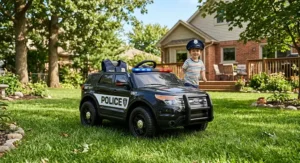
6. JOYLDIAS 12V7AH Kids Police Ride On Car — best 6-wheel stability for bumpy yards
What most buyers overlook about this one is the wheel count. Six wheels instead of the standard four means a noticeably wider, more stable footprint — genuinely useful if your “road” is actually a cracked patio or a lawn with more roots than grass. The 12V7AH battery pushes three speed settings between 1.8 and 3.1 mph, and the dual-drive system lets kids self-operate via foot pedal or switch to guided remote mode whenever a parent wants to step in.
Based on the spec comparison, the 77 lb weight capacity is the highest on this list, meaning this is one of the few options here that realistically stretches from toddlerhood into early elementary years without becoming a squeeze. The rear storage compartment and lockable doors are genuinely practical additions, not just marketing filler — reviewers frequently mention using the storage space for snacks, sunscreen, or a spare stuffed animal on longer rides. Emergency braking via the remote adds a real layer of reassurance for parents supervising near driveways or slopes.
Pros:
- ✅ 6-wheel spring suspension for stability on rough ground
- ✅ 77 lb weight capacity extends useful lifespan
- ✅ Rear storage compartment and lockable doors are practical
Cons:
- ❌ Larger footprint needs more storage space at home
- ❌ Sits at the higher end of the mid-range price bracket
Expect a price range of roughly $230-$300, reflecting its longer usable lifespan and sturdier build.
7. Kiddokidz Licensed Dodge Durango Pursuit — best 2-seater for siblings
This is the one you buy when you’re tired of refereeing whose turn it is. The Kiddokidz Dodge Durango Pursuit is a licensed two-seater running on dual 390 motors, which translates to noticeably more torque and hauling capacity than any single-seat model on this list — a genuine necessity once you’re moving two kids’ combined weight instead of one.
On paper, this means a bigger footprint, a bigger price tag, and a genuinely different ownership experience: parent remote control, flashing police lights, working megaphone, soft-start acceleration, and a power display all come standard, essentially bundling the best individual features from the rest of this list into one vehicle. What the spec sheet won’t tell you, but aggregated review patterns across licensed 2-seat ride-ons suggest, is that dual-motor units like this one tend to handle mild inclines and grassy stretches noticeably better than single-motor competitors, simply because the extra motor compensates for the added weight of a second passenger.
Pros:
- ✅ Two-seater design ends sibling turn-taking arguments
- ✅ Dual 390 motors provide extra torque for two riders
- ✅ Officially licensed Dodge Durango styling and branding
Cons:
- ❌ Larger size demands significantly more storage and yard space
- ❌ Premium pricing puts it well above the rest of this list
This model typically lands in the $350-$450 range — a meaningful jump, but arguably justified if you have two kids competing for the same seat.
What Makes the Best Police Ride On Car in 2026?
The best police ride on car for your family isn’t necessarily the fastest one or the one with the most flashing lights — it’s the one whose seating, weight capacity, and control setup actually match your child’s age and your driveway’s terrain. A genuinely “best” pick balances four things: a parental remote override for safety, a weight capacity with room to grow into, suspension suited to your actual riding surface, and a price point that doesn’t force you to compromise on the safety basics.
Based on everything covered above, families juggling two kids should lean toward the Kiddokidz Dodge Durango Pursuit, budget-conscious parents of a single toddler will get the most mileage from the TOBBI 12V Police Ride-On or Best Choice Products Police SUV, and anyone dealing with a rough, uneven yard should prioritize the JOYLDIAS 12V7AH Police Car‘s 6-wheel stability over raw top speed.
How to Choose a Ride On Police Car for Kids
- Confirm the recommended age range first. Most police-themed ride-ons cluster around ages 2-8, but weight capacity, not birthday, is the real ceiling — check both numbers before assuming a car “fits” your child.
- Prioritize parental remote override over top speed. A remote that instantly overrides pedal input is the single biggest safety differentiator between models, especially near driveways or slopes.
- Match wheel count to your terrain. Four wheels handle smooth pavement fine; six wheels, like on the JOYLDIAS 12V7AH Police Car, earn their keep on grass, gravel, or cracked concrete.
- Decide if you need one seat or two. Two-seaters solve sibling conflict but roughly double the price and footprint — worth it only if both kids are riding regularly.
- Check battery chemistry and charge time. Sealed lead-acid 12V batteries are standard and reliable, but always use the OEM charger and never leave a charging battery unattended overnight.
- Look for real safety extras, not just marketing language. Seat harnesses, locking doors, and soft-start acceleration matter more day-to-day than siren volume or paint detail.
- Read the weight capacity like a warranty, not a suggestion. A car rated for 65 lbs will handle a 40 lb toddler fine today, but that number tells you roughly how many riding seasons you’re buying.
Durable ABS Plastic Construction: Why Build Quality Matters
Durable ABS plastic construction is the quiet feature nobody photographs for the product listing, but it’s arguably the difference between a ride-on toy that survives three summers and one that cracks at the wheel well by August. ABS (acrylonitrile butadiene styrene) resists impact and UV fading better than the thinner PP (polypropylene) shells used in some of the cheapest police-themed ride-ons, which matters enormously for a toy that’s going to live outdoors, get left in direct sun, and occasionally collide with a mailbox post.
Here’s what to weigh: not every listing specifies which plastic they use, and manufacturers aren’t always consistent about disclosing it upfront. As a practical workaround, check aggregated reviews for mentions of cracking, fading, or “flimsy” panels — those complaints are the clearest real-world signal that a listing is using thinner, lower-grade plastic regardless of what the title claims. Products with reinforced ABS body panels, thicker wheel housings, and UV-stabilized paint jobs tend to hold their color and structural integrity noticeably longer, which is a real factor if you’re hoping to resell or hand the ride-on car down to a younger sibling later.
Parental Remote Override Explained: The Safety Feature That Matters Most
A parental remote override is exactly what it sounds like: a 2.4GHz (or similar) remote control that lets a parent take priority over the child’s pedal or steering input at any moment, typically including forward, reverse, turning, and an emergency stop function. On virtually every model in this guide, remote control input overrides manual control instantly — a design choice that exists specifically so a parent can intervene before a ride-on car reaches a curb, a driveway slope, or the street.
What most buyers overlook about this feature is how much it changes the actual supervision experience day-to-day. Instead of physically chasing a moving toy or shouting instructions a toddler can’t yet process fast enough, a parent standing ten feet away can simply steer the vehicle back onto the sidewalk. Reviewers across nearly every model in this category consistently flag remote lag and connection range as the two things to watch for — a remote that takes even half a second to respond, or that loses signal past 20-30 feet, meaningfully undercuts the safety benefit it’s supposed to provide. Testing the remote’s responsiveness during the return window, before it expires, is a smart practical habit.
Recommended Age Range: Matching the Ride On Police Car to Your Child’s Stage
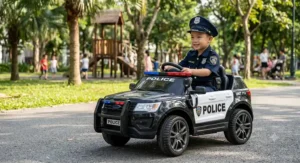
Recommended age range on these listings usually spans somewhere between “ages 2+” for the smallest toddler-oriented models, like the ANPABO Licensed Ford Police Car, up through “ages 3-8” for larger units like the Costzon Police Car Ride On. But age alone is a soft guideline — weight capacity and motor coordination matter just as much, if not more.
A two-year-old who’s still mastering basic walking coordination will likely rely almost entirely on parent remote control at first, gradually transitioning to independent pedal-and-steering-wheel driving over subsequent months. An eight-year-old, meanwhile, may already be nearing or exceeding the weight capacity on smaller units, making models like the 77 lb-rated JOYLDIAS 12V7AH Police Car a more realistic long-term fit. The safest approach: treat the printed age range as a starting point, then verify actual weight capacity and your child’s current coordination level before assuming any specific ride on police car for kids is the right match.
Ride On Emergency Vehicles for Kids: Police Cars vs Fire Trucks vs Ambulances
Ride on emergency vehicles for kids come in three flavors that dominate the category: police cars, fire trucks, and ambulances, and while they share a chassis DNA (12V batteries, remote overrides, flashing lights), the role-play experience and typical feature sets diverge meaningfully.
| Vehicle Type | Signature Feature | Typical Best For |
|---|---|---|
| Police Car (like the models above) | Siren + megaphone role-play | Kids drawn to “driving” and patrol pretend-play |
| Fire Truck | Ladder or hose attachments | Kids interested in rescue and climbing themes |
| Ambulance | Stretcher or medical-kit accessories | Kids drawn to caretaking and helper role-play |
Reading across that table, police-themed ride-ons tend to win out for kids specifically fascinated by driving, steering, and “pulling someone over” pretend scenarios, while fire trucks and ambulances lean more toward accessory-based imaginative play that doesn’t always center on the driving experience itself. If your child gravitates toward cop shows, traffic, or asking to “drive” everywhere, a ride on police car for kids is genuinely the better thematic fit over its emergency-vehicle cousins — the driving fantasy is the actual point, not a side feature.
✨ Don’t Miss These Exclusive Deals!
🔍 Take patrol-day playtime to the next level with these carefully selected police ride-on cars. Click through to check current pricing and availability before the good ones sell out!
Setting Up & Maintaining Your Ride On Police Car
Getting a new ride on police car for kids from box to backyard involves a few steps that the included instruction sheet tends to breeze past. Here’s the practical version.
First 30 days matter most for battery health: fully charge the 12V battery for the recommended window (typically 8-12 hours) before the very first ride, since an undercharged battery on day one can permanently reduce its total capacity. Avoid running the battery down to empty repeatedly during the break-in period — partial, frequent charges are gentler on sealed lead-acid batteries than full depletion cycles. Check tire pressure and wheel bolts after the first week of use, since vibration during shipping and initial rides can loosen fasteners that were only hand-tightened at the factory.
Common first-30-days mistakes include leaving the vehicle out in direct sun for extended periods (accelerates plastic fading and battery heat stress), forgetting to engage the parking brake or remote-lock feature on inclines, and skipping the manufacturer’s recommended terrain guidance in favor of gravel or rocky paths the suspension wasn’t designed for. A quick monthly habit — wiping down contacts, checking for cracked panels, and confirming the remote’s battery level — keeps most of these ride-on cars running reliably for multiple seasons.
Real-World Scenarios: Matching Families to the Right Ride On Police Car
The cautious first-timer. A newly-turned-three-year-old who’s never driven anything with pedals benefits most from heavy remote reliance early on. The ANPABO Licensed Ford Police Car or TOBBI 12V Police Ride-On, both with soft-start acceleration and full remote override, let this rider ease in without the intimidation of full manual control on day one.
The sibling standoff. Two kids, one driveway, and a nightly argument over whose turn it is — this is exactly the scenario the Kiddokidz Dodge Durango Pursuit‘s two-seat layout was built to solve. Yes, it costs more upfront, but it’s frequently cheaper than replacing a single-seat model that gets fought over into an early grave.
The rough-yard rider. A family whose “driveway” is actually a cracked, root-heavy patch of lawn needs stability more than speed. The JOYLDIAS 12V7AH Police Car‘s 6-wheel spring suspension and higher weight capacity make it the practical choice here, since narrower four-wheel models tend to tip or bottom out on uneven ground.
Buyer’s Decision Framework
If your child is under age 3 and driving for the first time, choose a toddler-rated single-seat model like the ANPABO Licensed Ford Police Car, because soft-start acceleration and heavy remote reliance matter more than speed or seating capacity at this stage.
If you have two kids who’ll both want to ride, choose a two-seater like the Kiddokidz Dodge Durango Pursuit, because the dual-motor torque and shared seating solve the sibling-turn problem that single-seat models can’t.
If your riding surface is rough, cracked, or grassy, choose a 6-wheel model like the JOYLDIAS 12V7AH Police Car, because extra wheels and a wider stance meaningfully reduce tipping risk on uneven terrain.
If budget is the deciding factor and you have one toddler, choose the TOBBI 12V Police Ride-On or Best Choice Products Police SUV, because both deliver the core safety features (remote override, suspension, LED lights) without premium-tier pricing.
Common Mistakes When Buying a Ride On Police Car for Kids
A lot of first-time buyers assume top speed is the most important spec, when in practice a slower vehicle with a responsive remote override is meaningfully safer than a faster one without it — speed only becomes relevant once your child has real steering confidence. Another common misstep is buying based on age range alone rather than checking weight capacity, which leads to disappointment when an “ages 3-8” vehicle turns out to have a 60 lb ceiling your seven-year-old already exceeds.
Skipping the terrain question is another frequent error — a smooth-driveway family and a cracked-patio family have genuinely different suspension needs, and the wrong choice here shows up as tipping, bottoming out, or excessive wear within the first season. Finally, plenty of buyers overlook charger compatibility and battery type until something goes wrong; always confirm the vehicle uses a standard, replaceable 12V battery, since proprietary battery packs can turn a simple replacement into an expensive hassle two years down the line.
What to Expect: Real-World Performance
On paper, most of these ride on police cars for kids look similar: 12V battery, 2-3 mph top speed, LED lights, some kind of siren. In practice, the experience diverges meaningfully once terrain, rider weight, and battery age enter the picture. Expect real-world runtime to land noticeably below the advertised 60-80 minutes once a rider is on the heavier end of the weight capacity or the terrain isn’t flat pavement — incline and rough ground both draw more current from the motor.
Expect the remote’s effective range to shrink somewhat from its rated distance once obstacles like fences, parked cars, or a house wall come between parent and vehicle. And expect battery capacity to gradually decline over roughly 18-24 months of regular use, which is normal sealed lead-acid battery aging rather than a defect — a replacement battery, widely available for most 12V ride-on models, typically restores close to original performance.
Long-Term Cost & Maintenance
The sticker price is rarely the full cost of ownership here. Budget for a replacement 12V battery roughly every 18-24 months of regular use, since sealed lead-acid batteries in this category naturally lose capacity over time regardless of brand. Tires, especially on models without spring suspension, may need periodic replacement if your child rides frequently on rough or abrasive surfaces.
| Ownership Factor | Typical Cost Range | Frequency |
|---|---|---|
| Replacement 12V battery | Budget for a moderate one-time cost | Every 18-24 months |
| Replacement tires (if worn) | Modest per-set cost | As needed, rough terrain increases frequency |
| Remote control replacement | Low one-time cost | Rare, usually only after loss or damage |
Looking at that breakdown, the real long-term value driver isn’t the upfront price tag — it’s how easily replacement parts are sourced for your specific model. Well-established brands like Best Choice Products and widely-sold models like the TOBBI 12V Police Ride-On tend to have more readily available replacement batteries and parts than smaller, less common listings, which matters more over a three-year ownership window than an extra $20 saved at checkout.
Safety, Regulations & Compliance Guide
All ride-on toys sold in the United States, including every ride on police car for kids featured in this guide, fall under the mandatory ASTM F963 toy safety standard, enforced by the Consumer Product Safety Commission under the Consumer Product Safety Improvement Act. That standard covers structural integrity, choking hazards, flammability, and labeling requirements specific to battery-operated ride-on toys, and manufacturers are legally required to include instructional literature covering safe use.
Beyond the federal baseline, practical safety comes down to supervision and setup: always use the vehicle’s OEM charger rather than a generic substitute, keep riding confined to flat, obstacle-free areas while a child is still learning, and never leave a young rider unsupervised near a driveway, street, or slope regardless of how reliable the remote override has proven. It’s also worth periodically checking the CPSC’s product recall database for your specific model, since even well-established brands occasionally issue safety recalls for issues like motors that continue running after the pedal is released.
FAQ
❓ What is the recommended age range for a ride on police car for kids?
❓ How long does the battery last on a ride on police car?
❓ Can two kids ride in a police ride on car at once?
❓ Is a parental remote override necessary on a ride on police car?
❓ What's the difference between ABS and PP plastic on ride-on toys?
Conclusion
Picking the right ride on police car for kids really comes down to three questions: how old is your rider, what does your driveway or yard actually look like, and how many kids need a seat. Get those three right, and nearly any of the seven models above will deliver months of genuine backyard patrol fun. Skip that step and even the flashiest siren won’t save a car that’s the wrong size, too fast for a first-timer, or unstable on your particular terrain.
If you’re still torn, the safest default for most families is a single-seat model with a strong parental remote override and a weight capacity that leaves room to grow — the TOBBI 12V Police Ride-On and JOYLDIAS 12V7AH Police Car both fit that description at different price points. From there, it’s really just a matter of matching your child’s excitement level to the siren volume and letting the neighborhood patrol begin.
Beyond the driving itself, this kind of role-play genuinely supports early social and emotional development — research summarized by the Child Mind Institute notes that pretend play like this helps young children build social skills and emotional regulation, which is a nice bit of validation the next time someone asks why the driveway sounds like a police chase.
Recommended for You
- Construction Ride On Toy For Toddlers: 7 Top Picks for 2026
- 7 Best Ambulance Ride On Toy Car Picks Parents Trust in 2026
- Fire Truck Ride On Car for Toddlers: 7 Best Picks (2026)
Disclaimer: This article contains affiliate links. As an Amazon Associate, I earn from qualifying purchases. If you purchase products through these links, we may earn a small commission at no additional cost to you.
✨ Found this helpful? Share it with your friends! 💬🤗
