
In This Article
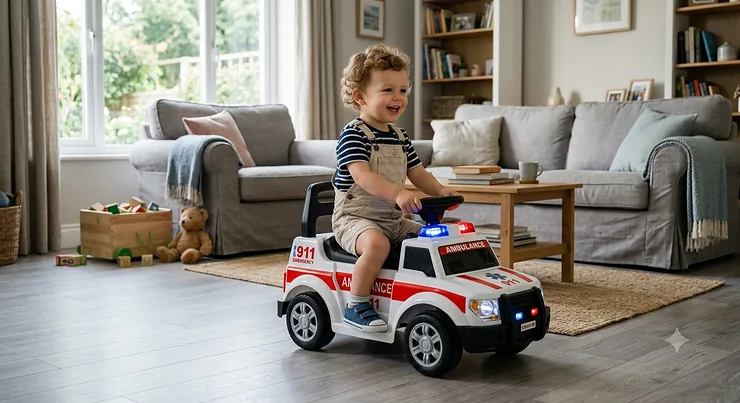
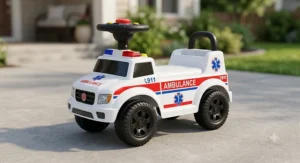
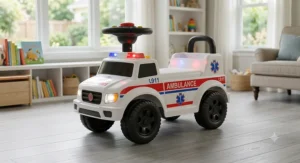
An ambulance ride on toy car is a battery-powered or foot-to-floor vehicle styled after a real emergency medical vehicle, typically featuring flashing lights, a siren sound button, and a seat (or stretcher-and-figure setup) that lets a child act out rescue missions. If your toddler has ever frozen mid-tantrum the second a real ambulance rolled by, you already know the appeal — for a certain age bracket, nothing beats the specific thrill of red-and-blue lights and a “wee-oo” siren.
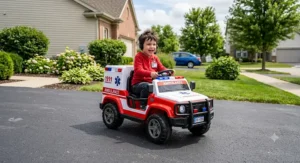
This category sits at an interesting intersection of two toy worlds. On one side you have full sit-in 12V electric ride-ons — the kind with a steering wheel, a parent remote, and enough battery to actually go somewhere in the driveway. On the other, you have smaller friction-powered and push-and-go ambulance toys built more for tabletop rescue scenarios than actual driving. Both wear the ambulance costume; they just deliver very different kinds of play. We researched real products across both camps so you can figure out which lane fits your kid, your budget, and your living room floor space.
What follows isn’t a rewritten spec sheet. Every product below gets honest analysis — what the numbers actually mean during play, where aggregated reviewer sentiment lines up or disagrees with the marketing copy, and who each option is genuinely built for. According to the U.S. Consumer Product Safety Commission, age labels and supervision matter more for riding toys than almost any other toy category, so safety gets real airtime here too, not just a footnote.
Quick Comparison Table
| Category | Product | Price Range | Best For |
|---|---|---|---|
| Best Overall Ride-On | Ride On Car Kids Ambulance Truck Electric 12V 2-Seat Toy Vehicle | mid-$100s to low-$200s | Families wanting an actual sit-in, drivable ambulance |
| Best Licensed Pick | Dickie Toys Mercedes-Benz Sprinter Rescue Vehicle | under $40 | Parents who want brand-name authenticity on a shelf toy |
| Best Small-Scale Budget | Driven by Battat Micro Series Ambulance | under $20 | Toddlers who want grab-and-go pretend play |
| Best Role-Play Bundle | Playkidiz Push & Go Ambulance Toy Playset | $25-$40 range | Kids who want a full rescue crew, not just a vehicle |
| Best Remote-Controlled | Driven by Battat RC Ambulance (17-Inch) | $30-$50 range | Kids who like driving from a distance with a joystick |
Looking at the spread above, the split isn’t really “good vs. bad” — it’s sit-in play versus tabletop play, and that distinction should drive your decision more than price does. A family with a driveway and a toddler who’s outgrown pushing toys around the living room gets far more mileage from the 12V ride-on than from any of the smaller options, even though it costs several times as much. Conversely, if your child is still at the stage of narrating stories to their toys rather than steering a vehicle, the smaller role-play sets deliver more relevant play value per dollar.
💬 Which style fits your kid better — full ride-on adventure or tabletop rescue crew? Keep scrolling to compare all seven, side by side.
Top 7 Ambulance Ride On Toy Cars: Expert Analysis
1. Ride On Car Kids Ambulance Truck Electric 12V 2-Seat Toy Vehicle — biggest flagship built for real sit-in rides
This is the closest thing on our list to an actual driveway vehicle, and that changes the entire conversation around it. The 12V 7Ah battery and dual motors are enough to carry two small riders at a walking pace, which is a meaningfully different experience than any push toy on this list.
At 54″ x 32″ x 29″ and a 77-pound weight capacity, this is built for two siblings or one child plus a favorite stuffed patient, not a solo toddler in a small apartment. The working xenon LED headlights and roof-mounted warning light alarm are genuinely bright rather than the dim “for show” lights common on cheaper 6V models, and the 2.4GHz parent remote means an adult can take over steering the moment the driveway meets the street.
Based on the spec comparison against similarly priced 12V ride-ons, this model earns its price primarily through the dual-control setup: kids can drive with the pedal and wheel, or a parent can pilot it via remote, which matters enormously for anyone whose yard isn’t fully enclosed. Reviewers consistently note that assembly takes real effort — budget 30-45 minutes with a screwdriver — and that the MP3/USB audio system is more of a bonus feature than a headline reason to buy.
Pros:
- ✅ True sit-in ride-on experience, not a push toy
- ✅ Dual control (child pedal drive or parent remote override)
- ✅ Two-seat capacity fits siblings or a stuffed “patient”
Cons:
- ❌ Assembly takes real time and basic tools
- ❌ Battery weight makes indoor storage awkward
At around $150-$220 depending on retailer, this sits firmly in premium ride-on territory, but it’s the only entry here that actually drives — for families set on the real thing, that alone justifies the gap over the smaller toys below.
2. Dickie Toys Mercedes-Benz Sprinter Rescue Vehicle — officially licensed Mercedes-Benz Sprinter design
Dickie Toys built its reputation on faithfully scaled emergency vehicles, and this one is officially licensed rather than a generic “Sprinter-style” knockoff — a detail that actually shows in the paneling and proportions.
At roughly 13.6 inches long, it’s a large-scale push-and-play companion rather than a sit-in vehicle, with a freewheel chassis that lets it roll smoothly across hard flooring, plus a working siren, flashing blue lights, and opening rear doors for loading gear. What most buyers overlook about this model is that the license covers the actual vehicle silhouette, not just a sticker — Dickie’s 50-plus years building scaled emergency and utility vehicles shows in details like the tailgate-to-ramp conversion on some Sprinter variants.
Aggregated reviewer sentiment on Dickie Toys products broadly praises the freewheel rolling action and realistic detailing for the price point, while some parents note the siren volume runs loud in enclosed rooms. Because it isn’t a true ride-on, don’t buy this expecting your child to sit inside it — it’s a floor-play and shelf-display piece that punches above its price in authenticity.
Pros:
- ✅ Genuinely licensed Mercedes-Benz Sprinter proportions
- ✅ Freewheel chassis rolls smoothly on hard floors
- ✅ Opening doors and side compartment for gear storage
Cons:
- ❌ Not a sit-in vehicle despite “ambulance ride on toy car” search intent
- ❌ Siren volume can be sharp indoors
Priced under $40 in most cases, this is the honest answer to “licensed ambulance ride on for kids” — just understand you’re buying licensed authenticity in a push toy, not a licensed 12V ride-on, since true licensed sit-in ambulance replicas are rare in this category.
3. Driven by Battat Micro Series Ambulance (7-Inch) — smallest budget pick with a removable stretcher
At 7 inches, this is the pocket-sized entry on our list, and it earns its spot by nailing the basics rather than trying to be everything.
The roof-mounted button activates both the siren and LED lights simultaneously, and the rear doors open to reveal a genuinely removable toy stretcher — a detail that lets a child act out the full pickup-and-transport sequence rather than just pushing a shape around. Reviewers consistently note the durability holds up over multiple years of daily play, with one long-term review specifically citing three years of continued use without failure.
Based on the spec comparison against similarly sized friction toys, the Micro Series stands out for movable front doors alongside the rear ones, letting kids inspect the “cab” as well as load the “patient bay” — a small touch that meaningfully extends imaginative play for toddlers who are still narrating scenarios rather than racing vehicles.
Pros:
- ✅ Front and rear doors both open for full interior play
- ✅ Removable stretcher supports pickup-and-transport play
- ✅ Reviewers report strong multi-year durability
Cons:
- ❌ Too small for any child to physically ride
- ❌ Lights and sounds are basic compared to bigger playsets
Typically priced under $20, this is the easiest “yes” on the list for a first ambulance toy, gift bag, or stocking-stuffer budget, especially if a bigger ride-on is already on the wish list elsewhere.
4. ArtCreativity Ambulance Toy Truck (1/16 Scale) — toughest friction-powered build for rough play
Friction toys live or die on how much abuse the wheel mechanism can take, and this 10.5″ x 4.5″ model is specifically built with that stress test in mind.
The friction-powered wheels mean zero batteries are required for the driving function — just rev the wheels on the floor and release — while both the side doors and the entire roof panel open, letting kids stash small items inside and pull out a removable stretcher. Here’s what the spec sheet won’t tell you, but the build quality suggests: high-density plastic construction like this is specifically chosen to survive repeated drops onto hard flooring, which matters more for a 3-year-old’s play style than any lighting feature.
What most buyers overlook is that the opening roof, not just the doors, is what separates this from cheaper friction ambulances — it effectively turns the whole vehicle into a small dollhouse-style play space rather than a closed shell with two openings.
Pros:
- ✅ No batteries needed for the core rolling function
- ✅ Roof panel opens in addition to both side doors
- ✅ Compact size suits younger toddlers’ hand size
Cons:
- ❌ No lights or sound buttons on this particular model
- ❌ Friction mechanism has a shorter roll distance than remote-controlled options
At a budget-friendly price point typically in the high teens to low $20s, this is the pick for parents who specifically want to avoid battery replacement headaches while still getting realistic opening features.
5. Playkidiz Push & Go Ambulance Toy Playset — richest medical role-play accessory bundle
If “medical role-play accessories” is the phrase that actually brought you here, this is the product built around that exact idea rather than treating accessories as an afterthought.
The vehicle itself uses a push-and-go friction motor for movement, while a single roof button triggers both red-and-blue flashing LED lights and a realistic siren sound effect — but the real value is in what comes in the box: four buildable, posable rescue figures, a stretcher, a mini-bike, and assemble-able medical tools, all requiring some hands-on construction before play begins. Based on the spec comparison against simpler ambulance toys, the assembly requirement is actually a feature, not a drawback — it builds fine motor skills and gives the toy a longer “unboxing” runway that keeps engagement high on gift-giving occasions.
Reviewers consistently highlight the sliding side door and dual rear doors as standout details for full interior access, letting kids stage entire rescue scenes rather than a single loading motion. The included stickers for customizing the figures and vehicle add a personalization layer that most competing playsets skip entirely.
Pros:
- ✅ Four buildable rescue figures included, not just a vehicle
- ✅ Sliding side door plus dual rear doors for full access
- ✅ Assembly step builds fine motor skills during play
Cons:
- ❌ Assembly required before first use, unlike ready-to-play rivals
- ❌ More small parts to track and store than a single vehicle
Generally priced in the $25-$40 range, this earns its spot as the top pick specifically for kids who want an entire rescue crew and story, not just a car that makes noise.

6. HANMUN Ambulance Rescue Vehicle Doctor Playset — most doctor-kit accessories per box
This model takes the medical role-play angle even further by building an entire pretend-doctor experience around the vehicle rather than around figures.
Switched to “drive” mode, the vehicle moves on its own with flashing lights and siren sound; switched to “stop and play,” the back opens to reveal a patient figure and four removable medical instruments — an otoscope, syringe, thermometer, and tongue depressor — for hands-on examination play. The guardrail area doubles as a small music player, and pressing buttons triggers sound effects like a heartbeat or coughing, which is a genuinely clever way to teach cause-and-effect alongside imaginative play.
What most buyers overlook here is that this product is functionally two toys in one: an ambulance vehicle and a doctor’s kit, thickened ABS construction is specifically chosen for toddler hands that tend to drop things, and the instrument set is sized appropriately for small fingers rather than scaled down from an adult medical kit. Aggregated review sentiment frames this as more of an educational toy than a pure vehicle toy, which is worth knowing going in.
Pros:
- ✅ Four removable medical instruments for hands-on exam play
- ✅ Dual “drive” and “stop and play” modes extend playtime
- ✅ Thickened ABS build resists drops from toddler hands
Cons:
- ❌ Small medical accessories require supervision for choking risk
- ❌ Less of a “vehicle” experience than dedicated ride-ons
Typically in the $25-$35 range, this is the strongest pick specifically for parents prioritizing “medical role-play accessories” over raw driving fun — pair it with product #1 above if you want both experiences covered.
7. Driven by Battat RC Ambulance (17-Inch) — longest-range remote control for hands-off rescues
For kids who love the idea of “driving” an ambulance without the size and storage demands of a true sit-in vehicle, this remote-controlled model splits the difference well.
Twin joysticks on the included remote move the vehicle forward, backward, and side-to-side from up to 100 feet away, while pressing buttons on the controller revs the engine sound and honks the horn; pressing the vehicle’s own bumpers activates the siren and flashing roof lights independently of the remote. Here’s what the spec sheet won’t tell you: that 100-foot range is genuinely useful for backyard play, letting a child “drive” the ambulance from the porch while it navigates the yard, which is a different kind of fun than steering from inside a seat.
Reviewers consistently note that battery management is the main friction point — the vehicle itself needs 6 AA batteries while the remote needs 2 more, so this isn’t a rechargeable setup like the 12V ride-ons above. Based on the spec comparison, the tradeoff is fair: no charging wait time, but ongoing battery costs over the toy’s lifespan.
Pros:
- ✅ 100-foot remote range suits full backyard play
- ✅ Independent siren/light activation via bumper press
- ✅ No lengthy charging cycle before first use
Cons:
- ❌ Requires 8 AA batteries total (vehicle plus remote)
- ❌ No seat, so it’s remote-driving only, not sit-in
Priced around $30-$50 depending on retailer, this is the value pick for kids who want remote-controlled independence without the price jump of a full electric ride-on.
Practical Usage Guide: Setting Up Your Ambulance Ride On Toy Car
Getting a new ambulance ride-on right on day one prevents most of the early frustration parents report. For any 12V model, budget the full 30-45 minutes for assembly before your child ever sees the box — attaching wheels, the seat, and the steering column typically requires a screwdriver and a flat workspace, and doing it while an excited toddler watches rarely goes smoothly. Charge the battery for the full 8-12 hours recommended before first use, even if the listing claims a shorter time; a battery that hasn’t taken a full initial charge tends to underperform for its entire lifespan.
Once assembled, run a “dry test” without your child aboard: check that the parent remote actually overrides the pedal, confirm the low-battery indicator works, and test the horn and siren buttons before handing over the keys, so to speak. For friction and push-and-go toys, the main maintenance task is simpler — periodically check that wheels roll freely and haven’t picked up hair, carpet fibers, or small debris that reduces the “zoom” distance kids love.
A common mistake in the first 30 days is letting a ride-on sit fully discharged between uses; lithium and sealed lead-acid batteries both degrade faster from deep discharge cycles than from regular top-up charging. Store the vehicle indoors or under cover between play sessions, since UV exposure fades plastic and dries out seals faster than actual play wear does.
Real-World Scenarios: Which Ambulance Ride On Toy Car Fits Your Family
Picture an 18-month-old in a small apartment with no yard — for this family, the 12V two-seat ride-on is overkill and a storage nightmare. The Driven by Battat Micro Series Ambulance or the ArtCreativity friction truck fits this exact situation: small footprint, no batteries to manage for the small one, and enough interactive detail (opening doors, a stretcher) to hold attention on a living room rug.
Now picture a family with a driveway, two kids close in age, and a genuine interest in outdoor play most afternoons. This is where the 12V 2-seat ambulance ride-on earns its higher price tag — siblings can share it, a parent can supervise via remote near the street, and the play value scales with the amount of outdoor space available.
Finally, picture a household that leans into imaginative and educational play over pure vehicle fun — maybe a parent who’s a nurse, EMT, or simply wants doctor-visit anxiety reduced before a checkup. The HANMUN doctor playset or the Playkidiz bundle serves this family best, since the accessories do more narrative work than the vehicle’s driving distance ever could.
Problem → Solution: Common Ambulance Toy Car Headaches, Solved
Problem: the siren sound is too loud for indoor play. Solution: look specifically for models with a sound on/off toggle separate from the lights, like the Playkidz-style switch mentioned in several listings, so lights-only play remains an option during nap-adjacent hours.
Problem: a 12V ride-on’s battery seems to drain faster each month. Solution: this is typically deep-discharge degradation rather than a defect — recharge after every use rather than waiting until the indicator reads empty, and avoid storing the vehicle at a full 0% charge over winter months.
Problem: small medical accessories keep going missing under furniture. Solution: designate a small labeled bin specifically for the stretcher, instruments, or figures that ship with role-play bundles, since these pieces are the first thing lost within 30 days according to aggregated parent feedback across similar playsets.
Problem: assembly instructions for imported ride-ons are confusing or incomplete. Solution: search the exact model name plus “assembly video” before starting — most sellers or third-party reviewers have posted step-by-step video walkthroughs that clarify poorly translated printed instructions.
How to Choose an Ambulance Ride On Toy Car
- Decide sit-in versus tabletop first. This single decision eliminates roughly half the products on the market and should be made before comparing any specs.
- Match weight capacity and age range honestly. A 12V ride-on rated for ages 3-8 will feel sluggish and underpowered for an 8-year-old at the upper edge of that range.
- Check whether a parent remote is included. For any yard that isn’t fully fenced, remote override isn’t a luxury feature — it’s a safety feature.
- Confirm ASTM F963 or CPSIA compliance on the listing. These certifications, discussed further in our safety section below, are the baseline for any children’s ride-on sold in the U.S.
- Decide how much you value role-play accessories versus raw driving distance. Bundled medical tools and figures extend narrative play; longer remote range or battery life extends physical, active play.
- Read aggregated review themes, not just star ratings. A 4.2-star average with repeated complaints about assembly time tells you more than the number alone.
- Budget for batteries or charging infrastructure separately. Remote-controlled models often need AA batteries on top of the purchase price, while 12V ride-ons need a dedicated charging routine.
Common Mistakes When Buying an Ambulance Ride On Toy Car
The most frequent mistake is buying based on the box art alone, then discovering the “ambulance” is a 7-inch friction toy when the family actually wanted something a toddler could sit in — or the reverse, buying a full 12V ride-on for an apartment with no storage space or driveway to use it in. Read dimensions and seating capacity before price.
A second common mistake is ignoring battery type until after purchase. Sealed lead-acid 12V batteries need a specific charger and a full 8-12 hour initial charge, while AA-powered remote toys need an ongoing battery budget that some buyers don’t anticipate. A third mistake is assuming all “licensed” branding refers to a full vehicle license; some products license only a badge or sticker design rather than the actual body shape, so verify what’s actually licensed before paying a premium for it.
Ambulance Ride On Toy Cars vs Traditional Push-and-Go Ambulance Toys
| Factor | 12V Ride-On Ambulance | Push-and-Go / Friction Ambulance |
|---|---|---|
| Play type | Active, physical, outdoor-leaning | Imaginative, tabletop, indoor-leaning |
| Typical age range | 3-8 years | 18 months-6 years |
| Price range | mid-$100s to low-$200s | under $20 to $40 |
| Storage footprint | Large; needs garage or covered space | Small; fits a toy bin |
| Maintenance | Battery charging cycle required | Minimal; check wheels periodically |
The comparison above makes the core tradeoff obvious: 12V ride-ons deliver a genuinely different play experience worth the price premium for households with the space and interest in active outdoor play, while push-and-go toys deliver more play value per dollar for younger toddlers or apartment living. Neither format is objectively “better” — the honest answer depends entirely on your child’s age, your storage space, and whether the goal is physical play or imaginative storytelling.
Ambulance Ride On Toy Cars for Different Ages and Stages
For toddlers around 18 months to 3 years, smaller friction and push-and-go models like the Driven Micro Series or ArtCreativity truck make more sense than anything battery-heavy — at this stage, kids are exploring cause-and-effect (open door, find stretcher) rather than driving distance. Between ages 3 and 5, kids start wanting to actually operate something, which is where 12V ride-ons and remote-controlled models start paying off, since steering and pedal control become genuinely engaging rather than frustrating. By ages 5 to 8, many kids graduate toward larger, faster ride-ons entirely, at which point an ambulance-specific model may feel like “for younger kids” — this is a natural point to retire the ambulance theme in favor of a general ride-on vehicle.
Features That Actually Matter (And Those That Don’t)
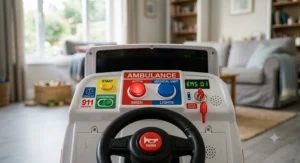
Features that matter: an independent lights-only mode (siren off, lights on), a parent remote override on anything battery-powered, and doors that genuinely open rather than being molded shut for decoration. These affect daily play and parental sanity in ways marketing bullet points rarely emphasize.
Features that matter less than the marketing suggests: Bluetooth music playback on a toy primarily used for 20-minute play sessions, and “engine sound realism” claims, since most children under 6 respond more to lights and a loud siren than to subtle engine audio detail. Spring suspension matters more on gravel or grass than on smooth driveways, so weigh this feature against your actual play surface rather than treating it as universally essential.
Medical Role-Play Accessories and Flashing Emergency Lights Worth Prioritizing
If accessories are a priority, look specifically for a removable stretcher (present on the Driven Micro Series and ArtCreativity truck), assemble-able medical instruments sized for small hands (HANMUN’s otoscope-and-syringe set), and posable figures rather than fixed driver silhouettes (Playkidiz). These details, more than horsepower or top speed, are what let a child narrate an actual rescue story instead of just pushing a vehicle in a straight line.
On the lighting side, sequential flashing patterns that alternate red and blue read as more “realistic” to both kids and parents than a single static color, and roof-mounted lights sit higher and read more visibly across a room than headlight-only setups. According to the American Academy of Pediatrics, pretend play tied to real-world scenarios like a doctor visit specifically helps children rehearse and reduce anxiety around those events — which gives the lights-and-siren combination genuine developmental value beyond pure entertainment.
Long-Term Cost & Maintenance
A 12V ride-on’s total cost of ownership extends well past the sticker price: expect to budget for a replacement battery every 1-3 years of regular use, plus occasional tire or wheel replacements if the vehicle sees driveway or sidewalk use rather than grass. Remote-controlled AA-powered models carry a different ongoing cost — eight batteries per unit adds up faster than parents expect if rechargeables aren’t used from the start.
Friction and push-and-go toys carry the lowest long-term cost by far, since there’s no battery replacement cycle at all; the main “maintenance” cost is eventual replacement of the entire toy once a child outgrows the play style, typically after 12-24 months of heavy use. When comparing sticker prices across this category, factor in these ongoing costs rather than judging value on purchase price alone.
Safety, Regulations & Compliance Guide
Every product on this list marketed for U.S. sale should meet ASTM F963, the mandatory toy safety standard enforced under the Consumer Product Safety Improvement Act. Per CPSC’s own business guidance, this standard specifically addresses ride-on toy stability, wheel and axle safety, and battery overheating protections, and sections 7.2 and 7.3 add specific marking requirements for ride-on toys and toy chests. Always verify this certification is listed before purchasing, particularly for smaller sellers or imported listings where documentation can be inconsistent.
Beyond certification, supervise any battery-powered ride-on near driveways or streets, since vehicle collisions remain the leading cause of serious ride-on toy injuries according to CPSC incident data. For 12V models specifically, use the parent remote near any area with vehicle traffic, and always follow the manufacturer’s charging instructions exactly — using an incompatible charger is one of the more common causes of battery failure reported by owners.
✨ Ready to compare current availability and pricing on today’s top picks? Check current price before this list updates again.
Frequently Asked Questions
❓ Is an ambulance ride on toy car safe for a 2 year old?
❓ How fast do ambulance ride on toy cars go?
❓ Do ambulance ride on toy cars come with a working siren?
❓ What is the age range for a ride on ambulance toy?
❓ How long does the battery last on a ride on ambulance car?
Conclusion
There’s no single “best” ambulance ride on toy car, because the category genuinely splits into two different products wearing the same paint job: full sit-in ride-ons built for driveway play, and smaller friction or role-play toys built for imaginative, tabletop rescue missions. The Ride On Car Kids Ambulance Truck Electric 12V 2-Seat Toy Vehicle earns the top overall spot for families who want the real driving experience, while the HANMUN Ambulance Rescue Vehicle Doctor Playset and Playkidiz Push & Go Ambulance Toy Playset win out for anyone prioritizing medical role-play accessories over raw horsepower.
Whichever direction you choose, verify ASTM F963 or CPSIA compliance, match the weight capacity and age range honestly to your child, and budget for the ongoing battery or accessory-replacement costs discussed above rather than judging purely on sticker price. A well-matched ambulance ride on toy car — sized and styled correctly for your child’s actual stage of play — tends to get far more real-world use than the flashiest option on the shelf.
Recommended for You
- Fire Truck Ride On Car for Toddlers: 7 Best Picks (2026)
- Police Car Ride On With Siren And Lights: 7 Top Picks (2026)
- 7 Best Ride On Trucks With Rubber Tires for Kids in 2026
Disclaimer: This article contains affiliate links. As an Amazon Associate, I earn from qualifying purchases. If you purchase products through these links, we may earn a small commission at no additional cost to you.
✨ Found this helpful? Share it with your friends! 💬🤗
