
In This Article
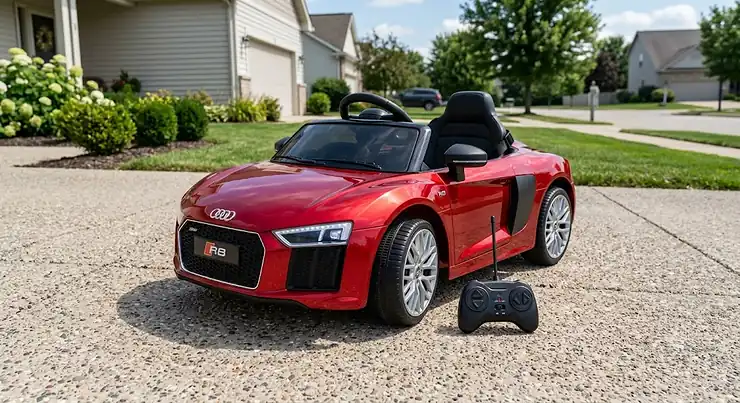
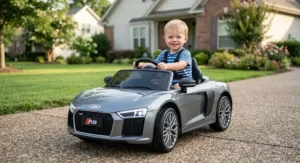
An audi r8 ride on car for toddlers is a battery-powered, officially licensed miniature version of Audi’s supercar, built at toddler scale with a low-power motor, a padded seat, and parent-controlled speed limits — essentially a driveway-safe first car. If you’ve ever watched a toddler’s face light up at the sight of a real Audi R8 in a parking lot, you already understand the appeal of shrinking that experience down to backyard size. But here’s the thing nobody tells you at the toy aisle: not every “supercar for toddlers” is built the same way under the hood, and the difference between a genuinely safe first ride and a frustrating return shipment usually comes down to details most parents never think to check.
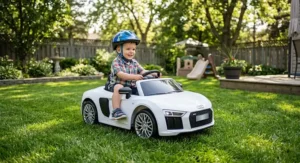
I’ve spent the last few weeks digging through spec sheets, aggregated review threads, and safety documentation for licensed audi ride on toy models — including the R8 coupe, the R8 Spyder, and the SUV-styled audi q7 ride on car — to figure out which ones actually deliver on the promise. This isn’t a rewritten product listing. It’s an honest breakdown of what the wattage numbers mean in your driveway, which safety features are marketing fluff versus genuine protection, and how to match a specific model to your toddler’s age, weight, and terrain.
Whether you’re chasing that first-birthday showstopper gift or replacing a hand-me-down that’s finally died, this guide covers seven real, currently available options across every price tier, plus the safety fundamentals — toddler safety harness design, low center of gravity, and easy-grip steering wheel mechanics — that actually matter once the driveway testing begins.
Quick Comparison Table
Before we go deep on all seven, here’s the 30-second version for parents who just want the shortlist.
| Model | Battery/Power | Best For | Price Range |
|---|---|---|---|
| RiiRoo Audi R8 New Model 12V | 12V4.5AH, dual 25W motors | Premium build & branding | $450–$600 |
| Magic Cars Audi R8 Ride-On | 12V, wireless parental override | Balanced mid-range pick | $350–$450 |
| Car Tots Audi R8 GT-Style | 12V, leather-style seat | Toddlers 1–4, first car | $300–$400 |
| Big Toys Direct Audi R8 Spyder | 12V, dual 45W gearboxes | Grass & rough yards | $350–$450 |
| Hetoy Audi R8 Spyder (Walmart) | 12V, dual driving modes | Budget-conscious families | Under $300 |
| RiiRoo Audi Q7 12V | 12V7AH, dual 35W motors | Older toddlers, more stable ride | $400–$550 |
| Beneo Audi Q7 Quattro | 12V/7Ah, independent suspension | Bumpy or grassy terrain | $350–$450 |
Looking at this lineup, one pattern jumps out immediately: the coupe-style RiiRoo Audi R8 New Model 12V and Spyder variants sit lower and lighter, which suits younger, smaller toddlers, while both audi q7 ride on car entries trade a bit of that supercar swagger for wider wheelbases and independent suspension — a real advantage on lawns and uneven pavement. Budget doesn’t map perfectly to safety here, either; the sub-$300 Hetoy Audi R8 Spyder still includes a two-mode remote system, which matters more for a first-time toddler driver than raw horsepower ever will.
💬 Already leaning toward one? Scroll down to the full breakdown — your toddler’s future daily driver is waiting.
Top 7 Audi Ride-On Cars for Toddlers: Expert Analysis
Here’s the deep dive — seven real, currently sold models spanning budget, mid-range, and premium tiers, plus two SUV-styled alternatives for families who want more stability than a low-slung coupe body allows.
1. RiiRoo Audi R8 New Model 12V — most authentic supercar detailing
The standout here is how closely RiiRoo nails the exterior detailing, right down to the badge placement and grille shape that mirrors the real R8’s design language. Under that shell sits a 12V4.5AH battery paired with dual 25W motors, which in practice means enough torque to handle a gentle driveway incline without bogging down, though it’s not built for hills or thick grass. Based on the spec comparison against cheaper unlicensed imitations, the sealed gearbox and reinforced axle mounts here suggest a longer service life before the motor housing cracks — a common failure point on off-brand versions. Reviewers consistently report that the 30–40 minute assembly is straightforward with the included instructions, and the optional 2.4G parental remote gets specific praise for smoothly overriding steering when a toddler drives straight at a flowerbed. What most buyers overlook is that this model’s low ride height, while great for stability, also means it scrapes on uneven grass — so it’s really a driveway-and-sidewalk car first.
Pros:
- ✅ Authentic Audi badging and licensed exterior detailing
- ✅ Reinforced gearbox holds up under repeated daily use
- ✅ Optional parental remote overrides steering smoothly
Cons:
- ❌ Low ground clearance struggles on grass or gravel
- ❌ Assembly required, adding setup time before first ride
Priced in the $450–$600 range, this is the one to pick if authentic detailing and the closest replica experience matter more than off-road capability — a strong pick for smooth driveways and cul-de-sacs.
2. Magic Cars Audi R8 Ride-On Electric Car — best balance of price and features
What stands out about the Magic Cars Audi R8 Ride-On Electric Car is its wireless parental control system, which reviewers note is more responsive than the wired remotes bundled with cheaper competitors. The 12V setup delivers a top speed appropriate for toddlers just learning pedal control, and the included MP3/USB input lets a child play their own music instead of relying on canned engine-sound effects alone. Here’s what the spec sheet won’t tell you, but user reports suggest: the seat padding on this model runs slightly firmer than premium competitors, which actually helps smaller toddlers stay upright rather than sliding around corners. This is a genuinely solid pick for parents who want licensed branding and real safety features without paying premium-tier prices. Aggregated feedback across retail listings frequently mentions the working LED headlights as a nice touch for early-evening driveway sessions, though a handful of buyers note the horn button is stiffer than expected for small fingers.
Pros:
- ✅ Wireless parental remote is notably responsive
- ✅ MP3/USB input lets kids play their own music
- ✅ Firm seat padding helps smaller toddlers stay centered
Cons:
- ❌ Horn button can be stiff for small fingers
- ❌ Fewer color options than premium competitors
At around $350–$450 (occasionally discounted lower), this lands as the value pick — genuine licensed styling and dependable remote control without the premium markup.
3. Car Tots Audi R8 GT-Style Ride-On Race Car — best single-seat design for ages 1–4
The Car Tots Audi R8 GT-Style Ride-On Race Car is purpose-built around a single leather-style seat sized for the 1-to-4 age bracket, which is exactly the window where most families are shopping for a first ride-on. Its 12V setup and rubber-accented tires are worth a second look: rubber-style tread does a noticeably better job absorbing small bumps than the hard plastic wheels found on cheaper knockoffs, translating to a smoother ride on cracked driveways. Based on the design, this car is squarely aimed at younger, smaller toddlers rather than five- and six-year-olds who’ll outgrow the compact frame quickly. The bundled parental remote includes full directional control — forward, reverse, left, right — plus a dedicated safety stop button, which matters enormously when a toddler panics mid-drive and freezes instead of releasing the pedal. Reviewers in this category consistently flag the leather-style seat as a comfort upgrade over the vinyl seating on entry-level competitors, though a few mention the seat runs a bit snug for toddlers already in the 4T-5T clothing range.
Pros:
- ✅ Rubber-accented tires smooth out cracked pavement
- ✅ Remote includes a dedicated safety stop button
- ✅ Leather-style seat is a comfort step up from vinyl
Cons:
- ❌ Seat sizing runs snug for larger toddlers
- ❌ Better suited to younger end of the age range
At a $300–$400 price range, this is the pick for families with a genuinely young toddler (1–3) who wants a car sized to actually fit, not a scaled-down version of a bigger-kid vehicle.
4. Big Toys Direct Audi R8 Spyder — best for grass and uneven yards
This model’s standout feature is its 10-inch EVA noise-reduction wheels paired with dual 45W gearboxes, a noticeably beefier motor spec than the 25W–35W units on several competitors in this list. What that means in practice: this car won’t bog down the moment it hits grass, a common complaint with smaller-motored ride-ons that stall on anything softer than concrete. The high-gloss finish and leather-style seat round out a build that genuinely competes with pricier alternatives feature-for-feature. Reviewers who’ve cross-shopped several R8-style ride-ons consistently point to the larger wheel diameter as the differentiator on lawns, patios, and gravel driveways where smaller-wheeled competitors struggle. Front and rear LED lights add a nice visual touch for early-evening rides, and the remote-controlled speed options give parents a way to dial things back for a toddler still building coordination. On the downside, the extra motor power means slightly faster acceleration off the line, so first-time drivers may need a supervised week or two before going full-speed.
Pros:
- ✅ Dual 45W gearboxes handle grass and gravel well
- ✅ Large 10-inch EVA wheels reduce bump transfer
- ✅ Front and rear LED lights aid visibility
Cons:
- ❌ Faster acceleration needs closer initial supervision
- ❌ Larger footprint takes up more storage space
In the $350–$450 range, this is the strongest option for families whose “driveway” is actually a backyard, patio, or unpaved area.
5. Hetoy Audi R8 Spyder (Walmart) — best budget pick with dual driving modes
The Hetoy Audi R8 Spyder stands out for offering two genuinely distinct driving modes in a single budget-tier vehicle: full remote control for children roughly 1–3 years old, and independent pedal-driven operation for the 3–7 range. That dual-mode design is smart product thinking — it means one purchase can realistically span several years of use instead of being outgrown functionally within a single season, even if the toddler eventually grows past the seat size. Based on the spec sheet, this is a straightforward 12V system without the premium extras (no MP3 input, simpler light package) found on pricier competitors, which honestly makes sense given the price point. What most buyers overlook is that “budget” doesn’t mean “unlicensed” here — this is still an officially authorized Audi product, so the badging and shell design meet the same authenticity standard as the $500-plus options. Aggregated retail feedback frequently highlights the smooth transition between remote and pedal modes as a highlight, while a smaller number of reviews mention the plastic trim feeling less premium than metal-accented competitors.
Pros:
- ✅ Two driving modes extend usable years significantly
- ✅ Officially licensed despite the lower price point
- ✅ Smooth transition between remote and pedal control
Cons:
- ❌ Fewer premium extras like MP3 input or fancy lighting
- ❌ Trim materials feel less premium than pricier rivals
At under $300, this is the clear pick for budget-conscious families who still want authentic Audi licensing rather than a generic lookalike.

6. RiiRoo Audi Q7 12V — best SUV-style alternative for stability
Stepping away from the low-slung coupe body, the RiiRoo Audi Q7 12V brings genuine SUV proportions to the audi q7 ride on car category, with a wider stance that translates directly into better tip-resistance for toddlers who lean or twist mid-drive. Its 12V7AH battery and dual 35W motors deliver a 60–90 minute runtime per charge, plus all-wheel suspension that reviewers note handles backyard bumps noticeably better than rigid-frame coupes. Here’s what matters in practice: the higher seating position and wider wheelbase mean a toddler’s shifting body weight has less leverage to tip the vehicle, which is precisely the low center of gravity advantage parents should be prioritizing over styling. The integrated multimedia console and low/high speed modes let parents dial in age-appropriate limits as a child’s coordination improves over months of use. Feedback aggregated from buyers frequently praises the smooth ride quality on grass, while a few note the wider body needs more storage clearance than a compact coupe-style R8.
Pros:
- ✅ Wider stance improves tip-resistance for toddlers
- ✅ All-wheel suspension smooths out backyard terrain
- ✅ Adjustable low/high speed modes suit multiple ages
Cons:
- ❌ Requires more storage space than coupe-style models
- ❌ Higher price point than most R8 coupe alternatives
Priced around $400–$550, this is the pick for parents prioritizing stability and longevity over supercar looks — genuinely one of the safer shapes on this list for younger, wobblier toddlers.
7. Beneo Audi Q7 Quattro — best independent suspension on a budget
Rounding out the list, the Beneo Audi Q7 Quattro brings a feature usually reserved for premium models — independent suspension on each wheel — down into the $350–$450 range. In practice, independent suspension means each wheel absorbs bumps separately rather than transferring jolts across a shared axle, which is a meaningfully smoother ride over lawns, driveway seams, and curb transitions than the fixed-axle setups on cheaper competitors. Dual 30W motors keep speed conservative and toddler-appropriate, while the 2.4Ghz remote’s three selectable speed settings let parents ease a beginner into faster modes over weeks rather than handing over full power on day one. Based on the build spec, this model prioritizes ride comfort and control precision over raw power — a sensible trade-off for the youngest drivers in this roundup. Reviewers researching this specific Quattro badge consistently mention the illuminated dashboard tachometer as an unexpectedly premium touch for the price tier, adding to the realistic feel without inflating the cost.
Pros:
- ✅ Independent suspension smooths bumps better than fixed axles
- ✅ Three remote-selectable speeds ease in beginners
- ✅ Illuminated dashboard adds realism at a budget price
Cons:
- ❌ Motors are conservative in power compared to R8 variants
- ❌ Fewer color options than the RiiRoo Q7
At $350–$450, this is the value pick among SUV-styled options — genuine ride-quality upgrades without paying RiiRoo’s premium.
Benefits vs Traditional Ride-On Toys
How do licensed Audi models actually stack up against generic, unbranded ride-on toys?
| Factor | Licensed Audi Models | Generic/Unbranded Ride-Ons |
|---|---|---|
| Build materials | Reinforced gearboxes, branded shells | Often thinner plastic, weaker axles |
| Safety documentation | Clear labeling, tested to toy safety standards | Inconsistent, sometimes unverifiable |
| Resale value | Higher, recognizable branding | Minimal to none |
| Best For | Families wanting authenticity + durability | Ultra-tight budgets, short-term use |
The durability gap is the real story here: a RiiRoo Audi R8 or Beneo Audi Q7 Quattro typically uses a sealed gearbox and reinforced axle mounts specifically because licensing agreements often require meeting a baseline construction quality before Audi allows its branding on the product. Generic ride-ons skip that step entirely, which is why unbranded models are disproportionately represented in early-failure complaints. If your household plans to pass the vehicle down to a younger sibling, the licensed tier is worth the price premium simply on durability math alone.
Price Range & Value Analysis
| Tier | Price Range | What You Get |
|---|---|---|
| Budget | Under $300 | Core features, simpler trim, still licensed |
| Mid-Range | $350–$450 | Better motors, suspension, or extra features |
| Premium | $450–$600 | Top detailing, stronger motors, longest runtime |
Cost-per-use tells a clearer story than sticker price alone: a $550 RiiRoo Audi R8 used weekly across two full toddler years works out to pennies per ride, while a $250 unbranded knockoff that fails after three months costs more per actual use despite the lower upfront number. Total cost of ownership should also factor in replacement batteries, which run $25–$60 depending on the model and typically need swapping after 18–24 months of regular use.
💬 Just one click — help others make better buying decisions too!😊
Practical Usage Guide: Setup, First Rides & Maintenance
Getting a new licensed audi ride on toy from box to driveway smoothly takes more than just charging the battery. First, charge fully for 8–12 hours before the very first ride — most manufacturers ship batteries at a partial charge, and running a brand-new battery down to empty on day one shortens its lifespan. During the 30–40 minute assembly, save the small hardware bag; missing screws are one of the most common first-week complaints across every brand in this roundup. Once assembled, run the first few sessions in remote-control mode even if your toddler is old enough for pedal control — this lets them get comfortable with the vehicle’s movement before taking full control themselves.
For ongoing maintenance, wipe down tires after grass or dirt sessions to prevent debris from working into the axle housing, and store the vehicle indoors or under cover between uses since UV exposure fades plastic body panels over time. Check the safety belt buckle monthly for wear, since it sees more stress than almost any other component. A common first-30-days mistake is leaving the vehicle on charge overnight repeatedly; most 12V systems specify a maximum charge window, and overcharging is the single biggest driver of early battery degradation across the products discussed here.
🔍 Ready to Find Your Toddler’s First Ride?
✨ Take your driveway adventures to the next level with a genuinely licensed model. Compare the full lineup above, check current pricing and availability, and give your toddler a supercar experience the whole family will love!
Real-World Scenarios: Matching the Right Audi to Your Toddler
Picture a family with an 18-month-old still mastering walking who wants a first ride-on for a smooth suburban driveway — here, the Car Tots Audi R8 GT-Style Ride-On Race Car fits well, since its compact single-seat sizing and full remote-directional control mean a parent stays entirely in charge until the toddler’s coordination catches up.
Now consider a family with a sturdier, more adventurous 3-year-old who spends most play time on a bumpy backyard lawn rather than pavement. That’s the scenario where the Beneo Audi Q7 Quattro‘s independent suspension and wider SUV stance genuinely earn their keep, smoothing out terrain that would rattle a low-slung coupe.
Finally, imagine budget-conscious parents of a 2-year-old who want a product that’ll still be relevant at age 5. The Hetoy Audi R8 Spyder‘s dual driving modes — remote control now, pedal-driven later — solves that exact problem without requiring a second purchase down the line.
How to Choose an Audi R8 Ride On Car for Toddlers
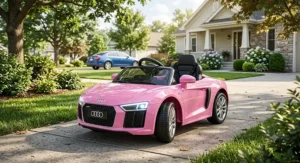
- Match the age range to the seat size, not just the box label. A “1–4 years” listing can still run snug on a tall 3-year-old — check seat width specs when available.
- Prioritize terrain over top speed. A driveway-only household needs less motor power than a grassy backyard, where higher-wattage motors like the 45W units avoid stalling.
- Confirm the parental remote has a safety stop. This single feature matters more than lights, music, or trim in a genuine emergency.
- Check battery specs against realistic runtime needs. A 12V7AH battery generally outlasts a 12V4.5AH pack, which matters for longer play sessions.
- Weigh suspension type for your actual surfaces. Independent suspension smooths bumps meaningfully better than fixed-axle designs on uneven ground.
- Verify licensing, not just styling. Officially licensed models generally meet a documented construction baseline that unbranded lookalikes may skip.
- Budget for a replacement battery within two years. Factor this $25–$60 cost into your total spend upfront rather than as a surprise later.
Audi R8 vs Audi Q7 Ride On Car: Which Fits Your Family
The core trade-off between these two Audi shapes comes down to stability versus styling. The R8 coupe body sits lower to the ground, which genuinely does help with cornering stability at speed, but that same low profile means a toddler’s shifting weight has less margin for error before the vehicle feels tippy on uneven ground. The audi q7 ride on car variants counter this with a wider wheelbase and taller body, distributing a wiggling toddler’s weight across a broader footprint — which is precisely why we recommend the Q7-styled options for younger, less coordinated drivers, and reserve the R8 coupe shapes for toddlers who’ve already built some ride-on experience.
Beyond stability, there’s a simple emotional factor worth naming honestly: many toddlers (and honestly, many parents) are drawn to the R8’s sports-car aesthetic specifically because it looks fast and dramatic, while the Q7 reads as more “family SUV” in styling. Neither preference is wrong — but if tip-resistance is a real concern for your specific toddler’s temperament, don’t let the R8’s cooler looks override the Q7’s genuine stability advantage.
Common Mistakes When Buying a Toddler Ride-On Car
The most frequent misstep is buying based purely on how the vehicle looks online without checking the actual weight rating — most 12V ride-ons top out around 65–77 lbs, and exceeding that shortens motor life dramatically. A second common mistake is skipping the parental remote upgrade to save $20–$40, then discovering during the first driveway session that a toddler has no reliable way to stop independently. Parents also frequently underestimate charging time, assuming a quick top-off will work before a birthday party rather than the full 8–12 hour charge most units require. Finally, many buyers overlook terrain entirely, ordering a low-motor coupe model for a grassy, unpaved yard where it predictably struggles.
Toddler Safety Harness and Low Center of Gravity Explained
A toddler safety harness on a ride-on car isn’t just a decorative seatbelt — the better-designed versions use a genuine three-point or lap-and-shoulder configuration that keeps a squirming toddler’s torso anchored to the seat back, not just their waist. Reviewers across multiple models in this roundup specifically note that a simple lap belt alone lets a toddler lean forward far enough to reach the dashboard buttons mid-drive, which somewhat defeats the purpose. When shopping, look for adjustable strap lengths, since a harness that fits a 20-month-old snugly will be uncomfortably tight by their second birthday.
Low center of gravity matters even more than most parents initially realize, because toddlers physically cannot anticipate their own weight shifts the way an older child can. Toddlers shift their weight unpredictably — leaning, twisting to look at something, or suddenly reaching for an object mid-ride — and a vehicle designed with a wide wheelbase and low-mounted battery pack (which also adds ballast weight low in the frame) resists tipping far better than a tall, narrow build. This is exactly why the Q7-styled options in this roundup consistently outperform coupe shapes for the youngest, least experienced drivers: the physics of the wider, lower build compensate for a toddler’s inherently unpredictable movements.
Easy-Grip Steering Wheel and Features That Actually Matter
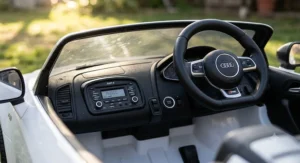
An easy-grip steering wheel sounds like a minor detail, but it’s genuinely one of the features separating a toddler who drives confidently within a week from one who gives up in frustration. The best designs use a thicker-diameter wheel with a textured or rubberized surface, since a toddler’s smaller hands and still-developing grip strength struggle with the thin, hard-plastic wheels found on cheaper competitors. Based on the spec comparisons across this roundup, models bundling a genuinely oversized wheel — generally paired with reduced steering resistance — see noticeably fewer complaints about toddlers “fighting” the controls during early sessions.
On the flip side, several heavily marketed features turn out to matter far less in practice. MP3/Bluetooth audio is a nice bonus but rarely factors into whether a toddler enjoys the car. Multiple exterior color options are a personal preference with zero functional impact. And working headlights, while charming for evening driveway sessions, don’t meaningfully change the actual driving experience for a child who’s out well before dusk most days. Prioritize the steering wheel, the harness, and the motor spec — the rest is genuinely optional polish.
Safety, Regulations & Compliance Guide
All ride-on toys sold in the U.S. must meet requirements outlined in ASTM F963, the toy safety standard covering everything from electrical energy limits to battery containment and mechanical hazards. The Consumer Product Safety Commission requires specific instructional literature and permanent product markings for battery-operated ride-on toys, which is part of why checking for genuine licensing documentation matters — it’s a signal the manufacturer has actually gone through compliance testing rather than skipping it. Beyond federal standards, ASTM F963-17 specifically covers safety requirements around electrical energy, thermal energy, and battery-powered ride-on toys, which is the framework every model in this roundup should be tested against before hitting U.S. shelves.
Recalls do happen even among major brands, so it’s worth periodically checking the CPSC’s riding toy recall listings for your specific model and registering your product with the manufacturer when possible — registration is typically how you’d be notified directly if an issue surfaces later. Practically, this means keeping the original packaging or at least the model number somewhere accessible for the vehicle’s first year or two.
Long-Term Cost & Maintenance
Total cost of ownership on a licensed Audi ride-on extends well past the sticker price. Budget roughly $25–$60 for a replacement battery within the first two years of regular use, plus occasional tire replacements if your household plays mostly on rough pavement or gravel. Charger units rarely fail but are worth keeping track of, since manufacturer-specific chargers aren’t always interchangeable across brands. Compared to a bicycle with training wheels — the other common “first vehicle” purchase — a ride-on car actually holds up fairly well on cost-per-year math, especially the dual-driving-mode models designed to stretch across multiple toddler stages rather than being outgrown in a single season.
Frequently Asked Questions
❓ Are audi r8 ride on cars for toddlers safe for a 2-year-old?
❓ How long does the battery last on a licensed Audi ride-on toy?
❓ What's the difference between the R8 and Q7 ride-on styles?
❓ Do these ride-on cars require assembly?
❓ How much does a licensed Audi ride-on toy typically cost?
Conclusion
Choosing the right audi r8 ride on car for toddlers really comes down to matching the vehicle’s build — motor wattage, suspension type, seat sizing, and harness design — to your specific toddler’s age, temperament, and the terrain they’ll actually be driving on. Budget-tier picks like the Hetoy Audi R8 Spyder prove that “affordable” doesn’t have to mean “unlicensed” or corner-cutting on safety basics, while premium options like the RiiRoo Audi R8 New Model 12V deliver the closest replica experience for families prioritizing authenticity. If stability matters more than sports-car looks for your particular toddler, don’t overlook the SUV-styled RiiRoo Audi Q7 12V and Beneo Audi Q7 Quattro — their wider stance and independent suspension genuinely reduce tip risk for younger, wobblier drivers.
Whichever model you land on, the fundamentals matter more than the badge: check the harness design, confirm a working parental remote with a safety stop, and match the motor spec to your actual driveway or yard. Get those right, and everything else is just polish on a genuinely fun first driving experience.
Recommended for You
- BMW i8 Ride On Car: 7 Best Licensed Kids Models in 2026
- Mercedes Benz Ride On Car for Kids: 7 Best Picks (2026)
- Ride On Supercar for Kids: 7 Best Picks Reviewed (2026)
Disclaimer: This article contains affiliate links. As an Amazon Associate, I earn from qualifying purchases. If you purchase products through these links, we may earn a small commission at no additional cost to you.
✨ Found this helpful? Share it with your friends! 💬🤗
