
In This Article
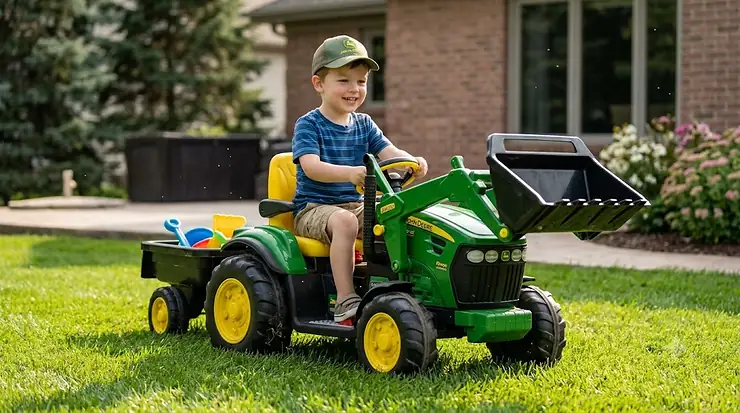
Somewhere between the driveway and the back fence, a four-year-old in a tiny green cap is currently negotiating the terms of his first “real” job: hauling imaginary gravel from the sandbox to the garage. That’s the pull of john deere ride on toys battery powered vehicles — they’re not just toys, they’re a rite of passage for kids who’ve watched grandpa, dad, or a neighbor rumble past on the actual machine. A john deere ride on toys battery powered vehicle is a scaled-down, motorized recreation of a real John Deere tractor or Gator, built with a rechargeable battery, a working accelerator, and enough branded detail to make any farm-obsessed toddler lose their mind with joy.
The category has exploded well beyond the single mini Gator most of us remember from big-box store aisles. Today you’re choosing between 6-volt starter tractors, 12-volt workhorses with trailers, and 24-volt two-seaters that genuinely climb hills. That’s a lot of green-and-yellow plastic to sort through, and the specs alone — volts, amp-hours, weight capacities — don’t tell you much about which one actually survives a Midwestern summer of driveway laps.
That’s what this guide is for. We dug into real product listings, manufacturer spec sheets, and aggregated customer feedback to break down seven genuine John Deere ride-on models, explain what the numbers actually mean for your kid and your yard, and flag the tradeoffs nobody puts on the box. Whether you’re shopping for an 18-month-old’s first foot-to-floor experience or a 24V Gator that two siblings can fight over, you’ll walk away knowing exactly which model earns its spot under the Christmas tree.
What Is a John Deere Ride On Toy Battery Powered Vehicle?
A john deere ride on toys battery powered vehicle is an officially licensed, motorized children’s tractor or utility vehicle powered by a rechargeable 6V, 12V, or 24V battery instead of foot-pedaling. Kids steer with a wheel, control speed with an accelerator pedal, and — depending on the model — haul a trailer, blast water bazookas, or listen to an onboard FM radio while they drive.
Most are manufactured by Peg Perego (the primary Deere-licensed ride-on partner) or TOMY, under agreements with Deere & Company, the American corporation that manufactures agricultural machinery, heavy equipment, forestry machinery, and lawn care equipment and has built its reputation over more than 180 years of farm-equipment history.
Quick Comparison Table: John Deere Ride On Toys Battery Powered at a Glance
| Model | Voltage | Best For | Seats | Top Speed | Price Range |
|---|---|---|---|---|---|
| Ground Force Tractor w/ Trailer | 12V | All-around family favorite | 1 | ~4.5 mph | $300–$400 |
| Gator XUV | 12V | Siblings riding together | 2 | ~4.5 mph | $350–$450 |
| Gator HPX | 12V | Hilly, uneven yards | 2 | ~4.5 mph | $320–$420 |
| Gator XUV 6×4 | 24V | Power + bigger kids | 2 | ~7.5 mph | $450–$580 |
| TOMY Mini Gator | 6V | Budget first ride-on | 1 | ~2.5 mph | Under $150 |
| Mini Tractor 6V | 6V | Toddlers 1.5–3 years | 1 | ~2.5 mph | $150–$220 |
| Gator XUV Realtree Camo | 12V | Licensed camo styling | 2 | ~4.5 mph | $400–$480 |
Looking at the spread, the pattern is clear: voltage tracks almost directly with speed, seating capacity, and price, while the “Best For” column matters more than the spec sheet alone. A family with a flat quarter-acre lot and one toddler doesn’t need the same machine as a family with two elementary-age kids and a sloped half-acre. Budget-conscious shoppers should note that the 6V options aren’t just “cheaper” — they’re genuinely built for a different, younger rider, so going budget isn’t automatically a downgrade if your child fits that age bracket.
💬 Just one click — help others make better buying decisions too!😊
💬 Which John Deere ride-on matches your yard and your kid’s age? Scroll down to the full breakdown below!
Top 7 John Deere Ride On Toys Battery Powered: Expert Analysis
1. Peg Perego John Deere Ground Force Tractor with Trailer — best all-around family hauler
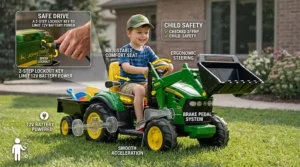
The Ground Force earns its “all-rounder” reputation by pairing a full-size tractor body with a detachable stake-side trailer, which instantly turns backyard laps into pretend farm-delivery missions. It runs on a 12V/8Ah rechargeable battery, offers two forward speeds (roughly 2.25 and 4.5 mph) plus reverse, and includes a second-gear lockout so parents can cap the top speed until a kid proves they can handle it.
Based on the spec comparison, the 85-pound weight capacity and adjustable, flip-up-armrest seat are what actually stretch this toy’s useful life — it’s rated for ages 3 to 7, which is a wider window than most competitors in this price tier. The working FM radio is a genuinely clever touch that keeps kids engaged longer than a silent ride ever could, and the knobby traction tires handle grass and gravel without much drama.
Reviewers consistently report that the tractor is heavier and bulkier than expected once it arrives, which is a fair trade for the added stability, but it does mean you’ll want a dry storage spot or a cover, since like most battery-powered ride-ons it isn’t built to sit out in the rain. A common theme in aggregated feedback is genuine surprise at how much play value the trailer adds — kids use it for everything from hauling toys to “delivering” mail around the yard.
Pros:
✅ Detachable trailer adds real hauling play value
✅ Second-gear lockout lets parents control top speed
✅ Wide age range (3–7) extends usable years
Cons:
❌ Heavier and bulkier than single-seat competitors
❌ Battery needs a full 18-hour initial charge before first use
Expect to pay in the $300–$400 range depending on retailer and bundle. Given the trailer, FM radio, and multi-year age range, this is one of the stronger value plays in the entire lineup.

2. Peg Perego John Deere Gator XUV — best for two kids who won’t share nicely
The Gator XUV solves a very specific household problem: two kids, one toy, constant arguments. Its bench seat and 130-pound weight capacity mean it’s built from the ground up for two riders, with an oversized working dump bed and opening tailgate that adds a second layer of play beyond just driving around.
What most buyers overlook about this model is that the 2-speed shifter (2.25 and 4.5 mph) with a speed lockout isn’t just a safety feature — it’s also what lets an older sibling drive responsibly while a toddler passenger rides along without the whole thing feeling like a rocket ship. The 12V rechargeable battery and included charger keep running costs low, and Peg Perego also sells a 2-hour quick-charge charger separately if the standard 18-hour cycle is too slow for your household’s patience.
Based on the spec comparison against the single-seat Ground Force, the XUV trades some hill-climbing torque for passenger capacity — reasonable, since it’s carrying more weight. Aggregated review sentiment frequently mentions the brush-guard grille and dump bed as standout details that make the toy feel more like a genuine utility vehicle than a generic ride-on car with a Deere sticker slapped on it.
Pros:
✅ Two-seat bench fits siblings or a passenger doll haul
✅ Working dump bed with opening tailgate adds play depth
✅ 130 lb weight capacity extends life as kids grow
Cons:
❌ Slower hill performance than the HPX or 24V XUV 6×4
❌ Standard charger requires an 18-hour cycle
Price typically runs $350–$450. For households with two kids close in age, this is often the single most requested model on a holiday wish list.
3. Peg Perego John Deere Gator HPX — best for hilly or uneven yards
The Gator HPX is the quiet overachiever of the Peg Perego lineup. It’s built around the same 12V/12Ah battery platform as its siblings but is specifically engineered — per its official spec sheet — to handle inclines of up to a 17% grade, which is a meaningfully steeper slope than most competing ride-ons are rated for.
Here’s what to weigh: that extra torque doesn’t show up as a flashy feature on the box, but it’s the difference between a toy that stalls out on your side yard’s slope and one that just climbs it. The HPX seats two, mimics the real Gator HPX utility vehicle’s boxy, functional styling, and includes the same forward/reverse gearing and speed-lockout logic found across the Peg Perego range.
What the spec sheet won’t tell you, but user reports suggest, is that the HPX’s stiffer suspension setup handles rutted lawns and gravel driveways noticeably better than the smoother-riding XUV, at a slight cost to ride comfort on paved surfaces. If your property has any real topography — a sloped driveway, a hill down to a pond, uneven pasture — this is the model built for exactly that scenario, not the flattest suburban cul-de-sac.
Pros:
✅ Rated for inclines up to a 17% grade
✅ Two-seat capacity with the same safety lockouts
✅ Utility-vehicle styling appeals to older Deere fans
Cons:
❌ Firmer ride is less smooth on flat pavement
❌ Trailer sold separately, unlike the Ground Force bundle
Expect a $320–$420 price range. For sloped or rural properties, the HPX’s climbing ability alone can justify choosing it over the visually similar XUV.
4. Peg Perego John Deere Gator XUV 6×4 — best for power and bigger kids
Step up to 24 volts and the character of the ride changes completely. The Gator XUV 6×4 is the premium tier of this lineup, built with a high-torque motor and a top speed around 7.5 mph — nearly double the 12V models — plus a wider wheelbase for stability at that higher speed.
Based on the spec comparison, the jump from 12V to 24V isn’t just about going faster; it’s about maintaining power under load. On paper this means the 6×4 keeps consistent torque even with two kids aboard and a full dump bed, where 12V models start to bog down. The smooth speed-control circuitry ramps acceleration gradually rather than jerking riders backward, which matters more at 24V speeds than it does on the gentler 12V models.
Reviewers consistently note that this is genuinely the most “real vehicle” feeling option in the category — the wide bench seat, individual seatbelts, and aggressive utility styling make it feel closer to an actual off-road vehicle than a toy. The tradeoff, and it’s a real one: at nearly double the speed of the 12V lineup, active adult supervision matters more here than with any other model on this list, and the higher price reflects the bigger motor and battery pack.
Pros:
✅ Roughly 7.5 mph top speed with a high-torque motor
✅ Wide wheelbase adds stability at higher speeds
✅ Seatbelts on both seats for two-passenger safety
Cons:
❌ Highest price point in the lineup by a meaningful margin
❌ Higher speed demands closer adult supervision
Price generally lands in the $450–$580 range. This is the pick for families whose kids have outgrown a 12V model and want genuine speed without leaving the John Deere brand.
5. John Deere Battery Operated Mini Gator — best budget single-seat starter
Not every family needs — or wants — a $400 toy in the garage. The TOMY-produced Mini Gator is a single-seat, 6-volt ride-on with a modest top speed around 2.5 mph and a 75-pound weight limit, built specifically as an entry point rather than a scaled-down replica of a full-size utility vehicle.
What most buyers overlook about this model is how much personality it packs into a budget frame: working headlights and engine sounds, two detachable water bazookas mounted on the roll cage, and an input jack for a personal music device so kids can “drive to their own tunes.” Based on the spec comparison, the direct-drive, non-slip traction strips on the tires are a smart inclusion at this price point — cheaper ride-ons often skip textured tires entirely and rely on smooth plastic that slips on grass.
Aggregated feedback across ride-on toy communities frequently mentions that mini gators like this one are ideal “first battery toy” purchases specifically because the low 2.5 mph ceiling keeps things safe for a still-learning driver, while the water bazooka accessory extends play value well past simple driving laps. It won’t satisfy a kid who’s already driven a 12V model, but as a genuine first ride-on, it punches well above its price.
Pros:
✅ Budget-friendly entry point under most 12V models
✅ Water bazookas and MP3 jack add extra play value
✅ Low 2.5 mph top speed suits first-time drivers
Cons:
❌ Single seat limits it to one rider at a time
❌ 75 lb weight cap means kids outgrow it faster
Typical pricing sits under $150, occasionally with seasonal discounts. For a first holiday or birthday ride-on, this remains one of the most accessible entries into the John Deere lineup.
6. Peg Perego John Deere Mini Tractor 6V — best first ride-on for toddlers
Built specifically for the 1.5-to-3-year age bracket, the Mini Tractor 6V is the toddler-specific answer in the Peg Perego catalog, distinct from the larger Ground Force. It includes working lights and sounds, a simple accelerator-only control scheme, and a 6-volt rechargeable battery with wall charger.
Here’s what to weigh with toddler-tier ride-ons generally: simplicity is the entire point. The Mini Tractor deliberately skips multi-speed gearing, trailers, and dump beds in favor of a low center of gravity and a single, predictable speed — exactly what a still-wobbly toddler needs rather than the added complexity that older siblings’ 12V models pack in. Based on the spec comparison against the larger Ground Force, this is a genuinely different product for a genuinely different developmental stage, not simply a smaller trim level.
Reviewers consistently frame this model as the toy that bridges the gap between a foot-to-floor toddler tractor and a “real” 12V ride-on, giving very young kids a taste of motorized driving under close supervision before they’re ready for anything faster. The lights-and-sounds features do the heavy lifting for engagement at this age, since the actual driving experience is intentionally tame.
Pros:
✅ Purpose-built for the 1.5–3 year age bracket
✅ Simple, single-speed control reduces overwhelm
✅ Working lights and sounds boost engagement
Cons:
❌ Outgrown quickly once a child hits 3–4 years old
❌ No trailer, dump bed, or multi-speed option
Expect a $150–$220 price range. If your household’s next John Deere purchase is a first ride-on for a genuinely young toddler, this is the more age-appropriate pick over the larger Ground Force.
7. Peg Perego John Deere Gator XUV Realtree Camo Edition — best licensed camo styling upgrade
Mechanically nearly identical to the standard 12V Gator XUV, this Realtree Camo edition swaps the classic green-and-yellow trade dress for officially licensed camouflage panels — a genuinely popular option among hunting and outdoor-lifestyle families who want the Deere-branded utility vehicle with a different look.
Based on the spec comparison, you’re getting the same extra-large frame, 12V rechargeable battery, dump bed, and two-speed-plus-reverse gearing as the standard XUV, so the decision here is almost entirely aesthetic rather than functional. What most buyers overlook is that licensed camo patterns like Realtree carry their own licensing costs, which is part of why this variant typically commands a modest premium over the standard color scheme despite near-identical mechanics underneath.
Aggregated review sentiment on camo ride-on variants tends to run smaller in volume than mainstream colorways simply because fewer units sell, but the available feedback echoes the standard XUV’s strengths and weaknesses almost exactly — sturdy build, heavy for its size, and genuinely durable across seasons if stored out of direct weather. If the aesthetic matters to your family more than saving $30–50, this is a reasonable upgrade; if not, the standard XUV performs identically for less.
Pros:
✅ Officially licensed Realtree camo styling
✅ Identical mechanics and capacity to the standard XUV
✅ Distinct look stands out among typical green ride-ons
Cons:
❌ Smaller review pool makes long-term reliability harder to gauge
❌ Modest price premium over the standard color XUV
Price generally runs $400–$480. Choose this over the standard XUV only if the camo styling itself is a priority for your family.
Real-World Scenarios: Which John Deere Ride-On Fits Your Family
If you’re a first-time parent with an 18-month-old who just started walking confidently, the Mini Tractor 6V or Sit-N-Scoot-style foot-to-floor options make more sense than jumping straight to a 12V machine — the simplicity matches the developmental stage, and the low speed keeps supervision manageable.
If you’re raising two kids three years apart who already fight over everything, the Gator XUV’s bench seat and 130-pound capacity turn a potential argument into shared playtime, especially paired with the dump bed for imaginative “farm chore” games that keep both kids engaged rather than competing for a single seat.
If you live on a rural property with real elevation change — a sloped driveway, a hill to the barn, uneven pasture — the Gator HPX’s 17% grade rating or the 24V Gator XUV 6×4’s higher torque will outperform the flatter-terrain Ground Force, which is better suited to a typical flat suburban yard with a driveway and a stretch of lawn.
Problem → Solution Guide for John Deere Battery Operated Ride On Toys
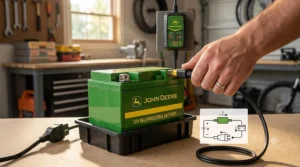
Problem: The battery won’t hold a charge after a season of use. Lead-acid batteries in these vehicles typically last 2–4 years with normal use; a battery that won’t charge at all after that window is usually due for replacement rather than repair, and Peg Perego and third-party sellers both stock direct-fit replacements for most 6V, 12V, and 24V models.
Problem: The toy struggles on hills or with two riders aboard. This is almost always a torque issue rather than a defect — it means the model is underpowered for the terrain or load, and stepping up from a 12V Ground Force to a Gator HPX or 24V Gator XUV 6×4 solves it structurally rather than through any aftermarket fix.
Problem: The ride-on toy got left out in the rain. Battery-powered ride-ons are weather-resistant, not waterproof — a soaking won’t necessarily kill it, but the battery compartment and wiring connectors should be dried thoroughly and inspected before the next charge, and an inexpensive grill cover or dedicated ride-on cover prevents the issue going forward.
Problem: Storage space is tight over the winter. Most 12V and 24V models measure five-plus feet long; if garage space is limited, look for models with a removable trailer or accessory bed, and always disconnect the battery during long off-season storage to prevent slow drain and prolong its lifespan.
How to Choose John Deere Ride On Toys Battery Powered
- Match voltage to age and experience. 6V suits first-time toddler drivers, 12V suits confident 3-to-7-year-olds, and 24V suits kids who’ve already outgrown a 12V model and want real speed.
- Count your riders. Single-seat models like the Mini Gator or Ground Force work fine for one child; households with two similarly aged kids should prioritize a bench-seat Gator XUV or HPX.
- Assess your terrain honestly. Flat suburban yards do fine on standard 12V torque; sloped or rural properties benefit from the HPX’s grade rating or the 24V XUV 6×4’s extra power.
- Factor in weight capacity, not just age range. A tall-for-their-age 6-year-old may already exceed a smaller model’s weight limit even within the stated age bracket.
- Decide how much play value beyond driving matters. Trailers, dump beds, water bazookas, and FM radios all add engagement time beyond the basic act of steering.
- Check charge time against your patience level. Standard chargers take roughly 18 hours; a quick-charge accessory (sold separately on some models) cuts that to about 2 hours.
- Confirm parts and battery availability before buying. Peg Perego and TOMY both maintain accessible replacement-part ecosystems, which matters far more three years in than it does on day one.
Voltage Guide: 6V vs 12V vs 24V John Deere Ride On Toys
The voltage rating on john deere ride on toys 24v, 12v, and 6v models isn’t a marketing number — it directly determines top speed, torque, weight capacity, and appropriate rider age. A 6V system tops out around 2.5 mph and suits toddlers who need a gentle, predictable ride; a 12V system roughly doubles both speed and torque, making it the sweet spot for most 3-to-7-year-olds and the most common choice across the entire John Deere lineup. A 24V system pushes speeds toward 7.5 mph with meaningfully more torque under load, which is why it’s reserved for older kids who’ve already mastered a 12V machine.
What most buyers overlook is that jumping straight to 24V for a young or inexperienced rider isn’t a value upgrade — it’s a mismatch that trades age-appropriate control for speed the child isn’t ready to manage safely. The smartest long-term play for many families is starting at 6V or 12V and treating a future 24V purchase as a genuine “grew out of it” upgrade a few years later, rather than trying to buy one toy to cover the entire childhood range.
John Deere Ride On Toys vs Traditional Pedal & Push Ride-Ons
| Factor | Battery-Powered John Deere | Traditional Pedal/Push Toys |
|---|---|---|
| Physical effort required | Minimal (steering + pedal control) | High (pedaling or foot-to-floor propulsion) |
| Typical top speed | 2.5–7.5 mph depending on voltage | 1–3 mph, rider-dependent |
| Ongoing cost | Battery charging, eventual replacement | None beyond initial purchase |
| Best for | Ages 1.5–8 depending on model | Ages 1–4, gross motor development |
| Maintenance | Battery care, charger storage | Virtually none |
The table makes the tradeoff explicit: pedal and push tractors cost nothing to run and build gross motor skills through physical effort, while battery-powered models trade that workout for realism, speed, and features like trailers and dump beds that pedal toys simply can’t replicate. Neither approach is objectively better — a foot-to-floor Sit-N-Scoot-style toy is arguably the better first purchase for an 18-month-old building coordination, while a 12V Ground Force better rewards a 5-year-old who already wants the “real driving” experience. Many families end up owning one of each across different developmental stages rather than treating it as an either-or decision.
What to Expect: Real-World Performance of John Deere Electric Ride On Toys
Specs on a box rarely translate cleanly into backyard reality, so here’s the practical version. A 12V john deere electric ride on toys model handles flat grass, packed dirt, and light gravel without issue, but expect noticeably reduced range and speed on tall or wet grass, where the motor works harder against resistance. Battery life on a full charge typically supports somewhere between 1 and 2 hours of realistic stop-start driving — not continuous motorway-style cruising, but the on-off, start-stop pattern that actually matches how kids play.
Reviewers consistently note that the first 18-hour charge feels agonizingly long to an excited kid, but subsequent charges are usually faster once the battery is properly conditioned. Cold weather reduces both range and top speed slightly, which matters for families in northern climates planning on year-round use rather than seasonal summer play.
Long-Term Cost & Maintenance of John Deere Gator Ride On Battery Systems
The sticker price is only part of the ownership picture. A replacement 12V lead-acid battery for most john deere gator ride on battery systems typically runs in the $40–$90 range depending on amp-hour capacity, and most owners report needing one replacement somewhere between years two and four of regular use. Tires, wiring harnesses, and battery connectors are the next most common replacement parts, and Peg Perego’s established parts ecosystem — plus a healthy secondary market of compatible third-party batteries — keeps these vehicles serviceable well past their original warranty window.
Calculated over a realistic 3-to-4-year ownership span, a $350 Gator XUV plus one $60 battery replacement works out to meaningfully less than the same family cycling through two or three cheaper, less durable ride-on toys over the same period. Total cost of ownership, not sticker price alone, is where the Peg Perego build quality genuinely earns its premium over budget alternatives.
Features That Actually Matter (And Those That Don’t)
Second-gear speed lockouts, weight-rated seating, and real traction tires actually matter — they directly affect safety and how long the toy stays usable as your child grows. Working FM radios and MP3 jacks are genuinely fun but functionally optional; they extend engagement without affecting the core driving experience.
What tends to get overhyped in marketing copy is exact top-speed bragging rights — the difference between 4.5 and 4.75 mph is imperceptible to a 5-year-old and irrelevant to your buying decision. Similarly, cosmetic trim differences between otherwise-identical models, like the camo XUV versus the standard XUV, matter far less than voltage, seating capacity, and terrain rating when it comes to actual play value.
Why Officially Licensed John Deere Kids Vehicles Matter
Buying licensed john deere kids vehicles isn’t just about brand loyalty — official licensing from Deere & Company means the manufacturer, typically Peg Perego or TOMY, has gone through approval on trade dress, logo usage, and often design accuracy, which correlates with more careful build quality than unlicensed “farm tractor style” knockoffs sold generically online.
Officially licensed products also tend to have more reliable long-term parts support, since the licensing relationship generally implies a longer manufacturer commitment to the product line rather than a one-season import. For a purchase kids will use for years and parents will need replacement batteries and tires for, that licensing relationship is a meaningfully protective factor, not just a logo on the hood.
Safety, Regulations & Compliance Guide
Battery-operated toys must meet requirements that include preventing children from accessing the battery during play, proper labeling, and ensuring the battery does not overheat, under standards enforced through the U.S. Consumer Product Safety Commission’s toy safety framework. Ride-on toys specifically must also meet stability and overload requirements so they don’t tip or collapse under a rated weight load. Before buying any battery-powered ride-on, it’s worth checking the current listing and any manufacturer recall notices, since even well-established brands occasionally issue safety updates.
Practical safety habits matter as much as the spec sheet: always supervise active driving, especially with 24V models capable of higher speeds; keep play confined to driveways, yards, and sidewalks away from moving vehicle traffic; and pair any ride-on toy with a properly fitted bike helmet once your child is old enough to reach higher speed settings. The American Academy of Pediatrics has consistently emphasized that outdoor play is linked to better physical health, lower stress, and greater mental well-being in children, which is a genuinely good reason to prioritize supervised outdoor ride-on time over screen time, provided the basic safety habits above are in place.
Best John Deere Ride On Models by Age and Budget
For toddlers 18 months to 3 years, the Mini Tractor 6V is the most age-appropriate pick among best john deere ride on models in this bracket, prioritizing simplicity over speed. For budget-conscious families with a 3-to-5-year-old, the TOMY Mini Gator delivers real play value under $150. For most 3-to-7-year-olds, the Ground Force with trailer remains the strongest all-around value thanks to its wide age range and included hauling accessory. For two-kid households, the Gator XUV or HPX (depending on terrain) makes the most sense, and for kids who’ve outgrown a 12V machine and are ready for real speed, the 24V Gator XUV 6×4 is the clear step-up choice.
✨ Ready to Find Your Family’s Perfect John Deere Ride-On?
🔍 Compare current pricing and availability on any of the seven models above before deciding — inventory and seasonal deals shift often. Whichever one you choose, you’re setting up hours of screen-free, engine-revving backyard memories your kids will talk about for years!

Frequently Asked Questions
❓ What voltage John Deere ride-on is best for a 3-year-old?
❓ How long does the battery last on a John Deere ride-on toy?
❓ Can two kids ride a John Deere Gator at the same time?
❓ Are John Deere battery-powered ride-on toys safe for hills?
❓ How long does it take to charge a John Deere ride-on toy?
Conclusion
Choosing among john deere ride on toys battery powered models really comes down to three honest questions: how old and how many kids are riding, what your yard actually looks like, and how much play value beyond basic driving matters to your family. The Ground Force remains the strongest all-around pick for most single-child households with a typical yard, the Gator XUV and HPX solve the two-kid problem in different terrain conditions, and the 24V Gator XUV 6×4 rewards families ready to upgrade a child who’s outgrown their first machine.
None of these are impulse buys — they’re a multi-year investment that, based on the total cost of ownership analysis above, tends to reward the sturdier, better-supported Peg Perego and TOMY licensed models over cheaper unlicensed alternatives. Whichever model fits your family, the real payoff isn’t the toy itself; it’s the hours of imaginative, outdoor, screen-free play it buys back for your kids.
Recommended for You
- 7 Best Motorized Ride On Toys in 2026
- 7 Realistic Electric Ride On Cars Kids Won’t Outgrow (2026)
- Electric Ride On Toy Car: 7 Best Picks for 2026
Disclaimer: This article contains affiliate links. As an Amazon Associate, I earn from qualifying purchases. If you purchase products through these links, we may earn a small commission at no additional cost to you.
✨ Found this helpful? Share it with your friends! 💬🤗
