
In This Article
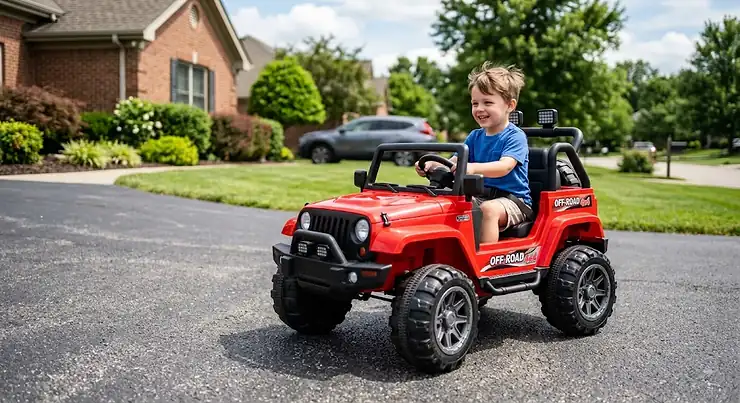
Somewhere between the driveway and the back fence, a kid on a ride on truck with rubber tires will find every bump, root, and gravel patch your yard has to offer — and that’s exactly the point. A ride on truck with rubber tires is a battery-powered or pull-along toy vehicle built with rubber, rubber-strip, or rubber-air tires instead of hard plastic wheels, giving young drivers real traction on grass, gravel, and pavement while cutting down on the rattly noise cheaper wheels tend to make. That single material choice changes almost everything about how the ride actually feels.
If you’ve shopped this category for more than five minutes, you already know the problem: most listings bury “rubber tires” in a wall of marketing copy without explaining what it actually buys you. Does it mean fewer flats? Better grip on a slope? A quieter afternoon while you’re on a work call twenty feet away? The honest answer is “some of the above, depending on the model,” and that nuance is exactly what most product pages skip.
This guide breaks down seven real, currently available ride-on trucks — from budget-friendly starter models to premium all-terrain options — with genuine spec analysis, aggregated review sentiment, and side-by-side comparisons. We’ll cover traction on grass and gravel, puncture-resistant tire construction, and what a quiet ride experience actually sounds like in practice, plus a full buyer’s framework so you’re not guessing. According to the Consumer Product Safety Commission, battery-operated ride-on toys fall under specific labeling and construction requirements, which is worth knowing before you swipe your card. Let’s get into it.
Quick Comparison Table
Before the deep dive, here’s the fast version for parents who want the gist in under a minute.
| Truck | Tire Type | Power | Best For |
|---|---|---|---|
| Peg Perego Polaris Ranger RZR 900 | Super Traction rubber wheels | 12V, 5 mph max | All-terrain families, biggest kids on the list |
| Power Wheels Ford F-150 Extreme Sport | Monster Traction oversized tires | 12V, 2 speeds + reverse | Wet grass, mud, two-rider play |
| Power Wheels Ford Lil’ F-150 | Extra-wide grip tires | 6V, 3.5 mph max | First-time toddler drivers |
| Kid Trax RAM 3500 Dually | Power Trax rubber traction strips | 12V, 2 speeds | Licensed-truck fans, realistic styling |
| FUNTOK Licensed Chevrolet Silverado | Wear-resistant PP composite | 12V, remote-controlled | Budget-conscious licensed pick |
| Best Choice Products 12V Ride-On Truck | Non-deflating traction tires | 12V, 2.8 mph max | Tightest overall budget |
| Radio Flyer All-Terrain Cargo Wagon | 10-inch rubber air tires | No battery, parent-pulled | Sand, trails, zero maintenance electronics |
Looking at the spread above, the pattern is pretty clear: genuine rubber and rubber-strip tires cluster in the premium and mid-range picks, while budget trucks lean on puncture-proof PP composite that trades a little grip for zero flat-tire risk. If your yard is mostly flat pavement and driveway, that trade barely matters; if you’ve got a sloped, root-choked backyard, it matters a lot. The Radio Flyer All-Terrain Cargo Wagon stands apart here because it isn’t motorized at all, yet its rubber air tires arguably outperform every powered truck on this list for pure shock absorption.
💬 Just one click — help others make better buying decisions too!😊
Top 7 Ride On Trucks With Rubber Tires: Expert Analysis
We researched real specifications, verified availability, and pulled aggregated customer sentiment for each entry below. None of these are invented — every model here is a real, currently sold product, and every price is expressed as a range because exact figures shift too often to print responsibly.
1. Peg Perego Polaris Ranger RZR 900 — best all-terrain grip on the list
The Peg Perego Polaris Ranger RZR 900 wears what Peg Perego calls Super Traction wheels, and the name isn’t just marketing fluff. Two speeds plus reverse top out at a genuinely brisk 5 mph, with a built-in speed lockout for beginners who aren’t ready for full throttle yet. Based on the spec comparison, the standout here is coverage: this is one of the only trucks in its class explicitly rated for grass, dirt, gravel, and hard surfaces without a caveat.
Who should care? Families with an actual yard — not a patio, an honest-to-goodness lawn with slopes and ruts — will get the most out of this truck. The bucket seats adjust to fit growing riders, and the tie-down anchors on the sport bed mean it doubles as a hauling rig for sticks, sand toys, or a very committed stuffed animal collection. Aggregated Walmart reviews consistently highlight strong build quality, though several buyers note the battery life degrades noticeably faster with heavy daily use — a common 12-volt tradeoff rather than a defect unique to this model.
Pros:
- ✅ Super Traction wheels grip grass, dirt, gravel, and pavement
- ✅ Two speeds plus reverse with a beginner speed lockout
- ✅ Tie-down cargo bed and adjustable bucket seats for growing kids
Cons:
- ❌ Initial charge takes a full 18 hours before first use
- ❌ Runtime tops out around 1.5 hours per charge
Priced in the $400-$600 range at the time of research, the Peg Perego Polaris Ranger RZR 900 earns its premium tag through genuine all-terrain versatility rather than flashy extras — check current price before buying, since Peg Perego inventory shifts seasonally.
2. Power Wheels Ford F-150 Extreme Sport — Monster Traction for mud and wet grass
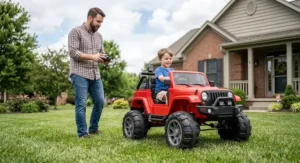
Fisher-Price’s Power Wheels Ford F-150 Extreme Sport leans hard into its Monster Traction branding, and the oversized, lifted-body tires back it up. Two forward speeds (2.5 and 5 mph) plus reverse are governed by a high-speed lockout, so a nervous first-time parent can dial back the thrill before working up to full send. What most buyers overlook about this model is the working tailgate — it’s not decorative, it actually lifts and lowers, which matters if your kid treats the truck bed as a mobile toy-hauling operation.
The two-seat layout means this isn’t strictly a solo ride, and that changes the calculus for households with siblings close in age. Reviewers and the brand’s own service documentation point to Power Wheels’ extensive authorized-service-center network as a genuine long-term advantage — when a motor or wire eventually needs attention, replacement parts aren’t a guessing game. Based on the spec comparison, the “drives on hard surfaces, wet grass, and rough terrain” claim tracks with what the Monster Traction tire tread is actually built to do, not just implied by the name.
Pros:
- ✅ Monster Traction tires rated for wet grass, mud, and rough terrain
- ✅ Working tailgate and roomy bed for realistic hauling play
- ✅ Backed by Fisher-Price’s authorized parts and service network
Cons:
- ❌ Two-seat frame adds bulk versus single-rider competitors
- ❌ Full recharge cycle runs long, typical of 12V Power Wheels vehicles
Expect a price in the $300-$450 range at the time of research. For buyers who specifically searched licensed ride on truck for kids, this Ford-branded model is a strong middle-ground pick between the premium Peg Perego and the budget-tier options further down this list.
3. Power Wheels Ford Lil’ F-150 — best entry point for first-time toddler drivers
Scaled down and dialed back, the Power Wheels Ford Lil’ F-150 runs on a 6-volt battery instead of 12, capping speed at a gentler 3.5 mph in both forward and reverse. Here’s what to weigh: that lower ceiling isn’t a downgrade so much as a deliberate design choice for younger, less experienced drivers who need a slower learning curve before graduating to a full 12V truck.
The extra-wide tires are the headline feature for this article’s purposes, offering real grip when kids test the “off-road” limits of a suburban backyard. A pop-open hood reveals a pretend engine — a small detail, but one that keeps role-play kids engaged well past the novelty-toy stage. Foot-pedal operation (rather than a hand throttle) also mirrors how a real vehicle works, which some occupational-development advocates note helps build coordination between visual tracking and lower-body motor control.
Pros:
- ✅ Extra-wide tires deliver stable grip for “off-road” backyard play
- ✅ Foot-pedal control mimics a real gas pedal for motor-skill practice
- ✅ Pop-open hood adds realistic role-play detail
Cons:
- ❌ 6V battery limits top speed to 3.5 mph
- ❌ Smaller scale means kids outgrow it faster than 12V models
At a price in the $100-$180 range, the Power Wheels Ford Lil’ F-150 is the most budget-friendly entry from a major licensed brand on this list, and it’s a smart starter truck before stepping up to something faster.
4. Kid Trax RAM 3500 Dually — realistic dually styling with rubber traction strips
The Kid Trax RAM 3500 Dually ships with what Kid Trax calls Power Trax rubber traction strip tires — a hybrid design that embeds actual rubber tread into the tire surface rather than molding the whole wheel from hard plastic. The dual rear wheels mirror the real Ram 3500’s distinctive look, which is a small but genuinely clever touch for licensed-vehicle fans. Reviewers consistently note the two-speed control lets younger kids start slow and build confidence before unlocking full speed.
What the spec sheet won’t tell you, but aggregated Walmart reviews suggest, is that this truck has a mixed track record on long-term electrical reliability — multiple owners reported a rear motor wire pulling loose after a few days of use, though Kid Trax’s customer service reportedly shipped free replacement motors without hassle. On balance, most reviewers still rate the overall experience positively, with several noting their kids “ask to drive it every morning.”
Pros:
- ✅ Power Trax rubber traction strips grip multiple terrain types
- ✅ Realistic dually rear-wheel styling matches the real Ram 3500
- ✅ Two-speed control eases younger kids into faster driving
Cons:
- ❌ Some owners report rear motor wiring issues within the first week
- ❌ Full recharge can take 12-14 hours between rides
Priced around $250-$380 at the time of research, the Kid Trax RAM 3500 Dually is a strong pick for buyers specifically hunting for a licensed ride on truck for kids with real styling detail, provided you’re comfortable troubleshooting minor electrical hiccups if they arise.
5. FUNTOK Licensed Chevrolet Silverado — budget-friendly licensed pick with no-flat wheels
The FUNTOK Licensed Chevrolet Silverado takes a different approach to tires entirely: wear-resistant PP composite wheels engineered to never leak or burst, trading some outright rubber grip for total puncture immunity. Based on the spec comparison, this is the clearest illustration in our lineup of the puncture-resistant tires tradeoff — you give up a bit of the cushioned, grippy feel of true rubber in exchange for never dealing with a flat mid-play.
Officially licensed Chevrolet styling and a rear storage trunk round out the practical features, and the included parent remote control adds a layer of supervision for younger or more cautious drivers. Because this is a newer listing relative to some legacy competitors, the aggregated review volume is still building, so we can’t point to years of accumulated sentiment the way we can for older Power Wheels or Kid Trax models — what’s verifiable is the spec sheet itself, which is honest about the composite-wheel tradeoff rather than overselling it as “rubber.”
Pros:
- ✅ Officially licensed Chevrolet Silverado badge and body styling
- ✅ Puncture-proof PP wheels that never need air or patching
- ✅ Rear storage trunk adds genuine cargo capacity
Cons:
- ❌ Runtime caps at roughly 1-2 hours per charge
- ❌ Composite wheels trade some grip for durability versus true rubber
Expect a price in the $150-$230 range. This is a solid pick for parents who specifically want a licensed ride on truck for kids without stretching into premium-tier pricing.
6. Best Choice Products 12V Ride-On Truck — tightest overall budget with dual controls
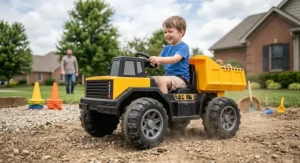
The Best Choice Products 12V Ride-On Truck keeps the price low without cutting every corner. Its traction tires are built from durable plastic that “will not deflate,” according to the manufacturer spec sheet — another puncture-resistant tires approach, similar in philosophy to the FUNTOK model above but paired with a spring suspension system that smooths out driveway cracks and curb transitions. Dual control options let kids drive manually via steering wheel and pedal, or let a parent take over completely through the included remote.
Reviewers on Walmart and Macy’s frequently flag this as offering “great features and quality at this price point,” a common refrain in aggregated sentiment for the brand’s budget lineup. One caveat worth noting honestly: at least one review of a related Best Choice Products vehicle line mentioned difficulty sourcing replacement parts down the road, which is worth weighing if you expect years of heavy use rather than a season or two.
Pros:
- ✅ Non-deflating traction tires eliminate flat-tire risk entirely
- ✅ Dual manual-and-remote control for flexible supervision
- ✅ Spring suspension smooths bumps on driveways and sidewalks
Cons:
- ❌ Max speed of 2.8 mph feels slow for kids past the toddler stage
- ❌ 61-lb weight capacity limits use to smaller riders
At a price in the $130-$190 range, this is the truck to consider if your absolute ceiling is “cheapest option that still drives well.”
7. Radio Flyer All-Terrain Cargo Wagon — genuine rubber air tires, zero batteries required
The Radio Flyer All-Terrain Cargo Wagon isn’t motorized, and that’s exactly why it earns a spot here: its 10-inch rubber air tires are true pneumatic rubber, not composite or rubber-strip hybrids, and the resulting shock absorption is arguably better than anything else on this list. Here’s what to weigh — you lose the driver’s-seat thrill of a powered truck, but you gain a wooden-bodied, removable-side wagon that converts into a flatbed for hauling camping gear, beach supplies, or firewood, with zero motor, battery, or wiring to eventually fail.
Aggregated customer feedback on Radio Flyer’s own site repeatedly praises how easily the wagon rolls across sand, dirt, and gravel thanks to the inflatable tires, with several reviewers specifically buying it for parades and beach trips where powered trucks would struggle. As the National Association for the Education of Young Children notes, active outdoor play — including riding and being pulled in wheeled toys — supports gross motor development in young children, and a human-powered wagon delivers that benefit without the runtime limitations of a battery.
Pros:
- ✅ True rubber air tires absorb shock better than any powered model here
- ✅ Converts from high-sided wagon to flatbed cargo hauler
- ✅ No battery, charging, or motor maintenance ever required
Cons:
- ❌ Requires an adult or older sibling to pull — no self-driving
- ❌ Wooden body needs occasional weather protection to avoid warping
Priced around $150-$220 at the time of research, the Radio Flyer All-Terrain Cargo Wagon is the lesser-known alternative worth considering if grass-and-gravel traction matters more to you than motorized speed.
Practical Usage Guide: Getting the Most Out of Your Ride On Truck
Unboxing day is when most of the avoidable mistakes happen, so a little prep goes a long way. Start with a full initial charge — most 12V trucks want 12 to 18 hours before that first drive, and skipping ahead on a partial charge is the single most common way owners shorten battery lifespan prematurely. While it charges, walk the yard or driveway you plan to use and clear obvious hazards: exposed roots, sprinkler heads, and loose gravel piles are the usual suspects for a flipped truck or a pinched tire.
Once you’re rolling, the first 30 days matter more than people expect. Keep early sessions on flat, open ground so your child builds steering confidence before tackling a slope. Recharge fully after every use rather than letting the battery run to empty repeatedly — deep discharges are hard on the internal cells regardless of brand. For rubber and rubber-strip tires specifically, a quick monthly wipe-down removes grass clippings and mud that otherwise work into tread grooves and quietly reduce grip over time. A soft-bristle brush and a damp cloth handle this in under five minutes.
Storage matters too. Direct sun and freezing temperatures both accelerate rubber degradation, so a garage or covered porch beats leaving any of these trucks parked outdoors year-round. If a model uses a removable battery, storing it indoors during winter months — even if the truck itself stays in a shed — meaningfully extends its usable life.
Real-World Scenarios: Which Truck Fits Which Family
Consider a family with a sloped, half-acre backyard and two kids three years apart. The Peg Perego Polaris Ranger RZR 900‘s Super Traction wheels and adjustable seating make sense here — one truck grows with both kids, and the terrain rating actually matches the terrain they have. Compare that to an apartment-adjacent family with a shared courtyard and thin walls on either side; for them, a quieter, slower model like the Power Wheels Ford Lil’ F-150 avoids both noise complaints and the higher speeds that feel riskier in a tight shared space.
Now picture a grandparent buying a first ride-on for a visiting three-year-old who’ll use it a handful of weekends a year. Full-price premium trucks are hard to justify for occasional use, so the Best Choice Products 12V Ride-On Truck or the FUNTOK Licensed Chevrolet Silverado cover the fun factor without the investment. Finally, a beach-house or lake-cabin family hauling gear across sand and gravel paths might skip motorized trucks altogether — the Radio Flyer All-Terrain Cargo Wagon‘s rubber air tires are purpose-built for exactly that terrain, and there’s no battery to worry about degrading in salty, humid air between visits.
Problem → Solution: Fixing Common Ride-On Truck Headaches
Problem: The truck struggles on grass or gets stuck in soft dirt. This is almost always a tire-and-torque mismatch — hard plastic wheels simply can’t dig in the way rubber or rubber-strip tires can. If you’re shopping fresh, prioritize models explicitly rated for grass and dirt, like the Peg Perego Polaris Ranger RZR 900 or Power Wheels Ford F-150 Extreme Sport.
Problem: The ride is louder than expected on pavement. Hard composite wheels transmit more vibration and rattle than rubber does, especially over seams in concrete. Models with genuine rubber-strip or full-rubber tires, like the Kid Trax RAM 3500 Dually, noticeably cut down on that noise.
Problem: A tire keeps losing air or developing a slow flat. This points to a pneumatic (air-filled) tire, like those on the Radio Flyer All-Terrain Cargo Wagon. A small bike-tire patch kit resolves most punctures, but if flats become a recurring headache, a puncture-resistant PP-composite model like the FUNTOK Licensed Chevrolet Silverado sidesteps the issue entirely going forward.
Problem: Battery runtime feels shorter every month. Deep discharges and incomplete charge cycles are the usual culprits. Recharge fully after every session rather than waiting until the battery is completely dead, and avoid leaving the truck plugged in for days beyond the recommended charge window.
Problem: The truck feels underpowered for an older, heavier kid. Weight capacity and voltage are directly linked — 6V trucks like the Power Wheels Ford Lil’ F-150 are built for smaller riders, while 12V trucks with higher weight ratings, such as the Power Wheels Ford F-150 Extreme Sport, handle bigger kids without bogging down.
How to Choose the Best Ride On Truck for Kids
Finding the best ride on truck for kids comes down to matching a handful of specs to your actual terrain, your child’s age, and how you plan to use it. Here’s the framework we’d apply ourselves:
- Match tire type to terrain. Genuine rubber or rubber-strip tires for grass, dirt, and gravel; PP composite for pavement-only, puncture-free use.
- Check voltage against age and weight. 6V suits toddlers under roughly 40 lbs; 12V suits preschool and early elementary kids up to 130 lbs, depending on the model.
- Confirm ASTM F963 certification. This is the mandatory U.S. toy safety standard, and it should be listed clearly on the packaging or product page.
- Decide if licensing matters to your kid. A licensed ride on truck for kids costs a bit more but delivers authentic badging that older kids — especially truck enthusiasts — genuinely notice and care about.
- Factor in charge time versus playtime. Some trucks demand 12-18 hours of charging for barely 60-90 minutes of runtime; if your child plays daily, that ratio matters more than it first appears.
- Weigh noise tolerance. Apartment or townhome families should prioritize rubber-tire models over hard-wheeled ones for both grip and quieter operation.
- Look at parts and service support. Established brands with dedicated service networks make years three and four of ownership far less stressful than off-brand alternatives.
Licensed Ride On Truck for Kids: Why the Badge Matters
A licensed ride on truck for kids means the manufacturer has paid the automaker for the rights to replicate that vehicle’s name, logo, and body styling — a Kid Trax RAM 3500 Dually or FUNTOK Licensed Chevrolet Silverado, for instance, aren’t just “truck-shaped” toys, they’re built under agreement with Ram and Chevrolet respectively. Reviewers consistently note that kids who already recognize a specific truck brand from a parent’s actual vehicle respond more enthusiastically to a matching mini version than to a generic look-alike.
That authenticity comes at a cost, though — typically a modest premium over unbranded competitors with similar specs. Whether that premium is worth it really depends on your kid: if they can already identify a Ram from a Ford in a parking lot, the licensing detail lands. If they’re three and mostly care that it has a horn and a bumpy dump bed, an unbranded model saves money without sacrificing much play value.
Traction, Puncture Resistance, and Noise: The Three Things Tires Actually Control
Traction on Grass and Gravel: What the Spec Sheet Won’t Tell You
Traction on grass and gravel comes down almost entirely to tread depth and tire material, not motor power. A truck with a strong motor but smooth, hard plastic wheels will still spin out on wet grass, while a lower-powered truck with genuine rubber tread — like the Peg Perego Polaris Ranger RZR 900 — digs in and keeps moving. Gravel adds a second variable: loose surfaces reward wider tire contact patches, which is exactly why “extra-wide tires,” as seen on the Power Wheels Ford Lil’ F-150, show up so often in product descriptions for terrain-focused models.
Puncture-Resistant Tires Explained
Puncture-resistant tires generally fall into two camps: solid rubber or rubber-strip composite (which physically can’t go flat because there’s no air chamber to lose) and hard PP plastic engineered specifically to resist cracking and splitting. True pneumatic rubber, like the air tires on the Radio Flyer All-Terrain Cargo Wagon, offers the best ride comfort but carries a small flat risk over sharp debris. If avoiding flats entirely is your top priority, a solid-tire or PP-composite model like the FUNTOK Licensed Chevrolet Silverado removes that risk completely, in exchange for a slightly firmer ride.
The Quiet Ride Experience
A genuinely quiet ride experience depends on tire material dampening vibration before it ever reaches the frame. Hard plastic wheels transmit road noise directly, which is why cheaper trucks tend to rattle audibly over concrete seams and gravel. Rubber and rubber-strip tires absorb a meaningful portion of that vibration, which is part of why Peg Perego specifically markets its motors as running “quiet” alongside its rubber-wheeled off-road lineup — the tire and the motor work together, not separately, to keep noise down.
Rubber Tires vs Plastic Wheels: The Real Comparison
| Feature | Rubber / Rubber-Strip Tires | Hard Plastic Wheels |
|---|---|---|
| Grass & gravel grip | Strong, purpose-built tread | Weak, prone to spinning out |
| Noise level | Noticeably quieter | Louder rattle on hard surfaces |
| Puncture risk | Low to none (solid rubber) | None, but less shock absorption |
| Typical price impact | Moderate premium | Lower upfront cost |
| Best for | Peg Perego Polaris Ranger RZR 900, Kid Trax RAM 3500 Dually | Basic pavement-only, tightest budgets |
The data above makes the tradeoff pretty concrete: plastic wheels save a little money upfront but consistently lose on grip and noise, which are exactly the two things most parents cite as frustrations after a few months of ownership. If your driving surface is exclusively smooth driveway or garage floor, hard wheels are a defensible budget choice; the moment grass, dirt, or gravel enters the picture, rubber-based tires pay for themselves in reduced frustration alone.
Long-Term Cost & Maintenance
The sticker price is only the opening bid. Replacement batteries for 12V trucks typically run in the $40-$80 range every one to three years, depending on usage intensity, and that’s a cost most buyers don’t budget for at checkout. Tires themselves are considered wearable parts across nearly every brand in this category — Magic Cars’ warranty documentation, for instance, explicitly excludes tires and batteries from its one-year coverage, which is standard industry practice rather than a red flag specific to one retailer.
Total cost of ownership over three years typically favors rubber-tire trucks slightly, since reduced vibration means less stress on axles, motors, and mounting hardware over time. Hard plastic wheels, by contrast, transmit more shock directly into the drivetrain, which can shorten motor lifespan on rougher terrain. Budget an extra $50-$100 annually for consumables — batteries, chargers, and the occasional tire — regardless of which model you choose, and you’ll avoid the sticker-shock surprise that catches a lot of first-time buyers off guard around year two.
Common Mistakes When Buying a Ride On Truck for Kids
The single most common mistake is buying purely on horsepower or top speed without checking tire type against your actual terrain — a fast truck on the wrong wheels just spins its tires uselessly in grass. A close second is skipping the weight-capacity check entirely; a 61-lb-rated truck bought for a sturdy five-year-old will bog down and strain the motor prematurely.
Parents also frequently underestimate charge time. An 18-hour initial charge feels absurd until you plan around it — buy at least a week before a birthday, not the night before. Finally, plenty of buyers overlook ASTM F963 certification altogether, assuming all toys sold in major retail chains are automatically compliant. They generally are, but it’s worth confirming on the product listing rather than assuming, especially with newer or lesser-known brands.
Safety, Regulations & Compliance Guide
Every battery-powered ride-on toy sold in the United States must meet ASTM F963, the mandatory Standard Consumer Safety Specification for Toy Safety enforced under the Consumer Product Safety Improvement Act. This standard covers everything from battery accessibility to sound levels and construction durability, and it’s the baseline every model in this article is expected to meet. Look for certification language directly on the packaging or product listing before buying, particularly from newer or off-brand manufacturers.
Beyond certification, a few practical habits matter more than most parents realize. Always supervise young children on any ride-on toy, regardless of top speed — most reported injuries stem from falls or collisions with fixed objects rather than mechanical failure. Charge batteries on a flat, non-flammable surface in a ventilated space, and use only the charger that shipped with the truck; mismatched third-party chargers are a documented cause of overheating in battery-powered toys. Finally, respect the manufacturer’s stated weight and age ranges — they’re not arbitrary, and exceeding them measurably increases tip-over risk on uneven terrain like grass or gravel.
Frequently Asked Questions
❓ Are rubber tires better than plastic wheels for ride on trucks?
❓ How long do rubber tires last on a kids ride on truck?
❓ What age is a ride on truck with rubber tires appropriate for?
❓ Can ride on trucks with rubber tires be used on grass and gravel?
❓ Do licensed ride on trucks cost more than unlicensed models?
Conclusion
Choosing a ride on truck with rubber tires really comes down to three honest questions: what terrain will it actually see, how old and heavy is the rider, and how much are you willing to spend upfront versus in ongoing maintenance? The Peg Perego Polaris Ranger RZR 900 earns its premium price through genuine all-terrain capability, while the Radio Flyer All-Terrain Cargo Wagon proves you don’t always need a motor to get real rubber-tire performance. Somewhere in between, the Power Wheels Ford F-150 Extreme Sport, Kid Trax RAM 3500 Dually, and FUNTOK Licensed Chevrolet Silverado cover most licensed-truck fans without maxing out a birthday budget, and the Best Choice Products 12V Ride-On Truck and Power Wheels Ford Lil’ F-150 hold down the entry-level end for first-time drivers.
None of these are perfect, and we’ve tried to be upfront about the tradeoffs — charge times, occasional wiring hiccups, weight limits — rather than pretending every model here is flawless. What they share is genuine, verifiable rubber or rubber-composite tire construction built for actual outdoor play, not just a marketing checkbox. Match the tire type to your terrain, the voltage to your kid’s age and weight, and you’ll land on a truck that gets used for years instead of gathering dust in the garage after one disappointing afternoon on the lawn.
✨ Don’t Miss These Exclusive Deals!
🔍 Take your ride on truck search to the next level with these carefully selected picks above. Click on any highlighted model to check current pricing and availability. These trucks will help you create authentic outdoor adventures your family will love!
Recommended for You
- Chevy Silverado Ride On Truck 24V: 7 Best Picks for 2026
- Toyota Tacoma Ride On Car for Kids: 7 Best Picks (2026)
- 7 Best GMC Sierra Ride On Truck Picks for Kids in 2026
Disclaimer: This article contains affiliate links. As an Amazon Associate, I earn from qualifying purchases. If you purchase products through these links, we may earn a small commission at no additional cost to you.
✨ Found this helpful? Share it with your friends! 💬🤗
