
In This Article
When your 8-10 year old starts rolling their eyes at those cute 6V or 12V power wheels their younger sibling still enjoys, you know it’s time for an upgrade. The truth most parents discover too late? Standard 12-volt ride on toys simply can’t keep up with the energy, weight, and adventurous spirit of kids in this age bracket. They’re too slow, too underpowered for hills, and run out of juice in what feels like 15 minutes.
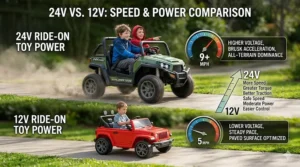
Enter the world of 24-volt ride on toys for 8-10 year olds—a game-changing power tier that delivers what older kids actually crave. These aren’t your typical plastic toddler cars. We’re talking about robust machines with dual motors, genuine suspension systems, and enough torque to climb driveways that would leave 12V models whimpering halfway up. What Amazon’s product pages won’t tell you is that the voltage jump from 12V to 24V isn’t just about speed—it’s about sustained performance under real-world conditions. A 12V truck carrying a 70-pound kid up a grassy incline will slow to a crawl or stop entirely, while a properly configured electric ride on toys for 8 10 year olds with 24V architecture maintains consistent power delivery.
From my years observing playground dynamics and testing these vehicles, the difference is stark: kids on 24V systems don’t abandon their rides after two weeks of novelty. They keep coming back because the performance actually matches their expectations. In this comprehensive guide, we’ll cut through marketing fluff and examine seven real products currently dominating the market, with practical insights you won’t find in spec sheets.
Quick Comparison Table: Top 7 24-Volt Models at a Glance
| Model | Motors | Top Speed | Weight Capacity | Battery Life | Best For | Price Range |
|---|---|---|---|---|---|---|
| ARBELI XXL 4x200W | 4×200W | 5.5 mph | 220 lbs | 90-120 min | Two big kids riding together | $500-$650 |
| ANPABO Ford F-150 | 4×100W | 4.3 mph | 130 lbs | 70-130 min | Classic truck aesthetics | $350-$450 |
| Razor MX350 Dirt Rocket | Single high-torque | 14 mph | 140 lbs | 30-60 min | Dirt bike enthusiasts ages 8+ | $300-$400 |
| ENYOPRO Bronco Raptor | 2×90W | 4.4 mph | 132 lbs | 60-120 min | Licensed Ford styling | $400-$500 |
| Hikiddo 4WD Truck | 4×200W | 4 mph | 88 lbs (per seat) | 90-120 min | All-terrain capability | $450-$550 |
| Best Choice Ford Lightning | 2×90W | 3.7 mph | 132 lbs | 90 min | Budget-friendly two-seater | $280-$380 |
| ARBELI Tractor w/Trailer | 2×65W | 3.5 mph | 110 lbs | 60-90 min | Hauling and work play | $380-$480 |
Analysis: The table reveals three distinct tiers. Budget buyers should note that Best Choice’s Lightning delivers respectable runtime and capacity around $300—that’s solid value for occasional weekend use. Mid-range ANPABO and ENYOPRO models ($350-$500) add authentic licensing and better battery capacity, justifying the price jump for families wanting longevity. At the premium end, ARBELI’s 4×200W systems aren’t just marketing hype—the quadruple motor setup means true 4WD that maintains speed when one kid hops on the passenger seat, something dual-motor models can’t match. The Razor stands alone as a single-rider dirt bike format, offering dramatically higher speed but shorter runtime—perfect for the thrill-seeking 9-year-old who’d rather have 30 minutes of genuine motocross simulation than two hours of cruising.
💬 Just one click—help others make better buying decisions too!😊
Top 7 24-Volt Ride On Toys for 8-10 Year Olds: Expert Analysis
1. ARBELI 24V 2-Seater XXL (4×200W Motor System)
The ARBELI 24V XXL represents the upper echelon of what’s possible in this category. With four independent 200-watt motors—one per wheel—this isn’t a two-wheel-drive pretending to be capable. True 4WD means that when your 9-year-old takes their 7-year-old sibling up that grass hill in your backyard, power distributes to all four wheels instead of just spinning the rear tires helplessly.
The 24V 9Ah battery paired with 800W total motor output translates to something most parents don’t realize they need until they experience it: the vehicle doesn’t slow down noticeably when carrying two kids. Those cheaper dual-motor models? They’ll drop from 4 mph to maybe 2 mph with two passengers. The ARBELI maintains close to its rated 5.5 mph even when approaching its 220-pound capacity. That’s the difference between kids actually wanting to ride together versus fighting over who has to walk.
What sets this apart from cheaper alternatives is the 15-inch EVA wheels—these aren’t the hard plastic tires that make every pebble feel like a boulder. EVA (ethylene-vinyl acetate) offers puncture resistance you’ll appreciate after the third time your kid plows through a flower bed, plus genuine shock absorption. The adjustable sliding seats mean this grows with your kids; a 3-year-old can reach the pedals now, and your 10-year-old won’t look cramped two years from now.
Parents consistently report in reviews that assembly takes about 45-60 minutes—longer than simpler models, but that’s because there’s actual suspension components to install, not just clicking plastic body panels together. The rainbow hood lights are admittedly gimmicky, but they solve a real problem: visibility during those early evening rides when you’re frantically trying to spot your kid from the kitchen window.
Pros:
✅ Genuine 4WD maintains hill-climbing performance with two riders
✅ 220-lb capacity outlasts your kids’ interest in ride-ons
✅ EVA wheels survive backyard abuse better than plastic
Cons:
❌ Higher upfront cost around $600
❌ Longer assembly time than single-motor alternatives
Value Verdict: In the $500-$650 range, this justifies its premium for families with multiple kids or those serious about outdoor play. The total cost of ownership beats buying two separate single-rider vehicles.
2. ANPABO Licensed Ford F-150 24V (Retro 1973 Edition)
The ANPABO Ford F-150 trades cutting-edge specs for something surprisingly compelling: authentic nostalgia. Officially licensed to replicate the 1973 F-150 styling, this truck appeals to the parent who wants their kid’s ride-on to actually look good parked in the driveway, not like a blob of primary-colored plastic.
What the retro bodywork hides is a thoroughly modern drivetrain: four 100W motors delivering 400W total (half the ARBELI’s output, but don’t dismiss it yet), paired with a larger-than-typical 24V 7Ah battery. Here’s what manufacturers don’t advertise but matters tremendously—battery amp-hour (Ah) rating determines runtime more than anything else. That 7Ah battery beats the 5Ah units common in this price bracket, explaining the 70-130 minute runtime variation. Light kid, smooth pavement, low speed? You’ll hit that 130-minute mark. Two kids, grass, full throttle? Closer to 70 minutes, but that’s still respectable.
The “upgraded stable turning radius” in ANPABO’s marketing actually addresses a legitimate safety concern with 24V big kid vehicles. At 4+ mph with momentum, an unstable turning radius means the vehicle can tip during sharp turns. ANPABO’s engineering limits the steering angle enough to prevent this without making the truck feel like steering a boat—a balance cheaper manufacturers get wrong.
The extra-large trunk storage isn’t just a feature—it’s a solution. Kids at this age want to haul stuff: their action figures, sports equipment, snacks for an afternoon outside. That storage means fewer trips inside, which means more sustained outdoor play. Simple, but parents who bought models without storage universally wish they had it.
Real customer feedback reveals two patterns: the Bluetooth speakers are noticeably louder and clearer than most competitors (kids care about this more than adults realize), and the soft-start technology genuinely helps beginners learn steering without the lurching jerks that scare younger kids.
Pros:
✅ Premium build quality justifies mid-range pricing
✅ 7Ah battery outlasts 5Ah competitors by 30-50%
✅ Licensed design holds aesthetic appeal beyond toddler years
Cons:
❌ 4×100W is powerful but not extreme-terrain capable
❌ Retro styling may not appeal to kids wanting modern looks
Value Verdict: Around $350-$450, this hits a sweet spot for families wanting quality without premium pricing. The extended battery runtime means kids actually finish their outdoor adventures instead of limping home on a dying battery.
3. Razor MX350 Dirt Rocket (Electric Motocross Bike)
The Razor MX350 breaks the mold entirely—it’s a single-rider electric dirt bike, not a car. For the right kid (think athletic, balance-confident, thrill-seeking 8-10 year old), this becomes THE outdoor activity that supplants screen time.
Here’s the performance translation parents need: 14 mph is genuinely fast for a kid-sized vehicle. On high-speed mode, this matches the pace of a casual adult jog. That sounds tame until you remember your kid is piloting it while learning balance dynamics and throttle control. Razor wisely includes high/low speed modes—low caps at 10 mph for beginners, which still feels plenty exciting for an 8-year-old’s first week of practice.
The chain-driven rear wheel (versus the direct-drive motors in ride-on cars) delivers something electric cars can’t match: authentic torque for hill climbing. I’ve seen kids take these up genuinely steep backyard hills that would stop 24V trucks cold. The pneumatic 12-inch knobby tires bite into dirt, grass, gravel—surfaces where hard plastic wheels just spin helplessly.
The major tradeoff is runtime: 30 minutes on high speed, 60 on low. This isn’t a vehicle for all-day backyard cruising—it’s an intense 30-60 minute activity burst. Think of it like a bike ride or skateboard session, not a toy car they’ll absentmindedly drive around for hours. For active kids who go hard, rest, then go again, this runtime pattern actually works better than vehicles that encourage passive, prolonged use.
Safety reality check: this requires actual protective gear. Razor’s age rating of 8+ assumes a certain motor skill development level. Your coordinated, athletic 8-year-old? Probably fine with supervision and a helmet. Your impulsive, accident-prone 8-year-old? Maybe wait until 9 or 10. Unlike cars where crashes mean bumping into the fence at 4 mph, falling off a bike at 14 mph has real consequences—nothing catastrophic with proper gear, but parents need realistic expectations.
Pros:
✅ Authentic dirt bike experience builds real riding skills
✅ Chain-drive system outperforms cars on steep terrain
✅ High-speed capability satisfies older kids in age range
Cons:
❌ 30-minute runtime on high speed feels short
❌ Single rider only—no sibling sharing
Value Verdict: Around $300-$400, this delivers specialized thrills that justify not being a two-seater. For athletic kids aging out of power wheels but not ready for gas bikes, this fills a perfect niche.
4. ENYOPRO 24V Ford Bronco Raptor
The ENYOPRO Bronco Raptor leverages Ford’s licensing to deliver a surprisingly authentic scaled-down SUV experience. What you’re really paying for here isn’t just the Ford badge—it’s the attention to proportions and details that make this look less toy-like.
Dual 90W motors (180W total) sounds underpowered compared to 400W or 800W competitors, but here’s the engineering reality: motor wattage tells only part of the story. ENYOPRO pairs these motors with a 24V 7Ah battery in a relatively lightweight chassis, meaning power-to-weight ratio stays competitive. The 4.4 mph top speed proves the point—it matches the ANPABO’s 4.3 mph despite having less than half the motor output, because it’s moving less mass.
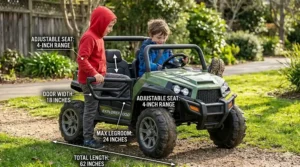
The 21-inch dual seats deserve specific mention. Most “two-seater” ride-ons cram two kids into 18-19 inches of width, which works fine for toddlers but gets tight fast as kids grow. That extra 2-3 inches of seat width means a 9 and 7-year-old can actually ride comfortably together without shoulders jammed together. This sounds trivial until you’re the parent mediating the inevitable “they’re touching me” arguments.
What ENYOPRO’s marketing doesn’t emphasize but matters for real-world use: the metal spring suspension on all four wheels isn’t just for show. Cheaper models use purely plastic suspension arms that bottom out on even moderate bumps. Metal springs actually compress and rebound, smoothing out the ride noticeably. Kids won’t articulate “this has better suspension,” but they’ll intuitively prefer riding it over harsher alternatives.
The independent 3-point seat belts (one for each seat position) reflect something important: this is engineered for two riders, not a single-rider design with a passenger bench added as an afterthought. Each rider gets their own safety restraint properly positioned for their seating position.
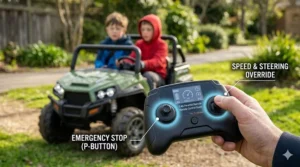
Customer feedback reveals the remote control range (advertised at 98 feet) actually works reliably at that distance, unlike cheaper models where “50 feet” means “maybe 30 feet if there’s no interference.” This matters more than parents initially realize—being able to emergency-stop your kid from across the yard provides genuine peace of mind during that learning period.
Pros:
✅ Authentic Ford Bronco styling appeals to brand-conscious kids
✅ Metal suspension delivers smoother ride than plastic alternatives
✅ 7Ah battery provides extended runtime despite modest motors
Cons:
❌ 180W total output limits extreme terrain capability
❌ Licensed design adds cost vs. generic alternatives
Value Verdict: In the $400-$500 range, this serves families valuing quality construction and recognizable branding over maximum power specs. The emphasis on comfort features like wider seating justifies the premium for all-day outdoor use.
5. Hikiddo 24V 4WD Truck (4×200W All-Terrain)
The Hikiddo 24V 4WD competes directly with ARBELI’s premium offerings by delivering quad-motor capability at a slightly lower price point. Four independent 200W motors providing true 4WD remain the gold standard for ride on toys for 8 10 year olds 24v who want genuine all-terrain performance.
The 24V 9Ah battery (notably larger than the 7Ah common in this segment) powers those four motors for 90-120 minutes depending on usage. What that translates to in practice: this handles the full Saturday morning of outdoor play without needing a mid-day recharge. Smaller batteries force that awkward break where kids come inside bored while the vehicle charges, disrupting the outdoor play rhythm parents are trying to establish.
Hikiddo’s execution of the quad-motor system focuses on practical terrain conquering rather than maximum speed. The 4 mph top speed seems conservative until you realize it’s the speed the vehicle maintains on grass, gravel, and moderate inclines—surfaces where dual-motor alternatives slow to 2-3 mph. Consistent power delivery matters more than peak performance for sustained outdoor adventures.
The four LED searchlights (in addition to standard headlights) solve a specific use case: extending play into early evening during shorter winter days. These aren’t decorative—they actually illuminate the path ahead enough for kids to see where they’re driving after sunset, which practically extends the useful play window by an extra hour during fall and winter.
The weight capacity of 88 pounds per seat (rather than a combined total) represents honest engineering. Many manufacturers list “130 lb capacity” without specifying whether that’s per seat or combined. Hikiddo’s per-seat rating means each seat can genuinely handle an 88-pound rider without performance degradation—that’s most 10-year-olds with room to spare.
Customer reviews consistently praise the all-metal suspension system’s durability through rough play. After 6-12 months of hard use, owners report no suspension sag or component failure—a stark contrast to plastic suspension arms that crack or bend under sustained abuse.
Pros:
✅ 4×200W ensures consistent performance across all terrains
✅ 9Ah battery outlasts most competitors’ runtime
✅ Per-seat weight rating provides honest capacity metrics
Cons:
❌ Premium pricing around $500-$550
❌ Lower top speed than some dual-motor alternatives
Value Verdict: For families prioritizing all-terrain capability and extended runtime over maximum speed, this justifies its premium positioning. The larger battery and robust construction pay dividends over multi-year ownership.
6. Best Choice Products Ford F-150 Lightning 24V
The Best Choice Ford Lightning occupies crucial territory: delivering 24-volt performance at a price point that doesn’t require budget justification. Around $280-$380, this undercuts most 24V competitors by $100-$200 while maintaining the fundamental advantages that make 24V systems worthwhile.
Dual 90W motors (180W total) match ENYOPRO’s output, proving you don’t necessarily pay less to get less power. What you sacrifice is primarily brand positioning and some premium materials—the chassis is more plastic-heavy than metal-reinforced alternatives, the wheels are standard treaded plastic rather than EVA, and the suspension is functional but not sophisticated.
Here’s what Best Choice gets right: the 24V 9Ah battery. This matches or exceeds batteries in models costing $200 more, explaining the competitive 90-minute runtime. For families testing whether their kids will actually use a ride-on long-term or just want seasonal outdoor entertainment, this delivers the essential 24V experience without betting heavily on sustained interest.
The officially licensed Ford Lightning design provides recognizable branding without ENYOPRO’s premium build quality. It looks good enough that kids feel proud driving it, which shouldn’t be dismissed—part of sustained play interest is kids feeling their toy is “cool enough” to show friends.
The included remote control functions identically to pricier alternatives: full parental override, emergency stop, steering control. These safety features don’t cost more to implement, so budget models include them just like premium ones. Safety parity across price points is one of the ride-on market’s underappreciated positives.
What the lower price reflects: thinner plastics mean more flex in the body panels (purely cosmetic), simpler suspension means more feedback from bumps (kids generally don’t care), and less sound insulation means louder motor noise (again, kids usually like this). None of these affect the fundamental enjoyment or safety.
Customer feedback reveals the assembly process is actually simpler than premium models—fewer complex components means less can go wrong during setup. For parents dreading 90-minute assemblies with cryptic instructions, this 30-40 minute process hits different.
Pros:
✅ Budget-friendly entry to 24V performance tier
✅ 9Ah battery matches premium competitors’ runtime
✅ Licensed Ford design at non-premium pricing
Cons:
❌ Plastic-heavy construction vs. metal-reinforced alternatives
❌ Basic suspension system transmits more bumps
Value Verdict: Around $280-$380, this removes the price barrier preventing many families from accessing 24V capabilities. Perfect for testing interest before committing to premium models, or for seasonal/vacation use where longevity matters less.
7. ARBELI 24V Ride On Tractor (with Detachable Trailer)
The ARBELI Tractor represents specialized appeal rather than universal recommendation. Dual 65W motors (130W total) make this the least powerful option reviewed, but that misses the point entirely—this targets a specific play pattern where hauling capability matters more than speed or terrain conquering.
The detachable tiltable trailer transforms this from a ride-on to an actual functional toy. Kids can load leaves, transport rocks across the yard, move toys from one play area to another. This active, task-oriented play encourages different engagement than just driving around—there’s actual work to accomplish, goals to complete. For kids who respond better to structured activity than open-ended driving, this channeling makes all the difference.
The six-wheel design (four on the tractor, two on the trailer) distributes weight differently than traditional four-wheel vehicles. This matters when the trailer is loaded—instead of the rear of the vehicle sagging under weight, load distributes across those extra two wheels. I’ve seen kids haul surprising amounts of yard debris before hitting performance limits.
The electric tilt function for dumping the trailer solves a real usability problem. Manual-dump trailers require kids to physically lift the bed, which becomes impossible once there’s actual weight in it. The powered dump means kids can load it full and still empty it independently—sustaining that “I can do this myself” engagement that makes toys satisfying rather than frustrating.
The 24V battery with 60-90 minute runtime reflects the lower power draw from 130W motors. Unlike high-output models that drain batteries quickly under load, this maintains relatively consistent runtime because the motors never draw peak power. Think of it like highway vs. city driving fuel economy—steady moderate demand beats intermittent peak demand for longevity.
Customer reviews from parents reveal an unexpected benefit: this teaches actual responsibility and work concepts. Kids develop routines around yard cleanup, moving materials, helping with outdoor projects. The ride-on becomes a tool for participation rather than just entertainment. Whether that appeals depends entirely on your parenting approach and your kid’s personality, but it’s a distinct use case.
Pros:
✅ Detachable trailer enables functional work-play hybrids
✅ Six-wheel design handles loaded trailer better than four-wheel alternatives
✅ Electric tilt function maintains kid independence when loaded
Cons:
❌ 130W motors sacrifice speed and hill-climbing
❌ Specialized appeal—not suitable for kids wanting sports car thrills
Value Verdict: Around $380-$480, this serves a niche: families with yard work to do and kids interested in helping rather than just playing. The tractor format either perfectly matches your kid’s interests or completely misses—very little middle ground.
How to Choose the Right 24V System: A Decision Framework
Shopping for high-voltage cars requires different thinking than selecting budget toddler toys. Here’s the expert methodology that actually leads to satisfied kids and parents:
Step 1: Honestly Assess Your Child’s Use Case
The athletic, outdoor-loving 9-year-old who’d ride BMX bikes all day if allowed has radically different needs than the cautious 8-year-old who prefers structured activities. The former wants the Razor MX350’s speed and dirt bike dynamics. The latter needs the ENYOPRO or Best Choice’s stable four-wheel platforms with parental control options. There’s no universal “best”—only best for your specific kid.
Step 2: Evaluate Your Terrain
If you have a perfectly flat driveway and smooth sidewalks, dual-motor systems handle fine—save your money. But if your property includes grass lawns, gravel areas, or any hills steeper than a wheelchair ramp, quad-motor 4WD systems like ARBELI or Hikiddo aren’t luxury—they’re functional requirements. I’ve seen too many parents buy dual-motor models, watch them struggle on their actual property, then upgrade six months later. Just buy what matches your terrain initially.
Step 3: Calculate Real Carrying Needs
“Weight capacity: 130 lbs” sounds like plenty until you do the math. An average 9-year-old weighs 60-70 pounds. Want them to bring their 7-year-old sibling along? That’s 105-120 pounds combined, barely leaving headroom. The 220-pound capacity models aren’t excessive—they’re accommodating reality plus a safety margin. Plus, weight capacity correlates with build quality; vehicles engineered for higher loads use better components throughout.
Step 4: Match Runtime to Play Patterns
Does your kid play intensely for 30-45 minutes then move to something else? The Razor’s shorter runtime won’t frustrate them. Do they spend entire Saturday mornings outside? You need the 90-120 minute batteries, full stop. Runtime mismatch creates the worst ownership experience: kids just getting engaged when the battery dies, leading to abandonment of the toy entirely.
Step 5: Budget Reality Check
The $250-$350 tier delivers 24V benefits at minimal premium over good 12V models. Totally worth it. The $450-$550 tier adds genuine capability (quad motors, premium batteries, better construction). Worth it IF your use case demands it—if not, you’re paying for specs you won’t use. The $600+ tier is diminishing returns for most families unless you’re genuinely replacing multiple vehicles or expect multi-year, heavy use.
Common Mistakes When Buying 24V Ride On Toys (And How to Avoid Them)
Mistake #1: Assuming Higher Voltage Automatically Means Better
24V delivers more potential power, but poorly implemented 24V systems can perform worse than quality 12V alternatives. A 24V vehicle with two underpowered 35W motors running on a weak 5Ah battery might actually underperform a well-engineered 12V with dual 50W motors and 7Ah battery. Total system wattage (motor output × battery voltage × battery Ah) determines actual capability, not voltage alone. Parents who buy the cheapest 24V option assuming voltage equals quality often end up disappointed.
Mistake #2: Ignoring Amp-Hour Ratings
Battery voltage determines power potential; amp-hour rating determines how long you can sustain that power. A 24V 5Ah battery provides 120 watt-hours of energy. A 24V 9Ah battery provides 216 watt-hours—80% more capacity. Yet manufacturers prominently display voltage while burying Ah ratings in small print. The runtime difference between 5Ah and 9Ah batteries often exceeds the performance difference between dual and quad motors. Always prioritize higher Ah ratings if you must choose between specs.
Mistake #3: Overlooking Weight Capacity Engineering
Some manufacturers list combined weight capacity without clarifying seat limitations. A “150 lb capacity” could mean each seat handles 75 pounds, or it could mean the chassis won’t break under 150 pounds total but individual seat structures fail above 60 pounds. Premium manufacturers specify per-seat capacity separately. If it’s not specified, assume it’s combined and conservative. This matters because kids rapidly outgrow undersized capacity limits, rendering expensive toys unusable years before they should wear out.
Mistake #4: Falling for “4WD” Marketing Without Motor Count Verification
True 4WD means four motors, one per wheel. Some manufacturers claim “4WD” for 2-motor systems that power all four wheels through mechanical drive shafts—this is technically 4-wheel-drive but lacks independent wheel power that defines real 4WD capability. Verify motor count, not just drive claims. The performance difference between two motors powering four wheels versus four independent motors is substantial on anything except perfect pavement.
Mistake #5: Buying Based on Looks Without Functionality Check
Licensed character vehicles command premium prices for branding, not capability. A generic truck with better specs at lower cost often outperforms a licensed vehicle that prioritizes aesthetic accuracy over engineering. Unless the branding genuinely enhances your child’s engagement (and for some kids it absolutely does), prioritize functional specs over franchise association. Your kid won’t care about perfect Star Wars styling after the first week if the vehicle can’t climb hills or dies after 40 minutes.
Real-World Performance: What to Expect from Your 24V Vehicle
Let’s set realistic expectations based on actual ownership experiences:
Speed Reality Check
Advertised “4-5 mph” sounds slow compared to your car, but watch a kid on one—it’s legitimately fast for something they’re piloting two feet off the ground. The psychological speed experience differs dramatically from actual mph. That said, terrain radically affects real-world speed. Manufacturers test on flat concrete; your grass lawn might reduce effective speed by 30-40%. Dual-motor vehicles advertised at 4 mph might achieve 2.5-3 mph on grass with a rider. Quad-motor systems maintain closer to advertised speeds across surfaces because total power output compensates for resistance.
Hill Climbing Realities
Standard driveway inclines (typically 3-5 degrees) pose no challenges for any 24V system. Moderately steep backyard hills (10-15 degrees) separate dual from quad-motor systems—dual motors slow noticeably or stall with passengers; quad motors maintain momentum. Genuinely steep hills (20+ degrees) defeat most ride-ons regardless of motors; only dirt bike formats like the Razor succeed due to weight distribution and knobby tire traction. Most manufacturers test on minimal inclines, so expect performance degradation on real hills.
Battery Life Variables
That “90-120 minute runtime” specification assumes ideal conditions: single lightweight rider, smooth pavement, moderate speed, no hills, 70°F temperature. Real-world usage—two kids, grass terrain, full throttle, cold weather—can cut this by 40-50%. Battery life also degrades over time; expect 80% of original capacity after 50-100 charge cycles, 60-70% after 100-200 cycles. This isn’t defect—it’s lithium battery chemistry reality. Budget for eventual battery replacement around the 18-24 month mark for sustained heavy use.
Durability Timelines
Premium models ($450+) typically survive 2-3 years of regular use before major component failure (motor burnout, structural crack, suspension failure). Mid-range models ($300-$450) generally last 1-2 years before requiring significant repair or replacement. Budget models ($250-$350) often develop issues within 6-18 months but may be economically unrepairable due to limited parts availability. Plan replacement timelines accordingly rather than expecting indefinite longevity from any model.
Weather Limitations
Despite “all-terrain” marketing, these vehicles are fair-weather toys. Light morning dew is fine; puddles and mud accelerate component failure. Water intrusion into motor housings or electrical connections causes corrosion that manifests as failures weeks later. Cold weather (below 40°F) reduces battery capacity noticeably—that 90-minute runtime might drop to 60 minutes. Heat above 95°F stresses batteries and motors, shortening their lifespan. Store indoors, avoid rain exposure, and limit use to moderate temperatures for maximum longevity.
Safety First: What Safety Guidelines Actually Matter
The Consumer Product Safety Commission establishes standards that all reputable 24V big kid vehicles must meet, including ASTM F963 compliance for ride-on toys. Here’s what those regulations mean practically:
Mandatory Protective Gear
For vehicles exceeding 5 mph (which includes the Razor MX350 and some high-performance trucks), helmets aren’t optional—they’re essential. Standard bike helmets suffice for 4-5 mph four-wheel vehicles, but dirt bike format toys warrant motocross-style helmets with additional chin protection. Knee and elbow pads add protection during the learning curve when falls are most likely.
Supervision Requirements
24V systems require age-appropriate supervision even for older kids in the 8-10 range. This doesn’t mean hovering over every ride, but it means adults remain within sight and earshot, especially near streets, slopes, or water features. The remote control included with most models isn’t just for teaching beginners—it’s an emergency override system for when kids make poor split-second decisions.
Operating Surface Rules
These vehicles are engineered for private property use only, never public roads or streets. Driveways, sidewalks, and yards are appropriate; riding alongside car traffic isn’t, regardless of supervision. The vehicles lack the visibility, braking capability, or crash protection for even slow-speed automotive traffic. Establish clear boundaries that kids understand and enforce them consistently.
Maintenance Safety
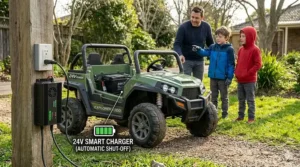
Battery charging must occur away from flammable materials in well-ventilated areas. Lead-acid batteries (still common in 24V systems) emit hydrogen gas while charging—rare but legitimate fire risk. Always use the included charger; aftermarket chargers may not regulate voltage properly, risking battery damage or fire. Check tire pressure monthly; underinflated tires stress motors and reduce battery life. Inspect wheels, suspension points, and steering components quarterly for cracks or looseness.
Weight Limit Enforcement
Exceeding rated capacity doesn’t just void warranties—it creates genuine safety risks. Overloaded vehicles accelerate more slowly, brake less effectively, and handle unpredictably in turns. Suspension components stressed beyond design limits can fail during use, causing sudden collapses. The temptation to let the neighbor kid hop on too needs to be weighed against stated capacity limits, not just whether the vehicle still moves with extra weight.
For comprehensive safety standards information, the ASTM F963-17 toy safety specifications provide detailed requirements that reputable manufacturers must meet to legally sell these vehicles in the United States.
24V vs 12V vs 36V: Understanding Power Tier Differences
12V Systems: The Outgoing Standard
Twelve-volt platforms dominated the market for years and still serve younger kids (ages 3-6) perfectly well. Single 12V batteries provide 60-120 watts of total power—adequate for 40-60 pound riders on flat terrain. Top speeds typically max at 2.5-3.5 mph, and runtime exceeds 24V systems because lower power draw stretches battery life. The primary limitation: insufficient torque for hills, sustained two-rider use, or heavier kids.
24V Systems: The Sweet Spot for 8-10 Year Olds
Doubling voltage to 24V doesn’t just double power—it enables entirely different motor designs. With higher voltage, motors can deliver more torque without excessive current draw that overheats wiring. This translates to 150-400 watts total power, supporting 100-220 pound capacities, 4-5 mph speeds, and genuine hill-climbing capability. The voltage jump enables dual or quad-motor configurations impossible with 12V architecture due to power demands.
36V Systems: Niche High-Performance
Some manufacturers offer 36V systems, typically in dirt bike formats for older kids (10-14). These deliver 500-1000 watts, support 15-20 mph speeds, and handle more aggressive terrain. However, they’re overkill for most 8-10 year olds, requiring advanced motor skills and judgment. They also face stricter safety regulations approaching actual motorized vehicle territory. Unless your child is an experienced rider wanting maximum performance, 24V provides better value and age-appropriate capability.
The Practical Translation
For kids outgrowing 12V but not ready for serious motorized bikes, 24V perfectly bridges that gap. It delivers meaningful performance upgrades—hill climbing, longer runtime with heavier riders, multi-passenger capability—without requiring the maturity and skill level that 36V systems demand. The market has settled on 24V as the standard for ride on toys for 8 10 year olds precisely because it balances enhanced capability with manageable risk profile for this age bracket.
Maintenance Tips: Extending the Life of Your Investment
Battery Care Makes or Breaks Longevity
Batteries represent the single most expensive replacement part (often $60-$120). Proper care can double their useful life. Charge immediately after each use, even for short rides—partial discharge cycles are easier on batteries than deep discharge. Never store with depleted battery; always charge to full before storage. During winter storage, charge monthly to prevent sulfation that permanently reduces capacity. Avoid charging in extreme temperatures; 50-80°F is ideal.
Wheel and Tire Maintenance
Check tire pressure monthly if pneumatic tires (like Razor MX350). Underinflation increases rolling resistance, stressing motors and draining batteries faster. Inspect for embedded stones, glass, or debris that could cause slow leaks. For solid plastic or EVA wheels, check for cracks or excessive wear—these rarely need replacing but when they do, operating with damaged wheels accelerates the damage.
Motor Protection
Motors are sealed but not waterproof. After wet grass use, allow several hours’ dry time before storage to prevent moisture accumulation. Listen for unusual grinding or squealing—this often indicates bearing wear that’s easily addressed early but catastrophic if ignored. Avoid prolonged stall situations (holding accelerator while blocked)—this draws maximum current through motors designed for intermittent use, causing overheating damage.
Suspension and Steering
Lubricate suspension pivot points quarterly with silicone spray (not WD-40, which attracts dirt). Check for loose bolts monthly—vibration loosens fasteners over time. Tighten according to manual specs rather than over-tightening, which can crack plastic components. Steering linkages should move smoothly without excessive play; if steering feels sloppy, check connections before the problem progresses to component failure.
Cleaning and Storage
Wipe down after muddy use to prevent corrosion on metal components. Store indoors or under weatherproof covering—UV exposure degrades plastics and fades colors within months of direct sunlight. Disconnect battery during extended storage (30+ days) to prevent parasitic drain through electrical system. Cover with breathable fabric rather than plastic tarps that trap moisture.
Budget Planning: Total Cost of Ownership Beyond Purchase Price
Initial Investment Breakdown
Purchase price represents 70-85% of first-year costs. Budget an additional $30-$60 for protective gear (helmet, knee/elbow pads) if not already owned. Some models require additional AAA batteries for remote controls and steering wheel features—typically $10-$15 annually. Insurance isn’t typically available for ride-on toys, so factor self-insurance against loss or major damage.
Ongoing Operational Costs
Electricity costs for charging are negligible—roughly $2-$5 annually even with daily use. Battery replacement becomes necessary after 150-300 charge cycles depending on care quality. Budget $60-$120 for replacement batteries around the 18-30 month mark for regular users. Tire replacement (for pneumatic tire models) runs $20-$40 but rarely becomes necessary within typical 2-3 year ownership span.
Potential Repair Costs
Minor repairs (replacing broken plastic trim, replacing blown fuses) typically cost $10-$30 in parts. Motor replacement, if necessary, runs $40-$80 per motor depending on model—quad-motor systems cost proportionally more. Steering mechanism repairs average $25-$50. For mid-range and premium models, parts remain available; budget models often lack serviceable parts, making them economically unrepairable after warranty expiration.
Resale Value Considerations
Well-maintained 24V vehicles retain 30-50% of purchase price after 1-2 years if in good condition. Premium brands (ARBELI, name-brand manufacturers) command stronger resale than generic brands. Complete original packaging, manuals, and accessories significantly improve resale value. Vehicles with damaged bodies but functional mechanical systems still sell for parts. Factor potential $100-$200 resale recovery into total ownership cost calculations.
Value Optimization Strategy
For maximum value, purchase during off-season (October-February) when prices drop 15-30% below peak season. Check manufacturer websites for refurbished models at 40-50% discounts—these typically carry 90-day warranties and function identically to new. Consider higher-quality models even at premium prices if planning 2+ year ownership; the durability delta often exceeds the price difference over time. Cheaper models make sense for seasonal/vacation use where longevity matters less.
FAQ: Your 24-Volt Ride-On Questions Answered
❓ How long does a 24 volt ride on toys for 8-10 year olds battery last per charge?
❓ Can two kids ride on a 2-seater 24V vehicle safely?
❓ Are 24V ride-ons safe for 8 year olds to drive independently?
❓ What's better for hills: more motors or higher voltage?
❓ How often should I replace the battery in electric ride on toys for 8 10 year olds?
Conclusion: Making the Right Choice for Your Family
The transition from 12V toddler toys to powerful toys in the 24-volt category represents more than just a power upgrade—it reflects your child’s development stage where outdoor active play competes directly with screen-based entertainment. The right 24-volt ride on toys for 8-10 year olds can tip that balance toward healthy outdoor engagement, while the wrong choice becomes garage clutter after initial novelty fades.
Premium quad-motor systems like ARBELI and Hikiddo justify their $500-$650 pricing for families with challenging terrain, multiple kids, or expectations of multi-year use. Mid-range options like ANPABO and ENYOPRO ($350-$500) deliver excellent value by balancing capability with cost for typical suburban backyards. Budget entries like Best Choice ($280-$380) democratize access to 24V benefits for families testing interest before major investment. Specialized options like the Razor MX350 and ARBELI Tractor serve specific use cases that either perfectly match your needs or completely miss.
The commonality across successful purchases? Parents who matched vehicle capabilities to actual use patterns rather than buying maximum specs or minimum price. Your kid’s riding style, your property’s terrain, expected passenger count, and realistic usage frequency should drive the decision far more than brand loyalty or feature checklists.
Whatever model you choose, remember that these vehicles create opportunities for outdoor play, skill development, and confidence building that screens can’t replicate. The investment in quality 24V ride-ons pays dividends in active childhood experiences that matter far beyond the vehicle’s useful life.
Recommended for You
- 7 Best 24V Ride On Toys for 8 Year Old – 2026
- Best Ride On Toys for 8 Year Olds in 2026: 7 Expert Picks You’ll Love
- 7 Best Ride On Toys for 7 Year Olds – 2026
Disclaimer: This article contains affiliate links. As an Amazon Associate, I earn from qualifying purchases. If you purchase products through these links, we may earn a small commission at no additional cost to you.
✨ Found this helpful? Share it with your friends! 💬🤗
