
In This Article
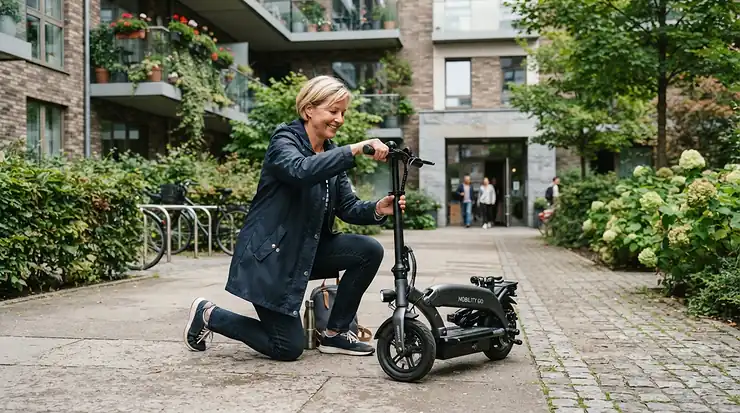
An electric ride-on vehicle for adults commuting short distance is a battery-powered personal vehicle, usually a folding stand-up kick scooter with a hub motor and a deck. It’s built for trips of roughly one to ten miles. Think train station to office, apartment to coffee shop, driveway to the corner market. Those routes are too short to justify starting a car and too long to enjoy on foot in a downpour.

Here’s what the checkout screen won’t tell you: the spec sheet and the street are two different countries. A scooter advertised at 25 miles may deliver far fewer when you’re carrying a backpack, facing a headwind, and living on a hill. A 40-pound machine sounds fine until you’re hauling it up three flights. And the sidewalk you planned to ride? In some places it’s fair game. In others it’s a ticket waiting to happen.
So this guide does the unglamorous homework. I compared published specifications, independent test data, and the recurring themes in genuine reviewer reports for seven real scooters. Then I translated every number into what it means on your commute. To be clear, this is research and analysis, not a claim of personal testing. Every price below is a range at the time of research, so check current pricing before you buy. (This post contains affiliate links; see the disclaimer at the end.)
You’ll get a quick comparison, seven detailed breakdowns, and practical sections on range per charge for commuting, charging time between short trips, storage, and local road/sidewalk regulations. Let’s roll. 🛴
Quick Comparison: Seven Scooters for Short-Distance Commuting
| Product | Claimed Range | Weight | Typical Full Charge | Best For |
|---|---|---|---|---|
| Gotrax G2 | 7 mi | ~21 lb | ~4 h | Tiny trips, tight storage |
| Gotrax Rival | 12 mi | ~26 lb | ~4 h | Light errand loops on a budget |
| Hiboy S2 | 17 mi | ~31 lb | ~6 h | Budget all-rounder |
| NAVEE V25 Pro | 15.5 mi | ~38 lb | ~4.5 h | Smooth 10-inch-tire ride, app extras |
| Gotrax G4 | 25 mi | ~37 lb | ~4–6 h | First-time buyers wanting range |
| Hiboy S2 Pro | 25 mi | ~37 lb | ~4–6 h | Riders who hate flat tires |
| Segway Ninebot Max G30P | 40.4 mi (≈30 mi tested) | ~41 lb | ~6 h | Longest real-world range |
Read the table as a trade-off map, not a leaderboard. The Gotrax G4 and Hiboy S2 Pro share a 25-mile headline claim. The Segway Ninebot Max G30P is the one where independent testing backed up a genuinely long real-world figure. The Gotrax G2 wins the weight contest by a wide margin, but its 7-mile claim confines it to micro-commutes.
Claimed range assumes a light rider, flat ground, and gentle speed, so treat it as a ceiling. If your route is under five miles each way, the lightest scooter you can comfortably carry usually beats the one with the biggest battery.
💬 Just one click — help others make better buying decisions too!😊
Top 7 Electric Ride-On Vehicle for Adults Commuting Short Distance: Expert Analysis
The seven picks below run from budget to premium. Each one gets a plain-English translation of its specs, an honest take on who it suits, and the review themes I could verify. Where I couldn’t verify independent reviews, I say so.
1. Gotrax G2 — lightest pick for tiny trips
The Gotrax G2 is the featherweight of this lineup, and that’s its whole pitch. It pairs a 200W motor with a roughly 15.5 mph top speed and a 7-mile claimed range, and it weighs around 21 pounds. Gotrax states it’s certified in accordance with UL 2272, the electrical-safety standard for personal e-mobility devices.
What does 21 pounds mean in practice? You can carry it up stairs one-handed and tuck it under a desk without an apology. The trade-off is the small 6-inch wheels, which are less forgiving over cracks, expansion joints, and potholes than the 8.5- to 10-inch tires on heavier scooters.
Based on the spec comparison, the Gotrax G2 suits riders whose entire commute is a couple of miles: dorm to lecture hall, flat to station. Reviewers describe it as simple for first-timers, and one testing site reported it handled a 12-degree hill without trouble. It does require some assembly out of the box.
Pros:
- ✅ Around 21 pounds, easy to carry upstairs
- ✅ Folds small enough for lockers and trunks
- ✅ Beginner-friendly, according to reviewer reports
Cons:
- ❌ Seven-mile claim leaves little real-world margin
- ❌ Small 6-inch wheels feel every crack
Price range: under $250. Value verdict: excellent for hops of a few miles, poor value if you’ll stretch past four or five miles round trip.
2. Gotrax Rival — air-filled tires without the heavy weight
The Gotrax Rival steps up to 8.5-inch pneumatic tires, a 250W motor, and a 15.5 mph top speed. It uses a 36V 5.2Ah battery (roughly 187Wh), is claimed to cover 12 miles, and weighs about 26 pounds. Gotrax quotes a recharge time near four hours.
Here’s what that battery number means: roughly 15.6 watt-hours per claimed mile, which is typical. But the pack is small, so the 12-mile figure is a ceiling rather than a promise. The real win is ride feel. Air-filled tires absorb the buzz that makes small-wheeled scooters tiring over broken pavement, and 26 pounds is still manageable on stairs.
My take: the Gotrax Rival fits someone with a two-to-three-mile loop who values a calmer ride over maximum range. I couldn’t verify independent aggregated review data for this model in my research. The available detail comes mostly from retailer and manufacturer listings, so read it as claimed specs rather than proven results.
Pros:
- ✅ Pneumatic 8.5-inch tires soften rough pavement
- ✅ Roughly 26 pounds, still carry-friendly
- ✅ About four hours to recharge
Cons:
- ❌ Small battery caps real-world range
- ❌ Independent review coverage was thin
Price range: roughly $300–$350. Value verdict: you’re paying for ride comfort, not range per dollar. The Gotrax G4 below offers more miles for a modest premium.
3. Hiboy S2 — proven budget all-rounder
The Hiboy S2 has an official range of about 17 miles, weighs roughly 31 pounds, and takes about six hours to charge fully. It offers two riding modes, comfort and sport, plus app support. The claimed rider limit is 265 pounds.
Those figures sit in a sweet spot. At 31 pounds it’s noticeably easier to carry than the 37-to-41-pound group, yet 17 miles covers most one-way commutes with plenty of buffer. A reviewer who tracked it found the official range generally consistent with user reports and tests. That’s rare in a category where claims often drift.
One caveat the spec sheet won’t tell you: the same reviewer’s own weight-limit test put the practical limit near 201 pounds, well below the 265-pound claim. Heavier riders should shop with margin. The long charge time is also worth planning around, since you’ll want to plug in at work or overnight. Reviewers broadly describe it as a strong budget performer for comfort and safety.
Pros:
- ✅ About 31 pounds, a middle-weight carry
- ✅ Official range matched user reports
- ✅ Comfort and sport riding modes
Cons:
- ❌ Roughly six-hour full recharge
- ❌ Independent test found lower real weight limit
Price range: sits below the Hiboy S2 Pro; check current price. Value verdict: one of the safest bets for riders under about 200 pounds on routes of 8 miles or less round trip.
4. NAVEE V25 Pro — 10-inch air tires and smart-app extras
The NAVEE V25 Pro lists a 15.5-mile maximum range, an 18.6 mph top speed, and a weight around 37.7 pounds. It has 10-inch pneumatic tires front and rear, a 600W peak motor, and a claimed 15% climb. Charging takes about 4.5 hours. NAVEE highlights an energy-recovery braking system and low-rolling-resistance tires to stretch range, and it pairs dual braking with a connected smartphone app.
Translate that into daily use. Big air tires make a real difference over cracked bike lanes, and regenerative braking adds a little range on stop-and-go routes. The 15.5-mile claim is modest next to the Gotrax G4‘s 25, so this is a comfort-first purchase rather than a range play. The newer NAVEE V25i Pro II reportedly adds a removable battery, front suspension, and Apple Find My tracking in some regions. That’s worth considering if you live in an apartment and want to charge indoors. Check US availability, though.
I couldn’t verify independent aggregated review data. The manufacturer’s store shows a strong rating, but that’s the seller’s own, so treat it cautiously. The listing does include a two-year warranty, which counts for something.
Pros:
- ✅ 10-inch pneumatic tires front and rear
- ✅ Dual braking with energy recovery
- ✅ App connectivity and two-year warranty
Cons:
- ❌ 15.5-mile claim trails similar-weight rivals
- ❌ Independent review coverage hard to verify
Price range: roughly $370–$480, depending on promotions. Value verdict: reasonable for ride quality, less compelling for range per dollar.
5. Gotrax G4 — first-timer’s long-range value
The Gotrax G4 is Gotrax’s best-selling scooter, and the specs explain why. It has a 350W continuous motor (500W peak), a 20 mph top speed, a 374.4Wh battery, and 10-inch tubed pneumatic tires. It’s claimed to go 25 miles and weighs 37 pounds. One listing rates it IPX4 for light rain, and it includes lights and a rider limit of 220 pounds.
That battery works out to roughly 15 watt-hours per claimed mile. But look at the real-world data. One scooter database lists the G4’s range at about 14.6 miles, which is only around 58% of the claim. A community reviewer also reported shorter battery life than expected. The sensible plan is to treat 14–18 miles as your planning range, still ample for most short commutes.
A two-week hands-on review (Android Authority) praised the G4’s durable build, real reflectors, and added security features, while flagging weight as the main drawback. That matches the spec sheet. At 37 pounds, it’s a scooter you’ll carry occasionally, not constantly.
Pros:
- ✅ 25-mile headline range with a 374Wh pack
- ✅ Sturdy build and real reflectors
- ✅ Built-in lights for dusk riding
Cons:
- ❌ 37 pounds is heavy for stair-dwellers
- ❌ Real-world range can fall well below claim
Price range: roughly mid-$400s typically; a price tracker shows swings from the high-$200s to the high-$500s over time. Value verdict: strong for a first purchase if you plan around the real-world range.
6. Hiboy S2 Pro — flat-proof honeycomb tires, 25 miles
The Hiboy S2 Pro uses a 36V battery of roughly 410Wh, with a claimed range up to 25 miles under ideal conditions. It weighs about 37.4 pounds and supports riders up to 220 pounds. Its standout feature is 10-inch honeycomb solid tires. Hiboy also lists cruise control, regenerative braking, app connectivity, an IPX4 water-resistance rating, and an optional seat, sold separately. Full charging runs about four to six hours.
Solid tires mean you’ll never fix a flat. If you commute through glass-strewn city streets or simply hate maintenance, that’s a real benefit. The usual trade-off with solid tires is a harsher, buzzier ride over rough pavement, so think about your route surface.
One test site called it the toughest budget scooter they’d reviewed and praised its range. By contrast, an automated spec-scoring comparison site rated its safety-feature list below some pricier rivals. That’s a fair reminder to check lights, brakes, and reflectors against your own needs. At roughly 16.4 watt-hours per claimed mile, the pack is competitive.
Pros:
- ✅ Flat-proof honeycomb solid tires
- ✅ 25-mile claim with a 410Wh pack
- ✅ Cruise control and optional seat
Cons:
- ❌ Solid tires typically ride harsher
- ❌ Recharge can stretch toward six hours
Price range: around $400. Value verdict: great for low-maintenance commuters who value zero flats over ride softness.
7. Segway Ninebot Max G30P — longest tested real-world range
The Segway Ninebot Max G30P is the range champion here. It has a 350W motor (700W peak) and a big 551Wh battery. It’s claimed to go 40.4 miles at up to 18.6 mph, weighs 41.2 pounds, and takes about six hours to charge. An independent testing site measured 30.3 miles of regular riding, 34.5 in eco mode, and 27.6 riding fast. They also recorded a 12.6-foot braking distance and an 18.4 mph top speed.
Those test numbers are the key advantage. The real-world result is about 75% of the claim, and that’s still the best real-world figure in this guide. At about 18 watt-hours per tested mile, it’s a thirsty but well-fed machine. The 10-inch tires are tubeless pneumatic, and the scooter carries an IPX5 splash rating.
The downside is physical. At over 41 pounds, it’s the heaviest pick here, with no suspension. A smaller-battery sibling, the Segway Ninebot Max G30LP (367Wh), tested at about 26 miles, which is excellent for the weight. One community reviewer used a G30P for quick boat-and-grocery errands and was happy with it.
Pros:
- ✅ Roughly 30 miles tested in regular riding
- ✅ IPX5 splash resistance
- ✅ Tubeless 10-inch tires with dual drum brakes
Cons:
- ❌ At 41 pounds, the heaviest here
- ❌ Six-hour recharge, no suspension
Price range: roughly $550–$700 typically; tracked prices have swung from the mid-$400s to about $1,000. Value verdict: the pick if range reliability matters more than weight.
Side-by-Side Snapshot: Price Ranges and Review Themes
| Product | Price Range | Range: Claimed vs. Reported | Review Theme | Best For |
|---|---|---|---|---|
| Gotrax G2 | Under $250 | 7 mi claimed | Beginner-friendly | Dorm or station hops |
| Gotrax Rival | $300–$350 | 12 mi claimed | Reviews not verified | Smooth short loops |
| Hiboy S2 | Below S2 Pro | 17 mi claimed; matched tests | Long charge; lower real weight limit | Budget all-rounders |
| NAVEE V25 Pro | $370–$480 | 15.5 mi claimed | Independent reviews not verified | Comfort-first riders |
| Gotrax G4 | $415–$500 | 25 mi claimed; ~14.6 mi listed in one database | Durable but heavy | First-time buyers |
| Hiboy S2 Pro | Around $400 | 25 mi claimed | Tough build; modest safety scoring | Flat-free commuting |
| Segway Ninebot Max G30P | $550–$700 | 40.4 mi claimed; 30.3 mi tested | Strong tested range | Longest real range |
The table shows how misleading headline range can be. The Gotrax G4 and Hiboy S2 Pro cost about the same and claim the same range, but only one has an independent source putting real-world range far below its claim. If range is your priority, the Segway Ninebot Max G30P costs more but is the only one where tested performance clearly backs the marketing. Budget buyers who only need a few miles will find the Gotrax G2 or Hiboy S2 more sensible.
How to Choose an Electric Ride-On Vehicle for Adults Commuting Short Distance
To choose the right scooter, match range, weight, safety certification, and local rules to your actual route. Follow these seven steps.
- Measure the real round trip. Add both directions plus errand detours. Then aim for a claimed range at least double that number, because claims rarely survive hills, wind, and heavier riders.
- Weigh your carry. Under 25 pounds is easy on stairs, around 30 is manageable, and 37–41 pounds means you’ll think twice. Be honest about your stairs.
- Look for certification. Check for UL 2272, the standard for electrical systems in personal e-mobility devices. It tests the battery, drivetrain, and charger together, which matters because battery fires are the category’s worst failure.
- Match tires to pavement. Pneumatic tires ride smoother. Solid tires eliminate flats but transmit more vibration.
- Leave weight margin. Don’t buy at the limit; one independent test found a practical limit well below a claim.
- Confirm local rules. Sidewalk, helmet, and speed rules differ by city.
- Plan your charging spot. If you can’t charge at work or home safely, shop for a removable battery.
Those steps filter out most bad purchases before you open a single product page.
Range Per Charge for Commuting: What the Numbers Really Mean
Range per charge for commuting is the number most buyers fixate on, and it’s the one most likely to mislead. Claimed range comes from ideal conditions, typically a lighter rider at modest speed on flat ground.
Use the data points in this guide as a reality check:
- The Segway Ninebot Max G30P claims 40.4 miles but tested at 30.3 in regular riding, about 75%.
- The Gotrax G4 claims 25 miles, and one database lists 14.6, about 58%.
- The Segway Ninebot Max G30LP claims 24.9 miles and tested at 26.2, roughly 105%.
So real-world results ranged from about 58% to 105% of the claim. Planning at 60% protects you.
Watt-hours per mile help compare packs fairly. The Gotrax G4 claims about 15 Wh/mile, the Hiboy S2 Pro about 16.4, and the G30P tested at about 18. Heavier riders, higher speeds, hills, cold weather, and soft tires all push that number up.
Here’s a simple rule: take your daily round trip, divide by 0.6, and make sure the claimed range exceeds it. A 10-mile round trip needs roughly a 17-mile claim, which puts the Hiboy S2 and everything above it in play.
Charging Time Between Short Trips: A Realistic Routine
The spec sheet’s charging time, typically four to six hours, describes a full 0-to-100% fill. Your actual need between short trips is a fraction of that. A commuter using 6 miles a day from a battery that realistically delivers 15 uses roughly 40% per day. Topping up once the day is done, rather than waiting for empty, makes the charge window trivially short.
Lithium-ion batteries generally tolerate partial top-ups. A practical routine:
- Charge at the destination during work, if safe and permitted.
- Do a short top-up before an evening errand run.
- Unplug when full instead of leaving it connected for days.
Safety matters here more than convenience. U.S. safety regulators advise that you always be present while charging, never charge while sleeping, use only the supplied charger, and unplug when done. Fire-safety guidance also recommends avoiding charging in extreme temperatures, roughly below 32°F or above 105°F.
If you need faster turnarounds, the Gotrax G2 and Gotrax Rival recharge in around four hours, while the Hiboy S2 and Segway Ninebot Max G30P need about six. For heavy daily use, the shorter recharge window can be the deciding factor. 🔋
Compact Electric Ride-On for Neighborhood Errands: Setup and First-30-Day Habits
A compact electric ride-on for neighborhood errands shines when you set it up right. Here’s a practical playbook Amazon listings don’t give you.
Setup (first hour):
- Charge fully before the first ride, as manufacturers recommend.
- Check tire pressure on pneumatic models like the Gotrax G4 or NAVEE V25 Pro; solid-tire models like the Hiboy S2 Pro skip this.
- Test the folding latch until it locks securely every time.
- Practice in an empty lot at the lowest speed mode. One manufacturer guide estimates most adults feel comfortable within 12–20 minutes; take longer if you need it.
Maintenance rhythm: weekly tire and brake checks, monthly bolt checks, and a quick wipe-down after wet rides. The Segway Ninebot Max G30P‘s IPX5 rating tolerates splashes, but no listed model is built for submersion.
Common first-month mistakes:
- Hanging heavy grocery bags on the handlebars, which upsets steering. Use a backpack.
- Leaving the battery drained for weeks, which can shorten its life.
- Riding at full speed on unfamiliar pavement.
- Skipping a helmet, which regulators strongly recommend.
Short errand loops are forgiving, which makes them ideal for building habits.
Easy-to-Store Electric Vehicle for Adults: Fitting a Scooter into Small Spaces
An easy-to-store electric vehicle for adults has to fold smaller than your excuses. Most scooters in this guide fold flat, with the stem dropping onto the deck. One spec listing for the Gotrax G4 shows a folded footprint of roughly 47 × 19 × 20 inches, about the size of a long duffel bag.
Weight matters as much as folded size, since you’ll lift the scooter into closets, trunks, and hallways. Here’s the practical ranking:
- Lightest: Gotrax G2 (~21 lb) and Gotrax Rival (~26 lb)
- Middle: Hiboy S2 (~31 lb)
- Heaviest group: NAVEE V25 Pro, Gotrax G4, Hiboy S2 Pro, and Segway Ninebot Max G30P (~37–41 lb)
Apartment dwellers should think beyond footprint. Fire-safety guidance recommends keeping charging scooters away from primary exits, and avoiding storage in direct sunlight or hot vehicles. A closet near a window is better than a hallway by the front door. If your building bans battery charging indoors, a removable battery (as on the NAVEE V25i Pro II, where available) is worth a premium.
The simplest storage test: fold the scooter, lift it from the floor to chest height, and walk twenty feet. If that feels like a chore today, it will feel like a punishment in February.
Local Road/Sidewalk Regulations: What to Check Before Your First Ride
Local road/sidewalk regulations vary enormously, and ignorance won’t help at a traffic stop. This is general information, not legal advice, and laws change.
What the research shows:
- In most U.S. states, low-powered scooters (generally under about 750W and 20 mph) are treated like bicycles, with no driver’s license required. The Gotrax G4‘s 20 mph top speed sits right at that line, so verify your state.
- Helmet, speed, sidewalk, and age rules differ by state and city. Minimum age is commonly 14–16.
- One 2025 guide counts 17 states that explicitly ban scooters from sidewalks, while many others let cities decide.
- Bike lanes are the most commonly permitted and safest option.
- One 2026 state summary reports Texas treats sidewalk speeds above 8 mph as prima facie unreasonable, and that Wisconsin has no statewide helmet mandate, applies DUI laws to scooter riders, and requires an audible signal when passing on sidewalks or paths.
Your move: use a state-by-state tool like ERideHero’s electric scooter law map, then check your city’s code and your campus or employer rules. Look specifically for sidewalk, bike-lane, parking, and speed-limit language.
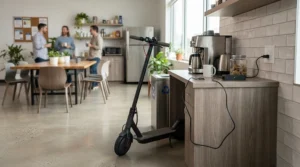
Real-World Scenarios: Three Riders, Three Smart Picks
Scenario 1: The dorm commuter. She rides 1.5 miles each way across campus, lives in a third-floor walk-up, and has a tight budget. Stairs dominate her decision, so the Gotrax G2 at roughly 21 pounds is the logical pick. Its 7-mile claim leaves comfortable margin for three to four miles of daily use.
Scenario 2: The hybrid-office rider. He rides 4 miles each way from home to a train station, then 4 more at the other end, with an outlet available at work. That’s roughly 8 miles round trip, so a real-world range of 14–18 miles is plenty. The Gotrax G4 delivers that at a sensible price, and weight is tolerable because he mostly rolls rather than carries.
Scenario 3: The suburban errand runner. She makes 3-mile loops to groceries, pharmacy, and school pickup over rough pavement and doesn’t want to repair tires. The Hiboy S2 Pro fits: honeycomb tires eliminate flats, cruise control helps on straight stretches, and the optional seat adds comfort on longer loops.
For anyone with a longer or hillier route, such as 6 to 8 miles each way, step up to the Segway Ninebot Max G30P. Across all three scenarios the pattern holds: start from your route and your stairs, then pick the scooter.
Problem → Solution Guide: Fixing the Most Common Commuter Headaches
Problem 1: Range anxiety. Solution: plan at 60% of the claimed range, and pick the Segway Ninebot Max G30P if your route exceeds 12 miles round trip.
Problem 2: Too heavy to carry. Solution: choose the Gotrax G2 or Gotrax Rival, or store your scooter on the ground floor and ride from there.
Problem 3: Battery heat and charging worries. Solution: use only the supplied charger, never charge while asleep, and unplug when full. The U.S. Consumer Product Safety Commission publishes a Micromobility Information Center with charging tips, and it warns against “universal” chargers that fit but aren’t compatible. Stop using a scooter that smells odd or swells.
Problem 4: Constant flats. Solution: switch to solid tires like the Hiboy S2 Pro‘s, or keep pneumatic tires properly inflated.
Problem 5: Sidewalk confusion. Solution: default to bike lanes and roads where permitted, slow to walking pace around pedestrians, and check your city’s code before riding.
Most of these headaches are predictable, and every one has a straightforward fix.
Electric Scooter vs Traditional Alternatives for Short Commutes
| Option | Sweet Spot | Storage Hassle | Weather Exposure | Best For |
|---|---|---|---|---|
| Electric scooter | 1–10 mi | Low (folds) | High | Last-mile and errand runs |
| Walking | Under 1 mi | None | High | Very short trips |
| Bus or transit | 3–15 mi | None | Moderate | Fixed routes |
| Car or rideshare | Any | High (parking) | Low | Bad weather, cargo |
| Pedal bicycle | 1–10 mi | Moderate | High | Fitness commutes |
Scooters win on door-to-door flexibility. You skip parking, ignore transit schedules, and cover distances that would eat a quarter-hour on foot. They lose to cars on weather and cargo, and to bicycles on repairability and fitness benefit.
The honest comparison depends on one factor: how often you can ride. For commuters who’d otherwise drive a mile or two and hunt for parking, a scooter pays off quickly. For commutes over about 10 miles, transit or a car remains more practical. A scooter also complements transit well, since a folded Gotrax G2 or Hiboy S2 fits beside your seat or under a desk.
Long-Term Cost & Value: What an Electric Scooter Really Costs
Operating costs are low. A full charge of a roughly 400Wh battery uses about 0.4 kWh, which at typical U.S. residential rates is well under a quarter. Maintenance mainly means tires, brakes, and eventually the battery. One manufacturer guide estimates a typical lifespan of three to five years with daily commuting and proper care, though that’s a vendor claim, so treat it as a rough benchmark.
| Product | Price Range | Claimed Range | Approx. Cost per Claimed Mile | Best For |
|---|---|---|---|---|
| Gotrax G2 | Under $250 | 7 mi | ~$21–$36 | Micro-commutes |
| Gotrax Rival | $300–$350 | 12 mi | ~$25–$29 | Smooth short loops |
| NAVEE V25 Pro | $370–$480 | 15.5 mi | ~$24–$31 | Comfort-focused riders |
| Gotrax G4 | $415–$500 | 25 mi | ~$17–$20 | Budget range |
| Hiboy S2 Pro | Around $400 | 25 mi | ~$16 | Low-maintenance riders |
| Segway Ninebot Max G30P | $550–$700 | 40.4 mi | ~$14–$17 | Range reliability |
I left the Hiboy S2 out because I couldn’t confirm a current price range. Cost per claimed mile is a rough yardstick and flatters scooters with optimistic claims. On tested mileage, the Segway Ninebot Max G30P works out closer to $18–$23 per mile, which still compares well. The Hiboy S2 Pro and Gotrax G4 deliver the best headline value, and the Gotrax G2 is the cheapest way in, not the cheapest per mile.
Factor in a helmet, lock, and lights, and budget a few extra dozen dollars on top of the sticker price.
Frequently Asked Questions
❓ Do I need a license to ride an electric scooter to work?
❓ How much does it cost to charge an electric scooter?
❓ Can I ride an electric scooter in the rain?
❓ How long does an electric scooter last for daily commuting?
❓ What is the best electric scooter for a heavier rider?
Conclusion
Choosing an electric ride-on vehicle for adults commuting short distance comes down to honest answers about your route, your stairs, and your storage space. If every trip is a mile or two, the Gotrax G2 is the lightest, cheapest way to get started. The Hiboy S2 is a proven budget all-rounder. The Gotrax G4 and Hiboy S2 Pro offer the best headline range value, with the S2 Pro’s flat-proof tires suiting low-maintenance riders. The NAVEE V25 Pro is the comfort-first choice, and the Segway Ninebot Max G30P is the pick when tested real-world range matters most.
Remember the three rules that save buyers the most regret: plan for about 60% of claimed range, choose a weight you can actually lift, and check your local sidewalk and speed rules before the first ride. Charge safely, wear a helmet, and a good scooter will quietly take over the short trips you used to dread.
✨ Ready to make the switch?
🔍 Click any highlighted scooter above to check current pricing and availability, and start turning your short trips into the best part of your day! 🛴
Recommended for You
- Adult Ride-On Car: 7 Best Picks For 2026 (Honest Ranking)
- Off-Road Electric Vehicle For Adults: 7 Proven Picks (2026)
- Adult Electric Go-Kart Vs Mini Bike: 7 Best Picks (2026)
Disclaimer: This article contains affiliate links. As an Amazon Associate, I earn from qualifying purchases. If you purchase products through these links, we may earn a small commission at no additional cost to you.
✨ Found this helpful? Share it with your friends! 💬🤗
