

In This Article
You’re scrolling through Amazon, ready to surprise your little one with their first electric ride-on car. Then you hit a wall—12V or 24V? The specs look similar, the prices vary wildly, and you’re wondering if doubling the voltage really makes that much difference. Trust me, I’ve been there, staring at product pages at midnight, calculator in hand, trying to decode what these numbers actually mean for your kid’s joy (and your wallet).
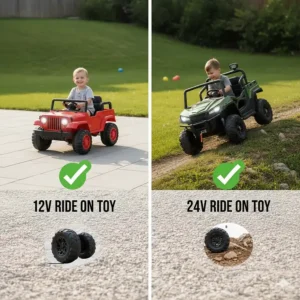
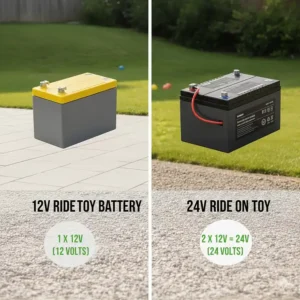
Here’s the thing: choosing between 12v vs 24v ride on toys isn’t just about numbers on a battery. It’s about matching power to your child’s age, your terrain, and how long you want that birthday gift to stay relevant. A 12V battery system provides approximately 12.6 volts through six cells connected in series, while a 24V system doubles that with twelve cells, producing 25.2 volts. But what does that mean for a three-year-old learning to drive versus a seven-year-old ready to conquer the backyard hills?
In this guide, we’ll break down everything from runtime and speed to real product recommendations. By the time you finish reading, you’ll know exactly which voltage suits your family—no engineering degree required.
Quick Comparison Table: 12v vs 24v Ride On Toys at a Glance
| Feature | 12V Ride On Toys | 24V Ride On Toys |
|---|---|---|
| Best Age Range | 2-5 years | 5-9 years |
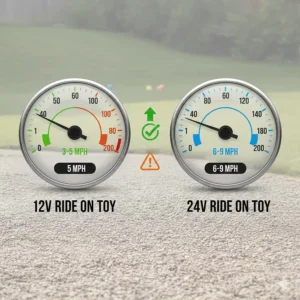
| Top Speed | 3-5 mph | 4-6 mph |
| Runtime | 45-90 minutes | 60-120 minutes |
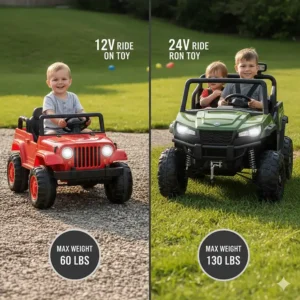
| Weight Capacity | 55-70 lbs | 100-130 lbs |
| Terrain Performance | Flat surfaces, light grass | Hills, grass, gravel, slopes |
| Seating | Mostly single-seater | Often 2-seater options |
| Price Range | $120-$250 | $280-$500 |
| Charging Time | 8-12 hours | 10-18 hours |
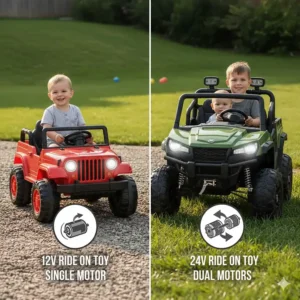
| Motor Power | 30W-70W | 75W-200W per motor |
💬 Just one click – help others make better buying decisions too! 😊
Top 7 12v vs 24v Ride On Toys: Expert Analysis
12V Category
1. Best Choice Products 12V Kids Ride On Truck
If you want a solid entry-level option that won’t break the bank, this Jeep-style truck consistently ranks as Amazon’s bestseller for good reason. The Best Choice Products 12V Kids Ride On Truck brings that authentic off-road aesthetic with LED headlights, lockable doors, and a grid windshield that makes kids feel like they’re driving the real deal.
Key Specifications:
- Dual 30W motors with 12V 7AH battery
- Max speed: 3.7 mph
- Weight capacity: 65 lbs
Priced around $150-$200, this ride-on includes both manual pedal control and a 2.4GHz parental remote—essential when your toddler decides the neighbor’s lawn looks interesting. Parents rave about the 2-hour runtime and spring suspension system that handles sidewalk cracks like a champ.
Pros:
✅ Bluetooth speakers for music
✅ Three-speed modes for gradual learning
✅ Available in 11 colors
Cons:
❌ Plastic wheels may slip on wet grass
❌ Assembly takes 45-60 minutes
2. MilleLoom 12V Ride-on Toy Truck
The MilleLoom 12V Ride-on Toy Truck stands out with its soft-start technology—a game-changer for nervous first-timers who get startled by sudden acceleration. This feature alone has saved countless parents from consoling scared toddlers. The PP material wheels are puncture-proof, meaning you’ll never deal with flat tires at the worst possible moment.
Key Specifications:
- 12V battery with dual motors
- Soft-start prevention technology
- Spring suspension for smooth rides
Customers appreciate the thoughtful safety features like a 3-point seat belt and dual locking doors. The AUX port and USB connectivity let kids jam to their favorite tunes, though one parent mentioned their daughter insisted on playing “Baby Shark” on repeat for three weeks straight.
Pros:
✅ Soft-start prevents sudden acceleration
✅ Durable PP material wheels
✅ Remote emergency stop button
Cons:
❌ Slightly heavier than competitors
❌ Remote range limited to about 50 feet
3. XCAR 12V Kids Electric Car
For families seeking compact power, the XCAR 12V Kids Electric Car delivers an authentic racing feel in a smaller footprint. This model’s 12V 7AH battery paired with dual motors provides 60-90 minutes of continuous fun—perfect for weekend backyard adventures without constant recharging.
Key Specifications:
- Three-speed settings (low, medium, high)
- LED lights and realistic dashboard
- Compact design for easier storage
Parents love how easy this car is to maneuver through tight spaces, making it ideal for smaller yards or indoor use. The light blue color option has been particularly popular, though the model comes in several vibrant choices.
Pros:
✅ Compact and easy to store
✅ Three adjustable speeds
✅ Quick charging time (8-10 hours)
Cons:
❌ Lower weight capacity (55 lbs)
❌ Best for flat surfaces only
24V Category
4. Hikole 24V Power Truck 2-Seater
Now we’re talking serious power. The Hikole 24V Power Truck 2-Seater features dual 200W motors—that’s 400W of combined power for tackling actual hills. This beast doesn’t just look tough; it performs like a mini SUV with its patented electron-assisted steering and shock absorber springs.
Key Specifications:
- 2x200W dual drive engine
- 24V 7AH rechargeable battery
- Max speed: 3.9 mph
- Weight capacity: 110 lbs (perfect for two kids)
The 20-inch wide seats comfortably accommodate two smaller children or one bigger kid who’s outgrown those flimsy 12V models. One dad shared that his twin six-year-olds have been using this for over a year, conquering the gravel driveway daily without issues. At $300-$400, it’s an investment, but the durability justifies the price.
Pros:
✅ True 2-seater capacity
✅ Handles rough terrain exceptionally
✅ Bluetooth and MP3 connectivity
Cons:
❌ Heavier to move (requires adult assistance)
❌ Higher initial cost
5. Sopbost 24V 2-Seater Dump Truck
Kids who love construction will lose their minds over the Sopbost 24V 2-Seater Dump Truck. The electric auto-lifting dump bed actually works, and it includes a shovel for maximum imaginative play. Four 75W motors (total 300W) give this truck serious climbing ability—up to 15-degree inclines without strain.
Key Specifications:
- 4x75W motors (4WD capability)
- Electric dump bed with shovel
- EVA rubber tires for all-terrain
- Max speed: 5 mph
The EVA tires are a standout feature, providing better traction than standard plastic wheels and eliminating the risk of punctures. Parents report this truck conquering grass, dirt, and even light sand without getting stuck. The $350-$450 price tag includes ASTM F963 safety certification.
Pros:
✅ Functional dump bed for interactive play
✅ 4WD for superior terrain handling
✅ Four-wheel spring suspension
Cons:
❌ Requires significant storage space
❌ Remote setup can be tricky initially
6. 24V Licensed RAM 1500 RHO 2-Seater
The 24V Licensed RAM 1500 RHO 2-Seater brings authentic truck styling with officially licensed details that make it look like a miniature version of the real thing. Dual 90W motors and a functional drop-down tailgate give older kids (6-9 years) the realistic driving experience they crave.
Key Specifications:
- Official RAM licensing with authentic details
- Dual 90W motors with suspension system
- Working manual gear shifter
- Weight capacity: 132 lbs
The metal frame construction ensures this ride-on survives sibling battles and aggressive backyard terrain. CPSC, ASTM, and FCC certified, it checks every safety box parents care about. The spacious truck bed stores toys, making it perfect for “hauling missions” around the yard.
Pros:
✅ Authentic RAM styling
✅ Metal frame for durability
✅ Functional tailgate and truck bed
Cons:
❌ Premium price ($350-$400)
❌ Longer charge time (12-14 hours)
7. Luibas 12V Electric Bumper Car
For something completely different, the Luibas 12V Electric Bumper Car transforms ride-on fun into a carnival experience. The 360-degree spin capability and bumping function create endless entertainment for younger kids (1.5-6 years) who aren’t ready for traditional driving but want motorized excitement.
Key Specifications:
- 12V battery with bumper car functionality
- 360-degree rotation feature
- Max speed: 1.12 mph (safe for toddlers)
- Weight capacity: 66 lbs
This unique option works on indoor floors, carpets, tiles, and concrete—making it a year-round toy regardless of weather. The built-in music and LED lights keep toddlers entertained, though parents note the slower speed might bore older kids quickly.
Pros:
✅ Unique bumper car experience
✅ Safe for very young children
✅ Indoor/outdoor versatility
Cons:
❌ Limited to flat surfaces
❌ May not hold interest beyond age 4-5
Understanding Battery Voltage: What Those Numbers Actually Mean
Let’s get nerdy for a minute (but I promise to keep it simple). When you see “12V” or “24V,” you’re looking at the electrical potential that powers the motors. According to voltage fundamentals, a common voltage for automobile batteries is 12 volts (DC), which has been the standard since the 1950s when it replaced 6-volt systems.
The Power Equation
Here’s where it gets interesting: power (watts) equals voltage (volts) multiplied by current (amps). So a 12V battery at 30 amps delivers 360 watts, while a 24V battery at 15 amps also delivers 360 watts. Same power, different delivery method. However, 24V systems are more efficient because they use half the current, resulting in less heat loss and longer battery life.
Think of it like water pressure in a hose. Higher voltage is like higher water pressure—it can push the same amount of water (power) through thinner pipes (wires) more efficiently.
Real-World Performance Differences
The practical difference? A 24V ride-on typically includes higher wattage motors (75W-200W each vs 30W-70W for 12V). This isn’t just about speed—it’s about consistent power delivery on challenging terrain. Your 12V car might struggle halfway up a grassy slope, while a 24V model climbs steadily.
Speed Comparison: How Fast Do They Actually Go?
Safety-conscious parents will appreciate that both voltage options stay within “walking to jogging” speeds—2-6 mph maximum. That’s intentional design, keeping kids safe while delivering enough speed for excitement.
12V Speed Profile
Most 12V ride-ons max out at 3-5 mph. The Best Choice Products 12V hits 3.7 mph at top speed, which looks slow on paper but feels zippy when your three-year-old is behind the wheel. The benefit? You can easily keep pace on foot, and your child has better reaction time at lower speeds.
24V Speed Advantage
24V models typically reach 4-6 mph, with some performance models like the Sopbost Dump Truck hitting 5 mph. That extra mile per hour makes a real difference for older kids who’ve mastered basic driving. It’s the difference between leisurely cruising and feeling that rush of speed.
Important note: Speed isn’t everything. Terrain capability and sustained power matter more than top-end velocity for most backyard adventures.
Terrain Performance: Where Each Voltage Shines
This is where 24V models truly justify their higher price tag.
12V Terrain Capabilities
12V ride-ons excel on:
- Flat driveways and patios
- Indoor smooth floors
- Short grass (well-maintained lawns)
- Gentle, barely-there inclines
The XCAR 12V and similar models work beautifully on sidewalks and even kitchen tile for rainy-day indoor play. But ask them to climb a 10-degree grassy slope? You’ll watch them struggle, slow down, and maybe even stop altogether.
24V All-Terrain Dominance
24V vehicles conquer:
- Hills up to 15-20 degrees
- Thick grass and uneven lawns
- Gravel driveways
- Dirt paths and light trails
- Transitions between surfaces
The Hikole 24V with its dual 200W motors laughs at challenges that would strand a 12V model. Parents with sloped yards or varied terrain consistently report 24V models as “worth every penny” for this reason alone.
Making Terrain Work for You
Before buying, walk your yard. Notice slopes? Gravel areas? If you answered yes, seriously consider 24V. If your child will mostly drive on flat concrete or tile, save your money and stick with 12V.
Battery Life & Runtime: The Real Story
Here’s something manufacturers don’t always make clear: runtime depends on three factors—battery capacity (Ah), terrain, and rider weight.
12V Runtime Reality
Expect 45-90 minutes of continuous use. The MilleLoom 12V averages about 75 minutes on flat surfaces with a 50-pound rider. Add hills or grass, and that drops to 45-60 minutes. Parents report this is actually perfect for young kids’ attention spans—they’re ready for a snack break before the battery dies.
24V Extended Sessions
24V systems deliver 60-120 minutes, sometimes more. The Sopbost Dump Truck runs 90-110 minutes on grass with two kids aboard. That longer runtime means fewer charging cycles, which extends overall battery lifespan. One parent mentioned their 24V truck has lasted three years with two kids using it regularly—the battery still holds a solid charge.
Charging Considerations
- 12V charging: 8-12 hours (overnight)
- 24V charging: 10-18 hours (plan for full day)
Pro tip: Invest in a spare battery for 24V models if your kids use them daily. Swap batteries to eliminate downtime.
Weight Capacity: When Kids Outgrow Their Ride
Nothing’s sadder than a beloved ride-on car that can’t support your growing child anymore.
12V Weight Limits
Most 12V models cap at 55-70 lbs. The Best Choice Products 12V maxes at 65 lbs. For reference, average five-year-olds weigh 40 lbs, six-year-olds about 45 lbs. You’ve got a decent window of use, but not forever.
24V Future-Proofing
24V ride-ons support 100-132 lbs, often accommodating two younger children or one older child up to age 8-9. The RAM 1500 RHO handles 132 lbs, meaning siblings can ride together or your big kid can enjoy it for years.
Cost per year calculation:
- 12V used 2-3 years: $60-$100/year
- 24V used 4-5 years: $70-$100/year
The longer lifespan makes 24V models surprisingly cost-effective despite higher upfront prices.
Price Analysis: Understanding the Investment
Let’s talk money without the marketing fluff.
Budget Breakdown
12V Models: $120-$250
- Entry-level: $120-$150
- Mid-range: $160-$200
- Premium 12V: $200-$250
24V Models: $280-$500
- Entry-level 24V: $280-$330
- Mid-range: $340-$400
- Premium 24V: $400-$500
What You’re Paying For
That price difference buys you:
- Stronger motors (often dual motors in 24V)
- Better build quality and materials
- Longer battery life
- All-terrain capabilities
- Often 2-seater designs
- Extended age range usability
When to Splurge vs Save
Choose 12V if:
- Your child is under 5 years old
- Budget is tight ($200 or less)
- You have flat terrain only
- This is a “try it out” first ride-on
Choose 24V if:
- Your child is 5+ or you have multiple kids
- You have varied terrain/hills
- You want 3-5 years of use
- Two kids will share it
Safety Features: What Really Matters
Both voltage levels offer similar core safety features, but implementation matters.
Standard Safety Across Both
✅ Seat belts (3-point or 5-point)
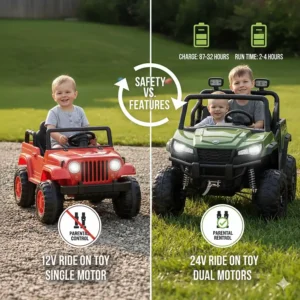
✅ Parental remote control override
✅ Lockable doors
✅ Gradual acceleration (soft start)
✅ Speed limiting options
24V-Specific Advantages
The heavier construction of 24V models provides inherent stability. The Hikole 24V weighs about 65 lbs empty, making it harder to tip compared to lighter 12V models at 35-40 lbs. Better spring suspension in 24V models also prevents sudden jolts on rough terrain.
What to Check Before Buying
- ASTM F963 toy safety certification
- CPSC compliance
- Working emergency stop on remote
- Stable wheel base (wider is better)
- Maximum incline rating
Seating Configuration: Solo vs Tandem
This often-overlooked factor dramatically affects usability.
Single-Seater Dominance (12V)
Most 12V models seat one child. This works great for only children or when you want each kid to have their own ride. The XCAR 12V is designed for solo adventures, teaching independence and control.
2-Seater Options (24V)
Many 24V models offer 2-seater configurations with 20-inch wide benches. The Sopbost Dump Truck comfortably fits two 5-year-olds or one 8-year-old with a younger sibling. This prevents the daily “whose turn is it?” arguments and makes playtime more social.
Shared experience benefits:
- Siblings bond during rides
- Teaches sharing and cooperation
- One purchase serves multiple kids
- Friends can join the fun
Age-Appropriate Recommendations
Matching voltage to age isn’t just about numbers—it’s about developmental readiness.
Ages 2-4: Start with 12V
At this age, kids are learning basic motor control. The Luibas 12V Bumper Car or Best Choice Products 12V Truck provides enough challenge without overwhelming them. Lower speeds give them time to react, and lighter weight means easier parental intervention if needed.
Ages 5-7: Transition Zone
This is where it gets tricky. A mature 5-year-old who’s confident might thrive with 24V, while a cautious 6-year-old might prefer 12V comfort. Consider temperament more than age alone. The Hikole 24V in low-speed mode offers a safe middle ground.
Ages 7-9: 24V All the Way
Older kids need the challenge and speed of 24V to stay engaged. The RAM 1500 RHO gives them room to grow, both literally (132 lb capacity) and in skill development.
Maintenance & Longevity Comparison
Let’s get practical about long-term ownership costs.
Battery Replacement Reality
- 12V batteries: $30-$50, replace every 1-2 years
- 24V batteries: $60-$90, replace every 2-3 years
Total lifetime battery costs are remarkably similar. You pay less per replacement for 12V but replace more often.
Common Maintenance Tasks
Both voltage types require:
- Tire inspection (monthly)
- Connection tightening (quarterly)
- Cleaning and lubrication (as needed)
- Proper storage (avoid extreme temps)
24V models typically use higher-quality components that withstand wear better. Several parents reported their Sopbost or Hikole models surviving three years of hard use with only one battery replacement.
Storage Considerations
12V models average 40x25x25 inches—garage-friendly. 24V trucks like the RAM 1500 measure 50x35x30 inches—plan your storage space accordingly. Consider weather protection; outdoor storage reduces battery life significantly.
The Upgrade Question: Should You Start with 12V or Jump to 24V?
This might be the question I hear most often from parents.
The “Start Small” Argument
Some families prefer buying a $150 12V for a 3-year-old, then upgrading to 24V at age 6. Total cost: $150 + $350 = $500 over 6 years. Benefits include age-appropriate power at each stage and the ability to pass down the 12V to younger siblings.
The “Buy Once” Strategy
Others invest $350-$400 in a 24V model from the start, using low-speed modes for younger kids and unlocking full power as they mature. Same $350-$400 total cost over 6 years, but only one learning curve and no transition period.
My Recommendation
If you have multiple kids (especially close in age): Buy 24V now. The 2-seater capability and extended age range justify the investment.
If you have one child under age 4 with no plans for more: Start with 12V. Upgrade later if interest continues.
If budget allows and you have varied terrain: Jump straight to 24V. You won’t regret the capability.
Environmental Impact & Energy Efficiency
Something worth considering in 2026 as we become more eco-conscious.
Energy Consumption Comparison
According to battery efficiency research, 24V systems use less current to deliver the same power due to reduced resistive losses. Over a year of regular use:
- 12V: Approximately 150-200 kWh
- 24V: Approximately 120-160 kWh
That’s about 30-40 kWh saved annually with 24V—roughly $4-$6 at average electricity rates.
Battery Disposal
Both voltage types use lead-acid or lithium-ion batteries requiring proper recycling. Most municipalities accept ride-on toy batteries at hazardous waste facilities. Check Earth911.com for local recycling options.
Longevity = Sustainability
The longer a toy lasts, the better for the environment. If your 24V ride-on serves one child for 5 years then passes to a cousin for 3 more, that’s 8 years of use from one product—significantly better than two shorter-lived 12V models.
Frequently Asked Questions
❓ Can you upgrade a 12v ride on toy to 24v?
❓ How long do 12v vs 24v ride on toys last on a single charge?
❓ Which battery power is better for kids learning to drive?
❓ Do 24v ride on toys really climb hills better than 12v?
❓ Are 24v ride on toys worth the extra money?
Conclusion: Making Your Final Decision
After diving deep into specifications, real-world performance, and dozens of parent reviews, here’s the bottom line: there’s no universally “better” choice between 12v vs 24v ride on toys—only what’s right for your specific situation.
Choose 12V if you’re shopping for a child under 5, have a limited budget, or primarily flat terrain. The Best Choice Products 12V Truck delivers fantastic value and plenty of fun for $150-$200.
Choose 24V if your child is 5+, you have hills or varied terrain, want multi-year longevity, or have siblings to share. The Hikole 24V or Sopbost Dump Truck will handle whatever your backyard throws at them.
The voltage difference between 12v and 24v ride on toys ultimately comes down to power delivery, terrain capability, and longevity. Understanding that 24V systems provide double the voltage through twelve battery cells versus six in 12V systems helps you see why they excel at climbing and sustained performance.
Remember: the best ride-on toy is the one that matches your child’s current abilities while providing room to grow. Whether that’s 12 volts or 24 volts, you’re giving them wheels, independence, and memories that’ll last way longer than any battery charge.
Ready to make your choice? Use the comparison table and product recommendations above to narrow down your options. And whatever you choose, buckle them in, charge that battery fully, and get ready for some serious backyard adventures!
Recommended for You
- 7 Best 24V Ride On Toys 2026 – Ultimate Power Guide for Big Kids
- 7 Best 12v Ride On Truck Toys That Kids Love in 2026
- 7 Best 12V Battery for Ride On Toys 2026
Disclaimer: This article contains affiliate links. If you purchase products through these links, we may earn a small commission at no additional cost to you.
✨ Found this helpful? Share it with your friends! 💬🤗
